Affiliate disclosure: The publisher may receive compensation from precious-metals companies, including companies discussed in this article. That compensation does not change what court, regulator, BBB or company records show.
Public records involving Lear Capital include a Los Angeles civil matter, a New York Attorney General proceeding, a multi-state regulatory resolution incorporated into a Chapter 11 plan, and a Chapter 11 reorganization in the U.S. Bankruptcy Court for the District of Delaware. Each record answers a different question. Allegations remain allegations unless a court or final order establishes otherwise, and the settlement records discussed below should not be rewritten as admissions of liability.
The durable lesson is methodological. A retirement saver researching any precious-metals company can identify the exact legal entity, search court dockets and regulator databases, read the operative documents, distinguish allegations from findings, and keep legal-record research separate from pricing, custody, and tax questions.
Which legal entity do the public records concern?
The historical legal entity in the court and regulator records is Lear Capital, Inc. The company’s Chapter 11 plan identifies the debtor as “Lear Capital, Inc., a California corporation.” The New York Attorney General’s verified petition likewise names Lear Capital, Inc. as a respondent and describes it as a privately held California corporation. Lear Capital Chapter 11 plan and New York Attorney General verified petition.
The present company website introduces an additional identity question. Its privacy notice, dated December 12, 2025, is titled “Lear Capital, LLC US Privacy Notice,” and its online terms, dated December 2025, state that “LEAR CAPITAL, LLC (and/or its affiliates)” is the contracting party for transactions governed by those terms. Yet the current contact page displays “Lear Capital, Inc” as the corporate address name. These are company statements rather than a state-registry determination. Lear Capital privacy notice, Lear Capital terms, and Lear Capital contact page.
This article does not infer the legal relationship between the Inc. and LLC entities. That relationship was not independently established from a live state business-registry record during this research. A current transaction file should therefore identify the exact contracting entity from the signed purchase agreement, invoice, wire instructions, and IRA paperwork.
The same principle applies to any company. Court and regulator searches should begin with the exact legal entity and corporate suffix. A consumer brand can be shared by affiliates, predecessors, or similarly named businesses, and a record should not be attributed across entities without matching names and identifiers.
What does the Los Angeles City Attorney matter show?
Lear Capital’s court-filed Chapter 11 plan describes a civil action filed on June 5, 2019 by the Los Angeles City Attorney’s Office, on behalf of the People of the State of California, in the Superior Court of California for Los Angeles County. The plan identifies the case as People of the State of California v. Lear Capital, Inc., Case No. 19STCV19362. Chapter 11 plan.
According to the plan, the Los Angeles action alleged violations of California’s Unfair Competition Law. The plan states that Lear Capital denied the allegations.
The plan further states that the parties resolved the action through a binding agreement dated December 30, 2021. Under the plan’s description of that agreement, Lear Capital paid $2.75 million and agreed to business-practice changes, including more prominent fee disclosures on invoices and, for most buyers, a 24-hour cancellation period after delivery of a written invoice. The plan says those changes were implemented nationally except in New York, which was subject to a separate agreement.
The plan also states: “There was no admission of wrongdoing.”
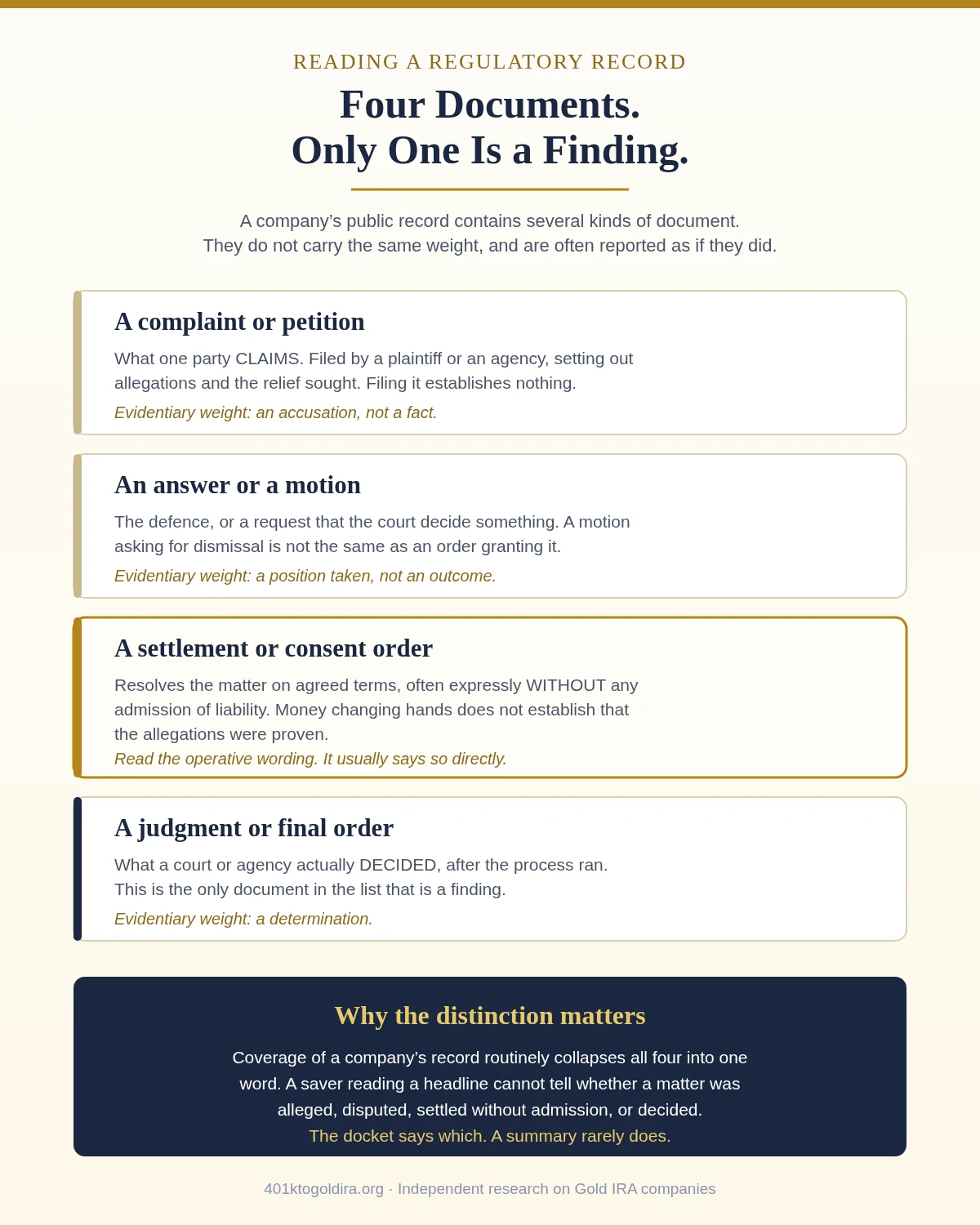
That sentence is important because it defines the evidentiary boundary. The civil complaint represented allegations. The settlement resolved the matter on stated terms. The quoted language means the settlement should not be presented as an admission.
A separate official Los Angeles Superior Court copy of the original complaint and the December 2021 binding agreement was not independently retrieved during this research session. The court-filed bankruptcy plan is therefore the primary record used here for the Los Angeles matter. That limitation is listed again in the section on unresolved research gaps.
What did the New York Attorney General allege and what did the settlement require?
The New York Attorney General filed a verified petition on June 17, 2021 in the Supreme Court of the State of New York, Erie County, under Index No. 807970/2021, naming Lear Capital, Inc. and founder Kevin DeMeritt. New York Attorney General verified petition.
The petition alleged that, beginning in 2014, Lear Capital sold precious metals to New York customers while failing to disclose certain commissions that the Attorney General alleged reached as high as 33% in some transactions. It also alleged failures to satisfy New York registration requirements applicable to commodity broker-dealers and telemarketers. Those statements describe the Attorney General’s allegations, not findings by this article.
The New York Attorney General announced the resolution on January 3, 2022. The Attorney General’s release states that Lear Capital agreed to pay $6 million and modify business practices in New York. The announced changes included clear and conspicuous fee disclosures, a 24-hour cancellation period for retirement and certain higher-fee transactions, enhanced complaint tracking, and personnel training. New York Attorney General settlement announcement and consent order.
The later court-filed Chapter 11 plan characterizes the New York resolution as having been reached “Without admitting any wrongdoing.” Chapter 11 plan.
The New York matter demonstrates why the operative settlement document matters more than a headline. A press release can summarize allegations and relief, while the filed petition and consent order establish the procedural history and binding terms.
What did the multi-state regulatory resolution provide?
By the time of the Chapter 11 case, state securities regulators had been examining Lear Capital’s sales practices. The confirmed plan ultimately incorporated a $5.5 million Customer Fund for distributions to certain customers. The Wisconsin Department of Financial Institutions, Texas State Securities Board, and District of Columbia Department of Insurance, Securities and Banking each published official statements describing the coordinated resolution. Wisconsin DFI release, Texas State Securities Board release, and District of Columbia DISB release.
The state releases describe regulators’ allegations concerning sales practices, fee disclosures, and marketing. Those descriptions remain attributed allegations. The Chapter 11 plan separately states: “The Debtor neither admits nor denies any violation of state or federal law.” It also states that the plan should not be construed as an admission of wrongdoing. Chapter 11 plan.
Which jurisdictions participated?
The plan lists 42 participating jurisdictions: Alabama, Arizona, Arkansas, California, Colorado, Connecticut, Delaware, District of Columbia, Georgia, Hawaii, Idaho, Illinois, Indiana, Iowa, Kentucky, Louisiana, Maine, Maryland, Massachusetts, Michigan, Minnesota, Mississippi, Missouri, Montana, Nebraska, New Hampshire, New Mexico, North Carolina, North Dakota, Ohio, Oregon, Puerto Rico, Rhode Island, South Carolina, South Dakota, Tennessee, Texas, Utah, Vermont, Washington, West Virginia, and Wisconsin. Chapter 11 plan.
The record should not be read as though every jurisdiction made a different individualized allegation. The state releases describe a coordinated regulatory group, while the plan defines the participating jurisdictions and the negotiated treatment.
Which customers were included in the distribution framework?
Wisconsin DFI and Texas SSB state that the pro rata distribution for customers who had not filed bankruptcy claims applied to purchases made from January 1, 2016 through March 3, 2022. Customers who filed timely bankruptcy claims were to receive payments calculated under the plan, while remaining Customer Fund money was to be distributed pro rata to qualifying customers who had not filed claims. Wisconsin DFI release and Texas SSB release.
The plan defines the recovery calculation by comparing the spread charged in the customer transaction with a hypothetical 12% spread. It also provides detailed rules for class claims and unfiled-customer distributions, including administrative provisions for uncashed or undeliverable payments. Chapter 11 plan.
The precise plan definitions control eligibility. A short article summary should not replace the plan itself for a former customer attempting to determine historical entitlement.
The independent precious-metals enforcement tracker can help organize state and federal records across the sector, but the agency release, court filing, or final order should always remain the controlling source.
What happened in Lear Capital’s Chapter 11 case?
Lear Capital, Inc. filed a voluntary Chapter 11 petition under Subchapter V on March 2, 2022 in the U.S. Bankruptcy Court for the District of Delaware, Case No. 22-10165 (BLS). The plan identifies Lear Capital, Inc. as a California corporation and states that Kevin DeMeritt owned the corporation at the petition date. Chapter 11 plan.
The plan’s section titled “Events Leading to the Filing of the Bankruptcy Case” recounts the Los Angeles and New York matters. The filing should not be reduced to a single inferred cause. The same plan states that, as of the petition date, the debtor had an approximately $420,000 secured line-of-credit obligation and described its other material debt obligations as potential contingent, unliquidated, and disputed claims. That description is the debtor’s court-filed account of its financial position and should not be extrapolated into claims about present financial condition.
The first amended plan created the $5.5 million Customer Fund using cash on hand, an insider contribution from Kevin DeMeritt, and, if needed, revenue from ongoing operations. A letter from Bankruptcy Judge Brendan Linehan Shannon stated that the plan was to be funded in full on its effective date and was not dependent on post-confirmation operating performance. Bankruptcy Court letter, Case 22-10165.
Wisconsin DFI reports that the Bankruptcy Court confirmed the plan on June 12, 2023. Wisconsin DFI release.
What business-practice commitments appear in the plan?
The confirmed-plan framework required several changes. Among them, the plan says Lear Capital would:
- use “fee” or “spread” rather than the prior “ask-to-cost” terminology;
- avoid misrepresenting the fee charged in a transaction;
- record transaction-confirmation calls continuously;
- provide customers a reasonable opportunity to ask questions during confirmation;
- extend certain complaint-record retention from two years to seven years;
- refrain from presenting itself as an investment adviser; and
- comply with applicable federal and state law.
These are plan commitments. Their inclusion should not be converted into a broader characterization of conduct beyond what the filed plan and prior proceedings state.
Does the company continue to operate?
Lear Capital’s present website states that the company completed its Chapter 11 reorganization in early 2024 and maintained operations during the process. The same company page says Lear Capital is currently operating. Those are current company statements, observed August 15, 2026, rather than an independent court-status determination. Lear Capital bankruptcy page.
This research did not independently locate a final decree or docket-closing order in the accessible primary records reviewed. The defensible statement is therefore that the plan was confirmed in 2023 and that the company currently states that it completed reorganization in early 2024 and continues operating.
What does Lear Capital publish now about minimums, fees and its buyback program?
Current company disclosures are materially more detailed than a generic “call for pricing” page, but they still require careful reading.
What Gold IRA minimum and scheduled charges does the company publish?
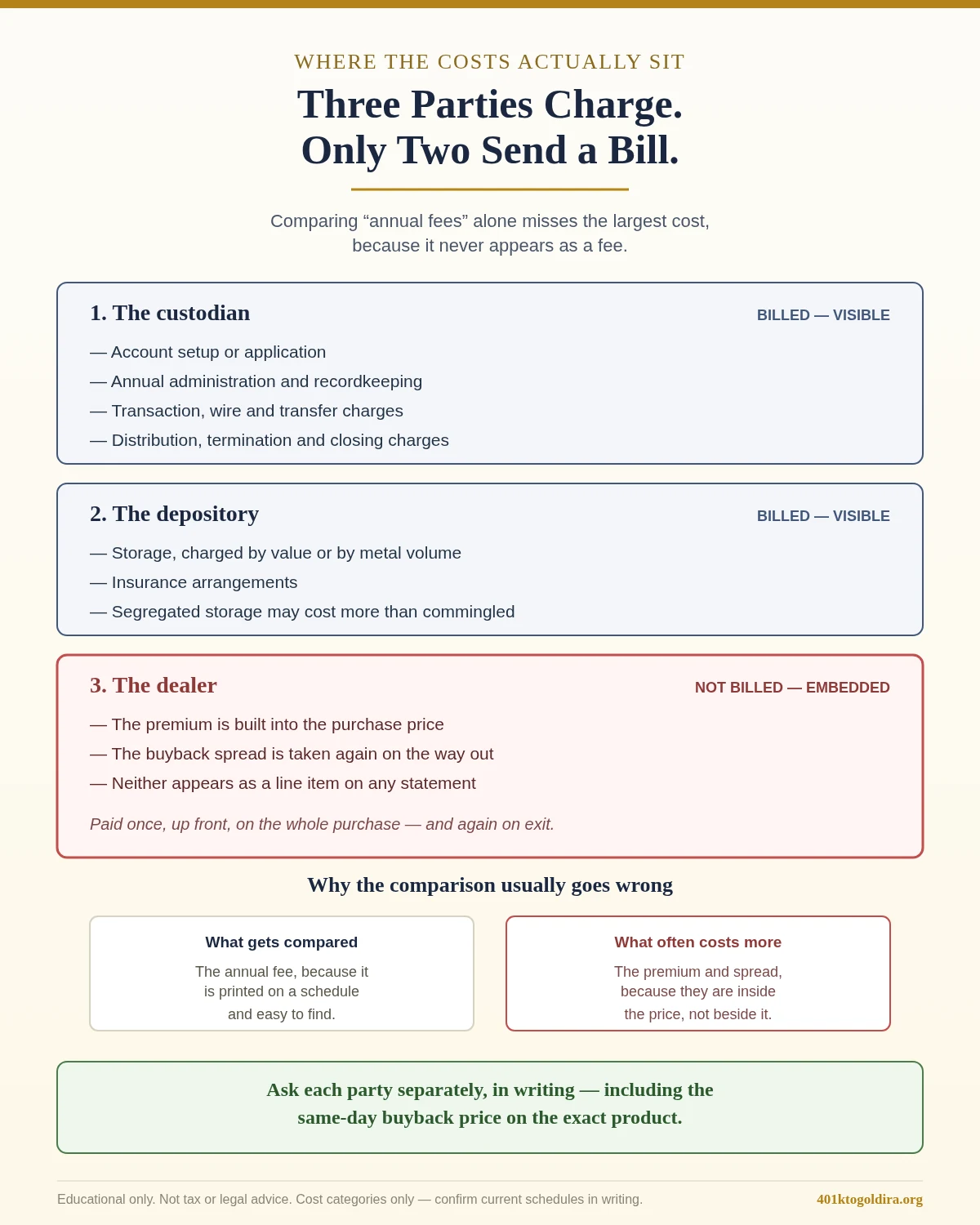
A company fee page dated December 17, 2025 states a $10,000 minimum to open and fund a Gold IRA. It lists:
- $50 one-time application charge;
- $30 one-time wire charge;
- $125 annual maintenance;
- $110 annual non-segregated storage; or
- $160 annual segregated storage.
The page totals those figures at $315 or $365 in the first year and $235 or $285 in later years. Lear Capital fee-transparency page.
A newer company fee article dated July 27, 2026 publishes the same component amounts and the same $315–$365 first-year and $235–$285 recurring totals. It also states that dealer premiums are additional and product-dependent. Lear Capital fee article.
Do the company’s live pages agree with each other?
Not completely.
The current Gold IRA guide lists the same $125 annual maintenance charge and $110 or $160 storage charges, but then states recurring totals of $225–$275 rather than the arithmetic sums of $235–$285. It also says first-year charges may reach $415, while the dedicated fee pages calculate $315–$365 from the listed components. Lear Capital Gold IRA guide.
This is a public-page inconsistency, not evidence of intent. It means the website does not provide one internally consistent total across every live page. For a specific account, the current custodian and depository schedules and the transaction agreement should control.
The gold IRA fee benchmark provides a framework for separating dealer pricing from account administration and storage costs.
What does the company publish about the dealer spread?
Lear Capital’s online terms, dated December 2025, define the spread as the difference between the retail price quoted to the customer and Lear Capital’s acquisition cost. The terms state that spreads generally range from 2% to 35% of the quoted purchase price, while varying by metal, customer, transaction type, and time. The exact spread is stated during the transaction voice-confirmation process and on the invoice. Lear Capital terms.
That disclosure corrects one common assumption: the company does publish a general percentage range. What it does not publish is a universal product-by-product spread schedule showing the exact spread for every coin or bar before a transaction-specific quote.
The same distinction is useful when applying the provider transparency scorecard: a published range is more information than silence, but it is not the same as a binding quote for the specific product being purchased.
What does the published buyback program say?
The current terms say the company does not promise that it will repurchase every metal it sells. They direct customers to request current buyback pricing and state that, when Lear Capital makes a repurchase offer for metal previously purchased from it, the bid is based on the highest list bid offered by its wholesaler at the time of sale. Lear Capital terms.
A published buyback program is therefore not a future-price commitment. The repurchase amount is determined when the customer seeks to sell, using then-current bid pricing.
The public pages reviewed do not provide a fixed future repurchase price for every product, nor can a present spread range establish the eventual round-trip cost.
What does the BBB record show?
The BBB business profile, rechecked September 1, 2026, displays an A+ rating and states that Lear Capital, Inc. is accredited. It lists accreditation beginning September 18, 1997, 29 years in business, a business-start date of June 3, 1997, and an incorporation date of September 27, 2013. Lear Capital BBB profile.
The BBB complaint page, rechecked September 1, 2026, displays 33 total complaints in the last three years and 11 complaints closed in the last 12 months. The same profile shows Lear Capital as BBB Accredited with an A+ rating. Lear Capital BBB complaints.
Those figures are point-in-time counts. BBB states that its business profiles generally cover a three-year reporting period, so the totals can change as complaints enter or age out of the window.
BBB also says the letter grade is its opinion of how a business is likely to interact with customers, using complaint information, business-supplied information, and public data. BBB advises users to consider company size, transaction volume, complaint nature, and business responses rather than treating the raw count as a stand-alone measure. BBB rating overview and Lear Capital BBB profile.
A BBB grade does not measure metal pricing, the dealer spread, product suitability, the tax consequences of an IRA transaction, or whether a company is appropriate for a particular person.
What broader pricing-context evidence can be supported?
The legal matters above repeatedly make fee terminology and disclosure relevant. That does not justify importing unsupported claims about the entire precious-metals sector.
A five-domain URL-status test supplied with the research brief stated that expected fee-page paths at five large precious-metals providers returned four 404 responses and one redirect to a video page. That test could not be independently reproduced under the strict source rules and available research environment, and competitor marketing pages are outside the permitted source set for this article. The 4-to-1 statistic is therefore not used as evidence here.
A narrower point can be supported directly from Lear Capital’s own current pages: pricing information is distributed across a fee page, a general Gold IRA guide, and transaction terms, and the live recurring-total figures are not internally consistent across those pages. The terms also show that the exact transaction spread is confirmed during the sales process rather than supplied as a universal product schedule.
That evidence is company-specific. It should not be generalized into a claim about every dealer.
How can a retirement saver check another precious-metals company independently?
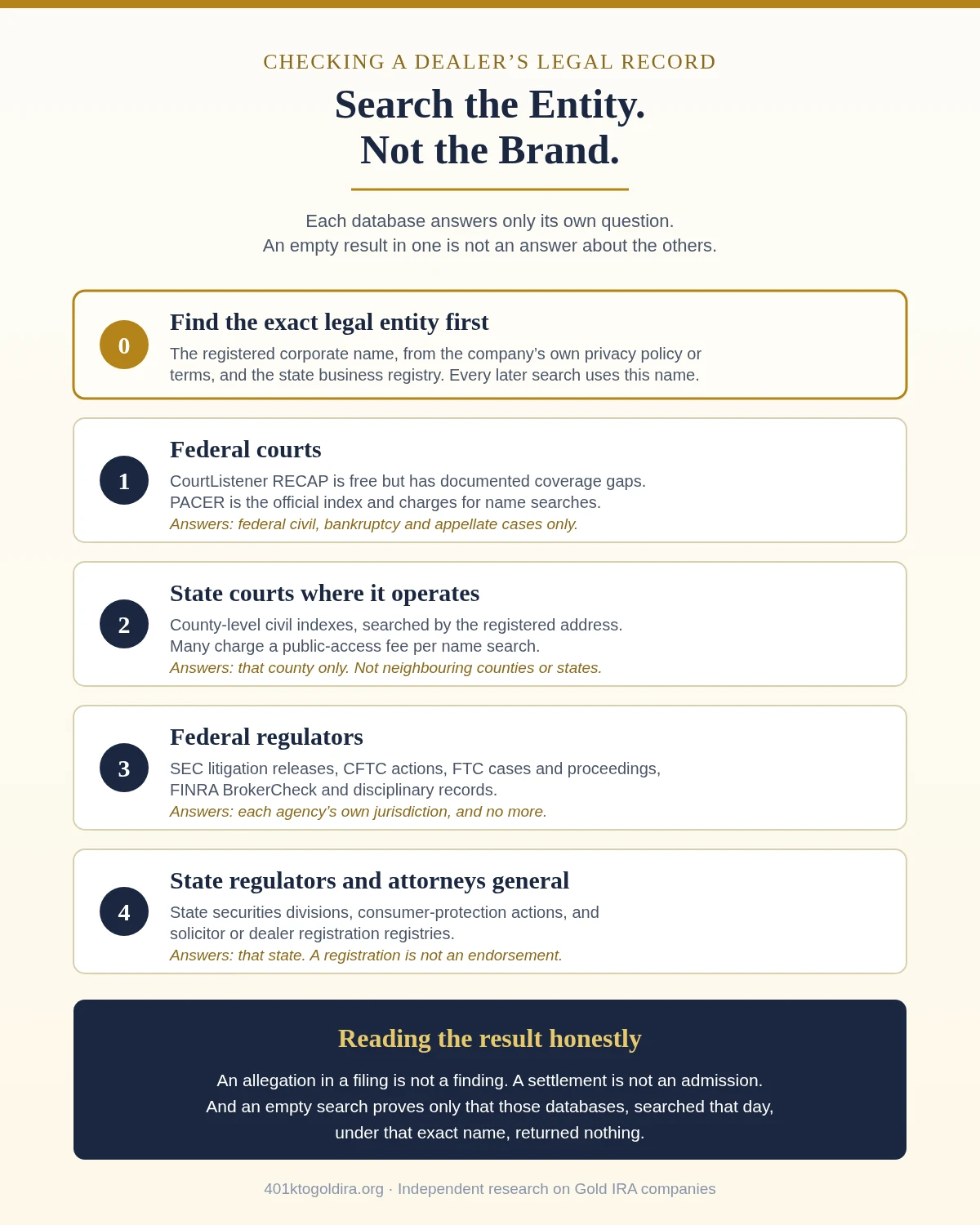
The strongest part of legal-record research is the process, because the same process works on a company with a completely different history.
Step 1: Establish the exact legal entity
The research file should capture the legal name, corporate suffix, state of organization, business-registry number, documented trade names, former names, and current address.
The controlling names should come from the purchase agreement, invoice, payment instructions, privacy terms, and official business registry. Brand-only searches are a first pass, not the final identity check.
Step 2: Search federal courts in two layers
CourtListener’s RECAP archive provides a useful free first search of federal dockets. PACER is the official federal system and its Case Locator provides a nationwide party index.
When a possible match appears, the docket should be opened. The complaint, answer, key motions, dispositive orders, settlement papers, and judgment should be read rather than relying on the case caption alone.
An allegation in a complaint is not a judicial finding. A motion is a request, not a ruling. An order records what the court decided at that stage.
The Preserve Gold public-record verification guide shows the same method applied where open court searches produced a different evidentiary result.
Step 3: Search relevant state courts
Federal searches do not cover state cases. The home state, headquarters county, states where a known dispute arose, and states identified in regulator records may each have separate court portals.
Some state and county systems permit free party searches. Others require paid name-index reports. The research log should record the exact name searched, portal, date, and any access limitation.
Step 4: Search federal regulator databases separately
Each database answers only its own jurisdiction.
Useful official sources include:
- SEC Litigation Releases: https://www.sec.gov/enforcement-litigation/litigation-releases
- FTC Cases and Proceedings: https://www.ftc.gov/legal-library/browse/cases-proceedings
- CFTC Enforcement Actions: https://www.cftc.gov/LawRegulation/EnforcementActions/index.htm
- FINRA BrokerCheck: https://brokercheck.finra.org/
- FINRA Disciplinary Actions: https://www.finra.org/rules-guidance/oversight-enforcement/finra-disciplinary-actions
Separate exact-name matters involving Lear Capital were not identified in those federal databases in the searches performed August 15, 2026 beyond the state and bankruptcy records described in this article. That is a database-specific, search-date result. It is not a statement about every possible court, agency, affiliate, officer, or former-name record. Readers should repeat the exact-name searches in current databases before relying on a dated result.
Step 5: Search state regulators and attorneys general
State securities divisions, departments of financial institutions, banking regulators, and attorneys general can publish proceedings that do not appear in federal databases.
A state result should be read at the document level. The complaint or petition states allegations. A consent order or final order states the actual disposition. A press release is useful for navigation but should not replace the order when the order is available.
Step 6: Read settlement language precisely
A settlement can impose money payments and business-practice requirements without containing an admission of liability.
For that reason, research should look specifically for phrases addressing admissions, denials, findings, stipulated facts, and the legal effect of the settlement. The exact order controls.
The Lear records illustrate this distinction: the Chapter 11 plan states that the Los Angeles resolution contained no admission, characterizes the New York resolution as reached without an admission, and separately states that the debtor neither admitted nor denied violations in connection with the plan.
Step 7: Preserve the source package
A reproducible file should save:
- the docket sheet;
- complaint or petition;
- answer where relevant;
- dispositive orders;
- settlement or consent order;
- bankruptcy plan and confirmation material;
- regulator release and order;
- BBB profile and complaint snapshot; and
- the company’s current terms, fee schedule, and entity disclosures.
That package prevents later page changes from erasing the basis for the article.
Step 8: Keep legal history separate from transaction economics
A settlement record does not reveal the price offered to a new customer. A BBB grade does not show the current spread. A bankruptcy filing does not establish the current value or custody status of an individual customer’s metal.
Price, custody, tax treatment, and legal-record research should remain separate evidence tracks.
What could not be verified from primary sources?
Several limits remain material.
The present relationship between Lear Capital, Inc. and Lear Capital, LLC
Historical court and regulator records concern Lear Capital, Inc. Current company privacy and transaction pages use Lear Capital, LLC, while the contact page still displays Lear Capital, Inc. as the corporate address name. A live state-registry record establishing the precise present relationship between those entities was not independently retrieved during this research.
A final decree or docket-closing order in the Chapter 11 case
The plan confirmation is supported by the bankruptcy record and state regulator releases. Lear Capital currently states that it completed reorganization in early 2024. A final decree or case-closing order was not independently located in the accessible primary records reviewed for this article. The article therefore does not state that the bankruptcy docket is closed.
The original Los Angeles complaint and settlement agreement
The court-filed Chapter 11 plan identifies Case No. 19STCV19362, summarizes the allegations, records Lear Capital’s denial, states the $2.75 million settlement amount, and describes the no-admission provision. The original Los Angeles complaint and December 2021 binding agreement were not separately retrieved from the Los Angeles Superior Court portal during this research.
A complete nationwide search of every state court
No single free database covers every state and county court. The article does not claim to have exhausted every state-court portal under every possible current, former, officer, or affiliate name.
Separate exact-name SEC, FTC, CFTC, or FINRA matters
Such matters were not identified in the exact-name searches performed August 15, 2026 in the public federal databases listed above. The result is limited to those searches and that date.
A fixed product-by-product spread schedule or future repurchase formula
Lear Capital’s current terms publish a general 2%–35% spread range and state that the exact spread is disclosed during transaction confirmation and on the invoice. The public pages reviewed do not publish one fixed spread for every product or a fixed future repurchase price.
The five-provider fee-path statistic supplied in the research brief
The claimed four-404/one-redirect test could not be independently reproduced under the strict source constraints, and competitor pages are outside the article’s permitted source universe. It is therefore excluded from the evidentiary conclusions.
These gaps are not side notes. They define the boundary between the public record and inference.
Consolidated primary source list
Court and bankruptcy records
- Lear Capital Small Business Debtor’s First Amended Plan of Reorganization, Case No. 22-10165 (BLS)
- U.S. Bankruptcy Court letter concerning plan funding, Case No. 22-10165
- PACER
- CourtListener RECAP
New York Attorney General
- Verified petition, Index No. 807970/2021
- Consent order
- New York Attorney General settlement announcement
Multi-state regulator records
- Wisconsin Department of Financial Institutions release
- Texas State Securities Board release
- District of Columbia DISB release
BBB
Lear Capital company statements
- Bankruptcy and reorganization page
- Privacy notice
- Online terms and conditions
- Contact page
- Minimum and fee-transparency page
- Gold IRA fee article
- Gold IRA guide
This article is for general educational research only. It is not legal, financial or tax advice. It reports what public records were found on the dates searched and does not assert that any allegation is true beyond what a filed document or final order establishes. Court and regulator records change; readers should check current databases directly. Purchasing precious metals involves risk, and past performance does not guarantee future results. Readers should consult a qualified legal or tax professional before acting.
Article reviewed and edited by Daniel — independent precious-metals retirement researcher.