Affiliate disclosure: Some links on this page may be sponsor links. The site owners may be compensated if customers request information from companies mentioned here. This page is educational only and does not provide financial, tax, or legal advice. Customers should speak with a financial or tax advisor before making retirement-account decisions. Past performance does not guarantee future results.
Quick Answer
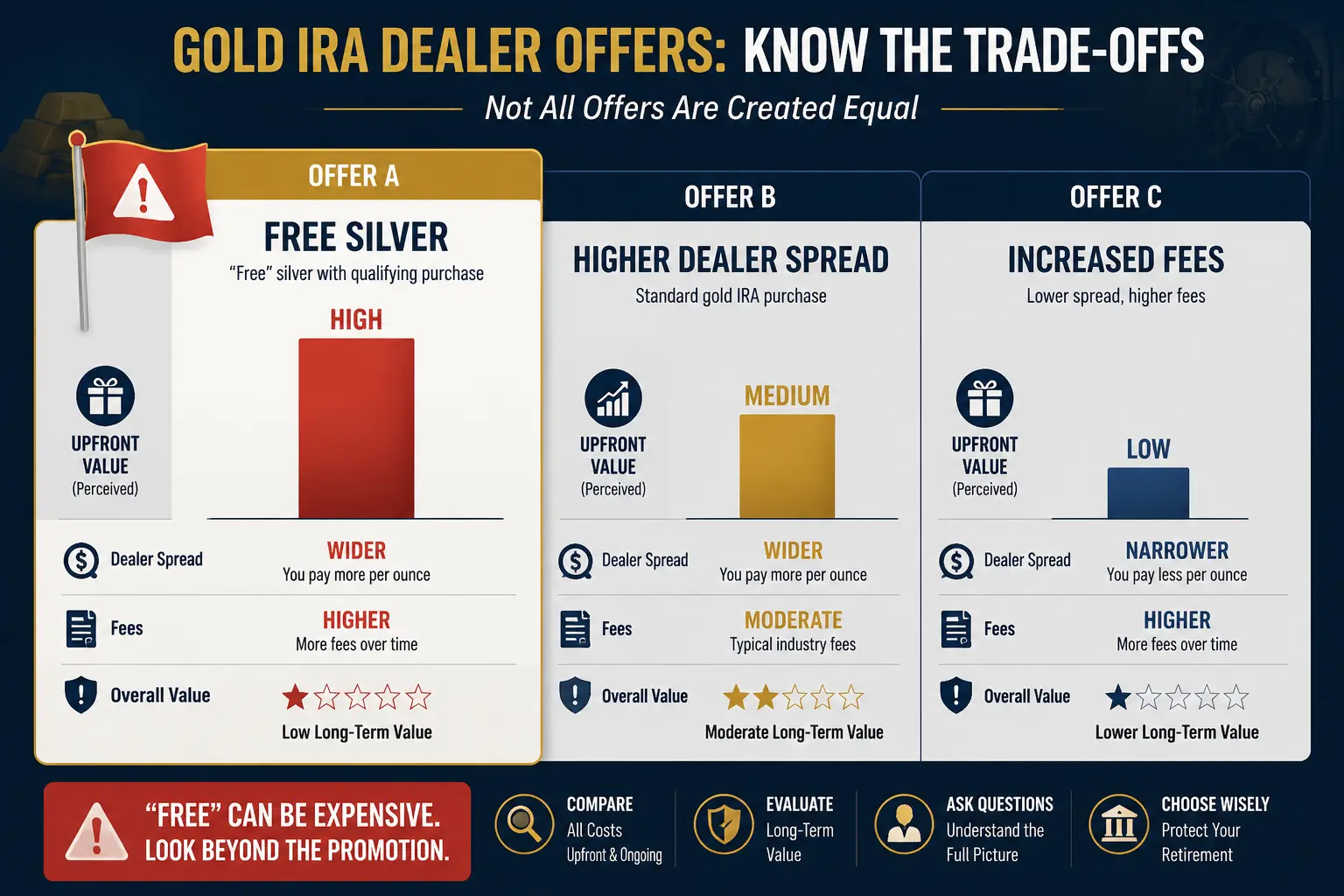
“Free silver,” “bonus metals,” “free gold,” “fee reimbursement,” and “matched metals” promotions are best treated as pricing structures, not windfalls. Federal and state regulators — including the SEC, FINRA, the CFTC, the IRS, the FTC, and state securities regulators — consistently point retirement savers toward the same discipline: get all fees, commissions, and the agreed retail price in writing, and ask how a company still earns a profit when it appears to give metal away.
A gold IRA can be a lawful retirement account structure, and the presence of a promotion does not prove wrongdoing. The concern is that a gold IRA free silver offer can distract from the harder questions: what metals are sold, how far above spot the quote sits, what the dealer would pay to buy the metals back, what annual fees apply, and whether the products are standard bullion or higher-premium coins with weaker liquidity.
What “Free Silver” or “Bonus Metals” Offers Usually Mean
In practice, a gold IRA free silver promotion usually means one of four things. First, it may be a bonus allotment tied to a funding threshold. Second, it may apply only to certain products, often premium coins rather than plain bullion. Third, it may be bundled with waived setup, shipping, or storage costs for a limited period. Fourth, it may sit inside a larger pricing structure described only in the customer agreement or in fine-print qualifications.
That matters because a precious metals bonus offer is still funded somehow. A dealer must recover metal cost, sales cost, and overhead somewhere in the transaction. Consumer-protection guidance from the CFTC and FINRA expressly encourages customers to ask how a company earns its profit when it appears to be giving away precious metal or other large freebies. That single question often brings the real economics of a “free gold IRA promotion” into view.

The most common funding paths are straightforward. The dealer may quote higher product premiums, may steer the account into harder-to-price coins, or may widen the gap between the retail price and the likely buyback price. FINRA has warned that firms selling or storing precious metals may charge account-opening fees, sales commissions, storage fees, management fees, and other costs. This is where many consumer pages stop too early. Saying that “free” may not be free is a useful start, but the more useful standard is full-cost review: written quote, product list, spot comparison, premium percentage, buyback terms, annual fees, storage arrangement, and a second quote without the promotion. That fuller review is the core of a real gold IRA due diligence process, and it connects directly to gold IRA scam warning signs, gold IRA markups and spreads, and questions to ask before opening a Gold IRA.
Gold IRA Free Silver Warning: The Real Issue Is Total Cost
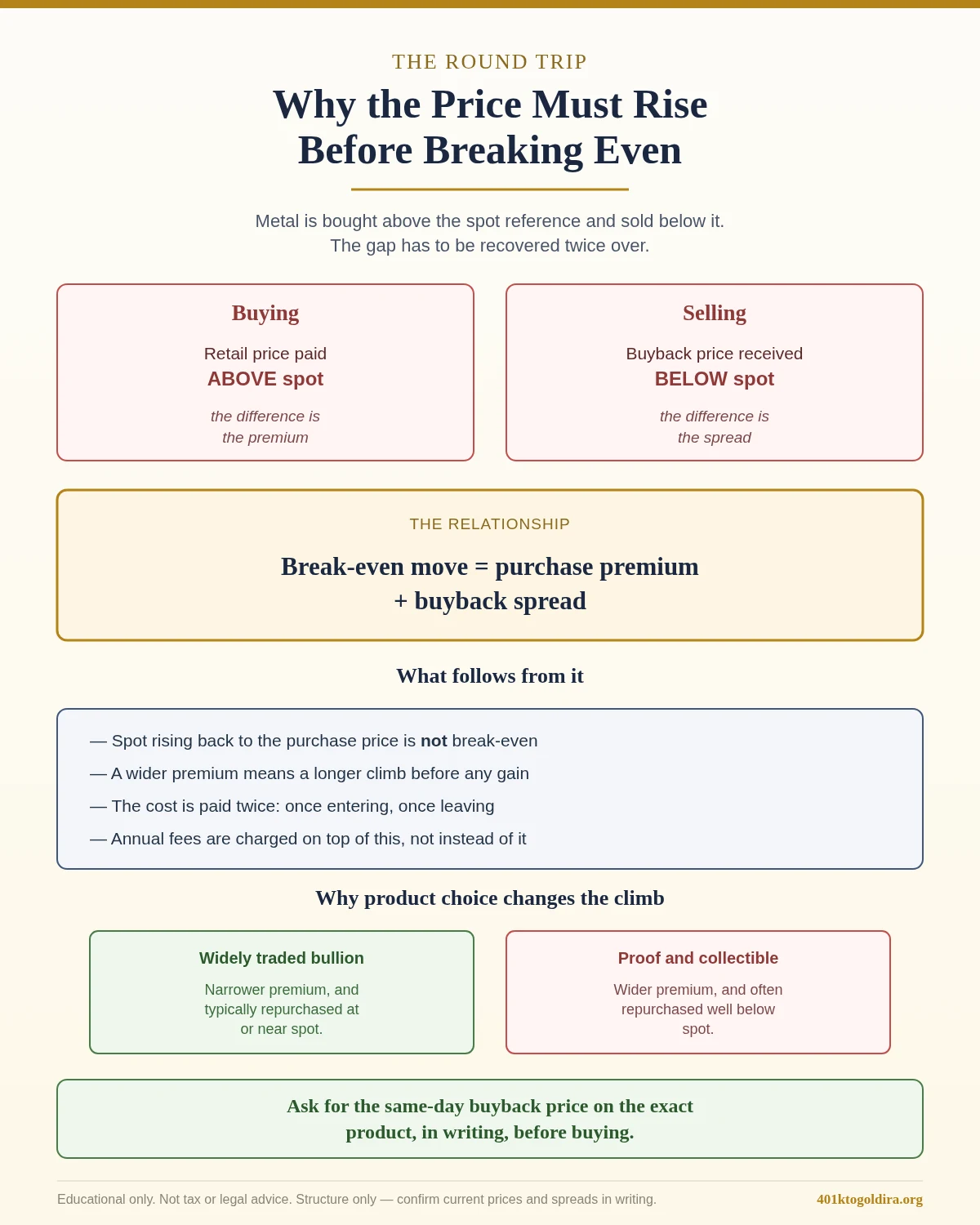
The key gold IRA free silver warning is that the right test is total cost, not the headline bonus. A saver can receive more ounces on paper and still end up with less economic value if the primary metals were sold at a heavy premium or if the buyback terms are weak. Regulators describe the same math in different words: the larger the spread and other transaction or ongoing costs, the more the metal price must rise before a buyer can even break even.
A simple example shows the problem. If a dealer quote lists metals with a same-day spot value of $100,000 but charges $118,000, the premium is 18%. If the dealer then adds $8,000 of “bonus” silver, the package may still be economically worse than a plain quote that prices similar bullion closer to spot. Total cost also includes what happens after the purchase date: account-opening fees, sales commissions, storage fees, insurance, administrative charges, and possible taxes or penalties if money leaves a qualified retirement account in the wrong way.
Another underappreciated point is the role of the self-directed IRA custodian. SEC and FINRA investor alerts explain that self-directed IRA custodians generally do not sell the investment, do not evaluate the quality or legitimacy of the investment or its promoter, and do not verify the accuracy of the financial information provided for the account. In other words, a custodian statement is not an endorsement of the dealer or the deal. That is a major reason gold IRA consumer protection work has to happen before funds move, because once retirement money enters a self-directed IRA, the account holder carries the due-diligence burden.
Dealer Spreads, Markups, and Product Premiums Explained
A dealer spread is the gap between what the buyer pays and what the dealer or market would likely pay back on resale. A product premium is the amount charged above the metal’s spot value. In real life these ideas overlap: a saver often pays above spot on the way in and receives below spot on the way out. Dealers generally charge more than spot when metals are purchased and pay less than spot when they buy metals back, and the higher the spread, the harder it is to break even.
Not all products carry the same pricing behavior. A CFTC customer advisory states that bullion is priced at the spot market price plus a markup or premium of between 5% and 10%, while numismatic coin premiums can range from 40% to 200% above spot. That advisory dates from the CARES Act period, so it is a dated regulator statement rather than a current average. In enforcement cases, far higher figures have been alleged against specific dealers. The distinction matters because a sales conversation often frames all coins as equally suitable, equally liquid, and equally transparent. They are not — and the joint CFTC and FINRA bulletin goes further, describing “semi-numismatic” as a made-up industry term with no special meaning.
| Term | Plain-English meaning | Why it matters for a bonus offer |
|---|---|---|
| Spot price | The market reference price for gold or silver. | It is the baseline for judging whether a promotional quote is fair. |
| Premium | The amount charged above spot for a specific coin or bar. | A high premium can quietly fund “free” metal. |
| Dealer markup | The dealer’s price above metal cost or spot reference. | It can exceed years of annual account fees in a single transaction. |
| Dealer spread | The gap between the buy price and the likely sell-back price. | It shapes liquidation value and exit planning. |
| Buyback price | What the company pays when buying metals back. | A weak buyback can erase the value of a bonus allotment. |
Liquidity is a second practical point. Some numismatic and semi-numismatic products can have lower liquidity than standard bullion, and in some cases an investor may be able to sell back only to the original broker. A product that looks attractive in a promotional packet can be far less attractive when measured by next-day resale value. This is why gold IRA dealer spread and gold IRA dealer markup should never be treated as technical side notes. They are often the central story. Past performance does not guarantee future results, and large day-one markups can damage an account before market performance has any chance to matter.
Red Flags in Promotional Sales Conversations
The clearest gold IRA dealer red flags are pressure and vagueness. Regulators warn against pushy salespeople, unsolicited pitches, cold calls, and demands for an immediate decision. When a conversation leans on deadline pressure instead of written analysis, the sales process itself becomes part of the warning sign. Another red flag is the “expert handoff,” where a telemarketer first tests willingness to buy, sometimes with a free gift, then passes the lead to a “special expert” who may not be qualified to give trading, investment, or tax advice.
Affinity marketing is another warning sign. Scam operations sometimes target people through political or religious programming and create fake endorsements to build trust. That does not mean every values-based advertisement is improper, but trust cues should never replace pricing documents, registration checks, and independent verification. Promotions linked to vague product labels also deserve caution: if a sales call spends more time on the “free silver” headline than on the exact bar or coin, weight, mint, IRA eligibility, and markup, the saver has learned almost nothing that would support a retirement decision. A dealer’s unwillingness to discuss exit value — what the customer would receive if the metal had to be sold back tomorrow — is one of the strongest red flags of all.
Questions to Ask Before Accepting a Bonus-Metals Offer
A serious review of a precious metals bonus offer starts with a hard reset: the promotion is set aside until the quote works without it. The questions below align closely with SEC, FINRA, CFTC, IRS, and state-regulator guidance. A longer worksheet appears in the gold IRA quote checklist, the gated comparison workbook, the fee calculator, and the gated fees guide.
- Exact metal list in writing. Product name, coin or bar type, mint or refiner, weight, quantity, and whether each item is IRA-eligible bullion. “Premium metals” or “exclusive coins” is too vague.
- Four prices on the same day. The metal’s spot value, the dealer’s retail price, any stated bonus-metal value, and the dealer’s buyback estimate for the same products.
- How the dealer and salesperson are paid. Whether commissions are included in the spread, and the salesperson’s background and registrations.
- The complete ongoing cost sheet. Setup fees, annual administration or custodian fees, storage fees, insurance or vaulting charges, and the conditions under which “free storage” ends.
- Where the metals are held and who verifies holdings. IRA bullion generally must be in the physical possession of a bank or approved non-bank trustee.
- A plain version of the promotion terms. What purchase amount qualifies, which coins are eligible, whether it can be combined with other pricing, and what happens if the quote changes before settlement.
The single premium calculation worth memorising is simple: premium % = (sales price − spot value) ÷ spot value × 100. The best comparison method is a side-by-side quote review — one quote with the promotion, one that strips the promotion out and prices similar standard bullion without the bonus — then comparing total ounces, exact products, spot value, premium percentage, annual fees, and buyback estimate. For broader screening once the quote work is done, a company directory appears on the best Gold IRA companies page.
Fees, Storage, Buyback Policies, and Official Resources
Promotions sit on top of the same operating costs faced by every precious-metals IRA: opening fees, sales commissions, storage fees, management fees, insurance, and administrative charges. “Free silver” and “free storage” should never be reviewed in isolation from the full annual holding cost. Buyback policy is just as important as purchase policy, because a large markup can stay hidden until liquidation. A helpful habit is to ask what the customer would receive if the metal had to be sold back tomorrow, and to remember that a custodian statement typically reflects the melt value of the metals held.
Tax and distribution rules do not disappear because the account holds bullion. Traditional IRAs are generally subject to required minimum distribution rules, withdrawals are generally taxable, and beneficiaries remain subject to distribution rules. Acquiring a non-exempt collectible inside the account can be treated as a distribution, with tax consequences and a possible additional tax for owners under age 59½. Customers should speak to a financial or tax advisor before making decisions. Goldco does not offer tax or legal advice. A rollover explainer appears in the gated rollover guide, and related cost detail appears in gold IRA tax mistakes and the fee calculator.
The official consumer-protection resources worth reviewing are straightforward. The SEC’s Investor.gov and FINRA’s BrokerCheck can help verify whether a person giving investment advice is registered. The CFTC and the National Futures Association can help with metals- and commodities-related registration and complaint checks. The FTC encourages researching the company and promoter and reporting suspected fraud. State securities regulators and state attorneys general can also show complaint history. The larger rule is simple: a gold IRA dealer red flags review should end with written numbers, not stronger emotions. If the quote cannot survive a side-by-side comparison without the promotion, the promotion has already done too much of the selling.
FAQ
Is a “free silver” Gold IRA offer automatically a bad deal?
No. The presence of a promotion alone does not prove unfair pricing. The correct test is whether the written quote, product mix, buyback value, and ongoing fees still make sense after the promotional language is removed from the analysis. Regulators focus on written pricing, written fees, and realistic break-even math rather than headline bonuses.
How can a saver tell whether bonus metals are being funded by a markup?
The cleanest method is to compare the same-day spot value of the metals against the dealer’s retail quote, calculate the premium percentage, then compare that quote against a similar non-promotional quote for standard bullion.
Are “bonus coins” always IRA-eligible?
No. Only certain coins and bullion fall within the collectible exception for retirement accounts, and IRA bullion generally must be held by a bank or approved non-bank trustee. Higher-priced collectible coins can fall outside those rules.
Why does a buyback policy matter so much?
Because liquidation value often reveals the real spread. A weak buyback price can erase the apparent value of a precious metals bonus offer very quickly, so written buyback terms should be reviewed before the first purchase.
What should appear on a written fee schedule?
At minimum, the agreed retail price, commissions, setup or account-opening fees, administration or custodian fees, storage fees, insurance or vaulting charges, and any promotional conditions. All fees and costs should be provided in writing before funds move.
Does a Gold IRA still have normal tax and RMD rules?
Yes. Traditional IRAs are generally subject to required minimum distribution rules, withdrawals are generally taxable, and beneficiaries remain subject to distribution rules. Customers should speak to a financial or tax advisor before making decisions. Goldco does not offer tax or legal advice.
Article reviewed and edited by Daniel — independent precious-metals retirement researcher.
Further Reading
 Gold IRA Scam Warning SignsReview 10 red flags every investor should check before rolling over retirement money.
 Gold IRA Markups and SpreadsSee how markup, spread, and proof-coin pricing affect the metal a customer owns.
 Questions to Ask Before Opening a Gold IRAWork through the written questions that protect retirement savers before funds move.