Educational only: This article is general educational information about preserving wealth in early retirement. It is not financial, tax, legal, insurance, investment, or retirement-planning advice. Early-distribution rules, health coverage, taxes, and account access depend on personal facts and current law. Customers should speak to a financial or tax advisor before making decisions. Goldco does not offer tax or legal advice. Past performance does not guarantee future results.
The IRS generally applies a 10% additional tax on the taxable part of most retirement-account withdrawals taken before age 59½ — separate from ordinary income tax — unless a specific exception applies.
Source: Internal Revenue Service — Topic 557, early distributions. Exceptions such as the Rule of 55 and 72(t)/SEPP are what make early access possible.
Key takeaways
- The portfolio's job changes from pure growth to a balance of preservation, income, and long-term growth — without moving everything to cash.
- Three problems are unique to early retirement: accessing money before 59½ (Rule of 55, 72(t)/SEPP), the pre-Medicare coverage gap, and the income bridge before Social Security.
- The Rule of 55 applies to a workplace plan, not an IRA — and a rollover can remove that access.
- A SEPP is rigid: once started, it generally must run to the later of 59½ or five years, so pair it with a separate emergency reserve.
- No single account or asset preserves wealth. Gold may be one small, lower-correlation diversifier, not the answer.
Quick answer: Early retirement shifts the job of the portfolio from pure growth to a balance of preservation, income, and long-term growth. The plan should map access rules before age 59½, price health coverage through age 65, build a bridge to Social Security, reduce forced selling during weak markets, and coordinate taxable, tax-deferred, and Roth accounts. The early-retirement plan must answer four questions: where spending money comes from before age 59½, how health coverage is maintained before Medicare, how income is created before Social Security begins, and how the portfolio stays resilient during the first years without a paycheck.
What Does Preserving Wealth in Early Retirement Mean?
Preserving wealth in early retirement means protecting a portfolio that has already reached its main funding goal while still allowing enough growth to support a long retirement. The challenge differs from ordinary retirement planning because someone who stops working at 45, 50, or 55 may face years before penalty-free IRA access, Medicare, and Social Security. The goal is not to stop all investment risk — a retirement beginning in the 40s or 50s can last several decades, so the portfolio may still need growth — it is to prevent one early market decline, one tax mistake, one health-insurance gap, or one rigid withdrawal plan from damaging the capital that took years to build. A strong plan uses several accounts, a liquid reserve, flexible spending, tax-aware withdrawals, and a diversified asset mix. No single account or asset preserves wealth by itself.
What Changes When the Goal Shifts From Growing to Preserving Wealth?
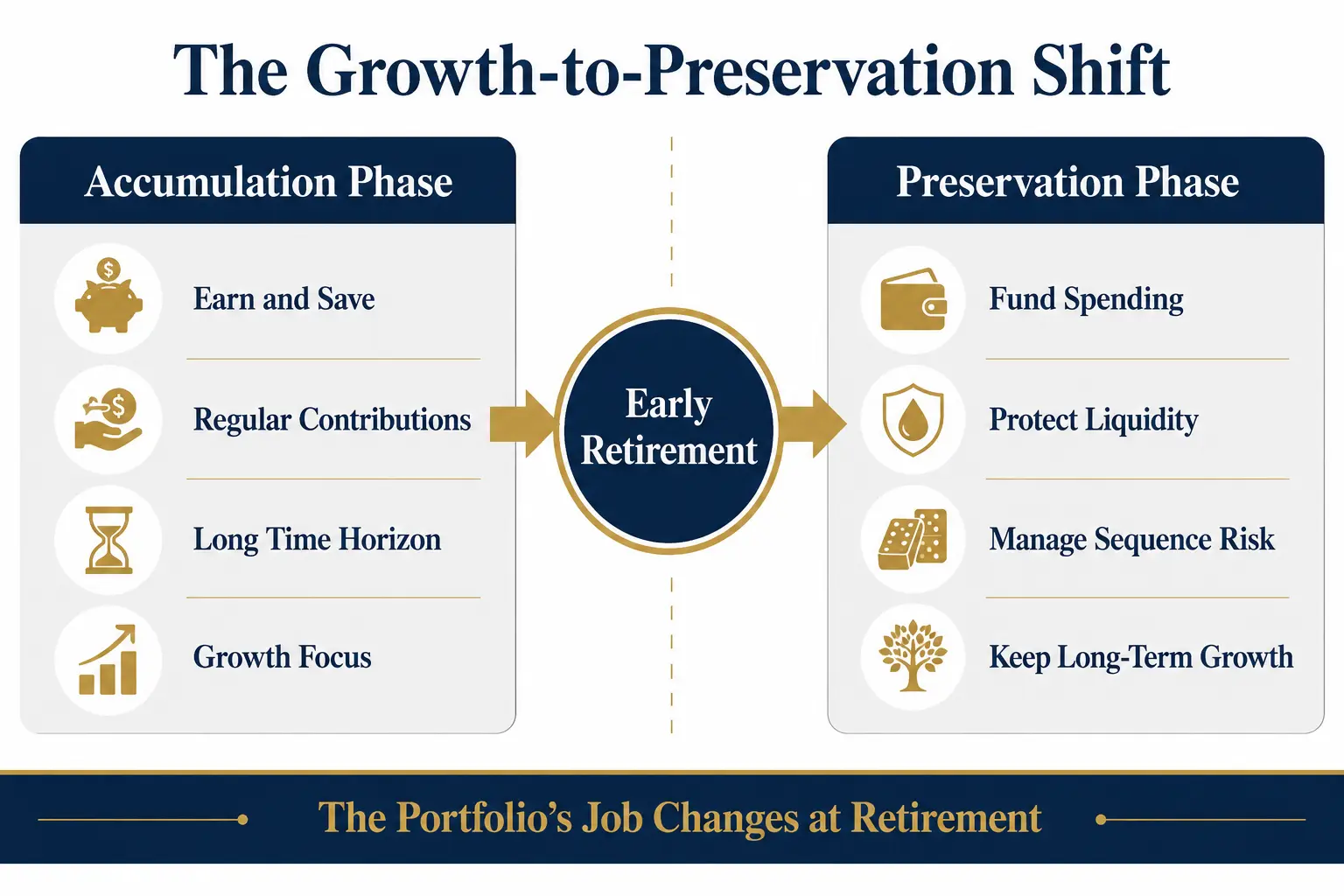
During the accumulation years, the main actions are usually simple: earn income, save regularly, invest for long-term growth, and avoid unnecessary withdrawals. Early retirement reverses the cash flow — contributions may stop, employer benefits may end, and the portfolio begins paying regular expenses. That change creates a growth-to-preservation shift. It does not require moving every dollar into cash or bonds; it requires changing the way risk is measured. Before retirement, a market decline may be an opportunity to keep buying at lower prices. After retirement, the same decline may arrive while the account holder is selling assets for living costs.
Investor.gov explains that asset allocation depends on time horizon and risk tolerance: a shorter time horizon generally supports less exposure to volatile assets, while a longer horizon may allow more risk (Investor.gov). Early retirees often have both horizons at once: near-term bills require stability, while money needed 20 or 30 years later still needs growth. The preservation plan should therefore separate money by purpose — near-term spending, medium-term stability, long-term growth, health and emergency reserves, and future income sources. The site's retirement planning at 45 guide covers the earlier accumulation stage; this article begins after the target portfolio has already been built.
How Can an Early Retiree Access Retirement Money Before Age 59½?
The normal IRA rule creates a major planning barrier. The IRS generally imposes a 10% additional tax on the taxable part of traditional and Roth IRA distributions taken before age 59½ unless an exception applies, and the additional tax is separate from ordinary income tax (Internal Revenue Service). Early retirees should not assume that every withdrawal before 59½ is penalized. Several exceptions exist, but the two most relevant planning methods are the Rule of 55 and substantially equal periodic payments under Section 72(t).
How Does the Rule of 55 Work?
The Rule of 55 is an exception for certain workplace retirement-plan distributions. The IRS states that the 10% additional tax may not apply when an employee separates from service during or after the calendar year in which the employee reaches age 55; the exception applies to qualified workplace plans but not to IRAs, and different age rules can apply to certain public-safety employees (Internal Revenue Service). Timing matters: IRS Publication 575 gives an example in which an employee separated at age 49 and later withdrew money at 55, and the exception did not apply because the separation happened before the year the employee reached 55 (Internal Revenue Service). Account location also matters, because rolling a former employer's plan into an IRA can remove access to this workplace-plan exception. Before moving a 401(k) or similar account, an early retiree should compare the former plan's withdrawal options, fees and investment choices, whether partial distributions are available, whether the Rule of 55 may be needed, and the benefits and limits of an IRA rollover. That first question is worth asking early, because many plans do not offer flexible access at all: published recordkeeper data on which plans allow partial withdrawals shows how sharply the odds vary with the size of the former employer's plan. A rollover decision should not be made only for convenience.
How Does a 72(t)/SEPP Plan Work?
Section 72(t) permits an exception for a series of substantially equal periodic payments, often called a SEPP. The IRS states that payments can be based on the account holder's life expectancy or the joint life expectancies of the account holder and a designated beneficiary, and identifies three methods that automatically satisfy the calculation rules: the required minimum distribution method, the fixed amortization method, and the fixed annuitization method (Internal Revenue Service). A SEPP is not a flexible checking account: once the schedule begins, the account generally cannot receive additions or make withdrawals outside the scheduled payments, and the schedule must generally continue until the later of the fifth anniversary of the first payment or age 59½. An improper modification can trigger the 10% additional tax for the year of the change and a recapture tax for earlier distributions, plus interest (Internal Revenue Service). That rigidity creates both value and risk — a SEPP can provide predictable access before 59½, but it can also force distributions when spending needs fall or create a tax problem when more than the scheduled amount is needed. The plan should be designed with a separate emergency reserve so an unexpected expense does not force a prohibited change. Customers should speak to a financial or tax advisor before making decisions about the Rule of 55, SEPP schedules, withdrawals, or rollovers. Goldco does not offer tax or legal advice.
How Do Early Retirees Bridge Health Coverage Before Medicare?
Medicare generally covers people age 65 or older, with earlier eligibility for certain disabilities, end-stage renal disease, or ALS, so someone who retires at 50 may need roughly 15 years of other health coverage (Medicare.gov). That pre-Medicare health-coverage gap can become one of the largest early-retirement costs. The main coverage routes may include an Affordable Care Act Marketplace plan, COBRA continuation coverage, a spouse's job-based health plan, retiree health benefits from a former employer, or other eligible public or private coverage.
How Does Marketplace Coverage Work After Retirement?
HealthCare.gov states that someone who retires before 65 and loses job-based coverage can buy a Marketplace plan, and that losing job-based coverage creates a Special Enrollment Period so enrollment may be available outside the normal annual window. Marketplace premium tax credits and lower out-of-pocket costs depend on household income and household size (HealthCare.gov). This creates an important connection between health planning and tax-aware withdrawals: large traditional IRA distributions, Roth conversions, capital gains, and other taxable income can affect the household income reported for Marketplace assistance. An early retiree should model health costs under several income levels before choosing a withdrawal plan.
How Does COBRA Fit?
COBRA may allow a worker and family members to continue the former employer's group health coverage for a limited period after job loss, retirement, reduced hours, or another qualifying event. The Department of Labor states that covered individuals may be required to pay up to 102% of the plan's cost, and that COBRA generally applies to group plans sponsored by employers with at least 20 employees in the prior year (U.S. Department of Labor). COBRA can preserve the same provider network and benefit design for a transition period, but it may be expensive because the former employer may stop paying part of the premium. HealthCare.gov notes that losing job-based coverage can create a 60-day Marketplace enrollment period, allowing COBRA and Marketplace costs to be compared before a decision is made (HealthCare.gov).
Can a Spouse's Employer Plan Fill the Gap?
A spouse's job-based plan may cover spouses and dependents if the plan permits it. HealthCare.gov states that an offer of spouse coverage can affect eligibility for Marketplace savings, and that when a spouse's plan provides affordable qualifying coverage, premium tax credits may not be available for the person offered that coverage (HealthCare.gov). The correct choice depends on premiums, deductibles, provider networks, prescriptions, expected care, and tax credits. A pre-Medicare plan should include annual premium increases, out-of-pocket costs, and a reserve for care not fully covered by insurance.
How Is Income Generated Before Social Security?
Social Security retirement benefits can generally begin at age 62 for an eligible worker. Starting before full retirement age reduces the monthly benefit, and waiting after full retirement age increases the monthly benefit through delayed retirement credits until age 70 (Social Security Administration; Social Security Administration). For someone retiring at 50, the bridge to age 62 lasts 12 years, and a longer bridge applies when benefits are delayed. The income bridge can draw from cash and short-term reserves, taxable brokerage assets, Rule of 55 distributions, a carefully designed SEPP, part-time or consulting income, rental or business income, pension payments when available, and Roth IRA amounts that can be distributed under applicable rules.
Traditional IRA distributions are generally taxable in the year received unless an exception such as basis applies, while qualified Roth IRA distributions are tax-free when the requirements are met (Internal Revenue Service; Internal Revenue Service). The bridge should not be treated as one account emptied in a straight line. A better income map shows the spending need for each year, health-insurance income targets, available taxable-account funds, workplace-plan access, IRA restrictions, potential Roth conversion room, and Social Security estimates at different claiming ages. Delaying Social Security may raise the future monthly benefit, but it also requires more spending from other assets during the waiting years; SSA states that delayed retirement credits stop at age 70 and equal 8% per year for people born in 1943 or later (Social Security Administration). The decision should be based on health, family benefits, taxes, available capital, and expected retirement length rather than one break-even age.
Why Does Sequence-of-Returns Risk Matter in Early Retirement?
Early retirement increases the period during which withdrawals and market losses can interact. The Center for Retirement Research at Boston College explains that negative returns early in retirement can have a greater effect than losses later because market declines and withdrawals reduce the portfolio at the same time, leaving less capital available for a later recovery (Center for Retirement Research at Boston College). Someone retiring at 50 may need the portfolio to support 40 years or more, so a weak first decade can affect both current income and long-term growth. The preservation response is not to predict the next bear market; it is to reduce forced selling.
How Can a Cash or Short-Term Buffer Help?
A reserve for near-term expenses can prevent every monthly bill from depending on the current stock-market price. The buffer may include bank cash, money market holdings, Treasury bills, short-term bonds, or other liquid assets, each with different credit, interest-rate, liquidity, and insurance features. The reserve should cover a defined purpose, such as essential expenses, insurance premiums, or the next year of planned withdrawals. Too little liquidity can force sales during a decline; too much cash can weaken long-term purchasing power. The site's retirement portfolio longevity guide provides a broader discussion of that balance.
How Can Flexible Withdrawals Help?
Vanguard describes dynamic spending as a system with a floor and ceiling: spending can rise after stronger results and fall after weaker results without moving beyond the preset range, seeking to protect the original portfolio in a down market while providing more stability than a fully market-driven withdrawal (Vanguard). An early-retirement version may divide expenses into essential spending, planned flexible spending, optional spending, and one-time projects, so that if markets fall the optional categories can adjust before housing, food, insurance, and health care. The retirement portfolio stress test can help organize weak-market scenarios without predicting future returns.
What Does a Preservation-Oriented Asset Mix Look Like?
There is no single preservation portfolio for all early retirees. Investor.gov explains that asset allocation divides a portfolio among categories such as stocks, bonds, and cash, that the suitable mix changes with time horizon and risk tolerance, and that rebalancing may be needed when market moves push the portfolio away from its planned risk level (Investor.gov). A preservation-oriented framework may include near-term liquidity (cash and short-term assets for spending, insurance, taxes, and emergencies); stability assets (high-quality bonds or similar holdings that reduce volatility and provide scheduled interest or maturities, though bonds can still decline when rates change); long-term growth (diversified stocks for future spending across a multi-decade retirement, which remain exposed to loss); and inflation-sensitive or diversifying assets (real estate, inflation-linked securities, commodities, or a limited precious-metals position).
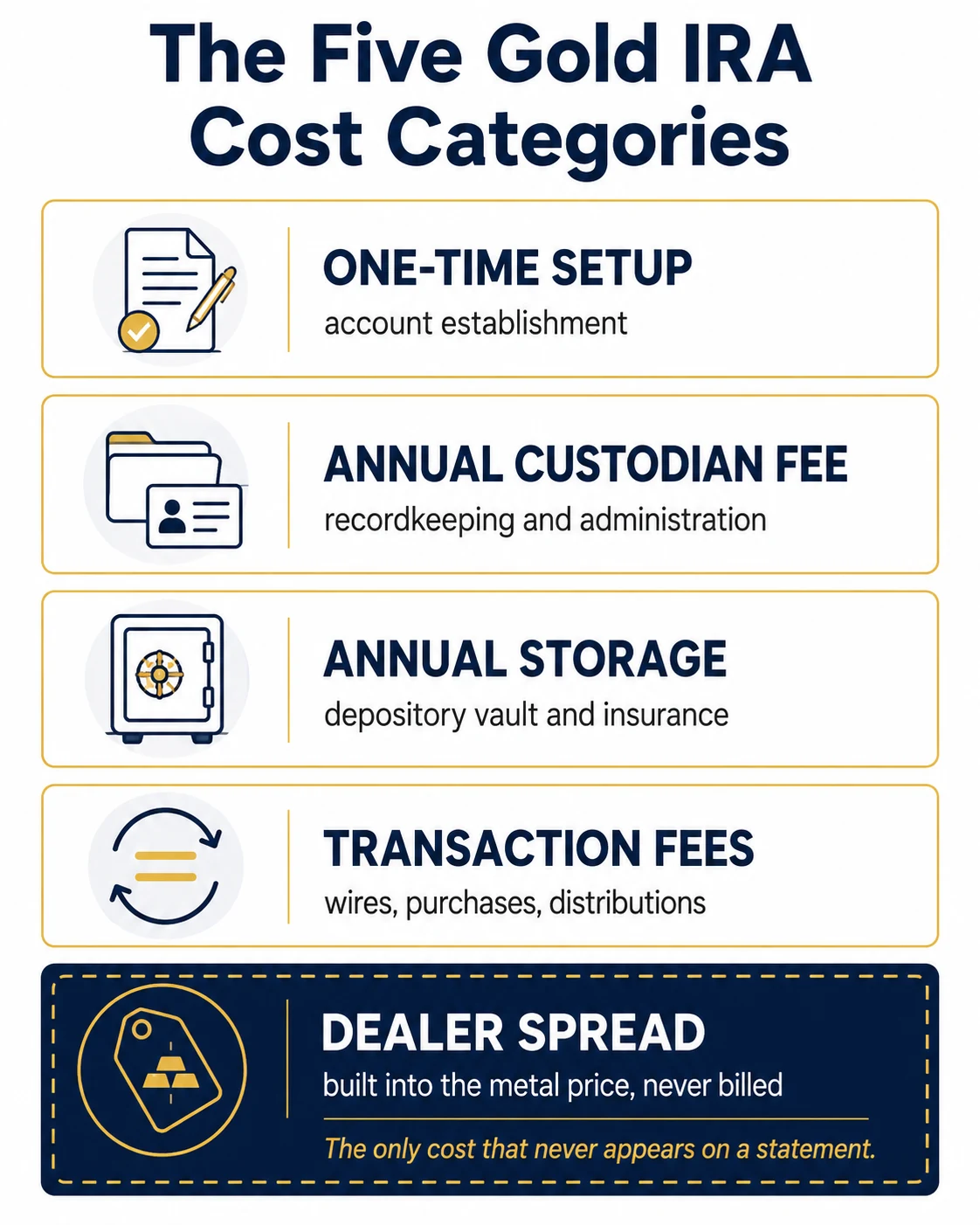
Precious metals may provide a different return driver from stocks and bonds, but they can be volatile, and physical holdings may involve dealer, custody, storage, and liquidity costs. They should not be presented as the primary way to preserve wealth, and no single asset protects against every risk. The retirement purchasing-power guide covers inflation in more detail, and the retirement gold-allocation guide and Gold IRA decision quiz are educational tools, not allocation recommendations. Customers should speak to a financial or tax advisor before changing an asset allocation.
How Can Tax-Aware Withdrawal Ordering Protect Wealth?
Tax-aware withdrawal planning looks at more than the account balance. Different accounts can create different tax results: traditional IRA distributions are generally taxable; qualified Roth IRA distributions are tax-free; taxable brokerage sales may create capital gains or losses; workplace-plan distributions may qualify for the Rule of 55; health-insurance assistance may depend on household income; and Roth conversions can create taxable income in the conversion year (Internal Revenue Service; Internal Revenue Service; HealthCare.gov).
A common mistake is using one fixed withdrawal order for every year. An early retiree may need to preserve workplace-plan assets for Rule of 55 access, limit taxable income to manage Marketplace costs, use taxable assets for flexibility, or make measured Roth conversions during lower-income years — and the right order can change from year to year. A tax-aware annual review should estimate ordinary taxable income, long-term capital gains, Roth conversions, Marketplace income, state income tax, available deductions and credits, future required minimum distributions, and the balance remaining in each tax category. Tax minimization in one year can create higher taxes later; the goal is lifetime coordination, not always the smallest current-year tax bill. Customers should speak to a financial or tax advisor before making decisions. Goldco does not offer tax or legal advice.
What Should an Early-Retirement Preservation Plan Include?
A practical plan can be organized into eight steps.
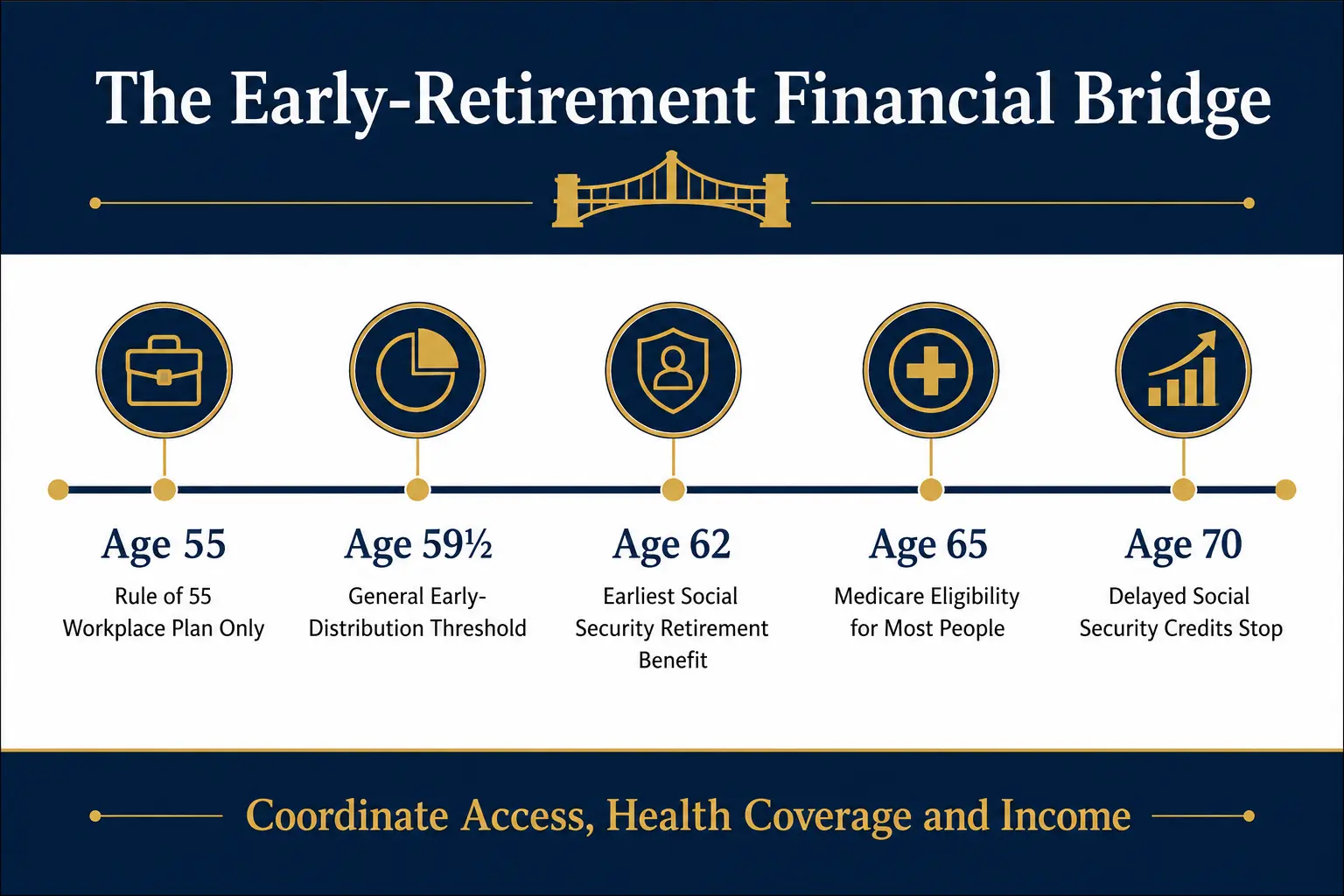
- Define the bridge years. List the years until age 59½, 62, 65, full retirement age, and 70 — each milestone changes available accounts, health coverage, or income choices.
- Separate essential from flexible expenses. Essential costs should have a more stable funding source; flexible costs can carry written guardrails.
- Build an account-access map. Label taxable accounts, former workplace plans, traditional IRAs, Roth IRAs, HSAs, and other assets, showing which funds can be used, when, and the possible tax treatment.
- Price health coverage before leaving work. Compare Marketplace estimates, COBRA, spouse coverage, and any retiree benefits — premiums, deductibles, out-of-pocket limits, networks, and prescriptions.
- Create a Social Security bridge. Estimate spending before 62 and before the chosen claiming age, including several claiming scenarios rather than one assumed date.
- Stress-test early market losses. Model a decline in the first, third, and fifth retirement years; test lower spending, part-time income, and delayed optional projects.
- Write rebalancing and withdrawal rules. State when cash is replenished, when flexible spending changes, and when the plan requires professional review.
- Review the plan annually. Health costs, tax law, asset values, family needs, and retirement goals change, so a preservation plan should adapt without becoming reactive.
What Are Common Questions About Preserving Early-Retirement Wealth?
Can someone retire before 59½ without paying the 10% additional tax?
Possibly. The Rule of 55, substantially equal periodic payments, and other statutory exceptions may apply. The exception depends on the account type, age, separation date, and transaction details (Internal Revenue Service).
Does the Rule of 55 apply to an IRA?
No. The IRS table lists the separation-from-service exception for qualifying retirement plans and not IRAs (Internal Revenue Service).
Can a SEPP be stopped after age 59½?
The schedule generally must continue until the later of age 59½ or the fifth anniversary of the first payment. An early modification can trigger additional tax and recapture tax (Internal Revenue Service).
What health coverage is available before Medicare?
Options may include a Marketplace plan, COBRA, spouse coverage, or retiree coverage. Medicare generally begins at 65 for most people (HealthCare.gov; U.S. Department of Labor; Medicare.gov).
What is the earliest Social Security retirement age?
Eligible workers can generally begin retirement benefits at 62, but starting before full retirement age reduces the monthly benefit (Social Security Administration).
Should an early retiree move everything into cash?
No universal rule supports that approach. A long early retirement may still require growth, while near-term expenses need liquidity and stability. Asset allocation should reflect time horizon, risk tolerance, income, and spending needs (Investor.gov).
Bottom Line
Preserving wealth in early retirement is not the same as avoiding every market decline. It means building a system that protects the portfolio during the years before normal retirement milestones — coordinating early-access rules, health coverage, Social Security timing, liquidity, investment risk, and taxes. The strongest early-retirement plans do not depend on one account, one withdrawal rule, or one asset. They create several bridges: a bridge to age 59½, a bridge to Social Security, a bridge to Medicare, and a bridge through weak markets.
Sources
- Internal Revenue Service. Topic 557 — additional tax on early distributions · Exceptions to tax on early distributions · Substantially equal periodic payments (72(t)).
- Internal Revenue Service. Publication 575 · Publication 590-B · Roth IRAs.
- Medicare.gov. Get started with Medicare.
- HealthCare.gov. Retirees · Losing job-based coverage · Self-employed and spouse coverage.
- U.S. Department of Labor. COBRA continuation coverage.
- Social Security Administration. Early retirement age reduction · Delayed retirement credits.
- Center for Retirement Research at Boston College. Retirees get a 401(k) withdrawal headache.
- Investor.gov (U.S. SEC). Asset allocation.
- Vanguard. Spending strategies in retirement.
Reviewed and edited by Daniel M. — editor, 401kToGoldIRA.org. Educational only; sourced to the IRS, Social Security Administration, Medicare.gov, HealthCare.gov, the U.S. Department of Labor, the Center for Retirement Research at Boston College, Investor.gov (SEC), and Vanguard. Not financial, tax, or investment advice.