Affiliate disclosure: Some links on this page may be sponsor links. The site owners may be compensated if customers request information from companies mentioned here. This page is educational only and does not provide financial, tax, or legal advice. Customers should speak with a financial or tax advisor before making decisions. Goldco does not offer tax or legal advice. Past performance does not guarantee future results.
Quick Answer: How Gold IRAs Fit Into Estate Planning
A Gold IRA is a self-directed IRA that holds bullion that qualifies under IRC §408(m) instead of, or alongside, paper assets. From an estate-planning standpoint it behaves like any other IRA, but with the added complexity of physical metal storage and distribution. The key questions are who should inherit the account (spouse, child, trust, or estate), how the inherited IRA rules and the 10-year rule affect an heir's withdrawal timing, and whether heirs should receive metals in kind, receive cash after liquidation, or a mix.
Related mechanics are explained in Gold-specific terms on Gold IRA beneficiary rules, inherited Gold IRA rules, and Gold IRA exit strategies. Customers should speak to a financial or tax advisor before making decisions about beneficiary strategy or wealth transfer.
Estate Planning With a Gold IRA: The Main Moving Parts
Estate planning with a Gold IRA involves the same core parts as any retirement account, but each step interacts with physical metals and depository storage:
- Account structure and titling. A Gold IRA is usually a traditional or Roth IRA held with a self-directed custodian and an approved depository.
- Beneficiary designations. Primary and contingent beneficiaries decide who inherits and often determine whether probate can be avoided.
- Inherited IRA rules and the 10-year rule. The SECURE Act framework controls whether heirs must empty the account within 10 years, can use life-expectancy payouts, or fall under a 5-year rule.
- Distribution mechanics for metals. Heirs may keep metals in an inherited Gold IRA, sell metals inside the IRA for cash, or receive coins and bars in kind.
- Tax and legal coordination. Estate documents, trust terms, and tax planning must align with IRA rules and state law.
Beneficiary Designations and Why They Matter
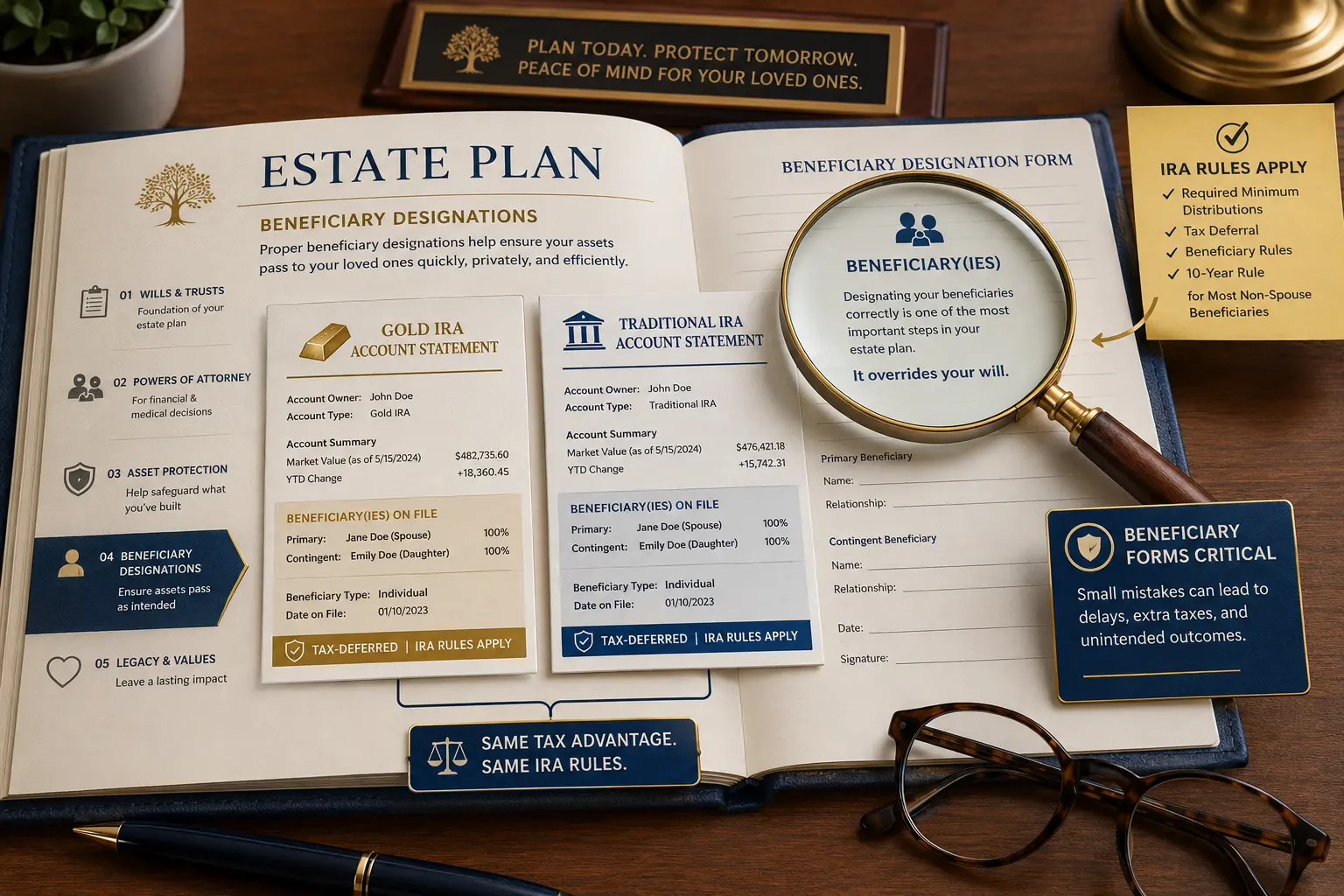
For IRAs, including Gold IRAs, beneficiary forms often matter more than the will. The IRA agreement instructs the custodian to pay the account directly to the named beneficiaries, which means the account can bypass probate when forms are properly completed. Designations determine who inherits regardless of will or trust language in many cases, influence which inherited IRA category applies, and help control whether the account follows the 10-year rule, life-expectancy payouts, or a 5-year rule.
Outdated or missing beneficiary forms can send a Gold IRA into probate or to unintended heirs, even when the rest of the estate plan is carefully drafted. Ongoing reviews are supported by Gold IRA beneficiary rules and creditor protection by state. Customers should speak to a financial or tax advisor before relying on beneficiary forms as the primary estate-planning tool.
Spouse, Non-Spouse, Eligible Designated Beneficiary, Trust & Estate
The type of beneficiary has a major impact on inherited IRA timelines and flexibility.
Spouse beneficiaries
A surviving spouse can generally treat the IRA as a personal account (via rollover or assumption), keep it as an inherited IRA with separate RMD rules, or disclaim the inheritance so contingent beneficiaries inherit instead. Because a spouse can often treat the IRA as their own, spouses have more flexibility with timing and RMD strategy than most other heirs. In a Gold IRA, a spouse may keep metals invested, change holdings, or eventually take in-kind distributions.
Non-spouse designated beneficiaries
Most adult children and other individual heirs are non-spouse designated beneficiaries. After the SECURE Act, most must empty inherited IRAs by the end of the 10th year after the original owner's death, and recent IRS guidance requires annual RMDs in years 1–9 when the owner died after starting RMDs. This 10-year framework affects how quickly metals must be sold or distributed.
Eligible designated beneficiaries
Eligible designated beneficiaries generally include spouses, minor children of the account owner (until majority), disabled or chronically ill beneficiaries, and certain beneficiaries within 10 years of the owner's age. These heirs often retain access to life-expectancy payout schedules rather than the strict 10-year limit, which can mean smaller, longer-term distributions and a different timeline for liquidating metals.
Trusts as beneficiaries
Trusts are common when beneficiaries are minors, have disabilities, or when the owner wants more control over distribution pacing. A trust must meet see-through requirements and have identifiable human beneficiaries to be treated as a designated beneficiary, and after the SECURE Act many trusts now fall under the 10-year rule unless all beneficiaries qualify as eligible designated beneficiaries. Trust language may also need to address how physical metals are handled — sold, held, or distributed.
Estate as beneficiary
If the estate is named, or no beneficiary survives without a contingent, the Gold IRA often becomes a probate asset. Estates are usually treated as non-designated beneficiaries, which can trigger a 5-year rule or distribution over the decedent's remaining life expectancy. Customers should speak to a financial or tax advisor — and often an estate-planning attorney — before naming trusts or estates as beneficiaries. Goldco does not offer tax or legal advice.
How Physical Metals May Be Liquidated, Distributed, or Transferred After Death
Inherited Gold IRAs involve choices about the metals themselves. Beneficiaries can leave metals in an inherited Gold IRA under a qualified custodian and depository and follow the RMD or 10-year schedule, keeping metals in tax-advantaged form until distributions are required. Many heirs instead sell some or all metals inside the IRA and take cash distributions to meet RMDs or the 10-year deadline, with custodian and dealer coordination determining which products are sold.
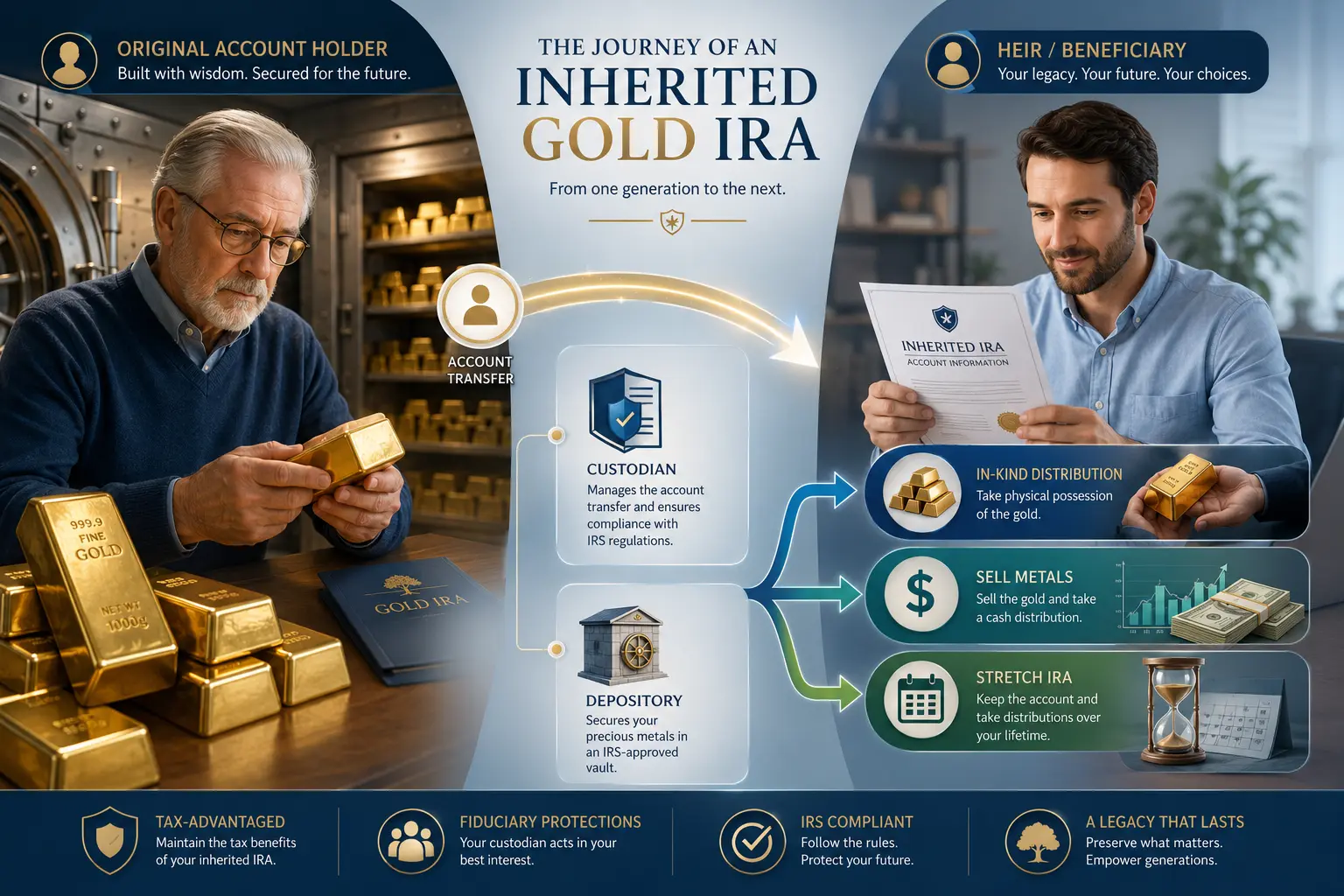
Gold IRA providers often allow in-kind distributions, where the beneficiary receives physical metals instead of cash. The fair market value at the time of distribution is reported as a distribution from the IRA, and the metals then become personally owned assets subject to future capital-gains rules when sold. Estate strategies may outline which heirs receive which specific coins or bars and when in-kind distributions should occur relative to the 10-year or life-expectancy schedules — see exit strategies and what happens if cash is needed. Customers should speak to a financial or tax advisor before deciding whether inherited metals should be sold, held, or distributed in kind.
RMD and Inherited IRA Issues
Gold IRAs are subject to the same RMD ages and rules as other traditional IRAs. The applicable age depends on the owner’s birth year: 73 for those born from 1951 through 1958, and 75 for those born in 1960 or later. The final regulations reserved the 1959 birth year, so that case is unsettled — see how the SECURE Act affects a Gold IRA.
Because the age-75 tier reaches people who turn 74 after 2032, every owner currently subject to an RMD falls under the age-73 rule. The distinction matters for planning rather than for distributions being taken today.
If the owner had reached their applicable RMD age and had not taken the full RMD for the year of death, heirs must still make up that final distribution. After death, inherited IRA RMD rules depend on the beneficiary category and whether the owner died before or after the required beginning date. Many non-spouse heirs who are not eligible designated beneficiaries must both empty the inherited IRA by the end of year 10 and take annual RMDs in years 1–9 if the owner was already taking RMDs. These rules are coordinated with metal-sale plans or in-kind schedules using Gold IRA RMD strategy and inherited Gold IRA rules. Customers should speak to a financial or tax advisor before making RMD or conversion decisions.
Probate and Account Titling Considerations
A major estate-planning benefit of IRAs is passing outside probate when beneficiary designations are properly completed. A Gold IRA is usually a non-probate asset when valid primary beneficiaries are named, contingents are listed, and the estate is not named unless intended. It can become part of the probate estate when no beneficiary form is on file, all named beneficiaries have died with no contingents, or the estate is named. After death, custodians retitle inherited IRAs to show both the original owner and the beneficiary, for example "Owner Name (deceased) IRA FBO Beneficiary Name" — and this applies to a Gold IRA even though the assets are metals. Details on how titling affects RMDs are on Gold IRA beneficiary rules.
Tax Issues to Review With Professionals
Gold IRAs touch several tax areas with significant estate-planning impact. Traditional inherited IRAs generally create taxable income on distributions, while Roth inherited IRAs may offer tax-free qualified distributions but still face distribution deadlines. SECURE Act and SECURE 2.0 changes can accelerate taxable income for many non-spouse heirs when large balances must be distributed within 10 years. When metals leave an IRA in kind, the distribution is taxed on fair market value at that time, which becomes basis for future sales. State income and estate tax rules can also interact with IRA planning. Related pitfalls are covered on Gold IRA tax mistakes. Customers should speak to a financial or tax advisor before implementing any tax strategy. Goldco does not offer tax or legal advice.
Communication and Documentation for Heirs
Practical estate planning also involves clear communication so heirs understand what they are inheriting and how to work with the custodian and depository. Useful steps include maintaining an inventory of IRA-held and personally held metals (types, weights, storage locations), keeping copies of depository statements and custodian contacts with other estate documents, and explaining in plain language whether heirs are expected to sell, hold, or request in-kind distributions. Good communication reduces confusion and helps heirs avoid missed deadlines under the 10-year rule.
Estate-Planning Checklist for Gold IRA Account Holders
Account structure and beneficiaries: confirm the Gold IRA is properly titled and the custodian and depository are in good standing; review primary and contingent beneficiaries every few years and after major life events; note whether any beneficiary may qualify as an eligible designated beneficiary and how that affects payout timelines.
Trusts and advanced structures: evaluate whether a trust makes sense for minors or complex situations; arrange legal review of trust language for IRA distributions, metals handling, and see-through rules; coordinate with broader trust or estate-tax strategies.
Distribution and RMD strategy: plan how RMDs will be met (metal sales, in-kind, or a mix); consider the 10-year rule's impact on heirs and whether lifetime withdrawals or conversions help, with professional guidance; use RMD strategy and exit strategies to understand timing.
Documentation and review: keep an up-to-date metals inventory; store beneficiary forms, statements, and custodian contacts with other estate documents; review periodically with professionals after SECURE Act, RMD-age, or state-law changes; revisit provider choice via best Gold IRA companies and the gated comparison workbook. Goldco does not offer tax or legal advice.
Coordinate the account with the wider plan
Compare providers and model costs before funding — the quiz is educational and makes no recommendation.
Take the Free Gold IRA Quiz →FAQ
How does a Gold IRA fit into an estate plan?
A Gold IRA can serve as a tax-advantaged account holding physical metals that pass directly to named beneficiaries, often outside probate, while following inherited IRA rules such as the 10-year rule or life-expectancy payouts. Estate planning focuses on aligning beneficiary designations, distribution timelines, and metal-handling instructions with the rest of the estate.
Do Gold IRAs avoid probate?
When beneficiary forms are complete and up to date, Gold IRAs usually pass directly to beneficiaries and bypass probate. If the estate is named or no valid beneficiary is listed, the account may become part of the probate estate instead.
How does the 10-year rule affect inherited Gold IRAs?
For many non-spouse beneficiaries of IRAs inherited after 2019, the account must be fully distributed by the end of the 10th year following the owner's death. Recent guidance also requires annual RMDs in years 1–9 in some cases when the owner had already begun RMDs.
Can heirs receive physical gold from a Gold IRA?
Heirs can often receive in-kind distributions of metals, with the fair market value treated as a distribution for tax purposes. After metals leave the IRA, they become personally owned assets subject to standard capital-gains rules when sold.
Is a trust a good beneficiary for a Gold IRA?
Trusts are sometimes used to manage distributions for minors or complex situations. SECURE Act rules, see-through requirements, and 10-year-rule implications make this a technical choice that usually requires legal review. Customers should speak to a financial or tax advisor. Goldco does not offer tax or legal advice.
Sources
- Internal Revenue Service. Retirement Topics — Beneficiary.
Article reviewed and edited by Daniel M. — editor, 401kToGoldIRA.org.