Educational only: This article is general educational information about retirement-timing and sequence risk. It is not financial, tax, legal, investment, or retirement-planning advice. Market returns, inflation, taxes, health needs, and retirement length are uncertain. Customers should speak to a financial or tax advisor before making decisions. Goldco does not offer tax or legal advice. Past performance does not guarantee future results.
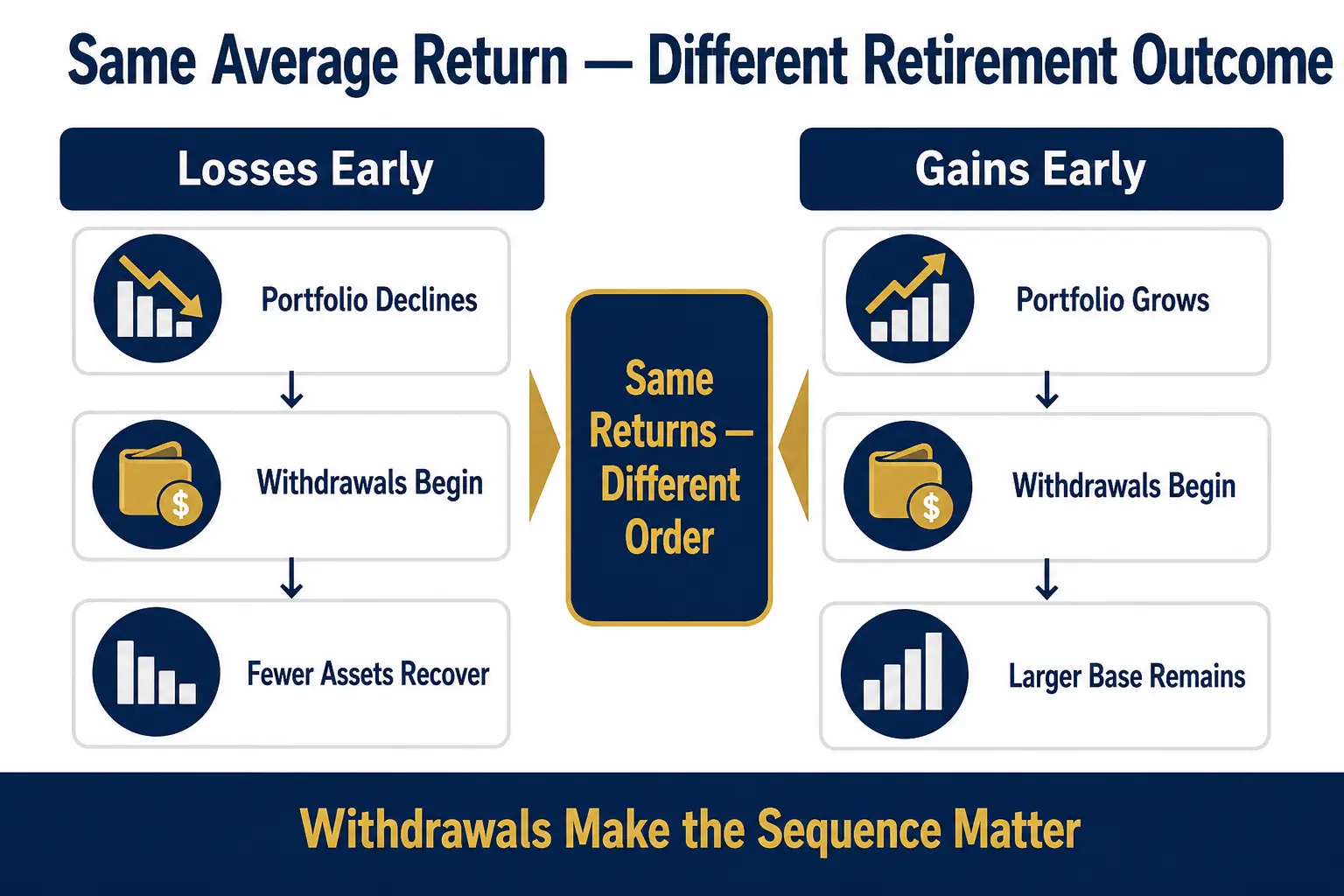
Two retirees with the same average return can end up with very different results: negative returns early in retirement reduce the portfolio through market losses and withdrawals at the same time, leaving less to recover.
Source: Center for Retirement Research at Boston College. The order of returns — not just the average — drives how long a portfolio lasts once withdrawals begin.
Key takeaways
- Timing beats size: the same loss does far more harm when it lands as withdrawals begin than years earlier during accumulation.
- Sequence risk is the order of returns. Once money is being withdrawn, an early loss sells shares that can't rejoin a later rebound.
- The "red zone" — roughly 5 years before through 5 years after retirement — is the highest-stakes window.
- Tools reduce, not remove, the risk: a cash buffer / bucket strategy, flexible withdrawal guardrails, delaying retirement or Social Security, and diversification.
- No single asset is the answer. Gold may be one small, lower-correlation diversifier, but it does not cure sequence risk.
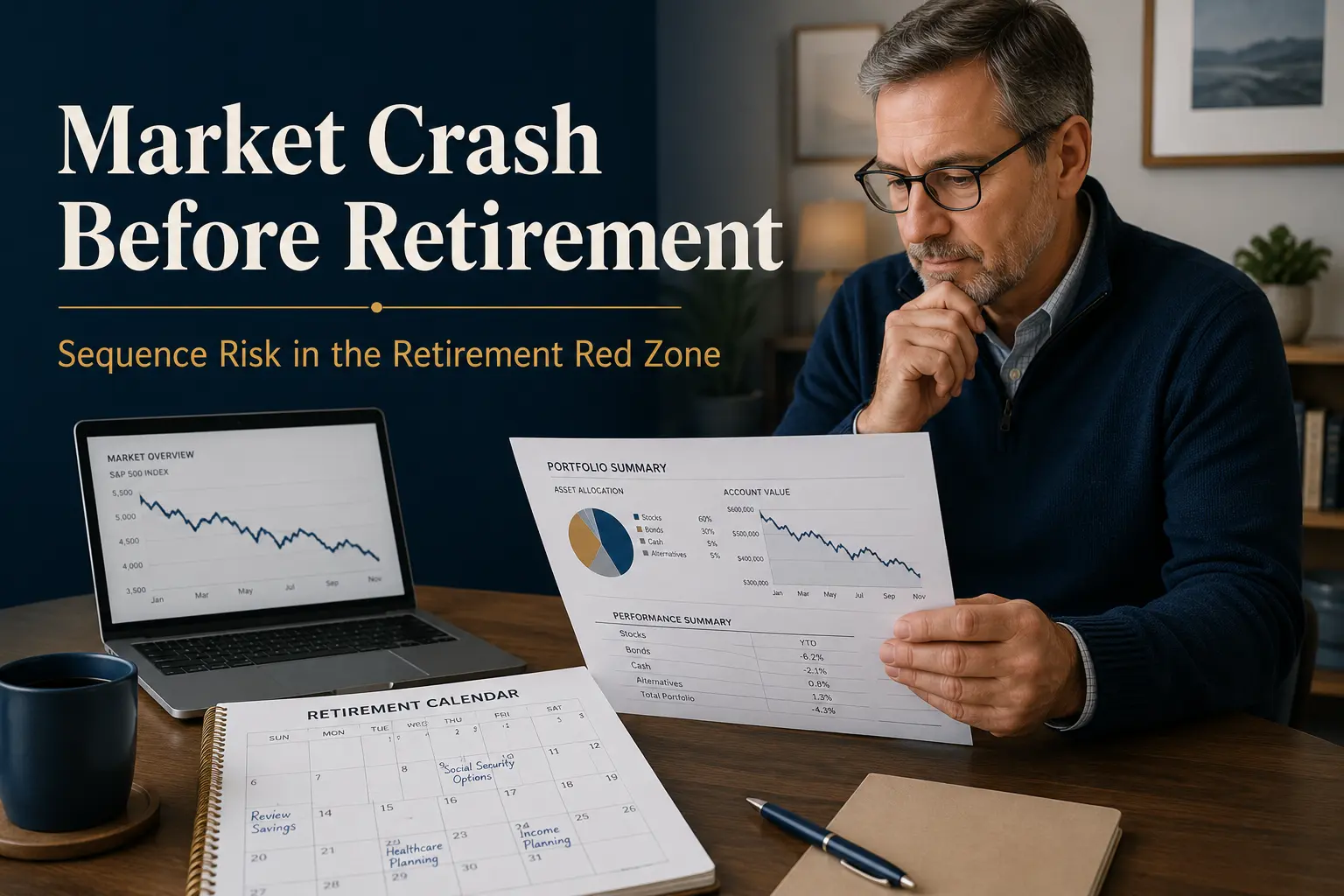
Quick answer: A sharp decline near retirement can lower the portfolio at the exact time withdrawals begin. That combination can permanently reduce the amount available later, even if long-run average returns eventually look acceptable. A cash buffer, bucket strategy, flexible spending rules, delayed retirement income, and broad diversification may reduce the damage — none removes the risk completely. The Center for Retirement Research at Boston College explains that negative returns early in retirement have a more severe effect because the portfolio is reduced by both market losses and withdrawals, leaving less money available for future growth (Center for Retirement Research at Boston College).
What Does a Market Crash Right Before Retirement Do?
A market crash right before retirement can create more damage than the same decline many years earlier, and the reason is timing, not only the size of the loss. Someone who is still working may keep contributing and wait for a recovery. A new retiree may need to begin withdrawals while prices are low, and those withdrawals remove shares that can no longer participate in a later rebound. A calm plan does not assume every downturn will be short: it sets aside near-term spending, makes withdrawals flexible where possible, reviews the retirement date and Social Security timing, and keeps the portfolio diversified.
What Is Sequence-of-Returns Risk?
Sequence-of-returns risk is the risk created by the order of investment returns. During the saving years, two portfolios with the same deposits and the same average return may finish near the same value even when annual returns occur in a different order, because no withdrawals are leaving the account and later gains can work on the full balance plus new contributions. The math changes after withdrawals begin.
Consider two hypothetical retirees who each start with $1 million and withdraw $50,000 at the end of every year. Each portfolio experiences the same five annual returns: negative 20%, negative 10%, positive 5%, positive 15%, and positive 25%. One retiree receives the losses first; the other receives the gains first. Without withdrawals, reversing the order produces the same ending value because multiplication is not changed by sequence. With annual withdrawals, the outcomes differ: the early-loss portfolio sells assets from a smaller base and has fewer assets left when stronger returns arrive. That is why average return alone does not describe retirement sustainability.
Vanguard defines sequence risk as damage to lifetime spending power caused by withdrawing during a down market early in retirement, and describes dynamic spending as one way to reduce the risk by lowering withdrawals modestly after weak market results (Vanguard). Sequence risk does not mean stocks should be removed from every retirement portfolio; it means the withdrawal plan and investment mix must work together. The sequence-of-returns risk calculator lets a reader test this directly — the same average return and withdrawals in a different order can produce a very different ending balance.
Why Is a Crash Right Before Retirement More Damaging Than One Years Earlier?
A crash near the retirement date creates several pressures at once. The portfolio may be near its largest value: for many savers the account reaches its highest balance shortly before work ends, so a percentage decline affects a large dollar amount — a 25% decline on a $1 million portfolio equals $250,000, versus $50,000 on a $200,000 portfolio. Contributions may stop: while employed, a saver may keep buying shares at lower prices, but after retirement contributions often stop or fall, and the account changes from receiving cash to paying cash. Withdrawals may begin: a retiree may need money for housing, food, insurance, health care, and taxes regardless of market conditions, so shares sold after a loss are no longer present when prices recover.
The recovery period may be shorter: a 40-year-old saver may have decades before withdrawals are necessary, while a 65-year-old retiree may need income immediately — the issue is whether the portfolio has enough time and enough liquid reserves to avoid selling growth assets under pressure. Investor.gov warns that market downturns can arrive at inconvenient times and encourages people nearing retirement to consider whether their portfolios need to become less aggressive before financial needs begin (Investor.gov). The withdrawal rate rises after a loss: a planned $40,000 withdrawal from a $1 million portfolio is a 4% rate, but if the portfolio falls to $750,000 before the first withdrawal, the same $40,000 equals about 5.3% of the new balance — the spending did not rise, but the strain on the portfolio did.
What Is the Retirement Red Zone or Fragile Decade?
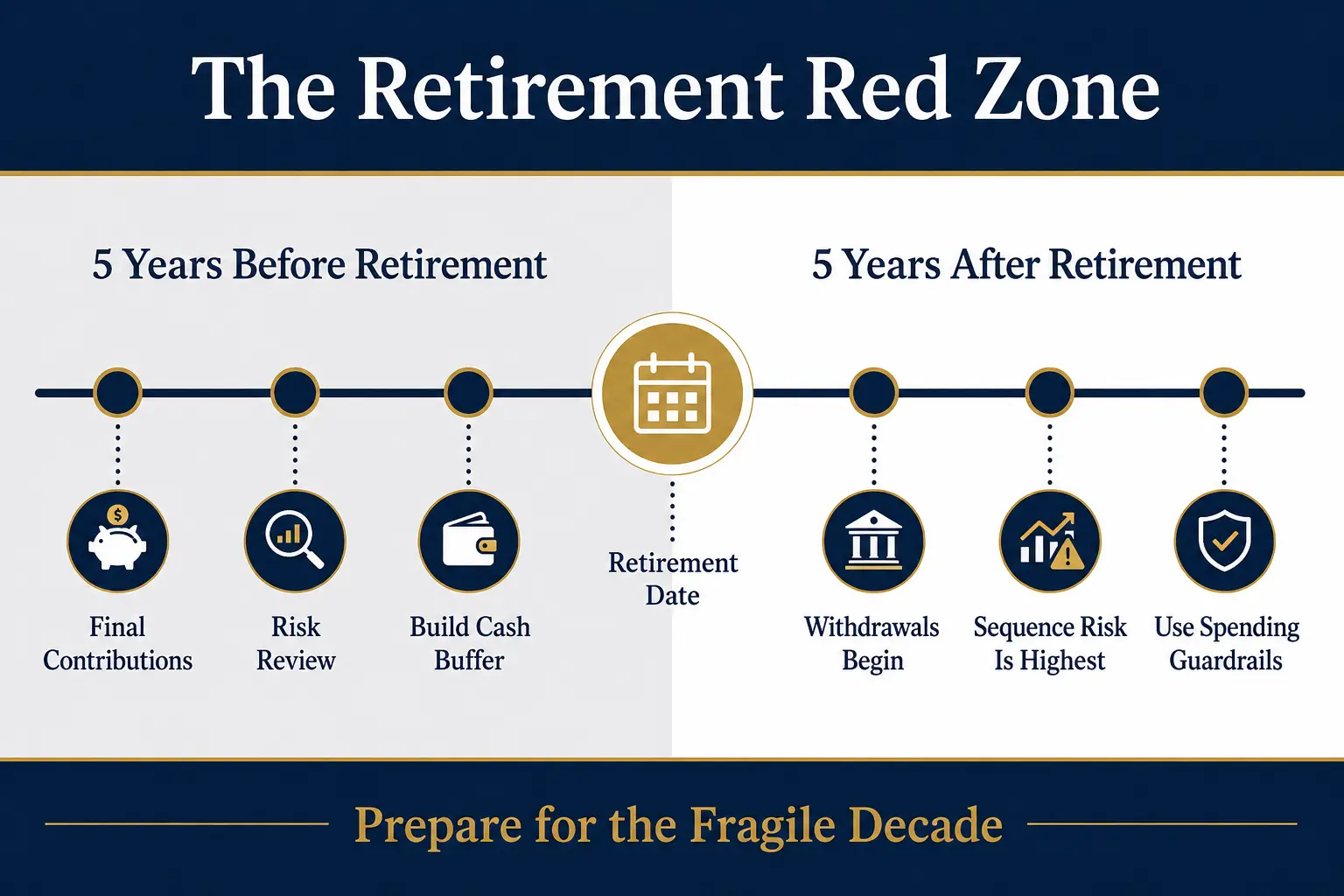
The term retirement red zone commonly describes the five years before retirement and the five years after it. Prudential has used the term for that ten-year window; it is a planning label, not an IRS, SEC, or FINRA rule (Prudential). The phrase fragile decade retirement is often used for the same period. The exact dates are not scientific boundaries — sequence risk does not begin precisely five years before retirement or end precisely five years after it — but the ten-year range is useful because it highlights a change in the portfolio's job.
Before the red zone, the main job is usually accumulation. Inside the red zone, the plan must prepare for four tasks: protecting near-term spending, continuing enough long-term growth, managing taxes and account withdrawals, and adjusting to an uncertain retirement date. The window also matters because a planned retirement date may move: a job loss, health event, caregiving need, or employer decision can force retirement earlier than expected, which makes a written backup plan valuable even when the current portfolio appears sufficient. A companion guide on preparing a 401(k) for a market downturn covers broader steps before volatility appears.
How Long Have Past Bear Markets Taken to Recover?
A bear market is generally defined as a decline of at least 20% from a recent market high. Fidelity uses that definition and reports that the median historical bear-market decline was 33%, and that U.S. stocks entered bear-market territory about once every six years on average over roughly 150 years of history (Fidelity). The length of the decline and the time required to regain the prior high are not the same.
Charles Schwab reports that the past 12 S&P 500 bear markets lasted about 14 months on average — the shortest about three months, while the 1946–1949 bear market lasted about three years — and that the 2007–2009 decline reached about 59% over roughly 27 months (Charles Schwab). Those figures describe peak-to-trough bear markets; a full recovery to the prior peak can take additional time. No single historical average can tell a retiree how long the next recovery will take, because recovery time depends on the starting valuation, economic conditions, inflation, interest rates, company earnings, the index used, and whether returns include dividends. The practical question is not "When will the market recover?" but "How long can essential spending continue without forced sales from depressed assets?"
How Can a Cash Buffer or Bucket Strategy Reduce the Harm?
A cash buffer holds money for near-term spending outside volatile growth assets. The purpose is not to avoid all market risk; it is to reduce the need for selling into a loss in retirement. A basic reserve might include cash, money market funds, short-term Treasury securities, or other high-quality short-duration assets, and the amount depends on spending needs, other income, risk tolerance, taxes, and the ability to cut flexible expenses.
A bucket strategy expands that idea. Charles Schwab describes a common three-bucket structure based on time periods — one example uses a first bucket for years zero through five, a second for years six through ten, and a third for year eleven and later — and notes that bucket time frames are flexible and that the structure does not prove the portfolio will meet every retirement goal (Charles Schwab). A simple version uses Bucket 1 for near-term spending (cash and very short-term holdings, a source for regular transfers during a decline); Bucket 2 for middle-term stability (high-quality bonds or other lower-volatility assets, which can still decline when rates rise); and Bucket 3 for long-term growth (diversified growth assets that remain exposed to declines but are not needed for years).
The bucket method requires a refill rule — without one, the cash bucket can be depleted while the other assets remain untouched. A refill rule might use portfolio rebalancing, bond maturities, dividends, interest, or sales after stronger market periods. Holding too much cash can also weaken long-term purchasing power, so the right reserve balances sequence protection with the need for growth. The site's retirement portfolio longevity guide can help frame that trade-off.
How Do Flexible Withdrawals and Guardrails Help During a Downturn?
A fixed withdrawal system may continue raising spending for inflation even after the portfolio has fallen. The 4% rule is a common example: Charles Schwab explains that the rule starts with a first-year withdrawal equal to 4% of the initial portfolio and then adjusts the dollar amount for inflation, and notes that the rule is rigid, assumes a specific portfolio and time horizon, and does not automatically respond to market performance (Charles Schwab). A safe-withdrawal-rate plan for a downturn may need more flexibility than one fixed number.
Vanguard describes dynamic spending as a method that sets an annual floor and ceiling: withdrawals can rise after stronger returns and fall after weaker returns without moving outside the preset range, seeking to protect the initial portfolio in a down market while avoiding completely market-driven spending (Vanguard). Guardrails can be written in several forms: pause the annual inflation increase after a negative year; cut travel or other flexible spending after a defined portfolio decline; restore spending after the withdrawal rate or account value returns to a chosen range; avoid cuts below a floor needed for housing, food, medicine, and insurance; and review the plan after large tax changes, health expenses, or family support. The value comes from deciding the rule before fear or excitement controls the decision. Customers should speak to a financial or tax advisor before making decisions about withdrawals, asset allocation, or retirement-account transactions.
Can Delaying Retirement or Social Security Change the Outcome?
Working longer can help in several ways: it may add contributions, reduce the number of retirement years funded by the portfolio, preserve employer health coverage, and delay withdrawals. Even one or two additional working years can change the cash-flow sequence, because the portfolio has more time to recover and the first withdrawal starts from a later date. Still, delaying retirement is not always available — health, caregiving, layoffs, job demands, and family needs can remove that option — so a plan should include both a preferred retirement date and a forced-retirement scenario. The not-enough-saved-for-retirement guide discusses practical choices when the planned date no longer fits the available resources.
Delaying Social Security after full retirement age increases the monthly benefit. The Social Security Administration states that benefits rise for each month of delay beyond full retirement age, with increases stopping at age 70, and that for people born in 1943 or later the delayed retirement credit rate is 8% per year, or two-thirds of 1% per month (Social Security Administration). A larger later benefit can reduce future dependence on portfolio withdrawals, but the trade-off is that delaying may require more portfolio spending, employment income, or other cash during the waiting period — which can be difficult during a market decline. The decision depends on health, longevity expectations, marital and survivor benefits, taxes, employment, and available assets, and should not be made only to avoid selling stocks for one year.
Can a Roth Conversion During a Downturn Help?
A market decline may reduce the value of traditional IRA assets considered for conversion to a Roth IRA, and converting a lower account value may produce less taxable conversion income than converting the same number of shares at a higher value. The tax result still depends on the amount converted and the taxpayer's full situation. The IRS states that a Roth conversion generally makes previously untaxed traditional IRA amounts taxable and is reported on Form 8606 (Internal Revenue Service). A conversion can also increase adjusted gross income, affect Medicare premiums, change taxation of Social Security, and create state-tax issues. The site's Roth conversion during a recession guide explains the framework in more detail. Customers should speak to a financial or tax advisor before making decisions. Goldco does not offer tax or legal advice.
Where Does Diversification Fit?
Diversification spreads money among investments that may react differently to market conditions. Investor.gov explains that diversification should occur between asset categories and within them — a portfolio may include stocks, bonds, cash equivalents, and possibly other categories, with broad exposure inside each group (Investor.gov). Diversification cannot stop every asset from falling at the same time, but it can reduce dependence on one company, sector, market, or risk factor. For someone in the retirement red zone, diversification may include U.S. and international stocks, high-quality bonds with varied maturities, cash for near-term expenses, inflation-sensitive assets, and a proportionate allocation to other assets with different return drivers.
Precious metals may be one small diversification consideration because their return drivers can differ from stocks and bonds. They can also be volatile, produce no interest or dividends, and carry dealer, custody, and storage costs when held physically. Gold is not a solution to sequence risk, and no single asset removes the risk created by withdrawals during a broad downturn. The retirement purchasing-power guide discusses inflation and diversification, and the Gold IRA decision quiz is an educational account-structure tool, not a recommendation.
What Practical Plan Can Help During the Retirement Red Zone?
A written red-zone plan can use the following steps.
- Calculate essential spending. Separate housing, food, health care, insurance, taxes, and basic transportation from flexible categories to show the minimum cash flow the portfolio must support.
- List stable income. Record Social Security, pension payments, employment income, and other scheduled cash flow. The difference between essential spending and stable income is the amount that must come from savings.
- Build a near-term reserve. Set aside enough liquid assets for the chosen buffer period — large enough to reduce forced sales, but not so large that long-term growth is ignored.
- Stress-test an early decline. Model a sharp loss in the year before retirement, the first retirement year, and the third retirement year, including lower returns, inflation, taxes, and health costs.
- Set withdrawal guardrails. Write the spending floor, normal spending level, flexible ceiling, and triggers for adjustment.
- Review the retirement date. Compare the planned date with one-year and two-year delays, and also test an earlier forced-retirement date.
- Review Social Security timing. Compare benefits and portfolio withdrawals at different claiming ages using SSA estimates.
- Check account taxes. Identify which withdrawals come from taxable accounts, traditional retirement accounts, and Roth accounts; tax-efficient sequencing depends on personal facts and current law.
- Rebalance before the downturn, not during panic. Investor.gov advises people approaching retirement to review whether the investment plan should become more conservative before market volatility damages near-term needs (Investor.gov).
- Revisit the plan each year. Retirement timing, spending, taxes, health, and markets change, and a static plan can become unsuitable even when it was reasonable at the start.
What Are Common Questions About a Crash Near Retirement?
Does a market crash mean retirement must be canceled?
No. The answer depends on essential spending, stable income, the cash reserve, portfolio allocation, withdrawal rate, and flexibility. Some plans may support the original date. Others may improve with part-time work, lower flexible spending, or a short delay.
Is sequence risk the same as normal market risk?
No. Market risk is the possibility that investments lose value. Sequence risk is the added damage caused when poor returns occur near the start of withdrawals.
How many years of cash should a retiree hold?
No universal amount fits every household. Schwab presents bucket examples ranging from one to five years for the first bucket, but the suitable amount depends on income, spending, risk tolerance, taxes, and portfolio structure (Charles Schwab).
Does the 4% rule protect against every downturn?
No. It is a historical rule of thumb based on a first-year percentage followed by inflation adjustments. It is not a personalized promise, and it may be too rigid when early returns are weak (Charles Schwab).
Should all stocks be sold before retirement?
Not as a universal rule. Removing all growth assets can increase inflation and longevity risk. The allocation should reflect spending needs, time horizon, stable income, and risk capacity.
Can diversification prevent losses?
No. Diversification can reduce concentration risk, but it cannot ensure a profit or prevent every portfolio decline (Investor.gov).
Bottom Line
A market crash near retirement is dangerous because losses and withdrawals can occur together. That does not make retirement planning hopeless, and the response is not a prediction or a single defensive asset. A stronger plan creates several sources of resilience: liquid near-term spending, diversified long-term assets, flexible withdrawals, clear guardrails, realistic retirement-date options, and careful Social Security timing. The retirement red zone is a period for preparation, not panic.
Sources
- Center for Retirement Research at Boston College. Retirees get a 401(k) withdrawal headache.
- Vanguard. Sequence risk and dynamic spending · Spending strategies in retirement.
- Prudential. Retirement red zone.
- Fidelity. What is a bear market?
- Charles Schwab. How to invest in a bear market · Bucket drawdown strategy · Beyond the 4% rule.
- Social Security Administration. Delayed retirement credits.
- Investor.gov (U.S. SEC). Don't panic, plan it · Beginner's guide to asset allocation.
- Internal Revenue Service. Retirement Plans FAQs regarding IRAs.
Reviewed and edited by Daniel M. — editor, 401kToGoldIRA.org. Educational only; sourced to the Center for Retirement Research at Boston College, Vanguard, Charles Schwab, Fidelity, the Social Security Administration, Investor.gov (SEC), and the IRS. Not financial, tax, or investment advice.