Educational only: This is a balanced decision guide, not a recommendation to buy silver. It summarizes IRS, SEC, and industry material in general terms and is not financial, tax, or legal advice. No fee or premium figures are asserted as universal — provider schedules must be confirmed directly. Customers should speak to a financial or tax advisor before making decisions. Goldco does not offer tax or legal advice. Past performance does not guarantee future results.
Quick Answer: Silver IRA Pros and Cons at a Glance
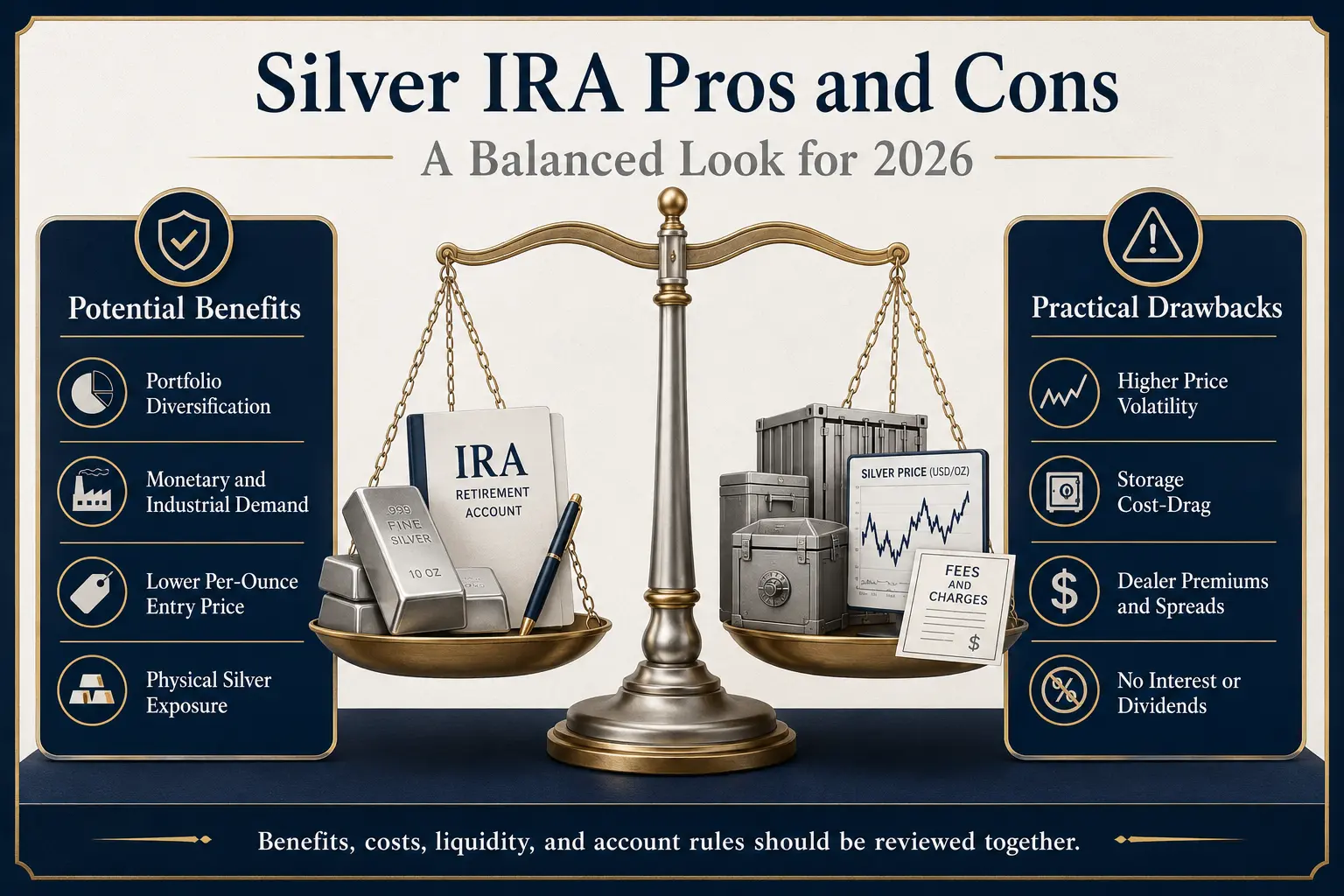
Pros: portfolio diversification, exposure to a metal with both monetary and industrial demand, a lower per-ounce entry cost than gold, and the ability to hold physical silver in a tax-advantaged account through a self-directed IRA structure. Cons: historically higher price volatility than gold, greater storage cost-drag per invested dollar because silver is bulkier and lower value-density, generally wider dealer spreads, no intrinsic income or yield, and operational complexity around custodians, depositories, and IRS rules. Both sides should be weighed together, within a broader retirement plan, rather than treating silver as a standalone solution.
How a Silver IRA Works
A "silver IRA" is typically a self-directed IRA that holds IRA-eligible silver coins or bullion instead of only stocks, bonds, or mutual funds. The underlying account is still an IRA governed by Internal Revenue Code section 408 and IRS publications such as Publication 590-A (Cornell Law School (26 U.S.C. §408); IRS Publication 590-A); the difference is the asset type. Under Internal Revenue Code section 408(m), most physical metals and coins are treated as "collectibles" that cannot be held in an IRA without triggering a taxable distribution, but there is a narrow exception for specific coins and bullion that meet contract-market fineness standards and are held in the physical possession of a qualifying trustee. Eligible bullion must meet minimum fineness thresholds commonly interpreted as at least .995 for gold and .999 (99.9% purity) for silver, aligned with major futures exchanges' delivery standards (IRS: Investments in Collectibles).
Because the IRS requires IRA-owned precious metals to be held by a bank or IRS-approved non-bank trustee, silver in a retirement account must be stored at an approved depository rather than in personal possession; home storage is treated as a distribution and may trigger tax and penalties. Investor alerts from the SEC and Investor.gov emphasize that self-directed IRAs with alternative assets, including precious metals, carry higher risks of fraud, illiquidity, and high fees compared with conventional brokerage IRAs (Investor.gov: Self-Directed IRAs and the Risk of Fraud). Customers should speak to a financial or tax advisor before making decisions about IRA structures, precious-metals allocations, or rollovers, and Goldco does not offer tax or legal advice.
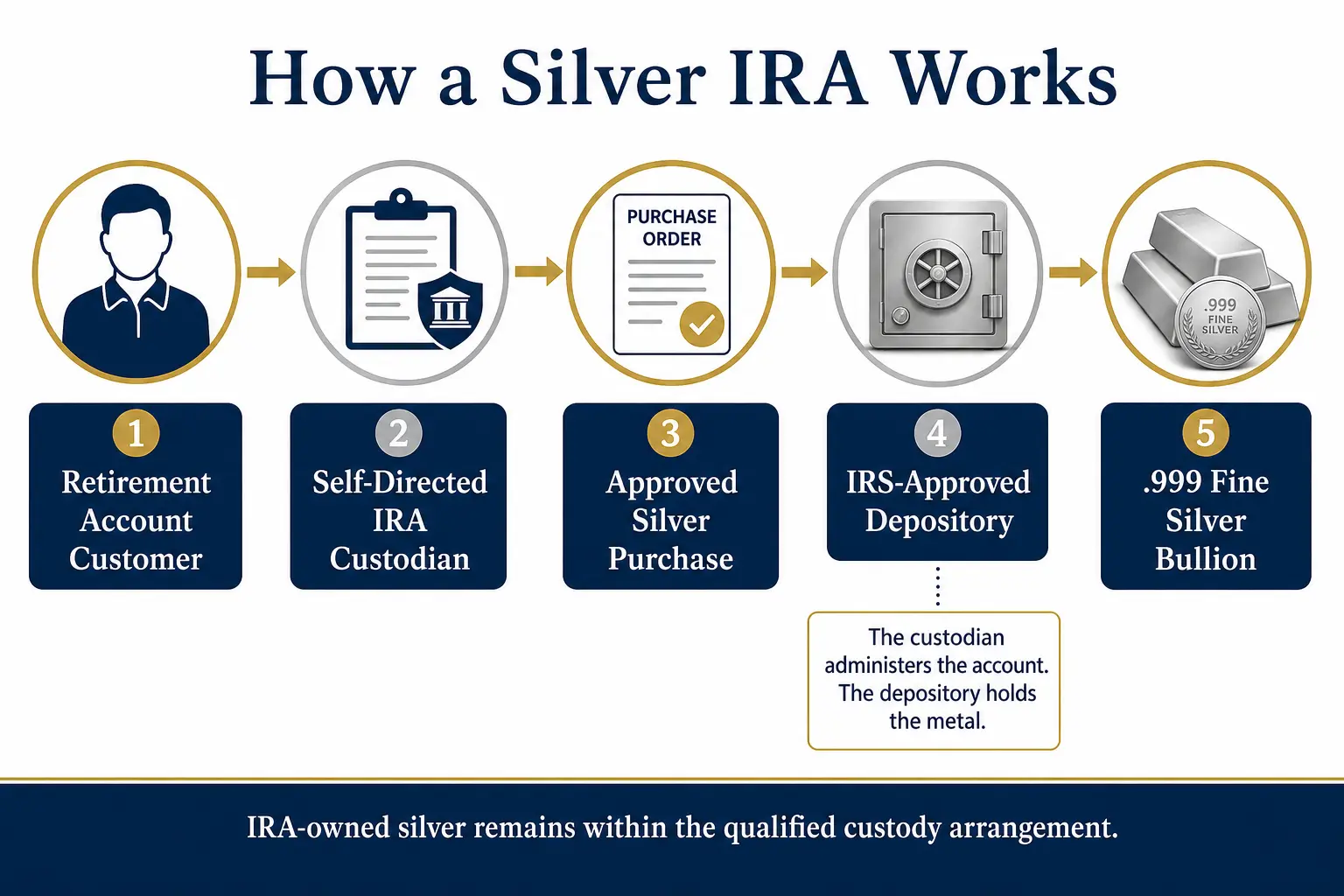
To hold approved silver in an IRA, an investor generally uses a self-directed IRA custodian (an IRS-approved bank, trust company, or specialized SDIRA custodian that opens and administers the account, handles reporting, and interfaces with the depository); approved silver bullion or coins that meet the IRS fineness requirement, commonly summarized as .999 fine silver, with most numismatic or collectible coins remaining prohibited; and a physical-possession arrangement in which the silver remains in the control of a qualifying trustee or depository. Self-directed IRA investors often use segregated or commingled storage at depositories, which may charge storage and insurance fees based on account size, storage type, and sometimes weight or value. There is no reliable public database summarizing silver IRA storage fees across all custodians and depositories, so cost comparisons typically rely on individual provider schedules and third-party commentary.
The Pros of a Silver IRA
Diversification potential. Industry research from the World Gold Council and other institutions finds that precious metals can improve risk diversification because their price behavior often differs from traditional stocks and bonds. Although much of this research focuses on gold, silver shares some characteristics as a monetary metal, and adding a modest allocation of precious metals to a broader portfolio may reduce exposure to certain macroeconomic or currency risks. World Gold Council materials are produced by an industry body that represents gold producers, so diversification findings should be read as industry research rather than neutral academic work (World Gold Council). The Gold IRA vs. Gold ETF and How Much Gold Should Be Held in Retirement guides offer more on how metals allocations fit a retirement plan.
Lower per-ounce entry price. Silver trades at a significantly lower price per ounce than gold over long periods, which means the same dollar value buys more ounces of silver than gold. This lower entry cost can make physical silver more accessible for smaller account balances. Because silver's value density is lower than gold's, the same dollar allocation typically translates into heavier, bulkier holdings — a physical characteristic that interacts with storage fees and logistics, addressed in the cons. The silver IRA calculator and gold IRA calculator can help estimate how many ounces a particular allocation might represent.
Monetary and industrial demand. Silver has a dual role as a monetary metal and an industrial commodity, which creates a distinct demand profile. Reports from The Silver Institute — an industry organization representing companies involved in silver mining and refining — indicate that global industrial demand for silver has reached record or near-record levels in recent years, driven by electronics, solar photovoltaics, and automotive applications (The Silver Institute; Sprott). Silver Institute materials reflect industry perspectives and should be treated as industry research rather than fully neutral analysis. Holding physical silver can offer exposure to these long-term demand trends, though it also means accepting the price volatility associated with industrial cycles.
Physical silver retirement exposure. A silver IRA allows direct exposure to physical silver within a tax-advantaged wrapper, rather than exposure only through mining stocks or exchange-traded funds. For some savers, the ability to own investment-grade silver bars or coins that meet the .999 fineness requirement inside a retirement account is attractive from a tangibility and diversification standpoint. IRS guidance makes clear that only specific forms of bullion and coins are eligible and that personal possession of IRA-owned silver is prohibited while the metals remain in the account. The segregated vs. commingled storage guide explains how different storage options work.
The Cons of a Silver IRA
Higher volatility than gold. Multiple market analyses highlight that silver has historically exhibited higher price volatility than gold — iShares commentary notes that over the past 20 years, silver's annualized volatility has been up to roughly twice that of gold, underscoring silver's more cyclical and industrially driven nature (iShares). This means silver prices may swing more sharply in both directions, with pronounced moves during economic expansions and contractions as industrial demand changes, and may experience larger drawdowns in certain periods. Past performance does not guarantee future results.
Storage cost-drag from low value-density. Because silver is lower value-density than gold — a given dollar amount buys more ounces and more physical volume — holding a comparable dollar allocation in silver typically requires more space and weight in a depository vault. Many depositories charge storage and insurance fees that scale with either the value or the quantity of metals held. Independent articles and custodian disclosures describe storage fees in annual flat ranges or percentages but show meaningful variation by provider, account size, and storage type, and there is no reliable public database capturing silver IRA storage fees across all institutions. When charges are tied to weight or discrete lot sizes, the bulkiness of silver can produce a worse storage cost-drag per invested dollar than more compact metals such as gold.
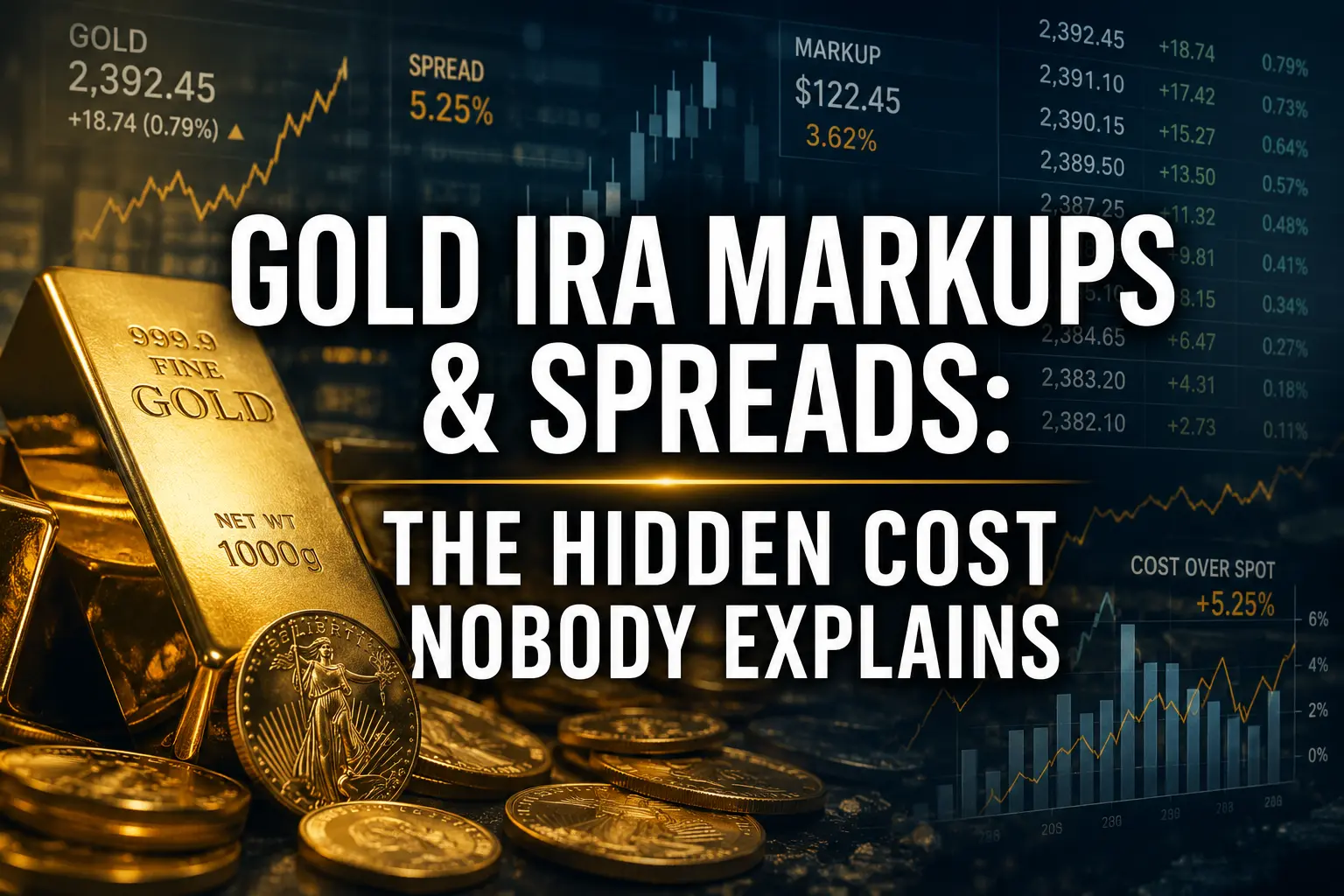
Wider dealer spreads and premiums. In physical bullion markets, the price paid or received differs from spot through premiums and spreads: a premium is the amount above spot paid when buying, while the spread is the difference between the dealer's sell price and buyback price for the same item. Silver bullion and some silver coins can carry higher percentage premiums and wider spreads than large gold bars or certain widely traded gold coins, reflecting manufacturing costs, liquidity, and dealer risk management. Exact premium and spread figures vary by product, dealer, order size, and market conditions, and there is no reliable public database of silver dealer premiums and spreads for IRA-eligible bullion — any quoted ranges on individual websites should be treated as provider-specific observations. Wider spreads mean round-trip transaction costs, buying silver for an IRA and later selling or taking an in-kind distribution, can be higher relative to more liquid metals or securities, reducing net returns if trading frequently.
No income or yield. Physical silver held in an IRA does not produce interest, dividends, or rental income; its return profile depends entirely on price changes between purchase and sale or distribution. Precious metals generally provide diversification and potential capital appreciation, but they do not generate cash flows the way bonds, dividend-paying stocks, or rental real estate do. This means a silver allocation must be balanced against the need for income-producing assets, particularly in retirement phases when distributions may need to fund spending.
Operational complexity and risk in self-directed IRAs. Self-directed IRAs used for silver involve extra steps — choosing an SDIRA custodian, coordinating with an approved dealer, arranging shipment to a depository, and managing tax reporting — that are more complex than opening a conventional brokerage IRA. Investor.gov and state securities regulators warn that self-directed IRAs with alternative assets carry elevated risks of fraud, illiquidity, and insufficient disclosure, particularly when marketed through unsolicited pitches or unregulated promoters (Investor.gov; Oregon Division of Financial Regulation). Common red flags include promises of high returns with little or no risk, pressure to act quickly, and opaque explanations of how the investment works. Silver IRAs therefore require careful due diligence on custodians, depositories, and dealers. Customers should speak to a financial or tax advisor before making decisions, and Goldco does not offer tax or legal advice.
Silver vs Gold in an IRA: Practical Cost and Volatility Comparison
For the equivalent evidence-graded appraisal of gold on its own, see the Gold IRA pros and cons assessment.
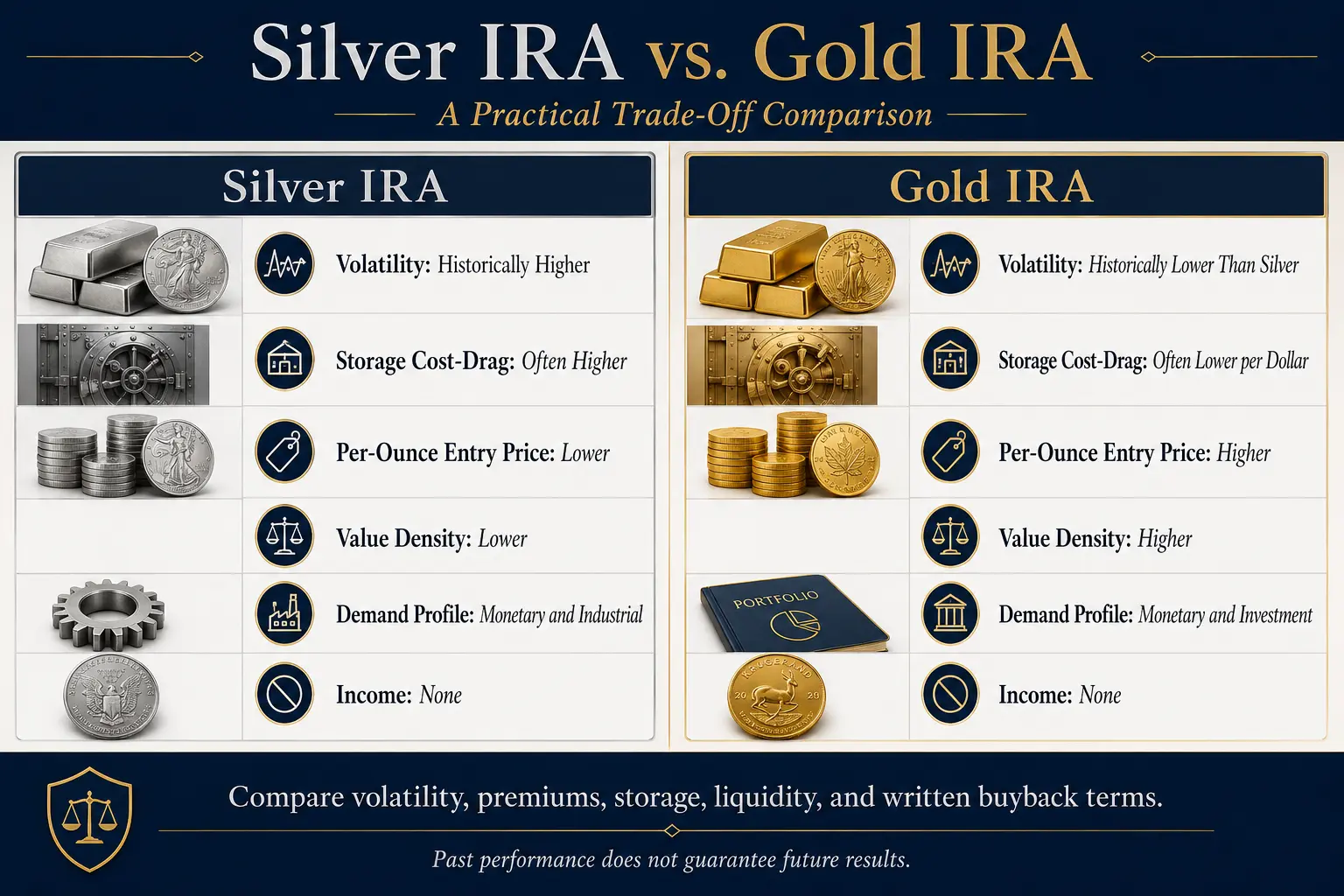
Volatility and price behavior. Gold has historically acted as a relatively lower-volatility "safe-haven" asset, whereas silver's dual monetary and industrial role exposes it to larger cyclical swings; silver's annualized volatility has often been higher than gold's over long periods, which can amplify both drawdowns and rallies. Value density and storage cost-drag. Gold's higher price per ounce means a given dollar allocation occupies less physical space and weight than an equivalent dollar allocation in silver, so when storage and insurance fees are influenced by weight or vault lots, this difference can give gold an advantage in storage cost-efficiency per invested dollar while silver's bulkiness can increase cost-drag, even if headline fee schedules appear similar. Premiums and spreads. Large gold bars and some widely traded gold coins may carry lower percentage premiums and tighter spreads than many silver products, especially small silver coins or rounds, so the effective round-trip cost of buying and later selling silver inside an IRA can be higher — though specific figures vary by dealer and product and are not captured in any comprehensive public database. Demand profile. Gold's role is more concentrated in monetary and investment demand, including central-bank reserves, whereas silver demand is more heavily industrial (solar panels, electronics), per Silver Institute surveys read with the caveat that the Institute represents industry interests. Gold IRAs and silver IRAs therefore offer different trade-offs: gold may focus more on wealth preservation and diversification with lower volatility, while silver may offer higher cyclical upside alongside greater volatility and storage cost considerations. The silver vs. gold IRA cost guide explores these trade-offs in detail.
Who a Silver Allocation Might Suit, and Key Questions to Resolve
A silver allocation inside a self-directed IRA is one option among many and is not a universal recommendation. It may suit investors who already have a diversified core of traditional assets and are exploring a modest precious-metals allocation for additional diversification; who understand and accept silver's higher volatility compared with gold and are comfortable with the possibility of larger price swings; and who are willing to manage the added operational complexity of a self-directed IRA, including custodian selection, depository arrangements, and fee monitoring. Before considering a silver IRA, key questions to resolve include: what overall percentage of the retirement portfolio should be allocated to precious metals, and how should that split between gold and silver be determined? How do storage fees, insurance premiums, setup costs, and custodian charges affect expected long-term returns, especially given silver's bulkiness and potential storage cost-drag? And how will required minimum distributions and liquidity needs be managed if a portion of the IRA is held in illiquid physical metals rather than readily tradable securities? Customers should speak to a financial or tax advisor before making decisions about allocation percentages, IRA structures, or the choice between silver bullion and other retirement assets, and Goldco does not offer tax or legal advice. The suitability quiz and allocation guide can help frame these questions.
Costs to Get in Writing Before Opening a Silver IRA
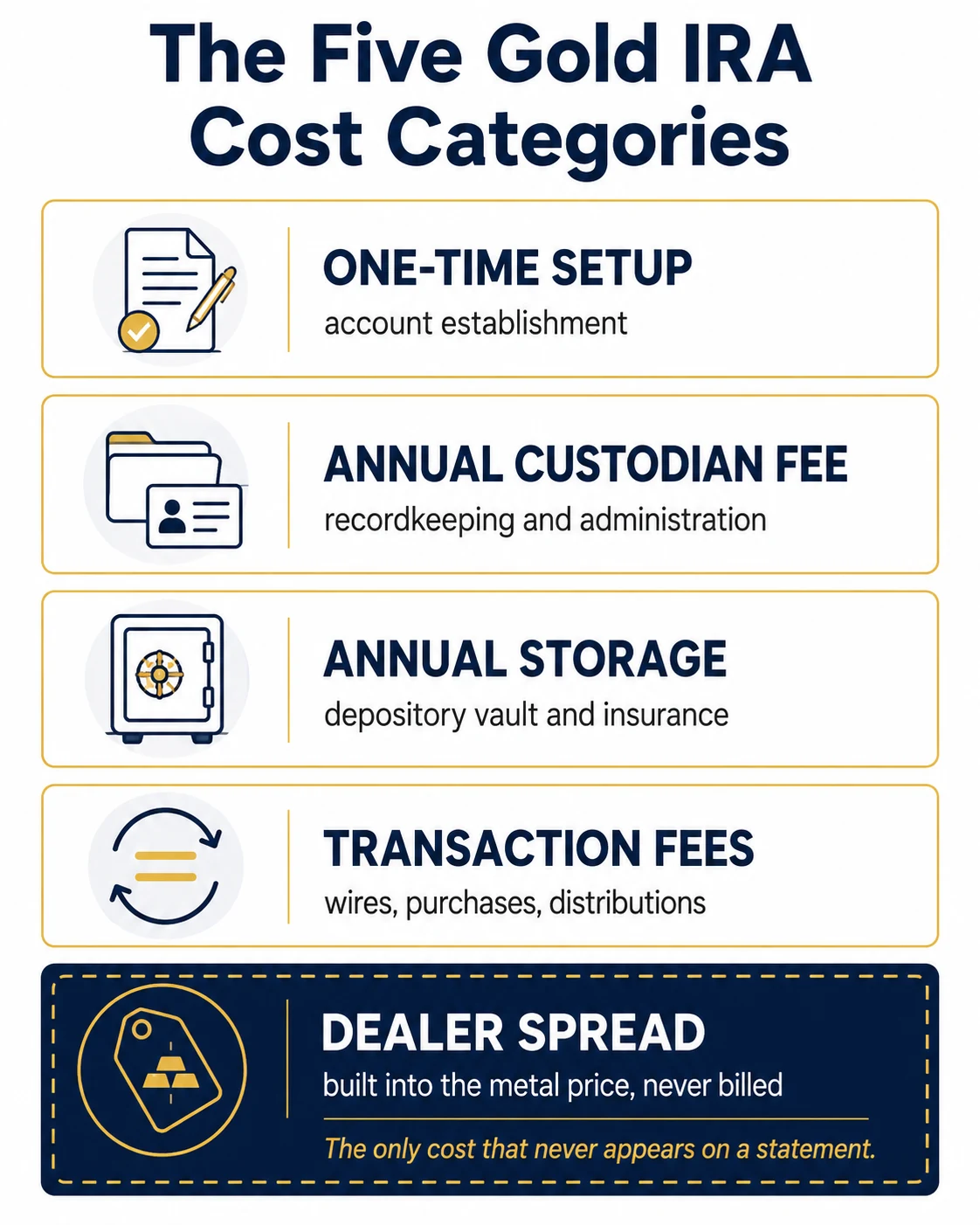
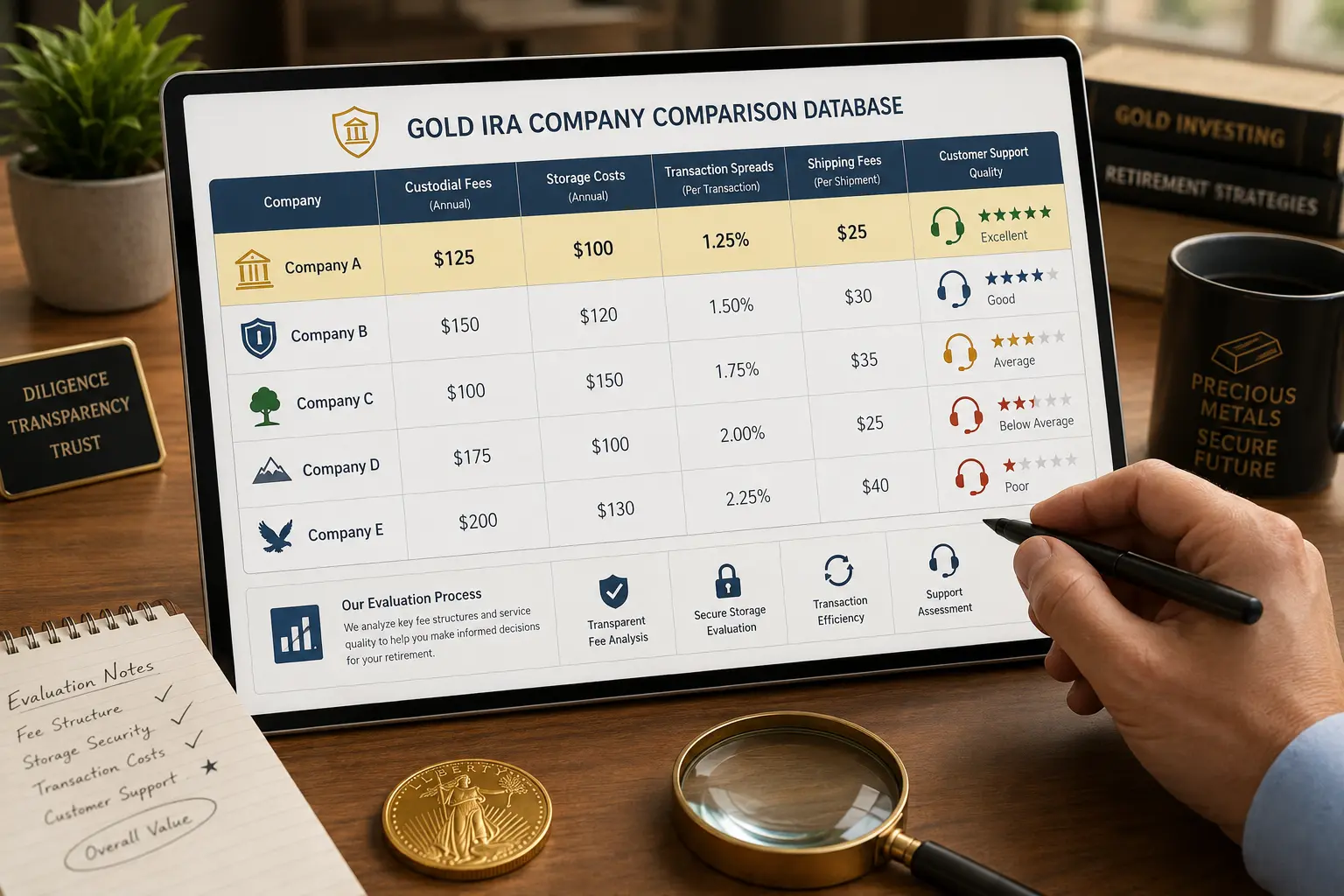
Because there is no centralized public database capturing all silver IRA costs, it is important to obtain written fee disclosures from custodians, depositories, and dealers. Typical categories to clarify include:
- Account setup fees — one-time charges by the self-directed IRA custodian to open the account and handle initial paperwork.
- Custodian maintenance fees — annual fees for recordkeeping, statements, regulatory reporting, and ongoing administration.
- Storage fees and insurance costs — charges by the depository for storing and insuring IRA-owned silver, which may be flat, value-based, or influenced by weight and storage type (segregated vs. commingled).
- Dealer premiums and spreads — the premium over spot for approved silver bullion and the dealer's buyback price, which together determine the round-trip spread; actual levels vary and must be confirmed directly with each dealer.
- Buyback and liquidation terms — any fees, minimums, or conditions associated with selling silver back to the dealer or liquidating through the custodian, including possible shipping or handling charges for an in-kind distribution.
Clarifying these costs in advance helps evaluate whether a silver allocation's expected diversification benefits justify the long-term fee drag, especially when comparing silver vs. gold IRA cost structures. The silver IRA calculator, silver vs. gold cost guide, gold IRA calculator, and storage guide can assist in modeling these variables.
Frequently Asked Questions
What is the IRS fineness requirement for silver in an IRA?
Internal Revenue Code section 408(m)(3) provides a narrow exception allowing certain coins and bullion to be held in an IRA if they meet contract-market fineness standards and are held in the physical possession of a trustee. Industry and legal summaries interpret this to mean IRA-eligible silver bullion must generally be at least .999 fine silver, consistent with major futures exchanges' delivery standards.
Can IRA-owned silver be stored at home?
No. IRS guidance on investments in collectibles and section 408(m) requires that qualifying bullion be held in the physical possession of a trustee, such as a bank or IRS-approved non-bank trustee. Home storage or personal possession of IRA-owned metals can be treated as a taxable distribution and may trigger income tax and early-withdrawal penalties.
How does silver price volatility compare with gold?
Market commentary from institutions such as iShares notes that over the past 20 years, silver's annualized volatility has been up to roughly twice that of gold, reflecting silver's more cyclical and industrially driven demand. Gold tends to behave as a comparatively more stable store of value, while silver's dual monetary and industrial role leads to larger swings.
Do silver IRAs produce income?
No. Physical silver in an IRA does not generate interest, dividends, or rental income; its return depends on price changes between purchase and sale or distribution. Metals are typically held for diversification and potential capital appreciation, not for ongoing cash flow.
What are the main silver IRA storage fees?
Custodian and depository schedules typically list annual storage fees and insurance charges that vary with account size, storage type, and provider. Third-party explainers describe fees in broad ranges but emphasize that costs differ meaningfully between institutions, and there is no reliable public database summarizing silver IRA storage fees across all providers.
Are silver IRAs risk-free?
No. The SEC and Investor.gov caution that self-directed IRAs with alternative assets, including precious metals, carry risks such as volatility, illiquidity, high fees, and elevated fraud exposure. Investors should be skeptical of any claim of high returns with little or no risk and should conduct thorough due diligence on custodians, depositories, and promoters.
Conclusion
A silver IRA offers real advantages — diversification, a lower entry price, and exposure to a metal with genuine industrial demand — but they come paired with equally real drawbacks: higher volatility than gold, a heavier storage cost-drag from silver's low value-density, wider dealer spreads, no income, and the operational complexity of a self-directed account. The honest conclusion is that silver belongs in the decision as one option to weigh proportionately, not as a default. Benefits, costs, liquidity, and account rules should be reviewed together, in writing, and within a broader retirement plan. Customers should speak to a financial or tax advisor before deciding. Goldco does not offer tax or legal advice.
Sources
- Internal Revenue Service. Investments in Collectibles in Individually Directed Qualified Plan Accounts.
- Internal Revenue Service. Publication 590-A (Contributions to IRAs).
- Cornell Law School, Legal Information Institute. 26 U.S.C. §408 (Individual Retirement Accounts).
- Investor.gov (U.S. SEC). Self-Directed IRAs and the Risk of Fraud.
- Oregon Division of Financial Regulation. Risks of Self-Directed IRAs.
- The Silver Institute. Global Industrial Demand On Track for a New Record High (industry body).
- Sprott. Silver's Strength and Industrial Demand.
- iShares (BlackRock). Gold and Silver: Investing in Precious Metals (volatility commentary).
- World Gold Council. The Relevance of Gold as a Strategic Asset (industry body).
Article reviewed and edited by Daniel M. — editor, 401kToGoldIRA.org. A balanced decision guide sourced to the IRS, Cornell Law, the SEC/Investor.gov, the Oregon Division of Financial Regulation, the Silver Institute, Sprott, iShares, and the World Gold Council (industry sources flagged); educational only, not financial, tax, or legal advice.