Educational only: This article is general educational information about gold's role in retirement decumulation. It is not financial, tax, legal, investment, insurance, or retirement-planning advice. Gold prices, interest rates, costs, tax rules, and retirement needs can change. Customers should speak to a financial or tax advisor before making decisions. Goldco does not offer tax or legal advice. Past performance does not guarantee future results.
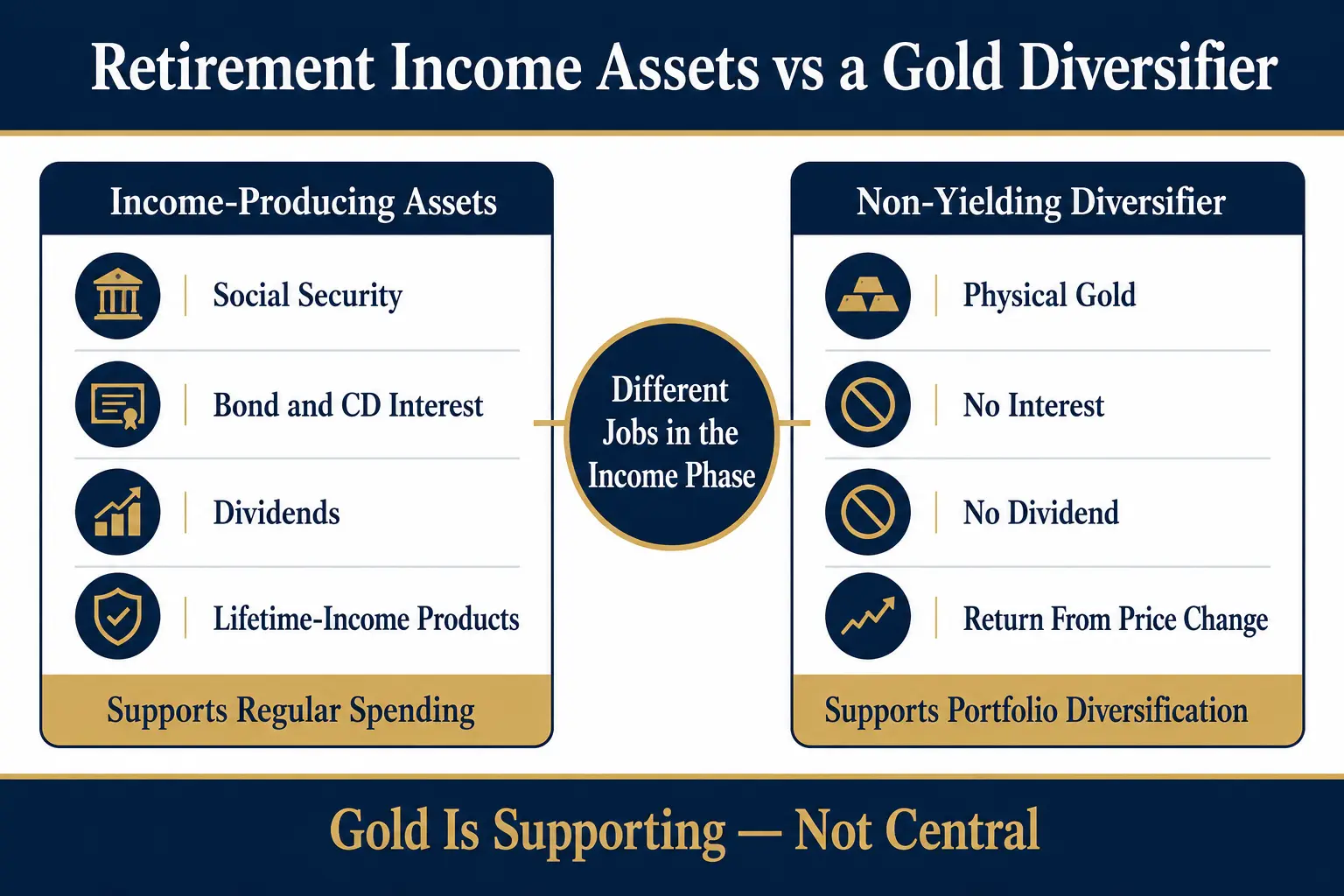
Physical gold provides no regular cash flow — holders depend entirely on price appreciation to benefit. In a phase that needs income, that makes gold a diversifier, not a paycheck.
Source: World Gold Council (an industry body), which promotes the gold market yet still confirms gold pays no cash flow. Any return depends on price change after costs.
Key takeaways
- Gold provides no income — its income-phase role is diversification and possible rebalancing, never a paycheck.
- Income comes from other assets: Social Security, pensions, bond and CD interest, dividends, and lifetime-income products.
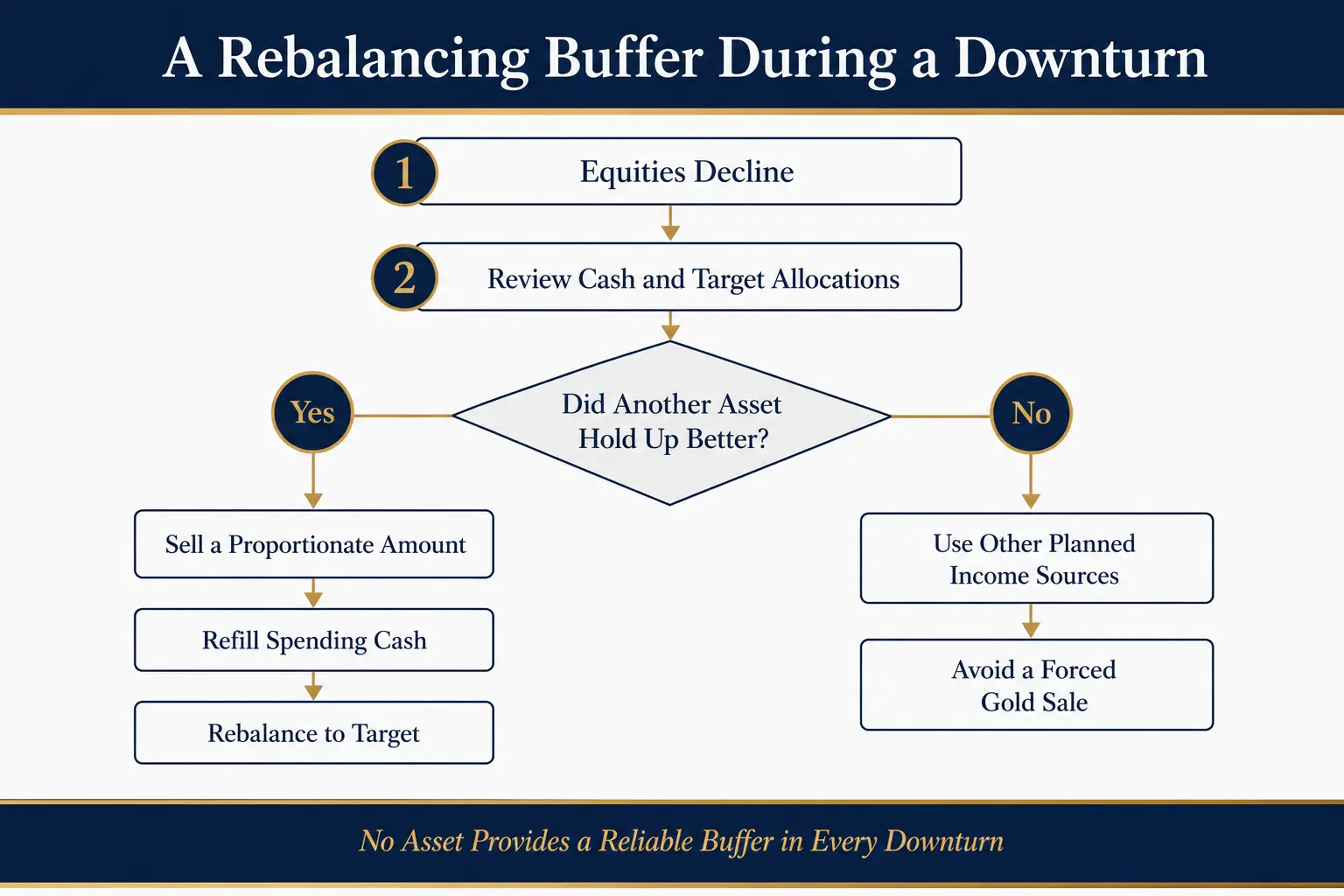
- Gold may act as a rebalancing buffer only when it has held up better than the assets being protected and can be sold at a reasonable cost.
- Don't sell gold automatically in a downturn — a gold position that fell alongside stocks provides no useful buffer.
- Keep the allocation modest so monthly income never depends on regular gold sales; build the income plan first.
Quick answer: Gold can have a limited role in decumulation when it remains proportionate, liquid enough for the plan, and part of a written rebalancing system. It should not be counted as income. Any return depends on price appreciation after dealer spreads, custodian charges, storage, and selling costs. The honest framework is simple: income-producing assets help pay bills directly, cash and short-term assets support near-term spending, growth assets help fund later years, and gold may serve as one supporting diversifier. No single asset removes sequence risk, inflation risk, market risk, or longevity risk.
What Is Gold's Honest Role During the Retirement Income Phase?
A gold IRA during the retirement income phase is not a paycheck. Physical gold pays no interest, produces no dividend, and does not create regular cash flow — its possible role is narrower: a modest diversifier beside assets that actually fund retirement spending. Once employment income stops, a portfolio must do several jobs at the same time: provide cash for current expenses, keep enough liquid assets for near-term needs, support spending over many years, and manage market risk. Gold can sometimes support those goals indirectly, as one portfolio diversifier, a potential store of value, or an asset that can be rebalanced when it has held up better than other holdings. It cannot replace Social Security, bond interest, CD interest, dividends, pension income, or a lifetime-income product.
What Is the Retirement Income Phase?
The retirement income phase is the period when accumulated savings begin supporting regular spending. It is also called decumulation. During the working years, cash usually moves into retirement accounts; during decumulation, cash begins moving out. That change makes income planning more important than account value alone, because a portfolio can show a large balance and still struggle to fund spending if most assets are volatile, illiquid, or non-yielding. Common retirement income sources include Social Security benefits, pension payments, interest from bonds, CDs, and certain cash products, stock or fund dividends, periodic payments from lifetime-income products, and withdrawals from taxable and retirement accounts.
The Social Security Administration states that eligible workers can typically receive monthly retirement benefits beginning at age 62, with amounts depending on work history and claiming age (Social Security Administration). TreasuryDirect states that Treasury notes and bonds pay interest every six months until maturity, and that Treasury bills generate interest through the difference between the discounted purchase price and the amount paid at maturity (U.S. Department of the Treasury, TreasuryDirect). The FDIC explains that a CD normally pays interest in exchange for leaving money on deposit for a stated term, with early withdrawal reducing interest or creating a penalty (Federal Deposit Insurance Corporation). Investor.gov explains that bonds can pay interest, stocks may pay dividends, and annuity contracts can provide periodic income payments under their terms, with costs and risks that vary by product (Investor.gov; Investor.gov). Gold does none of those things by itself. The site's retirement portfolio longevity guide covers withdrawal-rate and portfolio-duration questions in more detail; this article focuses only on where a non-yielding metal may fit beside the income system.
Does a Gold IRA Produce Retirement Income?
No. Physical gold does not create income simply because it sits inside an IRA. The World Gold Council, an industry body funded by the gold industry, states that gold does not provide regular cash flow and that holders depend on price appreciation to benefit (World Gold Council, an industry body). A Gold IRA is an account structure, and the metal inside it remains a non-yielding asset that pays no interest, dividends, bond coupons, rent, business earnings, or scheduled lifetime payments. If gold rises in value, the account may show an unrealized gain — but that gain does not become retirement cash until the metal is sold or distributed. If gold falls, the account value can decline, and storage and administration costs continue even when the metal price is flat or lower.
During accumulation, a saver may hold a non-yielding asset for years without needing it to pay expenses. During retirement, regular bills continue — housing, food, insurance, health care, taxes, and transportation require cash. A portfolio holding too much gold may need frequent sales to create spending money, and each sale can involve a dealer bid, a spread, custodian instructions, depository processing, and settlement time. FINRA and the CFTC explain that dealers generally sell physical metal above spot and buy it back below spot, and advise customers to obtain all fees, prices, and buyback terms in writing (FINRA and Commodity Futures Trading Commission). That makes gold less suitable as the main source for monthly retirement income. The site's cash-from-Gold-IRA guide explains the mechanics of turning IRA metal into cash, and the Gold IRA strategy after age 73 covers later-life account planning. Customers should speak to a financial or tax advisor before making decisions about withdrawals, distributions, or IRA assets. Goldco does not offer tax or legal advice.
What Actually Generates Retirement Income?
A retirement income plan usually combines several sources rather than depending on one asset. Social Security provides a monthly benefit to eligible workers and may also provide family or survivor benefits; the SSA states that retirement benefits can typically begin at age 62 for workers with sufficient covered employment, with the amount changing by claiming age and earnings history (Social Security Administration). Social Security differs from gold because it creates a scheduled monthly payment; gold creates none. Bonds and CDs have contractual payment terms — Treasury notes and bonds pay interest every six months, and a CD pays interest under the bank's deposit agreement for a stated term (TreasuryDirect; Federal Deposit Insurance Corporation). Bonds can still lose market value before maturity and CDs may impose early-withdrawal penalties, but the distinction holds: bonds and CDs can produce income, while physical gold does not.
Dividends are a portion of company profit paid to shareholders; Investor.gov also explains that income-focused funds may hold bonds that pay interest or securities that pay dividends (Investor.gov; Investor.gov). Dividends can be reduced or stopped and do not remove stock-price risk, but dividend-paying assets have an income mechanism gold lacks. Lifetime-income products such as annuities are contracts with an insurance company: Investor.gov states the insurer may agree to make periodic income payments immediately or in the future, with costs, surrender charges, risks, and features that vary, and obligations that depend on the insurer's financial strength and claims-paying ability (Investor.gov). These products may address part of the risk of outliving assets but can reduce liquidity or add complexity. Gold cannot provide the same contractual income function.
Can Gold Act as a Rebalancing Buffer During a Downturn?
Possibly, but only under specific conditions. Sequence-of-returns risk occurs when poor market returns arrive early in retirement while withdrawals are beginning. The Center for Retirement Research at Boston College explains that early negative returns can cause more damage because the portfolio is reduced by both market losses and spending withdrawals, leaving less capital to participate in a later recovery (Center for Retirement Research at Boston College). A common response is to avoid selling the most damaged asset when another planned source of cash is available. The Center for Retirement Research has discussed the value of a nonvolatile buffer asset during periods when selling stocks would be especially costly, using bonds and housing wealth as examples, not gold (Center for Retirement Research at Boston College).
Gold can serve a similar rebalancing function only when it has held up better than the assets being protected — that is an inference from rebalancing principles and gold's historical correlation pattern, not a promise that gold will rise during every stock decline. Investor.gov explains that diversification can reduce dependence on one market segment but cannot prevent all losses (Investor.gov). The World Gold Council, an industry body, reports that gold has historically behaved differently from equities and that its correlation can become more negative during some equity selloffs, while also acknowledging that gold can be volatile and can post large annual losses (World Gold Council, an industry body; World Gold Council, an industry body).
A written buffer process may work like this: the portfolio sets target ranges for stocks, bonds, cash, and any gold position; spending initially comes from Social Security, pension income, interest, dividends, and the cash reserve; after a stock decline, the retiree reviews which assets remain above target or held their value better; a partial sale from the stronger asset may refill cash or restore the intended allocation; and the remaining portfolio is reviewed after the transaction. Gold should not be sold automatically whenever stocks fall — only when the position is available, liquid, above target, or better suited to the withdrawal than another asset. A gold position that fell at the same time as stocks may provide no useful buffer, and a large dealer spread can make a physical-gold sale less attractive than using cash, maturing bonds, or another liquid holding.
How Large a Role Should Gold Play in Decumulation?
No universal percentage applies to every retiree. Rebalancing is occasional; income is recurring. A gold sale may provide cash once or periodically, but that does not make the gold an income-producing asset — the transaction simply converts part of the asset into cash, and repeated sales reduce the number of ounces remaining. Interest and dividends can create cash without requiring the same units to be sold, although the value and payment level can still change. A modest gold allocation means the position is small enough that retirement income does not depend on regular gold sales, and large enough to have a meaningful portfolio role if the plan includes it.
The decision should consider Social Security and pension income, essential spending, cash and short-term reserves, bond and CD income, stock exposure, expected withdrawals, Gold IRA fees, dealer spreads and liquidity, time horizon, and estate goals. A retiree with strong pension income and a large liquid portfolio may have more room for a non-yielding diversifier than someone whose IRA must fund most monthly expenses, while a retiree with a small account and high fixed Gold IRA fees may find the position's costs too large relative to its value. The site's retirement gold-allocation guide covers allocation questions in more detail without assigning one percentage to every household, and the Gold IRA decision quiz is an educational account-structure tool, not an allocation recommendation. Customers should speak to a financial or tax advisor before changing an allocation or withdrawal plan.
What Are the Trade-Offs of Holding Gold During the Income Phase?
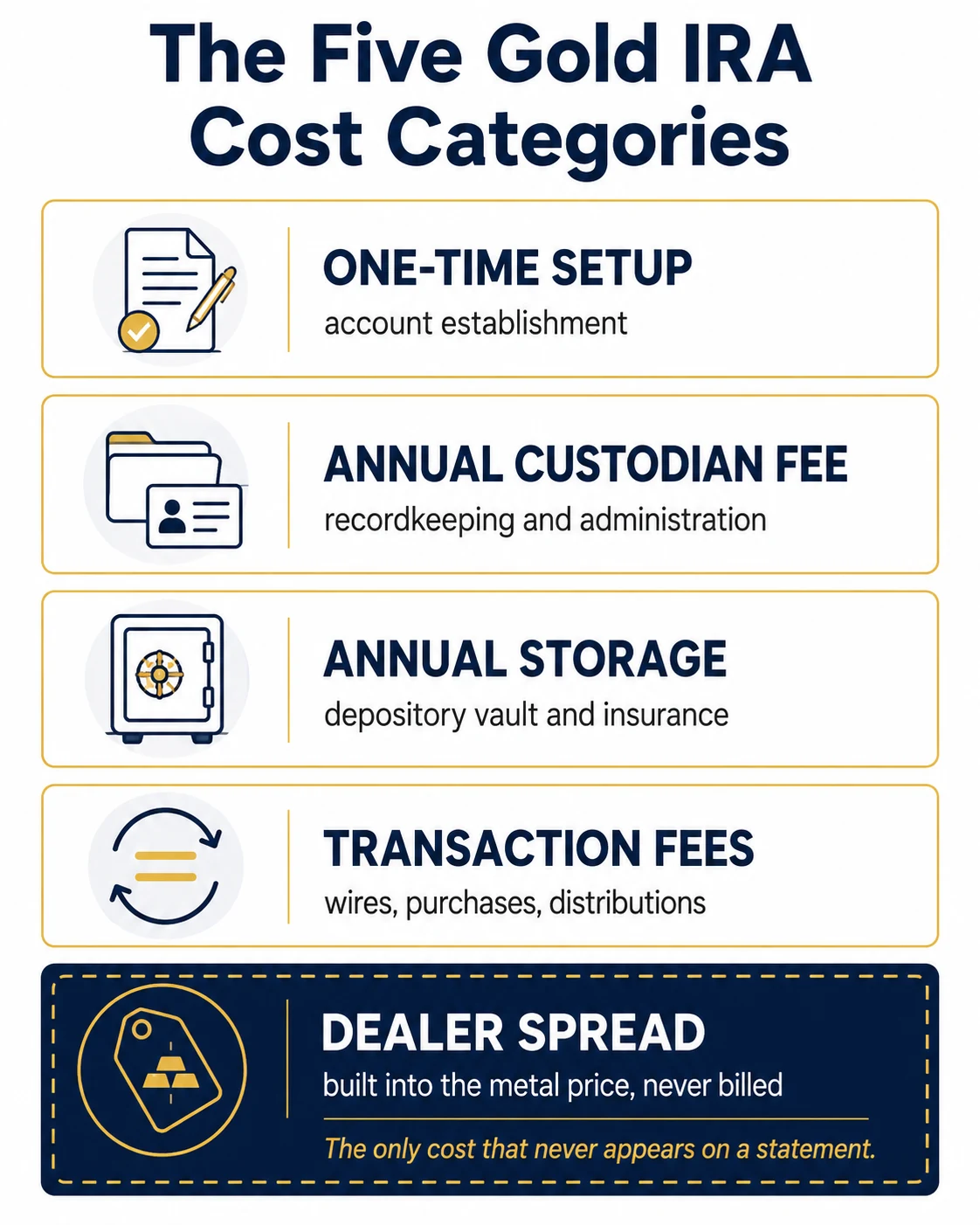
Gold has potential supporting uses, but the disadvantages become especially important during decumulation. On the income trade-off, gold creates no regular cash flow, so every dollar allocated to gold is a dollar not held in an interest-bearing, dividend-paying, or scheduled-income asset — an opportunity cost that becomes more visible when bond, CD, and cash yields are higher. On fees, a physical Gold IRA may charge a dealer spread or markup, custodian administration, depository storage, insurance or handling, transaction fees, shipping or distribution costs, and account-closing charges; FINRA and the CFTC advise obtaining every cost in writing and calculating how much the metal must rise to break even (FINRA; FINRA and Commodity Futures Trading Commission).
On price risk, FINRA states that precious-metals prices can fluctuate and may be volatile, so a retiree who needs cash during a gold decline may be forced to sell at an unfavorable price (FINRA). On liquidity, physical metal requires a buyer, a written bid, custodian instructions, and settlement, and bullion is generally more liquid than collectible or so-called semi-numismatic products (FINRA and Commodity Futures Trading Commission) — a less direct process than withdrawing existing cash. On custody, the IRS states that qualifying bullion must be held in physical possession by a bank or approved nonbank trustee, which limits personal access while the asset remains inside the IRA (Internal Revenue Service). On diversification, a gold position may reduce dependence on stocks and bonds in some periods and underperform both for long stretches — correlation is not fixed, and diversification is a portfolio characteristic, not a promise that one asset will always rise when another falls. The site's retirement purchasing-power guide explains how inflation and real spending power affect decumulation beyond gold alone.
What Practical Framework Can Define Gold's Income-Phase Role?
A retiree can separate the retirement plan into four layers. Layer 1: contractual or scheduled income may include Social Security, pension payments, bond interest, CD interest, and periodic payments from lifetime-income products. Layer 2: near-term liquidity holds cash and short-term assets for current expenses and emergencies. Layer 3: long-term growth may include diversified stock exposure and other growth assets for later retirement years. Layer 4: supporting diversifiers may include a proportionate gold position or other assets with different return drivers. Gold belongs in the fourth layer, not the first.
A written policy should state the purpose of the gold position, the target allocation range, the maximum acceptable annual cost, the conditions for rebalancing, the liquidity needed before a sale, and the estate or beneficiary plan. The plan should be reviewed when spending, health, taxes, income sources, or family needs change. Without those rules, a buffer can become informal market timing.
What Are Common Questions About Gold During Retirement Decumulation?
Does a Gold IRA pay retirement income?
No. Physical gold pays no interest or dividend. Cash is created only after a sale or distribution.
Can gold replace bonds in an income portfolio?
Not directly. Bonds can pay contractual interest. Gold does not. A limited gold position may provide diversification, but it does not perform the same income function.
Can gold reduce sequence-of-returns risk?
It may help only when it holds up better than the assets being protected and can be sold at a reasonable cost. It cannot remove sequence risk, and gold may decline during the same period as stocks.
Should gold be sold during a stock-market downturn?
Not automatically. A sale should follow the portfolio's target ranges, spending needs, dealer bid, and written rebalancing rules.
Can Gold IRA storage fees reduce retirement income?
Yes. Storage, administration, spreads, and transaction costs reduce the resources available for future spending.
Is a larger gold allocation safer during retirement?
Not as a universal rule. A larger allocation creates more exposure to a non-yielding and potentially volatile asset. The suitable role depends on the full retirement plan.
Bottom Line
A Gold IRA can have a supporting role during the retirement income phase, but it is not an income source. Its possible value comes from diversification, a potential store-of-value role, and occasional rebalancing when it has held up better than other assets. Its limits are equally important: no interest, no dividend, ongoing fees, dealer spreads, price risk, and a slower path to cash than ordinary liquid assets. The income plan should be built first, and a modest gold position can then be judged by whether it supports that plan without weakening liquidity or regular cash flow.
Sources
- Social Security Administration. Retirement benefits.
- U.S. Department of the Treasury, TreasuryDirect. Glossary of terms (Treasury notes, bonds, bills).
- Federal Deposit Insurance Corporation. Shopping for a certificate of deposit.
- Investor.gov (U.S. SEC). Income funds · Annuities · Dividend · Introduction to investing / diversification.
- Center for Retirement Research at Boston College. Retirees get a 401(k) withdrawal headache · Boomers facing tough financial decisions.
- Internal Revenue Service. Investments in collectibles.
- FINRA. Physical precious metals · Buying physical gold or other metals (with the CFTC).
- World Gold Council (an industry body). Risks and challenges · Key attributes: diversification.
Reviewed and edited by Daniel M. — editor, 401kToGoldIRA.org. Educational only; sourced to the Social Security Administration, TreasuryDirect, the FDIC, Investor.gov (SEC), the Center for Retirement Research at Boston College, the IRS, the CFTC/FINRA, and the World Gold Council (flagged as an industry body). Not financial, tax, or investment advice.