
Educational only: This reference explains annual fair market value reporting for self-directed IRAs using published statutes, Treasury regulations, IRS form instructions and named custodian documents. It does not recommend a custodian, appraiser, valuation service or asset, and it is not financial, tax or legal advice. Account owners should consult a qualified tax professional or attorney who can review their actual custodial agreement and asset facts. Named custodian policies are evidence of that custodian's practice on the document date given, not of any federal requirement.
What Is Reported, and on Which Form
Form 5498 Box 5 reports the fair market value of the IRA at the end of the calendar year. For tax year 2026 the instruction is direct: enter the FMV of the account on 31 December 2026.
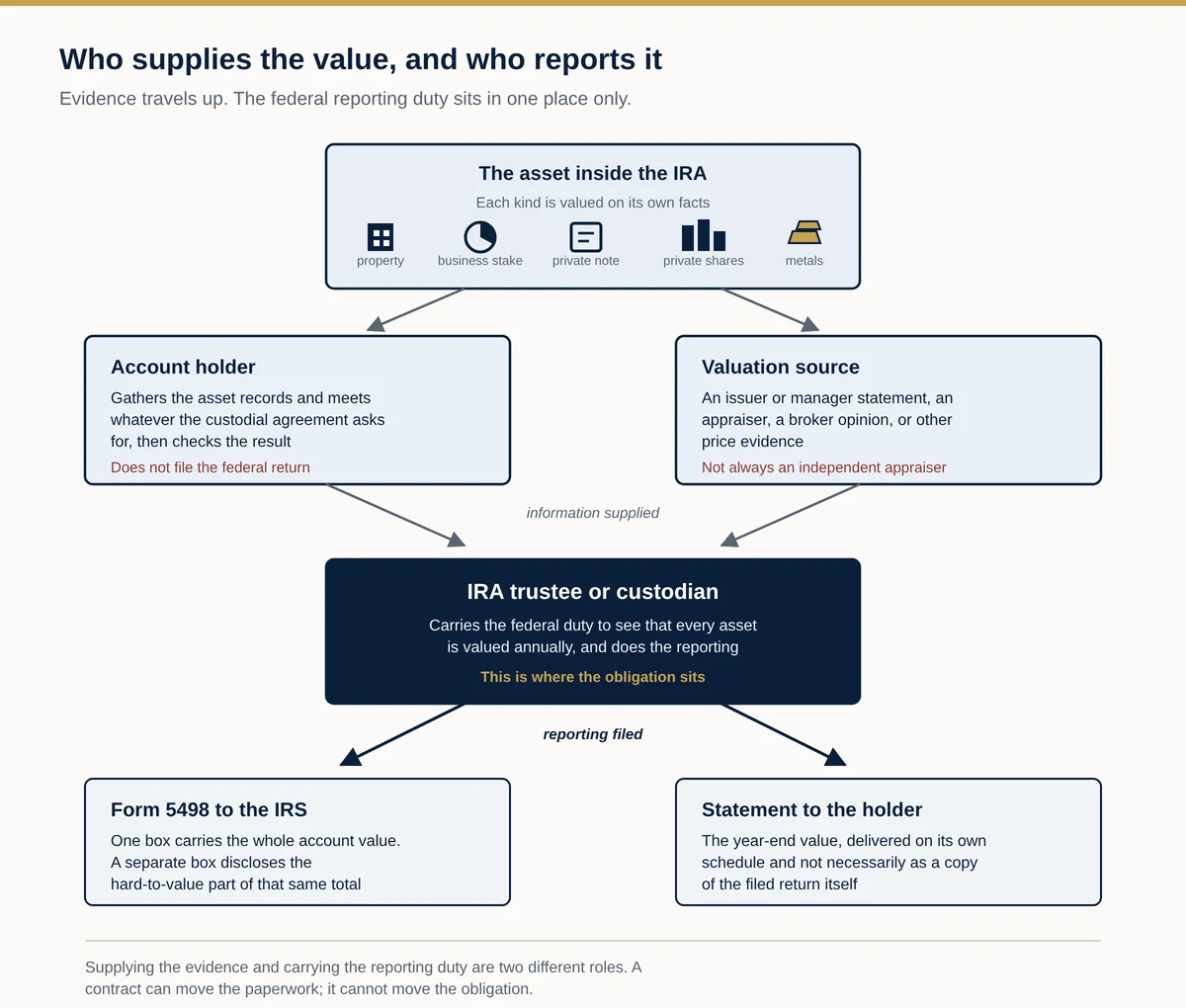
Two further boxes handle assets that are harder to price. Box 15a discloses the FMV of specified hard-to-value categories, and Box 15b carries the code identifying which category applies.
The relationship between them is the detail most often got wrong. Box 15a is a component of the Box 5 total, not an additional amount added to it. A hard-to-value asset is counted once.
One Form 5498 ordinarily reports all investments under a single IRA plan rather than one form per investment. Separate IRA plans under the same trustee are reported separately.
Who Carries the Reporting Duty
The trustee or custodian does. The 2026 instructions state that trustees and custodians are responsible for ensuring that all IRA assets, including those not traded on established markets or lacking a readily determinable market value, are valued annually at their fair market value.
Under IRC §408(i) the trustee carries the information-reporting duty, and §408(h) addresses treatment of a qualifying custodian as trustee.
In practice the account holder usually does much of the work. A custodial agreement commonly obliges the holder to coordinate supporting evidence, valuation forms, manager or issuer statements, and appraisals where the contract requires them.
Supplying the evidence and carrying the reporting duty are two different roles. A contract can move the paperwork; it cannot move the federal obligation to the account holder.
One named example shows how far a contract can go. Schwab's October 2026 IRA agreement, at section 36, requires the holder to provide annual instructions by 15 January concerning assets without a readily ascertainable FMV as of the preceding 31 December, and allows Schwab to request and charge for an outside appraisal if they are not provided.
That 15 January date is a contractual deadline at one custodian. It is not an IRS-wide cutoff, and reading it as one would misstate the federal position.
Measurement Date and Deadlines
The measurement date is fixed by federal rule; the surrounding deadlines are a mix of printed dates and calculated adjustments.
| Item | Date (tax year 2026) | Register |
|---|---|---|
| FMV measurement | 31 December 2026 | Federal, Box 5 instruction |
| FMV and RMD statement to participant | 1 February 2027 | Federal, statements to participants |
| Printed Form 5498 filing deadline | 31 May 2027 | Federal, as printed |
| Calculated timely filing date | 1 June 2027 | Applying the next-business-day convention, because 31 May 2027 is Memorial Day |
A custodian can impose an earlier internal deadline for paperwork or appraisals, and many do. It cannot change the federal 31 December measurement date by contract.
The holder must receive the applicable annual FMV statement and the relevant RMD and hard-to-value information. Where a custodian has already furnished the required year-end statement and no reportable contributions or conversions were made, the instructions say it need not provide a further statement showing zero contributions, though Form 5498 is still filed with the IRS.
So the account holder does not necessarily receive a mailed paper copy of the exact filed form. Delivery format, portal presentation and statement layout vary by custodian and are not federally standardised.
What Happens If It Is Wrong
IRC §6693(a) specifies 50 dollars for each failure to make a required report at the required time and in the required manner, unless reasonable cause is shown.
That figure is an information-reporting penalty, and it is worth keeping separate from two other things it is often confused with: the RMD shortfall excise tax under §4974, and prohibited-transaction excise taxes under §4975. They arise from different conduct.
Where a previously filed Form 5498 is found to contain an error, the IRS instruction is to correct it as soon as possible.
What is not established is any fixed IRS percentage tolerance for a genuine valuation disagreement, or a guaranteed exemption because an appraisal was believed reasonable.
Hard-to-Value Assets
Box 15b uses letter codes to identify the category of a hard-to-value holding. These are reporting categories, not IRS-prescribed valuation methods, and that distinction matters more than the codes themselves.
| Code | Category |
|---|---|
| A | Stock or corporate interest not readily tradable |
| B | Short or long-term debt obligation not traded on an established securities market |
| C | Ownership interest in an LLC or similar entity |
| D | Real estate |
| E | Partnership, trust or similar entity interest |
| F | Option or similar contract not exchange-traded |
| G | Other asset without a readily available FMV |
| H | More than two of categories A through G |
| Codes identify what the asset is. They do not prescribe how to value it. | |
IRA-owned LLC interests, including checkbook-control structures
The asset being valued is the IRA's membership interest in the LLC, under code C. Checkbook control does not remove the trustee or custodian's reporting duty, and our separate reference on checkbook-control IRA LLCs covers what that structure does and does not change.
The common error is substitution. The LLC's bank balance, the original investment cost, and the gross market value of the LLC's underlying assets are each not automatically the FMV of the IRA's equity interest in it.
Debt, ownership rights, transfer restrictions and updated asset performance can all move that interest's value away from any of those simpler numbers.
Custodian practice varies. Depending on the agreement, a holder may be asked for LLC financial statements, asset and liability schedules, manager or issuer certifications, transaction records and an outside valuation.
Real estate held directly by the IRA
Annual FMV applies, under code D. A defensible valuation may need location, physical condition, liens, rents, leases, comparables and occupancy, because a property is not a single fungible unit.
One custodian's June 2018 disclosure refers to an updated property appraisal or a broker's price opinion, annually or at such other intervals as it requires. That is a named custody policy offering a choice of document, not a federal rule mandating either one.
Not established: any universal Form 5498 requirement for a new state-licensed-appraiser report every year, or any blanket approval of a property-tax assessment as FMV.
Private notes and loans
Annual FMV applies, under code B. Payment performance, default, credit risk, collateral, maturity and prospects of collection can all bear on what the note is actually worth.
The same custodian's 2018 policy describes possible use of cost, face amount or amortisation information, and a potential independent valuation where the debt is in default. Notably, it does not make the principal balance equal FMV in all circumstances.
Not established: a universal annual discounted-cash-flow formula, a mandate to write a defaulted note down to zero, or a qualified-appraisal rule reaching every private note.
Private equity and closely held shares
Annual FMV applies, under code A for qualifying nontraded corporate stock, code E for partnership or trust interests, and code C for LLC interests. Information typically comes from issuer or management statements and periodic business valuations.
One custodian's financial disclosure references Revenue Ruling 59-60 as an approach that may be required in a particular valuation. Treat that as evidence of the custodian's reference to the ruling, not as proof that Form 5498 imposes a single mandatory annual method for every private holding. The original ruling text was not independently verified in this research pass.
Not established: a mandated earnings multiple, discount rate, lack-of-marketability discount, annual certified appraiser, or any consistent federal cost-to-FMV conversion rule across privately held companies.
Precious Metals and the Spot Question
IRA precious metals form part of the Box 5 year-end total. Where a holding falls within a specified hard-to-value category the 15a and 15b boxes apply, but widely traded bullion should not be automatically classified under the residual code G.
IRC §408(m)(3) prescribes which coins and bullion escape collectible treatment and requires trustee possession for qualifying bullion, which our eligibility reference covers in detail. It does not specify a market-quotation source or reporting vendor.
One custodian's November 2025 precious-metals instructions state that value reflects spot price multiplied by fine metal ounces, while expressly noting that the figure excludes markups, markdowns, premiums and commissions and is not a firm bid price.
That candour is useful, because four different numbers get casually treated as one.
| Term | What it actually is |
|---|---|
| Spot reference | A quotation for the underlying metal, often a reference rather than an executable price for a specific product |
| Dealer bid | A dealer's current offer to buy a specified product under specified conditions |
| Dealer ask | A dealer's selling price, which may include product premium and fees |
| Liquidation proceeds | What a sale actually yields after that transaction's terms and charges |
| Reported FMV | The custodian's tax-reporting value under its own valuation policy and available evidence |
Bid and spot can differ without either being improper. Context decides, and a difference is not itself evidence of a bad valuation.
Not established: that all custodians must value bullion at spot, that the IRS selects a spot vendor, that dealer wholesale bid is required instead, or that an insured depository must independently appraise each coin and bar annually.
When an Appraisal Is Actually Required
This is the question the page exists to answer, so it is worth stating without hedging.
A categorical independent-appraisal obligation for every annual Form 5498 FMV was not established from the reviewed federal guidance. An annual value is mandated. An annual independent appraisal of all assets is not.
Custodians may nonetheless impose asset-specific appraisal requirements by contract, and may require an appraisal to process an in-kind distribution. Those are real obligations for that account, enforceable by the agreement rather than by the Code.
One common error is importing appraisal standards from a different tax event. IRS Publication 561, issued December 2025, addresses donated property and the qualified-appraisal standards that apply to charitable deductions.
It does not convert every IRA property valuation into a charitable-appraisal case. Distribution, conversion and audit circumstances can each carry their own distinct valuation expectations.
Frequency follows the same split. FMV reporting is annual; how often a formal appraisal, issuer letter, broker opinion or sponsor update must be refreshed is asset-dependent and custodian-dependent.
What to Keep on File
No published federal automatic-acceptance safe harbour for an annual IRA FMV file was found. IRC §6001 and 26 CFR §1.6001-1 support retaining records adequate to substantiate a reporting position, but they do not prescribe a specific checklist.
What follows is therefore a practical documentation protocol, not a guarantee of IRS acceptance:
- Asset identity and the IRA's legal ownership or fractional interest.
- A clearly dated 31 December measurement, and any different transaction-date measurements.
- The author of the valuation, their relationship to you, and their competence.
- Underlying financials, market data, collateral details, property information or physical inventory.
- Methodology, assumptions, any discounts applied, debt, and material limitations.
- Evidence of impairments, defaults, vacancies, restricted interests or other intervening changes.
- The statement or appraisal actually transmitted to the custodian, with its date of receipt.
- The custodian's year-end account statement and the corresponding Form 5498 reporting.
- A correction trail, if the reported number later changes.
None of this is a universal nine-document IRS requirement, and keeping it does not prevent an adjustment. It is simply the evidence a reader would want to hold if a reported figure were ever questioned.
Failure modes worth avoiding
| Failure mode | Why it is a problem | What is not established |
|---|---|---|
| Stale carrying value | Repeats an earlier figure after an economic change; the IRS instructs prompt correction once discovered | No safe-harbour carry-forward rule identified |
| Purchase cost used as current FMV | Cost and current value are different things, with downstream RMD and conversion effects | No federal rule that cost equals FMV |
| Self-valued LLC interest | Incomplete data and lack of independence; a custodian may demand more evidence | Not a per se §4975 prohibited transaction simply for preparing a value |
| Related-party valuation | Invites scrutiny, and an actual self-dealing transaction may trigger §4975 | Related-party preparation alone does not prove a §4975 transaction |
| Defaulted note carried at par | Ignores uncertain repayment and likely overstates value | Automatic zero value on default is not established |
| Metals held at old purchase cost | Treats a historic dealer premium as current market value | No universal IRS bid-or-spot method established |
How the Value Feeds RMDs
For an IRA subject to required minimum distributions, the annual calculation uses the previous 31 December account balance and an applicable life-expectancy divisor, subject to regulatory adjustments.
So the 31 December 2026 value generally drives a 2027 traditional IRA RMD. The valuation and the distribution are a year apart, which is why an inaccurate figure does not stay contained to one filing.
Illiquidity does not waive the requirement. Depending on the custodian's mechanics and the applicable rules, a holder may need cash from a liquidation, a valid in-kind distribution, or eligible aggregation of distributions across other traditional IRAs.
The aggregation rules for qualified employer plans are different and must not be carried over to IRAs automatically.
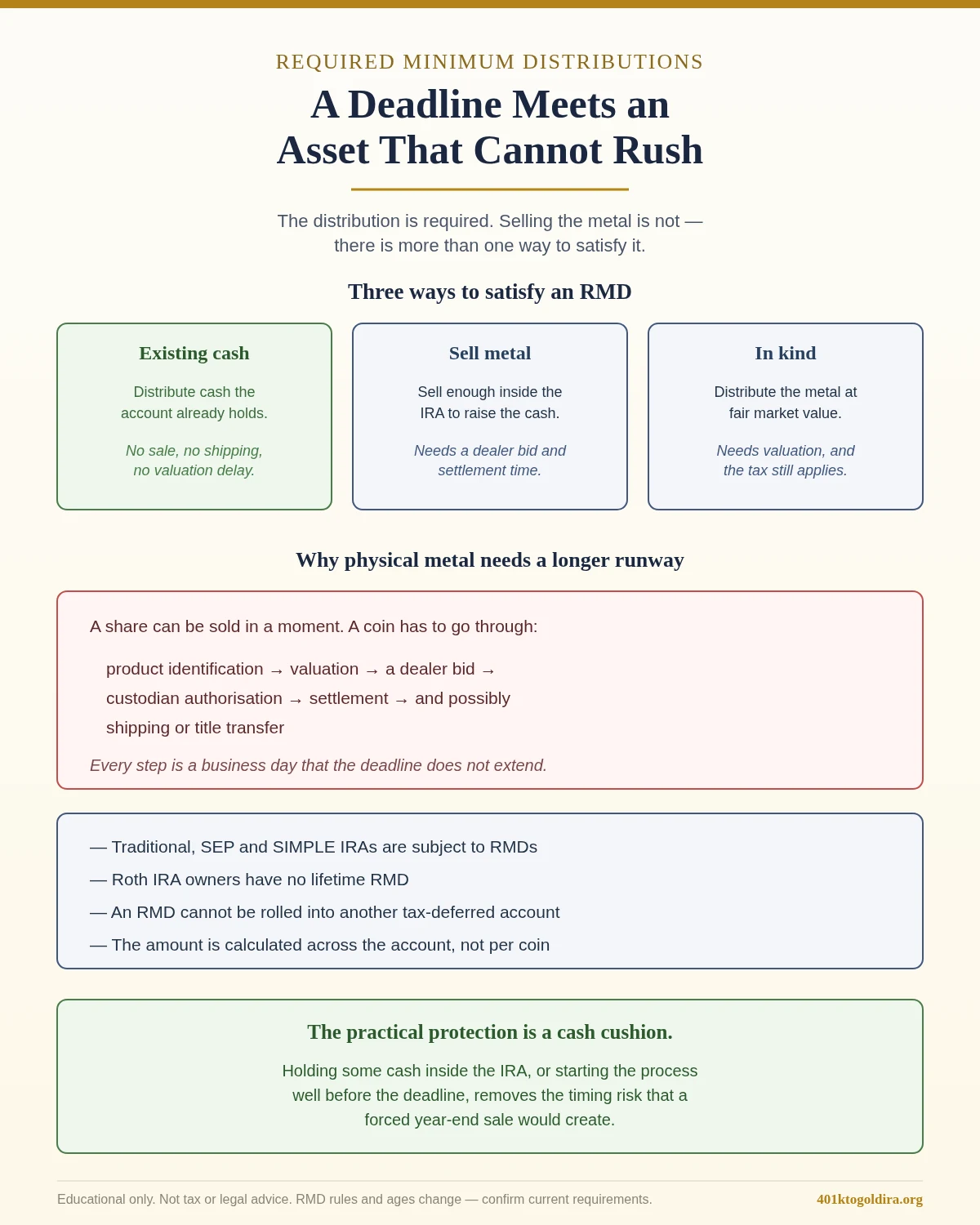
Under IRC §4974 and the 2025 Form 5329 instructions, an RMD shortfall can trigger an excise tax generally of 25 percent, reducible to 10 percent on a timely correction satisfying the specified conditions, with a reasonable-error waiver potentially available.
Those rates concern the shortfall, not the FMV reporting itself. One more timing note: RMD starting ages depend on birth cohort, and the statutory age-75 transition applies to people born in 1960 or later, so not every current retiree is on the same age.
Roth Conversions and Prohibited Transactions
A conversion or noncash distribution raises a transaction-date valuation question that is separate from the ordinary 31 December annual FMV.
Form 1099-R reports distributions and Form 5498 Box 3 reports traditional-to-Roth conversion amounts. For distributions of assets without a readily available FMV from traditional IRAs, code K may apply under the 2026 instructions.
An earlier year-end statement does not necessarily substitute for the asset's value at the moment of conversion. Treasury Regulation §1.408A-4, Q&A-14 addresses valuation of annuity contracts at conversion, and that annuity-specific methodology must not be generalised into a mandated method for every LLC, note or building.
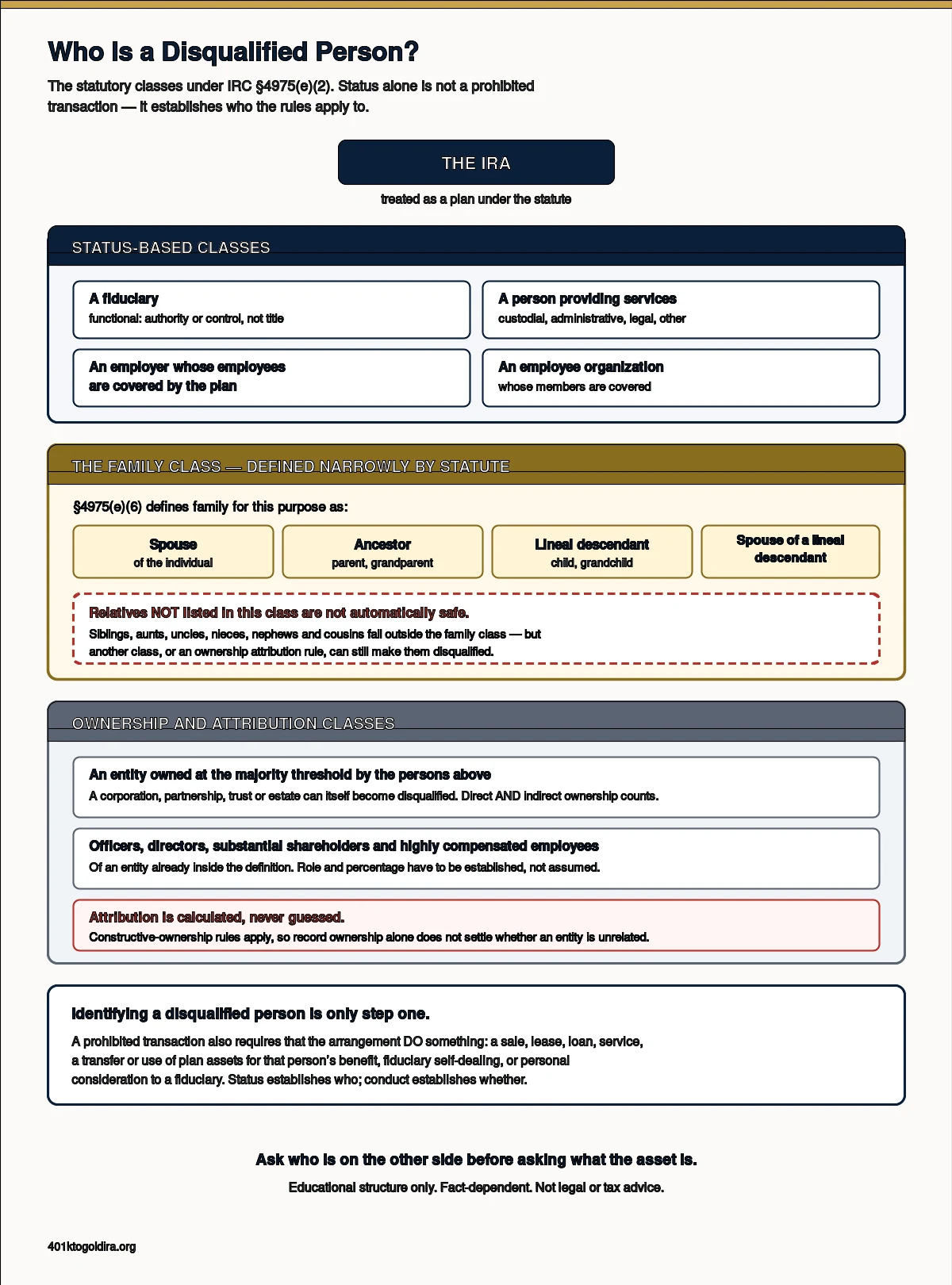
On prohibited transactions, the position is narrower than commonly claimed. An incorrect year-end value in isolation is not expressly listed as a prohibited transaction in §4975(c)(1), which addresses sales and exchanges, lending, use of IRA assets by disqualified persons, and fiduciary self-dealing.
A valuation tied to actual improper conduct is a different matter. A lowball sale to the owner or a related party, or a figure used to disguise a transfer of benefits, can implicate those substantive rules depending on the facts, and our reference on prohibited transactions sets out the statutory categories.
Where a prohibited transaction does occur, §408(e)(2) can deem the IRA to cease qualifying as of the first day of that tax year, with an FMV-based deemed distribution on that date. That is a separate measurement question from the preceding year-end Box 5 figure.
Ellis v. Commissioner, T.C. Memo. 2013-245, decided 29 October 2013, involved prohibited self-dealing in an IRA-owned LLC. It is not authority that self-prepared annual valuations are themselves prohibited transactions.
Where the Sources Disagree
Several points in this area are genuinely unsettled, and papering over them would make the page less useful rather than more authoritative. These conflicts are preserved rather than reconciled.
| Topic | One source says | Another says |
|---|---|---|
| Annual report deadline in the older regulation | 26 CFR §1.408-5(c)(1), originally issued 1980, retains 30 June wording for specified annual reports to individuals | The 2026 Form 5498 instructions specify earlier FMV statements and a 31 May filing date |
| Participant statement date | IRC §408(i) frames 31 January | The 2026 instructions give 1 February 2027, the intervening weekend explaining the operational date |
| Filing deadline | Instructions print 31 May 2027 | The general holiday rule moves timely filing to 1 June 2027 |
| Carried-forward values | One custodian's 2018 disclosure permits certain last-known or cost values administratively where new data is unavailable | The 2026 instructions require assets to be valued annually at FMV |
| Real-estate documentation | A custodian may accept an annual appraisal or a broker price opinion | The federal instructions do not universally mandate either method |
| Statement versus reported value | One custodian notes some nontraded statement values may be old, marked not available, or different from the tax-reported figure | The IRS still requires annual FMV reporting |
The 1980 regulation is the sharpest of these. 26 CFR §1.408-5 is still published with its 30 June wording while the 2026 instructions set a different current procedure, and this research did not identify a controlling IRS ruling fully reconciling the two.
That limitation is stated rather than resolved. A page that silently picked one authority would be inventing a repeal that no located source performed.

Not Established From Primary Sources
These are the questions readers most often arrive with, and the honest answer to each is that published federal guidance does not settle it.
- Whether every IRA rental property needs a new independent appraisal each year.
- Whether a county property-tax assessment can always substitute for a valuation.
- Whether any LLC valuation worksheet is preapproved by the IRS.
- Whether an IRA owner is always forbidden to prepare the LLC's annual estimate.
- Whether a manager's letter will be accepted without supporting records.
- What minimum appraiser credential applies to annual Form 5498 valuations.
- How many years an older appraisal may be reused.
- Whether a defaulted note is always worth zero.
- Whether every private loan must use discounted cash flow.
- What fixed liquidity or minority discount applies to private shares.
- Which bullion spot-data vendor the IRS requires.
- Whether product premiums are always included for proof or special-edition bullion.
- Whether a missing issuer valuation authorises using acquisition cost instead.
- Whether a prior year-end FMV can be reused at a later conversion.
- Whether any special valuation safe harbour exists for checkbook-control LLCs.
- What documentation conclusively prevents an IRS adjustment.
An independent appraisal, by itself, also does not eliminate prohibited-transaction concerns. Those require evaluating the separate statutory elements.
The Defensible Bottom-Line Rule
The annual fair market value is mandatory. An annual independent appraisal of every IRA asset is not universally mandated by the reviewed Form 5498 instructions.
The trustee or custodian must report the value, and the account holder often must supply the supporting evidence, with the balance between them set by the custody agreement and the asset type.
Keep three things apart that are easily merged: current economic FMV, a stale administrative carrying number, and an executable dealer bid or sale price. Where federal guidance does not settle a method, the accurate position is to say so and then identify the dated custodian policy as practice.
Reviewing how a custodian handles annual valuations?
Goldco is a precious metals company. Customers can request a free Gold & Silver Kit at signup. Goldco markets a buyback program; customers should request current written terms directly.
Minimum investment: $25k · BBB rating: A+
Owners of this website may be paid to recommend Goldco. The content on this website, including any positive reviews of Goldco and other reviews, may not be neutral or independent.
Frequently Asked Questions
Does a self-directed IRA need an appraisal every year?
An annual fair market value is required. An annual independent appraisal of every asset class is not established by the reviewed federal guidance. The 2026 Form 5498 instructions require trustees and custodians to ensure all IRA assets are valued annually at FMV, but prescribe no single method and no qualified appraiser for every asset. Custodians can impose appraisal requirements by contract, which are real obligations without being federal rules.
Who is legally responsible for reporting the value, the custodian or the account holder?
The trustee or custodian. The 2026 IRS instructions make them responsible for ensuring all IRA assets, including those not traded on established markets, are valued annually at fair market value. A custodial agreement often obliges the holder to supply the underlying evidence, but supplying evidence and carrying the federal reporting duty are different roles, and a contract cannot move the duty.
Which box on Form 5498 carries the fair market value?
Box 5 reports the fair market value of the account at the end of the calendar year. Box 15a separately discloses the FMV of specified hard-to-value asset categories and Box 15b identifies the applicable code. The Box 15a amount is a component of the Box 5 total, not an additional amount added to it.
What date is the value measured on, and when is it reported?
For tax year 2026 the measurement date is 31 December 2026. The participant statement is due 1 February 2027 and the printed filing deadline is 31 May 2027. Because that date is Memorial Day, the next-business-day convention makes 1 June 2027 the calculated timely date. A custodian may set an earlier internal deadline but cannot change the federal measurement date.
What is the penalty for a missing or inaccurate annual valuation?
IRC section 6693(a) specifies 50 dollars for each failure to report at the required time and manner, unless reasonable cause is shown. That is an information-reporting penalty, distinct from the RMD shortfall excise under section 4974 and from prohibited-transaction excise taxes. Where a filed Form 5498 is found to contain an error, the IRS instruction is to correct it as soon as possible.
How is an IRA-owned LLC interest valued?
The asset valued is the IRA's membership interest in the LLC, under Box 15b code C. The LLC's bank balance, original investment cost and the gross value of its underlying assets are not automatically that interest's FMV, because debt, ownership rights and restrictions all bear on it. No mandatory federal annual LLC appraisal, required discount or IRS-approved calculator was established.
Can last year's value be carried forward if nothing new is available?
Not as a matter of federal rule. The 2026 instructions require assets to be valued annually at fair market value. One custodian's older disclosure permits certain last-known or cost values where new data is unavailable, which is a genuine tension: an administrative placeholder on a statement is not proof of an accurate current FMV. No federal safe harbour for reusing acquisition cost was established.
How are precious metals in an IRA valued for the annual report?
IRA metals form part of the Box 5 year-end total, with the hard-to-value boxes used where a holding falls in a specified category. Widely traded bullion should not default to residual code G. One custodian's November 2025 instructions state spot price multiplied by fine ounces, while noting it excludes premiums and is not a firm bid. That is that custodian's method, not an IRS rule.
Does the year-end value affect required minimum distributions?
Yes. The annual RMD calculation uses the previous 31 December balance divided by the applicable life-expectancy divisor, so the 31 December 2026 value generally feeds a 2027 traditional IRA RMD. Illiquidity does not waive it. A shortfall can trigger an excise tax, generally 25 percent, reducible to 10 percent on a timely correction meeting the stated conditions.
Can an inaccurate valuation itself be a prohibited transaction?
An incorrect year-end value in isolation is not expressly listed in section 4975(c)(1), which addresses sales and exchanges, lending, use of IRA assets by disqualified persons, and fiduciary self-dealing. A valuation tied to actual improper conduct, such as a lowball sale to a related party, can implicate those rules on the facts. Preparing a value is not itself the prohibited act.
Does a self-directed IRA ever have to file Form 990-T?
They are separate regimes. The 2025 Form 990-T instructions state that trustees of listed IRAs with 1,000 dollars or more in gross income from an unrelated trade or business are among required filers, treat each account as a separate trust for UBIT, and require an EIN when it must file. A rising Box 5 value does not itself create UBIT.
Sources
Primary federal sources, with the edition or statutory currency reviewed on 18 October 2026:
- IRS, Instructions for Forms 1099-R and 5498 (2026) — Box 5, Box 15a, Box 15b, statements to participants, correction guidance.
- IRS, Form 5498 Asset Information Reporting Codes and Common Errors.
- 26 U.S.C. §408 — trustee reporting duty, §408(m) metals conditions, §408(e)(2).
- 26 U.S.C. §6693 — the 50-dollar information-reporting penalty.
- 26 U.S.C. §4975 — prohibited transactions.
- 26 CFR §1.408-5 — the 1980 annual-report regulation retaining 30 June wording.
- 26 CFR §1.408A-4 — Roth conversions, including the annuity-specific valuation provision.
- 26 CFR §1.6001-1 and 26 U.S.C. §6001 — records.
- IRS, Publication 590-B (2025) and Instructions for Form 5329 (2025) — RMD mechanics and the shortfall excise.
- IRS, Instructions for Form 990-T (2025) — the 1,000-dollar UBIT filing threshold.
- IRS, Publication 561 (12/2025) — donated property, cited only to show what it does not govern.
Named custodian documents are cited in the text as evidence of that custodian's practice on the date given: Schwab's IRA and ESA Account Agreement, October 2026 edition; STRATA Trust's IRA Financial Disclosure, displayed revision 1 June 2018; and STRATA Trust's Precious Metals Purchase/Exchange Investment Direction, form dated 13 November 2025. Ellis v. Commissioner, T.C. Memo. 2013-245, 29 October 2013.
How to Cite This Page
401ktogoldira.org, Self-Directed IRA Annual Valuation: Fair Market Value, Form 5498 and Hard-to-Value Assets. https://401ktogoldira.org/self-directed-ira-annual-valuation/ (published 18 October 2026).
Methodology
Claims were built from statute, Treasury regulation, IRS form instructions and publications, and a Tax Court decision, in that order of authority. Named custodian documents were used only as evidence of that custodian's own practice, tied to the specific document edition reviewed.
Where federal guidance did not settle a question, the page records it as not established rather than supplying an inference. Where two authorities differ, both are shown.
Figures and rules tied to a tax year are labelled with that year. Tax year 2026 is the principal year, reported during 2027.
Further Reading
 Checkbook Control IRA LLCWhat the LLC structure permits, what it does not, and why the valuation question is hardest here.
 Prohibited TransactionsThe statutory categories under IRC 4975, and where a valuation can cross into one.Gold IRA RMD StrategyHow an illiquid holding meets a distribution obligation the year-end value creates.