Educational only: This article is general educational information about retirement planning abroad. It is not financial, tax, legal, immigration, or investment advice. Laws, treaties, account policies, and reporting duties vary by country and can change. Customers should speak to a financial or tax advisor before making decisions. Goldco does not offer tax or legal advice. Past performance does not guarantee future results.
711,778 Social Security beneficiaries were living in foreign countries in December 2024 — including 463,480 retired workers receiving U.S. dollar payments while spending in another currency.
Source: Social Security Administration — Annual Statistical Supplement 2025, Table 5.J. Living abroad does not end U.S. IRA or tax rules.
Key takeaways
- The core problem is a currency mismatch: dollar income versus local-currency bills. A 10% dollar move can change local purchasing power by about 10% before fees.
- A U.S. IRA usually stays a U.S. account: the Internal Revenue Code still applies, but a custodian may restrict service based on the country of residence — confirm the written policy before moving.
- U.S. tax duties never stop: citizens and resident aliens are taxed on worldwide income, and foreign accounts may trigger FBAR or FATCA reporting.
- Social Security is often payable abroad, but country and citizenship rules matter, and SSA provides a screening tool.
- No single asset removes currency risk. A layered plan — local reserve, dollar reserve, staggered conversions, guardrails — manages it better than any one holding.
Quick answer: An American retiring overseas may keep U.S. retirement income and, in many cases, existing U.S. accounts. U.S. tax duties continue, Social Security can often be paid abroad, and account access may depend on the custodian's country rules. A useful plan matches near-term local-currency spending with a local reserve, spreads conversions over time, keeps enough liquid U.S.-dollar assets for taxes and other dollar bills, and reviews withdrawals when currency conditions change. FINRA defines currency risk as the possibility of better or worse financial results because exchange rates move between a home currency and another currency (FINRA). The U.S. Department of State also tells Americans preparing for retirement abroad to expect exchange-rate fluctuations and consider whether a local bank account is needed (U.S. Department of State).
What Is Currency Risk for a Retiree Living Abroad?
Currency risk appears when income and spending use different currencies. A retiree may receive Social Security, a pension, or IRA withdrawals in dollars while most bills are priced in another currency. Local spending power then depends on both the dollar amount and the exchange rate.
The International Monetary Fund explains that exchange rates are closely linked to the comparative purchasing power of national currencies, and its discussion of real exchange rates shows how prices and exchange rates combine to affect what money can buy across countries (International Monetary Fund; International Monetary Fund). Exchange rates can also affect local prices. The Federal Reserve has explained that currency depreciation can place upward pressure on consumer prices through imported goods, although the amount passed through to consumers varies by country, product, and period (Board of Governors of the Federal Reserve System).
Two risks can reinforce each other: a fixed dollar payment may convert into fewer local-currency units, while local inflation raises prices. A stronger dollar can create the opposite result, but exchange rates can reverse.
How Much Can Exchange-Rate Swings Change Dollar-Based Retirement Income?
The effect can be calculated without a forecast. Suppose a monthly $3,000 payment converts at 0.90 local units per dollar. The retiree receives 2,700 local units before fees. If the exchange rate falls to 0.81 local units per dollar, the same payment produces 2,430 local units — 270 fewer local units, or a 10% decline. If core living costs were 2,500 local units, the original payment covered them; after the currency move, it no longer does. A stronger dollar may create more local spending power, but housing, insurance, food, and care costs cannot always be changed quickly.
The State Department's retirement-abroad guidance tells Americans to expect currency fluctuations, prepare finances, and seek country-specific advice (U.S. Department of State). A currency plan should therefore test several exchange rates rather than one current quote. A basic stress test can compare the current exchange rate, a 10% weaker dollar, a 20% weaker dollar, a stronger dollar, local inflation above the U.S. rate, and conversion charges and bank fees. These are planning scenarios, not predictions. No reliable institution can state the exact exchange rate that will apply throughout a long retirement.

Can an American Keep and Access a U.S. IRA While Living Overseas?
Moving abroad does not, by itself, cancel a U.S. IRA or remove it from U.S. tax law. The same Internal Revenue Code rules continue to govern contributions, distributions, rollovers, early-distribution taxes, and required minimum distributions. The IRS states that traditional IRA owners generally must begin required minimum distributions at the applicable age, and living abroad is not listed as an exception (Internal Revenue Service). The IRS also maintains international guidance confirming that IRA rules continue to apply when foreign earned income and the foreign earned income exclusion are involved (Internal Revenue Service).
Custodian service may still change after a customer changes residence. Fidelity states that an existing account may generally remain open after a move abroad, but deposits, security purchases, mutual fund transactions, managed services, and other features may be restricted, and that it does not open new accounts for people residing outside the United States — these are Fidelity policies, not universal IRA rules (Fidelity). Schwab offers international account services in qualifying countries and states that non-U.S. residents are subject to country-specific restrictions (Charles Schwab; Charles Schwab).
A retiree planning to move should ask the custodian, in writing, whether the destination country is supported, which transactions will be restricted, where distributions can be sent, which forms must remain current, and whether transfers or in-kind distributions remain available. A transfer should not be started until the receiving custodian confirms acceptance. Some institutions serve only residents of selected countries.
Do IRA Taxes Change Because the Owner Lives Abroad?
U.S. federal IRA tax rules continue. Traditional IRA distributions are generally taxable under U.S. rules unless part of the distribution represents after-tax basis. Roth IRA treatment depends on the account rules and whether a distribution is qualified. Required minimum distribution rules continue for traditional IRAs and other covered accounts (Internal Revenue Service). The country of residence may also tax an IRA distribution under local law. A tax treaty or foreign tax credit may affect the final result, but treatment varies by country, account type, residency status, and treaty language. The IRS states that a foreign tax credit may be available for certain foreign income taxes paid or accrued (Internal Revenue Service). Customers should speak to a financial or tax advisor before making decisions about withdrawals, rollovers, conversions, or account allocations. Goldco does not offer tax or legal advice.
Do U.S. Tax and Reporting Duties Continue After Moving Abroad?
Yes. U.S. citizens and resident aliens are generally subject to U.S. tax on worldwide income regardless of where they live. Filing rules are generally the same for people inside and outside the United States, although special exclusions, credits, treaties, and filing extensions may apply (Internal Revenue Service; Internal Revenue Service). The State Department also warns that leaving the United States does not exempt a U.S. citizen from U.S. tax duties, and that a retiree must also follow the tax laws of the new country of residence (U.S. Department of State). State domicile rules vary, so a move abroad should include a review of voter registration, property, driver's license, mailing address, business ties, and other state-specific factors.
What Is the FBAR?
A U.S. person generally must file an FBAR when that person has a financial interest in, or signature authority over, one or more foreign financial accounts and the combined value of those accounts exceeds $10,000 at any time during the calendar year. The FBAR is FinCEN Form 114 and is separate from the federal income tax return (Internal Revenue Service). Local bank and brokerage accounts may count toward the combined threshold. A U.S.-held IRA does not become a foreign account simply because the owner lives overseas; the IRS states that foreign financial accounts held inside qualifying U.S. IRAs and certain tax-qualified plans are not reported on the FBAR (Internal Revenue Service).
What Is FATCA Reporting?
FATCA may require certain U.S. taxpayers to attach Form 8938 to a federal return when specified foreign financial assets exceed the applicable threshold. The threshold depends on filing status and whether the taxpayer lives inside or outside the United States. Form 8938 and the FBAR are separate requirements, and some accounts may appear on both (Internal Revenue Service; Internal Revenue Service). The reporting rules are technical. A retiree with local bank accounts, foreign pensions, foreign funds, business interests, or jointly owned accounts should obtain advice from a professional who works with U.S. taxpayers abroad.
How Is Social Security Paid to Retirees Outside the United States?
Many eligible U.S. citizens can receive Social Security retirement benefits while living outside the United States. The Social Security Administration states that a U.S. citizen may receive payments outside the United States as long as the person remains eligible, although payments cannot be sent to certain countries and special restrictions may apply, and it provides a Payments Abroad Screening Tool for country-specific results (Social Security Administration; Social Security Administration). Noncitizens can face additional rules: SSA states that benefits may stop after six consecutive calendar months outside the United States unless an exception applies (Social Security Administration).
SSA records show that 711,778 beneficiaries were living in foreign countries in December 2024, including 463,480 retired workers (Social Security Administration). Benefits may be deposited into a U.S. financial institution or, where available, a financial institution in a country with an international direct-deposit agreement (Social Security Administration; Social Security Administration). A beneficiary should report a foreign address even when payments continue to a U.S. bank; SSA asks beneficiaries planning to leave the United States to report an address change before departure (Social Security Administration). Social Security may still face U.S. tax, local-country tax, or treaty treatment, depending on income, citizenship, residency, and the country involved.
What Strategies Can Help Manage Currency Risk in Retirement?
No single step removes exchange-rate risk. A practical plan uses several layers.
1. Match Near-Term Bills With Local Currency
A local-currency reserve can cover rent, utilities, insurance, food, and other expected bills without converting dollars every week. The reserve is not meant to predict currency markets; it creates time, so a retiree can avoid an urgent conversion on the exact day the exchange rate is unfavorable. The size should reflect the stability of income, local banking access, emergency needs, conversion costs, and the ease of moving money between countries. The State Department recommends preparing finances for exchange-rate fluctuations and considering a local bank account (U.S. Department of State). A very large local cash balance can create other risks, including local bank exposure, inflation, and foreign-account reporting, so the buffer should be planned rather than allowed to grow without review.
2. Keep Dollar Reserves for Dollar Obligations
Some bills may remain in dollars, such as U.S. taxes, insurance premiums, family support, travel to the United States, or expenses tied to U.S. property. Keeping every liquid dollar in the local currency can create the opposite mismatch. A two-currency cash plan may be more practical: local currency for near-term local bills and dollars for expected U.S. obligations.
3. Stagger Currency Conversions
Converting an entire year of spending on one date creates a single exchange-rate bet. A retiree can divide conversions into monthly, quarterly, or rules-based transfers. This does not ensure a favorable average rate; it reduces dependence on one day's price. The schedule should also consider bank fees, transfer limits, local holidays, and the time required for funds to clear.
4. Use Spending Guardrails
A retirement budget can separate essentials — housing, food, medicine, insurance, basic transportation — from flexible spending such as travel, gifts, dining, and optional projects. If the dollar weakens sharply, flexible spending can adjust before essential spending; if the dollar strengthens, the plan can rebuild reserves rather than permanently raise lifestyle costs. The retirement purchasing-power guide explains how inflation and asset values can affect long-term spending.
5. Review IRA Withdrawals in Both Currencies
A withdrawal plan should show the amount in dollars and the expected amount in local currency after taxes and conversion costs. A $40,000 annual IRA withdrawal may look unchanged in U.S. records while its local purchasing power moves widely. The review should include the gross dollar distribution, U.S. withholding or estimated tax, a local tax estimate, the exchange-rate assumption, transfer and conversion charges, the net local-currency spending amount, required minimum distribution obligations, and cash needed for the next 12 months. Customers should speak to a financial or tax advisor before making decisions.
6. Diversify Sources of Retirement Income
Social Security, pensions, IRA withdrawals, taxable accounts, rental income, or local work may respond differently to taxes and currencies. Diversification can reduce dependence on one payment source, but it cannot remove exchange-rate risk.
7. Treat Formal Currency Hedges With Care
Currency forwards, options, and hedged funds can reduce some exposure, but they add cost, complexity, counterparty risk, timing risk, and the chance that the hedge will not match actual spending. FINRA states that hedging can add significant costs and may involve complex or higher-risk activity, and BIS research explains that derivatives can reduce risks but do not remove every risk (FINRA; Bank for International Settlements). A local-currency buffer and staged conversion plan may be easier to manage than a derivatives strategy.
Where Can a Diversified Store of Value Fit?
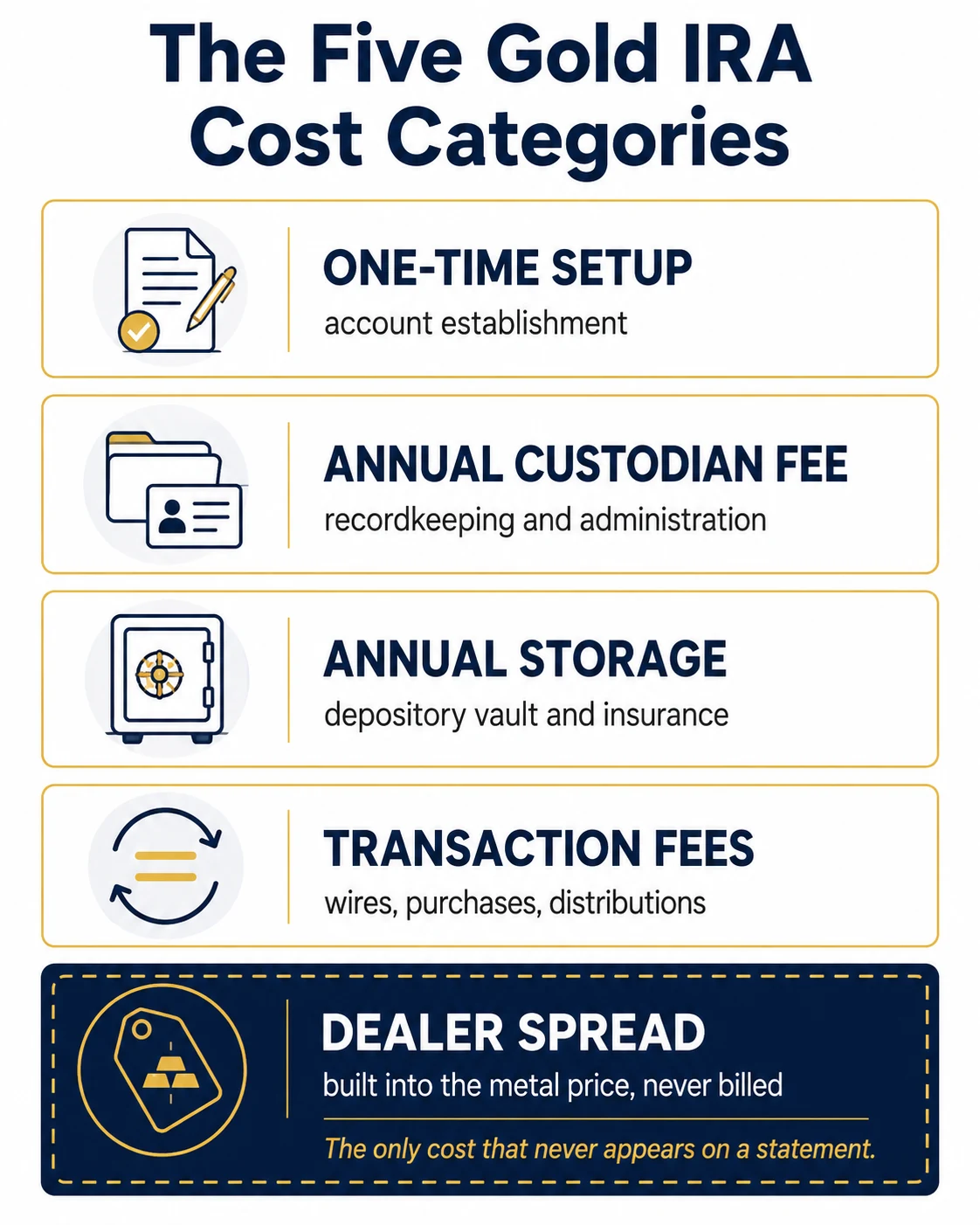
Some retirement plans include assets that are not tied to one national currency, which may include global stocks, real assets, or a small precious-metals position. Precious metals can be one diversification consideration, but they do not pay local bills directly and do not remove currency risk. Their prices can fall, dealer spreads can be wide, and physical IRA holdings may involve storage, custodian, shipping, and distribution costs. A precious-metals IRA also remains a U.S. retirement account: living abroad does not remove IRS rules, custodian procedures, or distribution taxes. Before transferring an IRA to physical metals, the saver should review how an IRA-to-gold-and-silver transfer works, how gold compares with cash, and how cash can be accessed from a Gold IRA. No single asset solves a mismatch between dollar income and local-currency spending. The retirement gold-allocation guide and Gold IRA decision quiz are educational tools; they do not provide personalized allocation advice.
What Should an American Complete Before Retiring Overseas?
A written expat retirement checklist can cover the following steps.
- Residency and visa rules: Confirm the legal right to remain in the country and the renewal process.
- Tax residency: Identify when local tax residency begins and whether a treaty applies.
- U.S. filing: Plan for federal returns, estimated tax, FBAR, and possible Form 8938.
- IRA access: Obtain the custodian's country policy in writing.
- Banking: Maintain workable U.S. and local banking arrangements.
- Social Security: Use the SSA Payments Abroad Screening Tool and update the foreign address.
- Currency plan: Set a local reserve, conversion schedule, and exchange-rate stress test.
- Health coverage: Confirm which insurance works in the country of residence.
- Estate documents: Review powers of attorney, beneficiaries, wills, and local succession rules.
- Emergency access: Keep copies of identification, account contacts, and instructions for a trusted person.
The State Department recommends preparing finances, understanding local taxes, reviewing health care, and consulting advisers familiar with the destination country (U.S. Department of State).

What Are Common Questions About Retiring Abroad as an American?
Can an American keep a U.S. IRA after moving abroad?
In many cases, an existing IRA can remain in the United States, and the Internal Revenue Code continues to govern it. Custodian services may be restricted by the country of residence, so the provider's written policy should be checked before the move (Internal Revenue Service; Fidelity).
Can IRA withdrawals be taken while living abroad?
Yes, an IRA owner can request distributions, subject to the account agreement and normal U.S. tax rules. Banking methods, withholding, paperwork, and local tax treatment depend on the custodian and country.
Does moving abroad end U.S. tax filing?
No. U.S. citizens and resident aliens are generally taxed on worldwide income and must file when normal filing rules require it (Internal Revenue Service).
Is a foreign bank account always reported?
Not always. An FBAR is generally required when the combined value of covered foreign accounts exceeds $10,000 at any time during the year. Form 8938 has separate rules and higher thresholds that depend on filing status and residence (Internal Revenue Service; Internal Revenue Service).
Can Social Security be paid outside the United States?
Many eligible U.S. citizens can receive Social Security abroad, subject to country restrictions. Noncitizens may face additional rules. SSA's screening tool provides a country-specific result (Social Security Administration).
Does holding gold remove foreign-exchange risk?
No. Gold has its own price, liquidity, cost, and custody risks. It does not automatically match local rent, taxes, food, or health costs. No single asset removes currency risk.
Bottom Line
Retiring overseas as an American adds a currency layer to every retirement decision. A dollar payment can support very different lifestyles as exchange rates change. U.S. IRA and tax rules continue. Foreign bank accounts may create reporting duties. Social Security is often payable abroad, but country and eligibility rules matter. A practical plan keeps near-term local bills in local currency, retains dollars for dollar obligations, staggers conversions, tests weaker-dollar scenarios, and confirms account access before the move. The goal is to keep one exchange rate, bank, account, or asset from controlling the entire retirement plan.
Sources
- Bank for International Settlements. BIS Quarterly Review — derivatives and risk.
- Board of Governors of the Federal Reserve System. Exchange rates and consumer prices (pass-through).
- Charles Schwab. U.S. expat investing · IRA.
- Fidelity. How to retire overseas.
- FINRA. Currency risk: why it matters to you · Risk.
- Internal Revenue Service. Topic 451 — individual retirement arrangements · IRAs for international taxpayers · Foreign tax credit.
- Internal Revenue Service. U.S. citizens and resident aliens abroad · Filing requirements.
- Internal Revenue Service. Report of Foreign Bank and Financial Accounts (FBAR) · Details on reporting foreign accounts.
- Internal Revenue Service. Summary of FATCA reporting · Form 8938 vs. FBAR.
- International Monetary Fund. Real exchange rates · Purchasing power parity.
- Social Security Administration. Payments abroad · Payments while outside the U.S. · Country list · Direct-deposit countries.
- Social Security Administration. Annual Statistical Supplement 2025, Table 5.J · Direct deposit abroad FAQ · Leaving the U.S..
- U.S. Department of State. Retirement abroad.
Reviewed and edited by Daniel M. — editor, 401kToGoldIRA.org. Educational only; sourced to the IRS, Social Security Administration, U.S. Department of State, International Monetary Fund, the Federal Reserve, FINRA, and the Bank for International Settlements. Not financial, tax, or legal advice.