Educational only: This is a balanced decision framework, not a recommendation for either metal. It summarizes IRS, regulator, and industry material in general terms and is not financial, tax, or legal advice. No fee or premium figure is asserted as universal — confirm current provider schedules directly. Customers should speak to a financial or tax advisor before making decisions. Goldco does not offer tax or legal advice. Past performance does not guarantee future results.
Gold has recently traded around 70 times silver's price per ounce, and silver's annualized volatility has been up to twice gold's over 20 years — so the same dollar allocation to silver means far more weight to store and a wider range of outcomes. Neither is a universal winner.
Sources: GoldPrice — gold-silver ratio; iShares. The ratio changes daily and is a price relationship, not an allocation rule.
Key takeaways
- A "Gold IRA" and "Silver IRA" are the same account type — a self-directed IRA holding qualifying metals under the same IRS rules; the tax structure favors neither.
- Silver is more volatile (up to ~2× gold's) and more cyclical because of its industrial demand; gold leans monetary and reserve.
- Silver's lower value density means more weight and storage per dollar, but the actual bill depends on the written custodian/depository schedule — no universal rule.
- No fabricated premium or fee holds for every product; compare exact products, spot timestamp, retail quote, same-day buyback, and all charges in writing.
- Gold, silver, or a mix can each be reasonable — no authoritative source sets a universal gold-to-silver ratio for an IRA.
How Can a Retirement Saver Choose Between a Gold and Silver IRA?
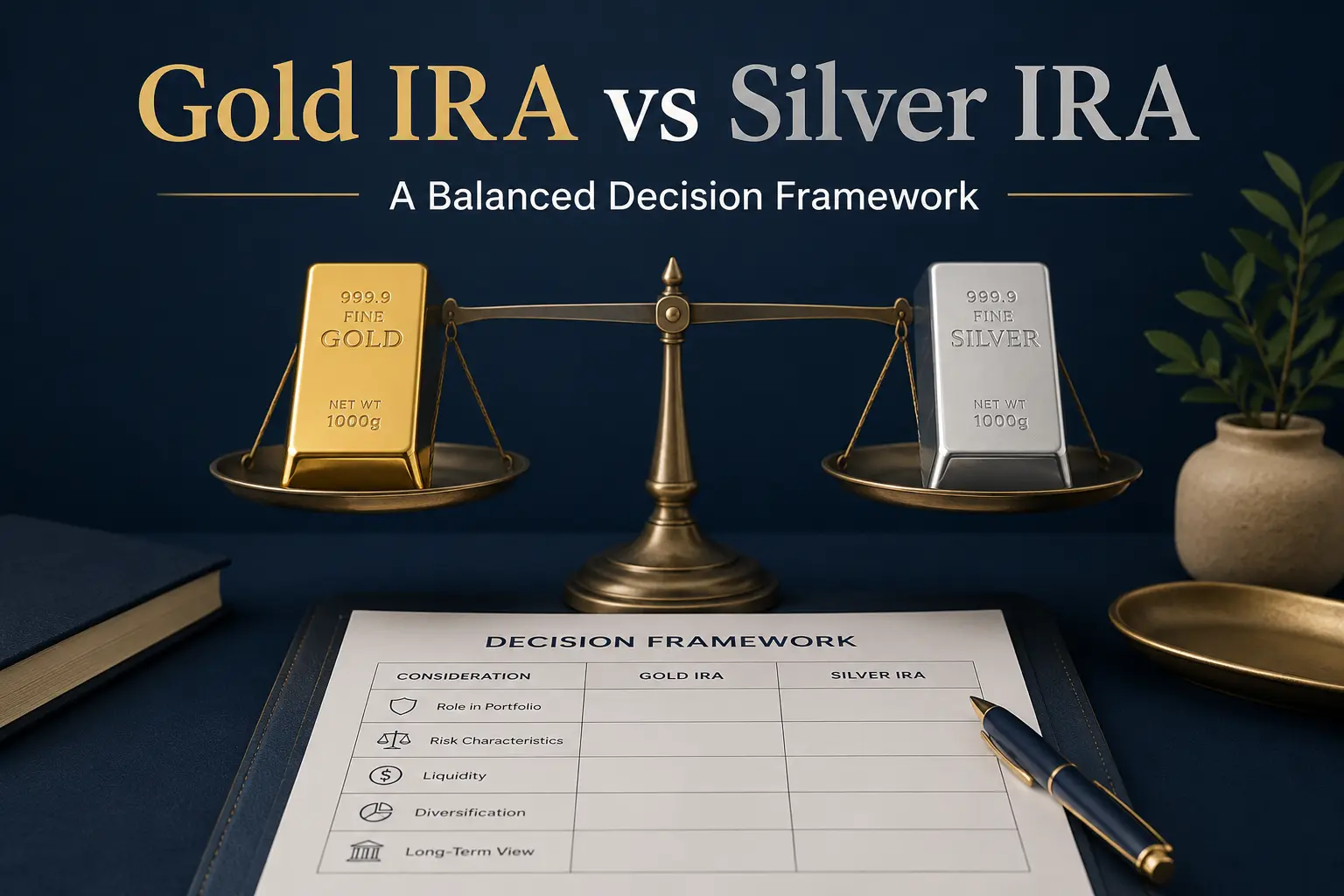
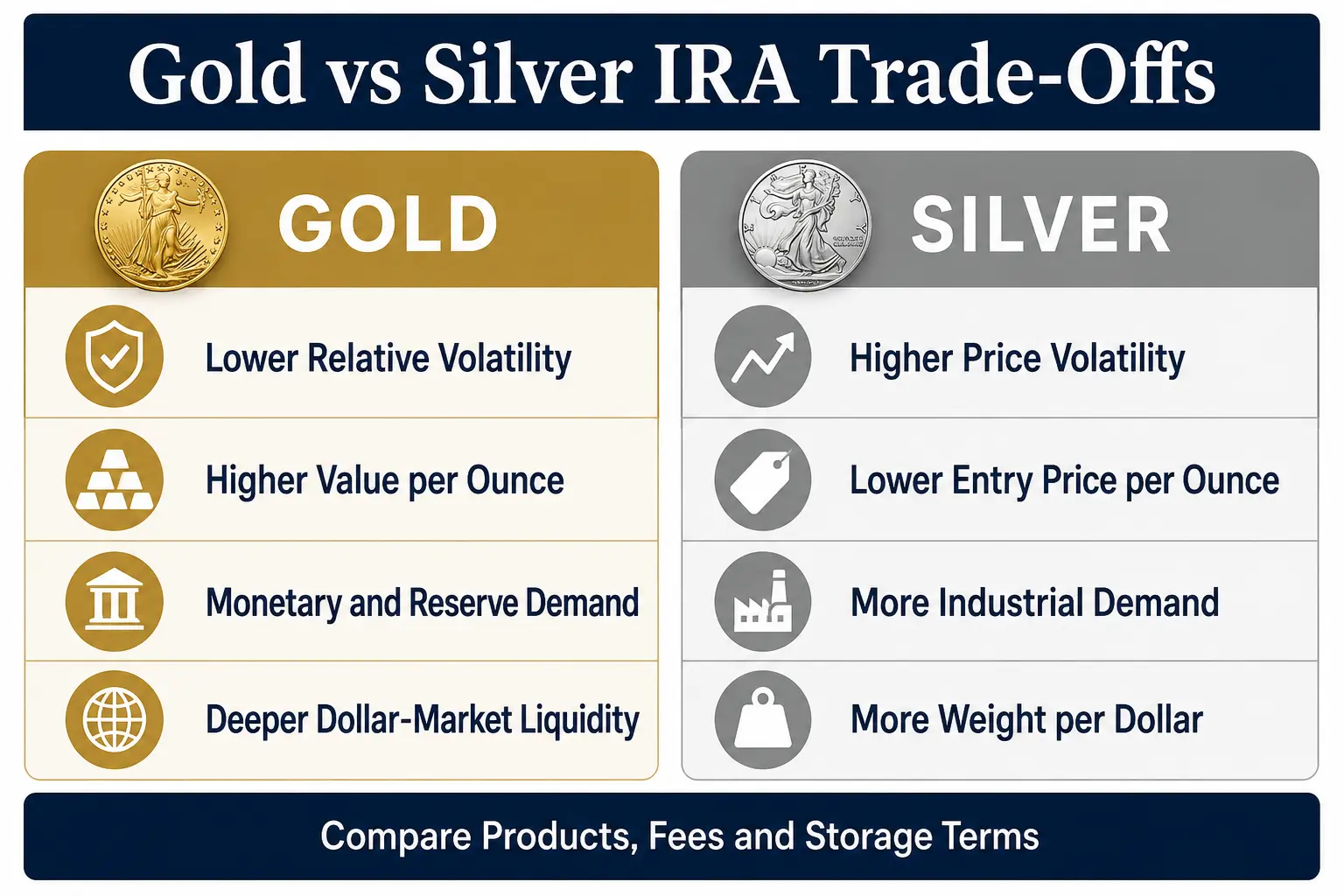
The choice should begin with the account's own situation, not a price forecast. Gold may fit a saver who places more weight on lower relative volatility, value density, and deeper market liquidity. Silver may fit a saver who accepts wider price swings and wants more exposure to industrial demand at a lower price per ounce. A mix is also possible, but no reputable public rule establishes one ideal gold-to-silver allocation for every retirement account. Gold and silver behave differently — gold has carried more value per ounce, traded in a larger dollar market, and shown lower historical volatility, while silver has had a lower entry price, more industrial demand, and sharper swings (iShares; Silver Institute, an industry body). The decision rests on purpose, account size, time horizon, risk tolerance, costs, and liquidity needs.
What Do Gold and Silver IRAs Have in Common?
A "Gold IRA" and a "Silver IRA" are not separate tax categories in the Internal Revenue Code — both terms normally describe a self-directed IRA holding qualifying precious metals through an IRA trustee or custodian, and the CFTC and FINRA describe both as self-directed IRAs used to hold bullion (CFTC and FINRA). The IRS generally treats metals and coins as collectibles, but Section 408(m) provides exceptions for certain coins and qualifying bullion, which must remain with a bank or an IRS-approved nonbank trustee — including when an IRA-owned LLC makes the purchase (IRS; IRS FAQs). Publication 590-B lists specified U.S. gold coins, one-ounce Treasury-minted silver coins, certain platinum coins, and qualifying bullion, and treats coins taken into the owner's possession as distributed (IRS Publication 590-B).
What fineness standards apply? The IRS framework requires bullion to meet the minimum fineness accepted for delivery under regulated futures contracts. GoldStar Trust, a self-directed IRA custodian, summarizes the commonly applied minimums as .9950 for gold and .9990 for silver (.9995 for platinum and palladium), though some coins are allowed because the law names them, not because they meet the general threshold (GoldStar Trust). A saver should verify the exact product, mint, weight, and IRA eligibility before purchase — the tax structure does not make one metal more suitable than the other. Customers should speak to a financial or tax advisor before making decisions about an IRA, rollover, distribution, or precious-metals allocation. Goldco does not offer tax or legal advice.
Is Gold or Silver More Volatile?
Silver has historically moved more sharply than gold. A March 2026 iShares analysis reported that silver's annualized volatility over the prior 20 years had been as much as twice gold's, and described silver as more cyclical because its price reflects both investment flows and industrial demand (iShares). Volatility measures the size and frequency of price changes, not direction — higher volatility means a wider range of possible short-term outcomes. That can create larger short-term account changes and make a poorly timed distribution more costly, and a saver near retirement may have less time to wait through a recovery. Gold can still fall sharply, and neither metal produces predictable returns; a longer horizon can make short-term changes less urgent, but it does not remove price risk, and the wider plan still needs liquid assets for expected withdrawals. The gold allocation backtest can help frame historical behavior, though a backtest cannot establish a future result or a suitable allocation.
Which Metal Costs More to Own in an IRA?
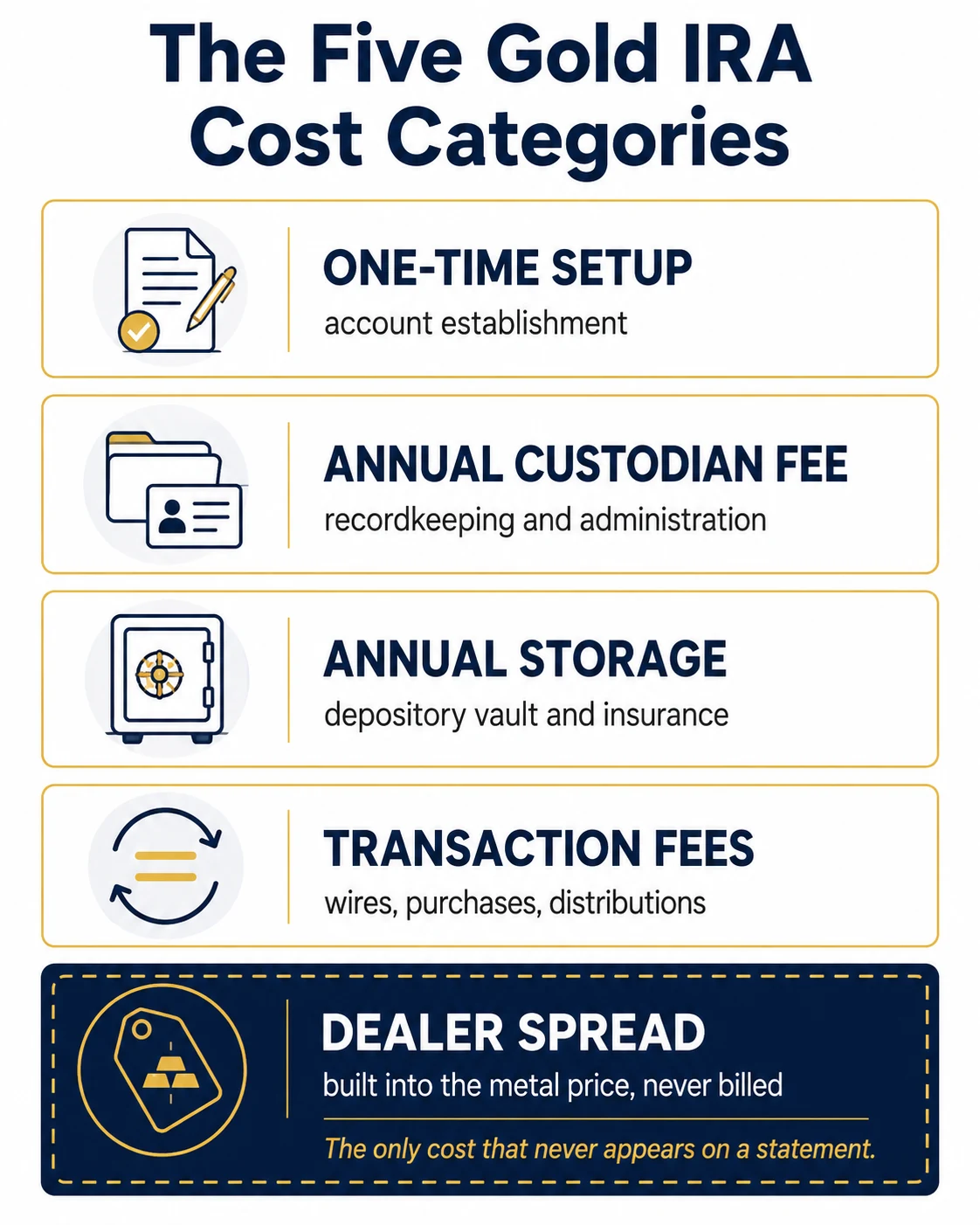
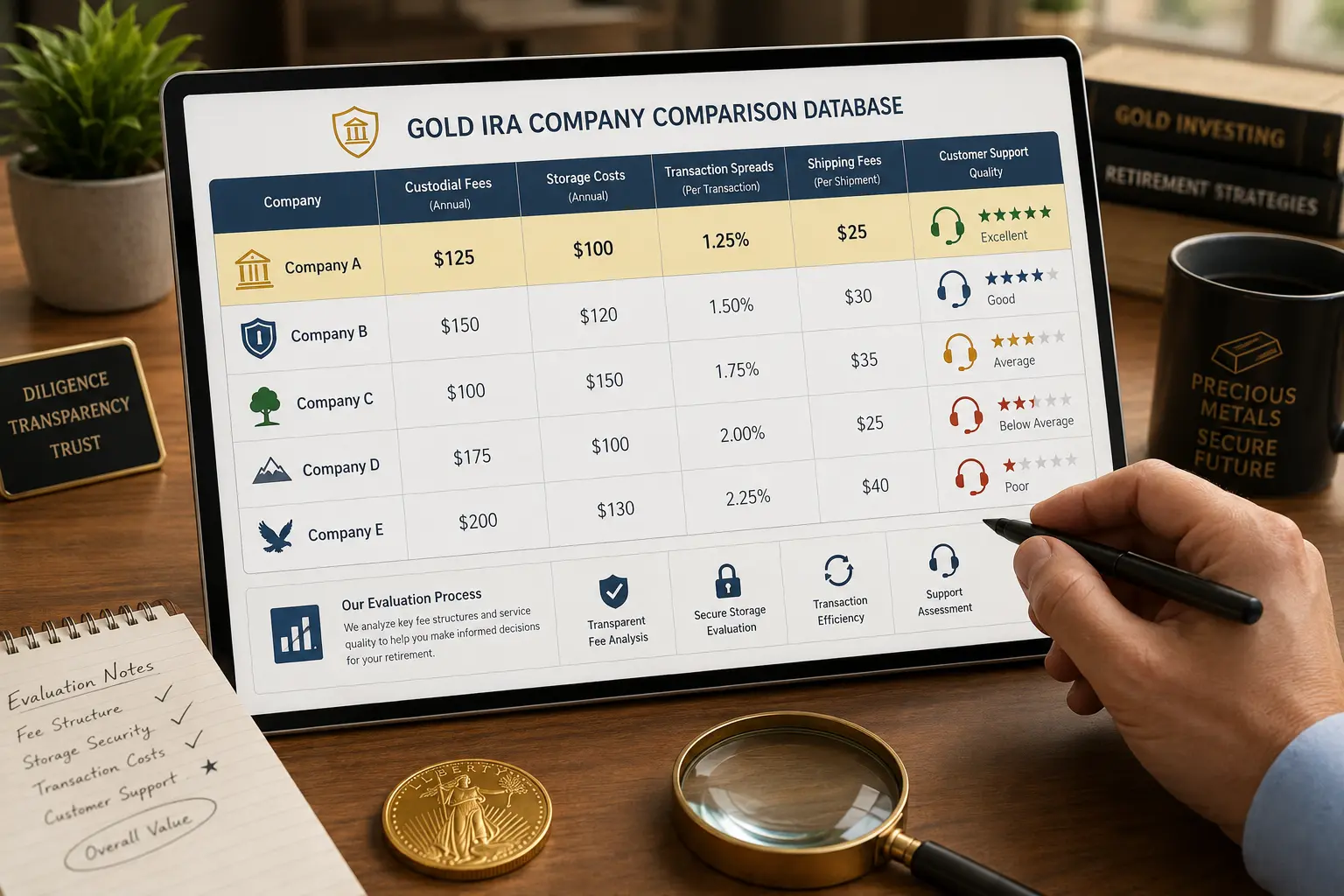
The answer depends on the type of cost. A physical precious-metals IRA can include dealer pricing, a custodian charge, depository storage, transaction fees, shipping, insurance, and distribution or closure costs, and the CFTC and FINRA advise customers to request all charges, commissions, retail prices, and buyback terms in writing (CFTC and FINRA).
How does value density affect storage? Gold has carried far more value per ounce than silver — with the gold-silver ratio recently around 70 to 1, roughly 70 ounces of silver represent the metal value of one ounce of gold, so a silver position of equal dollar value requires much more weight and storage space (GoldPrice). The ratio changes every trading day and is not a fixed law. That difference can create more handling or storage cost-drag for silver, but it does not make silver automatically more expensive in every IRA. GoldStar Trust states its precious-metals maintenance and storage charges can vary with account value, and the Texas Bullion Depository publishes a schedule that applies the same value-based storage rate to gold and silver at standard account sizes while noting large silver volumes may receive different pricing — provider-specific examples, not universal IRA rates (GoldStar Trust; Texas Bullion Depository). Some custodians also charge shipping by metal type and weight (Vantage Retirement Plans). The final bill depends on the written depository and custodian schedules — a detailed comparison is in the silver vs. gold IRA cost guide.
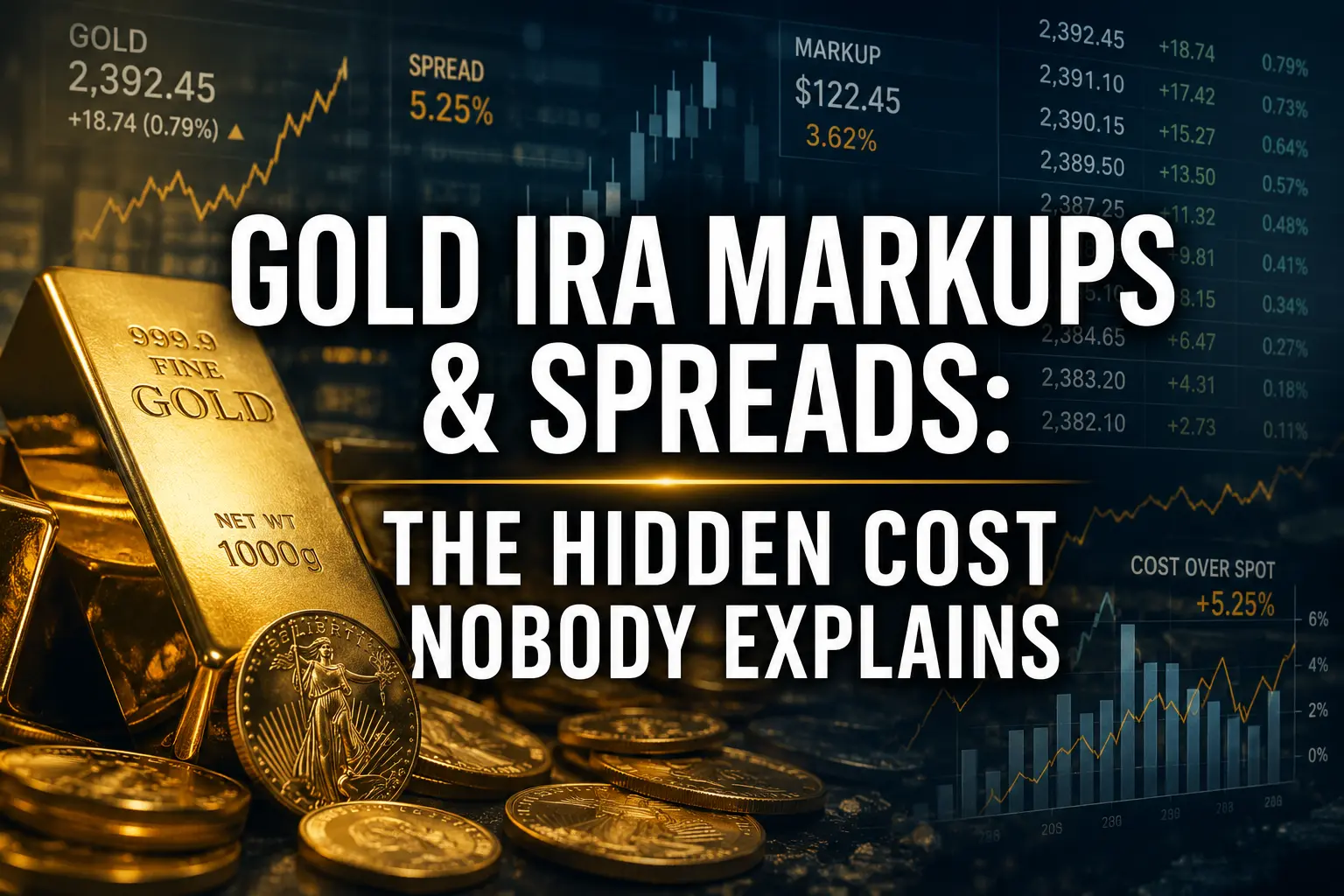
Does silver always carry a higher percentage premium? No universal retail premium can be stated. The U.S. Mint explains that bullion prices include the metal price plus a premium for minting, distribution, and marketing (U.S. Mint). A fixed dollar premium can represent a larger percentage of a lower-priced silver coin than of a higher-priced gold coin, but retail dealers add their own pricing and supply conditions change the spread. No reliable public database was found that establishes one universal retail premium for all IRA-eligible products — any claim that silver "always" costs a specific premium, or gold "always" costs less, would be unsupported. A sound comparison records the live spot-price timestamp, exact product, weight, purity, retail quote, same-day buyback quote, and all custodian, storage, shipping, and liquidation charges.
How Do Gold and Silver Demand Profiles Differ?
What drives gold demand? Gold demand comes from investment products, bars and coins, jewelry, central banks, and technology. The World Gold Council, an industry body funded by gold miners, reported that 2025 gold demand included about 2,175 metric tons of investment demand, 1,638 tons of jewelry fabrication, 863 tons from central banks and other institutions, and 323 tons of technology demand (World Gold Council, an industry body). That mix gives gold a strong monetary and reserve profile. What drives silver demand? Silver demand has a larger industrial component — the Silver Institute reported industrial demand reached a record in 2024, supported by electronics, photovoltaics, automotive, grid infrastructure, and AI-related applications, then fell 3% in 2025 to 657.4 million ounces after four years of growth (Silver Institute, an industry body; Silver Institute). That decline shows industrial exposure works in both directions: strong manufacturing may support silver, while substitution, thriftier manufacturing, or weaker production may reduce demand. Silver's industrial role can make it more sensitive to business cycles than gold — which helps explain the higher volatility, not a future price direction. The silver inflation-hedge analysis examines why industrial demand can complicate a simple inflation narrative.
Is Gold More Liquid Than Silver?
Both metals trade in large global markets, but gold has had a much larger market in dollar terms. LBMA daily trade-reporting data for the 12-week period ending July 3, 2026 showed an average reported trade value of about $969 billion for gold versus $168 billion for silver — wholesale-market activity, not only IRA coins and bars (London Bullion Market Association). The World Gold Council estimated overall gold trading volume at about $361 billion per day during 2025 across OTC, futures, and exchange-traded markets (World Gold Council, an industry body). A deeper wholesale market supports price discovery but does not mean every IRA product sells at spot — physical IRA liquidity depends on the product, dealer bid, depository, custodian process, and paperwork, and the CFTC and FINRA advise requesting the current buyback price before purchasing. Common bullion coins and bars may have broader dealer recognition than unusual products; collectible and "semi-numismatic" products can be harder to value and sell.
Who Might Prefer Gold? Who Might Prefer Silver?
Gold may deserve closer review when several of these apply: the owner places high value on lower relative volatility; the planned amount is large enough for storage space to matter; the account is close to planned withdrawals or required distributions; the saver prefers a metal with a larger monetary, investment, and central-bank demand profile; more metal value in less physical weight is wanted; or the plan values deeper dollar-market liquidity. These are decision factors, not a recommendation — gold can still decline, spreads can be wide, and a gold IRA carries costs a brokerage IRA does not. A higher price per ounce also affects product selection: small-denomination gold coins may carry higher percentage premiums than one-ounce coins.
Silver may deserve closer review when different conditions apply: the owner accepts higher volatility; wants a lower price per individual ounce or coin; the thesis includes industrial demand from electronics, energy, transportation, or infrastructure; the position is small enough that weight and storage volume are manageable; the custodian and depository provide clear written terms for silver; and the account has enough other liquid assets to avoid a forced sale during a weak silver market. Silver's lower unit price can support smaller purchase increments, but many coins add premiums, handling, storage, and shipping costs. The silver IRA pros and cons guide covers those trade-offs, and the retirement allocation guide presents allocation questions without treating one percentage as suitable for every account.
Does a Mix of Gold and Silver Make Sense?
A mix is one available structure, not a default answer. Holding both metals can reduce dependence on one metal's demand profile — gold contributing a more monetary and reserve-oriented exposure, silver adding more industrial sensitivity. That reasoning is sound diversification logic, but it does not establish an ideal ratio: no authoritative IRS, regulator, or independent retirement-research rule sets a universal gold-to-silver split, and the market gold-silver ratio is a price relationship, not an allocation instruction. A mix may add products, pricing comparisons, storage weight, and rebalancing costs, and can fragment a small account or complicate distributions when little cash remains. The allocation should be reviewed against the full household portfolio, not only the precious-metals IRA. Customers should speak to a financial or tax advisor before making decisions. Goldco does not offer tax or legal advice.
How Should a Saver Decide Which Metal Fits an IRA?
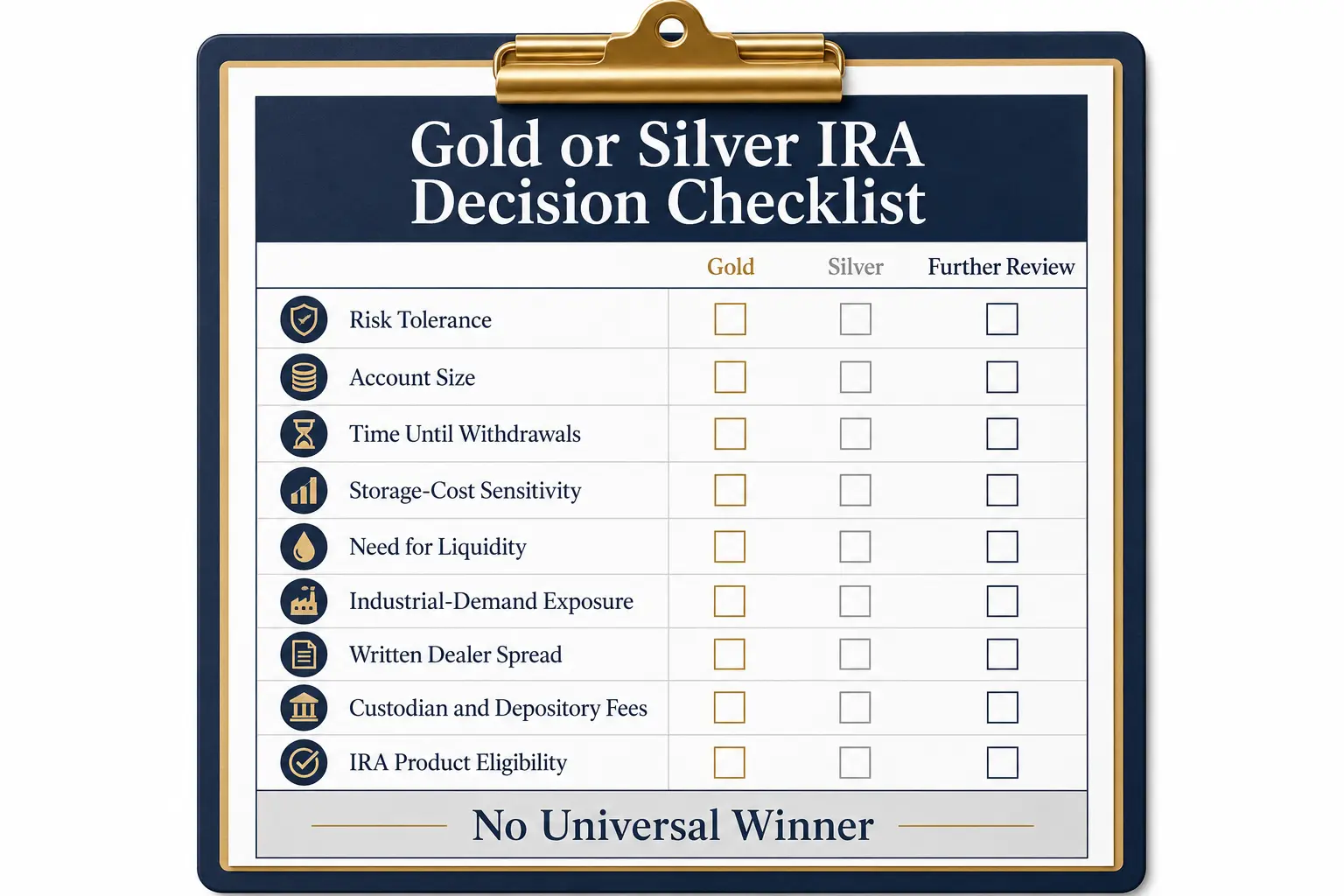
This checklist focuses on the account's actual needs:
- What job is the metal expected to perform? State the purpose clearly (diversification, physical-asset exposure, industrial-demand exposure) — a vague goal like "safety" is not enough, because both metals can fall.
- How much volatility can the plan absorb? Silver's historical volatility has been up to twice gold's; a saver who may need to sell within a few years should test the plan against a sharp decline.
- How large is the planned position? Gold's value density matters more as the position grows; silver creates more weight for the same value, and fixed annual fees consume a larger share of a small account.
- How sensitive is the plan to storage and shipping costs? Get current written schedules and identify whether charges are flat, value-based, weight-based, or metal-specific, and confirm commingled vs. segregated availability.
- What is the full round-trip cost? Compare weight × spot with the retail quote, then ask what the dealer would pay to buy the product back the same day.
- When may distributions begin? An account close to withdrawals may weight lower volatility and simple liquidation more heavily.
- Is the product clearly IRA-eligible? Check metal, fineness, mint/refiner, weight, condition, and custody with the custodian before funds move — a non-exempt collectible purchase is treated as a distribution (IRS).
- Does the household already have metal exposure? Physical metals, mining shares, or commodity funds elsewhere may already create exposure — use the full balance sheet.
- Is a physical-metals IRA necessary for the goal? Regulated exchange-traded products can provide metal-price exposure inside some existing IRAs with their own fees and risks; physical bullion adds dealer, storage, and handling layers.
The Gold IRA decision quiz can organize account-structure questions; it does not provide personalized advice.
Frequently Asked Questions
Is a Silver IRA a different legal account from a Gold IRA?
No. Both labels normally refer to a self-directed IRA that holds qualifying precious metals under the same tax and custody framework.
Which metal has been more volatile?
Silver's annualized volatility over the 20 years reviewed by iShares was as much as twice gold's. The relationship can change over shorter periods.
Does silver always cost more to store?
No. Silver requires more weight and volume for the same metal value, but some depositories charge by account value rather than metal volume. Actual IRA charges require a current written custodian and depository schedule.
Are silver premiums always higher than gold premiums?
No universal rule is supported. Premiums vary by product, size, supply, mint, and dealer. A fixed dollar premium can represent a larger percentage of a lower-priced silver coin, but final retail IRA prices differ.
Is gold more liquid than silver?
Gold has traded in a larger market by dollar value, but both metals have active global markets. Physical IRA liquidity depends on the exact product, dealer bid, custodian process, and depository procedures.
Is there an ideal gold-to-silver ratio for an IRA?
No authoritative universal allocation ratio was found. The market gold-silver ratio compares prices; it does not determine how a retirement account should be divided.
Bottom Line
The gold vs. silver IRA decision is not a contest with one permanent winner. Gold has historically offered lower relative volatility, greater value density, a larger monetary and reserve demand profile, and deeper dollar-market liquidity. Silver offers a lower price per ounce, greater industrial exposure, and the possibility of wider price movements. The stronger choice is the one that fits the retirement plan's risk capacity, account size, time horizon, storage terms, liquidity needs, and full written cost — compare exact products and written fees rather than broad labels. Gold, silver, or a mix can each be reasonable in the right structure; none should be selected only because of a sales pitch, recent price move, or prediction.
Sources
- Internal Revenue Service. Investments in Collectibles.
- Internal Revenue Service. Retirement Plans FAQs Regarding IRAs.
- Internal Revenue Service. Publication 590-B.
- CFTC & FINRA. 10 Things to Ask Before Buying Metals.
- iShares (BlackRock). Gold and Silver: Investing in Precious Metals.
- GoldStar Trust. Precious Metals IRA Education.
- U.S. Mint. Authorized Bullion Purchaser Program.
- GoldPrice. Gold-Silver Ratio.
- Texas Bullion Depository. Storage Pricing.
- Vantage Retirement Plans. Precious-Metals IRA Fees.
- The Silver Institute. Silver Supply & Demand (industry body).
- World Gold Council. Gold Demand Trends Full Year 2025 (industry body).
- London Bullion Market Association. LBMA Daily Trade Reporting Data.
Article reviewed and edited by Daniel M. — editor, 401kToGoldIRA.org. A balanced decision framework sourced to the IRS, CFTC/FINRA, iShares, the U.S. Mint, GoldStar Trust, the Texas Bullion Depository, LBMA, the Silver Institute, and the World Gold Council (industry sources flagged); educational only, not financial, tax, or legal advice.