Silver IRA vs Gold IRA Cost: What Published Fee Schedules Actually Charge
It is widely repeated that silver costs more to store in an IRA because it is bulkier. This page checks that against what US custodians and depositories actually publish. Across four published schedules, none charges a different storage rate for silver than for gold — which moves silver's real cost drag somewhere else entirely.
View the Schedule Comparison →Educational only: This comparison records published costs from named primary sources. It does not provide financial, tax, or legal advice. Customers should verify current written pricing directly. Past performance does not guarantee future results.
Key figure
Zero of four published US custodian and depository fee schedules charge more to store silver than gold. All four price storage on account value, a flat fee, or the number of asset types — not on weight or volume.
Texas Bullion Depository, STRATA Trust, The Entrust Group and Equity Trust, each read from the provider's own published schedule on 2 September 2026. Schedules change; verify current pricing before funding.
Quick Answer: The Bulk Is Real, the Storage Surcharge Is Not
Silver is far bulkier than gold for the same money. In December 2025 it took roughly 69.1 ounces of silver to match one ounce of gold by value, so a given retirement balance in silver is a great deal heavier and takes far more vault space.
The usual conclusion is that this makes silver more expensive to store. The published schedules do not show that. Every schedule checked here charges on account value, a flat annual fee, or the number of asset types held — none on weight or volume, and none at a different rate for silver. Where weight does appear is in non-storage items such as shipping and handling, charged per transaction rather than every year.
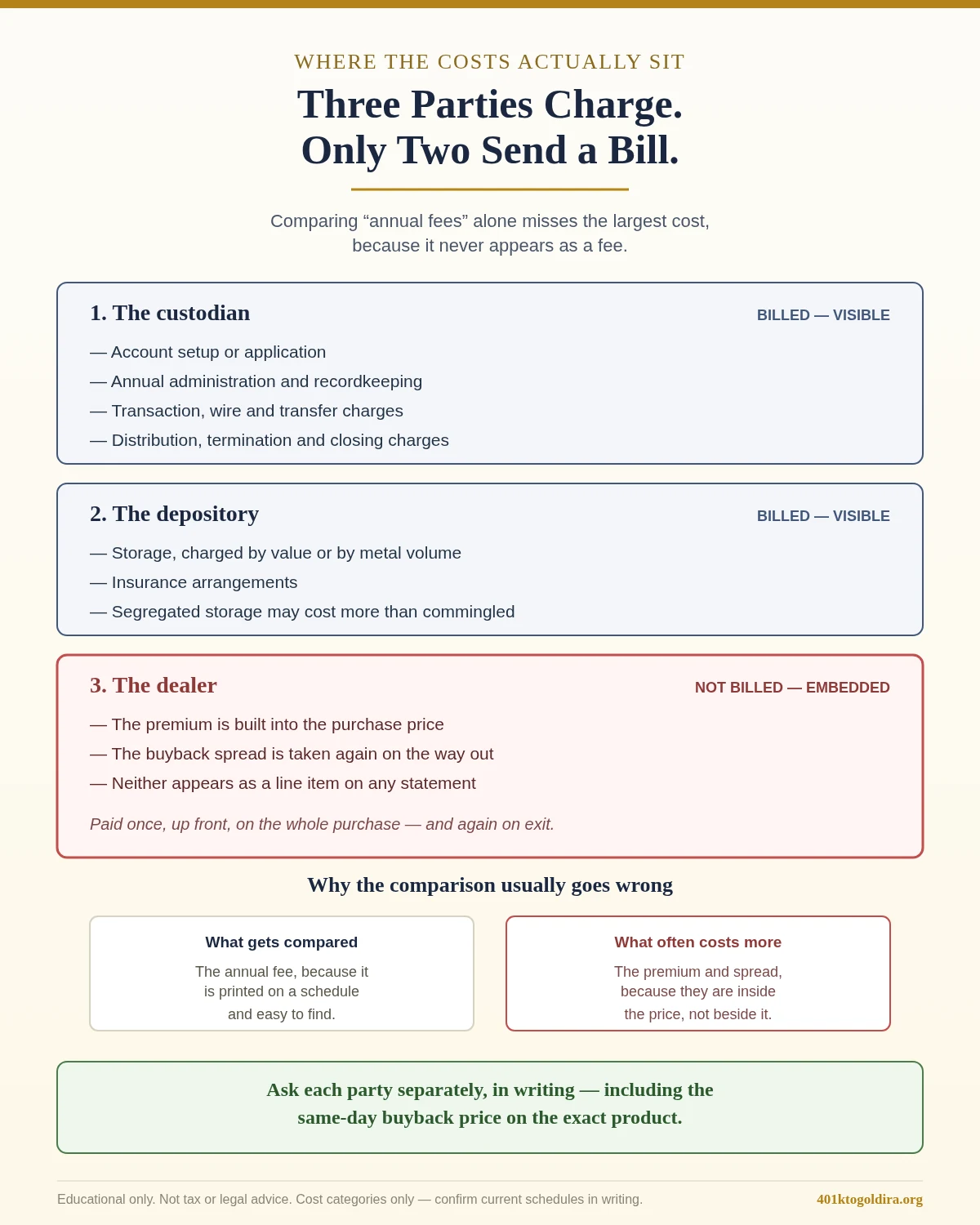
That does not make silver cost-free. It relocates the cost: silver's genuine drag sits in dealer premiums and buyback spreads, which are quote-specific and not published by any regulator. Those are the numbers to get in writing, rather than the storage line.
What Four Published Schedules Actually Charge
Each row was read from the provider's own published fee page on 2 September 2026. “Rate difference by metal” records whether the schedule sets a different storage price for silver than for gold.
| Provider | Storage priced on | Published rate | Rate difference by metal | What the schedule says |
|---|---|---|---|---|
| Texas Bullion Depository State-administered depository | Ad valorem on average daily value | 0.49% to 0.34% by tier ($25/quarter minimum) | None | States “Same low rates for gold, silver, platinum, and palladium.” Schedule |
| STRATA Trust Company Self-directed IRA custodian | Flat annual storage fee | $115 commingled / $175 segregated, plus $150 annual IRA fee | None at the commingled rate | Commingled storage covers gold, silver, platinum and palladium at one price. The higher segregated rate is listed for gold, platinum and palladium. Schedule |
| The Entrust Group Self-directed IRA custodian | Account value and number of asset types | $589 first year, $329 after, on a $62,350 single metals asset type | None | Worked examples price by asset type and count. Metal type is never a variable. Schedule |
| Equity Trust Self-directed IRA custodian | Published retail schedule | Storage and maintenance by account, not by metal | None | The retail schedule describes precious-metals storage generically, with no silver-specific rate. Schedule |
Four schedules is not the whole market. It is the set that published a rate basis and was retrievable on the date checked. A depository that prices by weight may exist; none of these does.
Why the Bulk Doesn't Reach the Storage Bill
The bulk is not in dispute. What the schedules show is that the pricing model absorbs it. A depository charging 0.49% of average daily value arrives at the same annual figure for $50,000 of silver as for $50,000 of gold, whatever the difference in weight. A custodian charging a flat $115 a year for commingled storage reaches the same answer by a different route.
The most direct statement comes from the Texas Bullion Depository, which sets out its tiered rate and then says plainly that the same rates apply to gold, silver, platinum and palladium. STRATA is more revealing still: its flat commingled storage fee covers all four metals at one price, and the higher segregated fee is listed for gold, platinum and palladium.
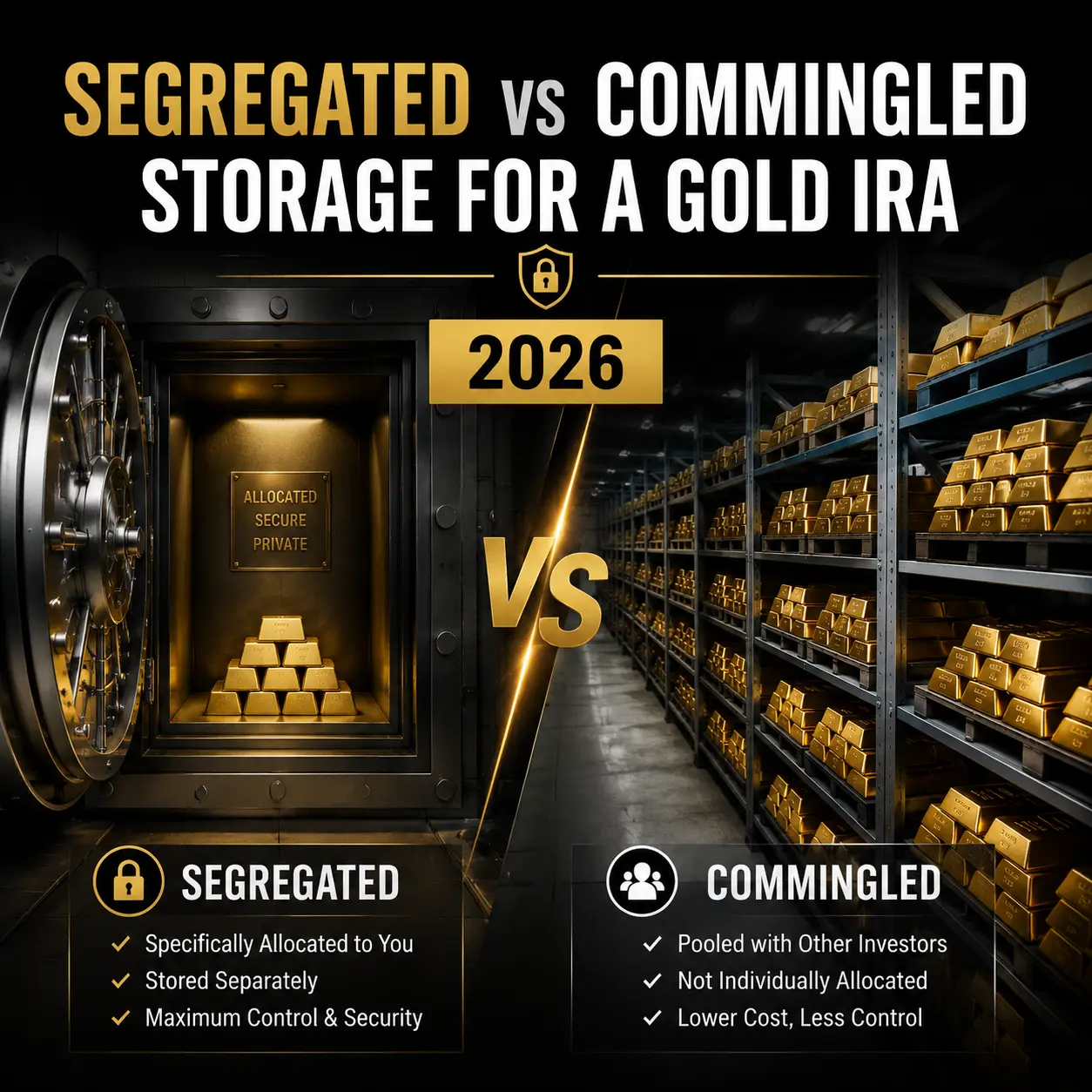
Weight does appear in these schedules, but outside annual storage. The Texas non-storage table prices domestic shipping at a flat charge plus a small percentage of value, valid for up to 5,000 ounces of silver or 100 ounces of gold — fifty times the silver by weight for the same fee. That is bulk being accommodated, not surcharged. The segregated vs commingled storage guide covers how the storage arrangement changes the number, and the fees benchmark places storage in the total cost picture.
Where Silver's Cost Drag Actually Sits
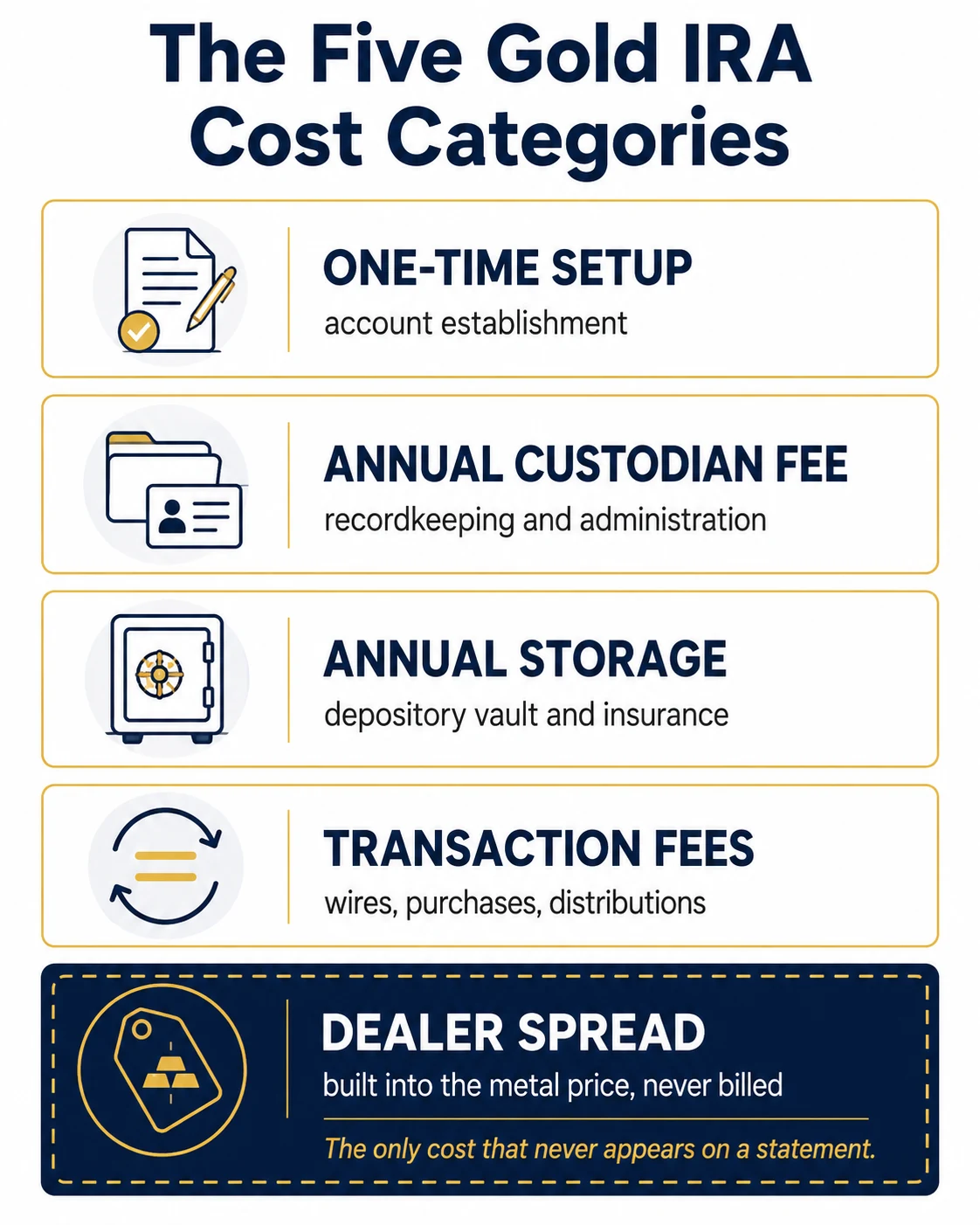
Removing the storage claim does not make silver cheap to hold. It moves the cost to the part of the transaction that no schedule publishes: the dealer's premium on the way in and the buyback spread on the way out.
This page does not publish a silver-versus-gold premium percentage, and the reason is worth stating. A premium is only meaningful measured against the same dealer's own spot price at the same moment. Dealers quote different spot prices from one another, so a product price taken from one dealer and a spot price from another produces a number that looks precise and means nothing. A same-dealer, same-moment pair for both metals was not obtained, so no figure is asserted here.
What can be said without a benchmark: the premium is a percentage of a much cheaper metal, so minting and handling costs weigh more heavily on it, and the round trip is where the money goes. Ask for the premium over spot and the current buyback bid, in writing, for the exact product. The per-product detail is in the dealer markup data, and promotional "free silver" offers are examined in the free silver warning.
The Gold-to-Silver Ratio, With Its Date
The ratio is the figure behind the bulk, and it moves constantly. Computed from World Bank monthly commodity price data, it stood at 69.1:1 in December 2025, the most recent month in the series. The median across the preceding 12 months was 88.9:1, and across 60 months 83.0:1, ranging from 66.3:1 to 101.0:1 over those five years.
An earlier version of this page described the ratio as “often 70:1 to 90:1” without a date. That band held for roughly four of every five months across the last five years, but the most recent observation sits below it and two months in 2025 sat above it. A ratio quoted without its date should be treated as approximate.
When Silver Can Still Make Sense
Higher cost drag does not mean silver is wrong for every investor. Silver has historically been more volatile than gold, which cuts both ways — larger potential moves up and down. Some investors accept silver's higher carrying cost in exchange for that volatility, for industrial-demand exposure, or as a deliberate diversifier alongside gold. The point of this data is not to rule silver out, but to make sure the storage, premium, and spread costs are counted before deciding. Model a scenario on the silver IRA calculator.
Methodology
Fee schedules. Each provider's own published fee page was read on 2 September 2026 and recorded as written. A provider was included only if it published a rate basis that could be read directly; providers whose schedules were not retrievable on that date were left out rather than estimated. “Rate difference by metal” records whether the schedule sets a different storage price for silver than for gold, and every row here records none.
The ratio. Gold and silver monthly prices come from the World Bank Commodity Price Data (the “Pink Sheet”) monthly series, the same source used for this site's inflation and bear-market datasets. The ratio is gold divided by silver for each month; medians and ranges are computed across the trailing 12 and 60 months to December 2025, the most recent month published in the series.
What is deliberately absent. No silver-versus-gold premium percentage appears on this page. Dealer product prices and dealer spot quotes were not obtainable from a single dealer at a single moment, and a premium computed across two dealers is not a valid measurement. No regulator publishes a per-metal premium benchmark. Rather than publish an approximate figure, the premium is described qualitatively and readers are directed to obtain it in writing.
Limits. Four schedules are not the whole market, and fee schedules change without notice. This page records what four named providers published on one date. Confirm current written pricing before funding an account.
How to Cite This Page
Source: 401ktogoldira.org — Silver IRA vs Gold IRA Cost Comparison.
https://401ktogoldira.org/silver-vs-gold-ira-cost/
Frequently Asked Questions
Does a Silver IRA cost more to store than a Gold IRA?
Not according to the published schedules checked on 2 September 2026. All four price storage on account value, a flat annual fee, or the number of asset types held, and none charges a different storage rate for silver than for gold. Texas Bullion Depository states the same rates apply to gold, silver, platinum and palladium, and STRATA's commingled storage fee covers all four metals at one price.
Doesn't silver take up more vault space than gold?
Yes, and that is where the confusion starts. The same dollar amount of silver is far bulkier. But the schedules checked here do not convert that bulk into a higher storage rate, because they charge on account value or a flat fee rather than on weight or volume. Weight does appear in non-storage items such as shipping and handling, which are charged per transaction rather than annually.
Are silver premiums higher than gold premiums?
Dealer premiums are quote-specific and no regulator publishes a per-metal benchmark. A premium can only be measured against the same dealer's own spot price at the same moment, because dealers quote different spot prices from each other. This page does not publish a premium percentage, because a comparable same-dealer, same-moment pair was not obtained. Request the premium for the specific product in writing.
What is the gold-to-silver ratio now?
It was 69.1:1 in December 2025, the most recent month in the World Bank monthly series. The median over the preceding 12 months was 88.9:1 and over 60 months 83.0:1, ranging from 66.3:1 to 101.0:1 across those five years. The ratio moves continuously, so any single figure should be read with its date. The gold and silver mix calculator can model a combined split alongside stocks or bonds using assumed returns.
Update Log
- 2 September 2026: Rebuilt on published fee schedules. A source audit found the page had asserted that depositories price storage by space and weight, so silver costs more to store per dollar. No published schedule supports that: four were checked and none charges a different storage rate by metal. The storage claim was corrected, the undated 70:1–90:1 ratio band replaced with dated figures computed from World Bank monthly data, and the premium claim reduced to a qualitative statement because a valid same-dealer measurement was not obtainable.
- 2026: Initial silver-vs-gold cost comparison published with the cost-factor table, bulk/premium analysis, methodology, and FAQ schema.
Article reviewed and edited by Daniel — independent precious-metals retirement researcher.