Educational only: This article is general educational information for public-sector workers. It is not financial, tax, legal, pension, investment, or retirement-planning advice. Public retirement systems and employer plans have different rules, and state law may affect benefits. Customers should speak to a financial or tax advisor before making decisions. Goldco does not offer tax or legal advice. Past performance does not guarantee future results.
86% of state and local government workers had access to a defined-benefit pension in March 2025 — compared with just 14% of private-industry workers.
Source: U.S. Bureau of Labor Statistics. A pension foundation changes the job of any supplemental savings — it does not remove investment risk.
Key takeaways
- Public-sector retirement is usually two layers: a defined-benefit pension plus a supplemental 457(b), 403(b), or deferred-comp account.
- A gold IRA is a separate, third layer — a self-directed IRA holding qualifying metal, relevant only after an eligible rollover or through regular IRA contributions.
- Not every balance is portable: a rollover needs an eligible distribution and a plan-approved event like severance from employment.
- Rolling a governmental 457(b) can cost its special early-distribution treatment — review that before moving money if under 59½.
- A pension does not make gold appropriate. Metal is one proportionate diversification choice, weighed against fees, storage, and liquidity.
Quick answer: A state or local employee may have a pension plus a 457(b) or 403(b). An eligible distribution from a supplemental plan can often be rolled to an IRA after severance from employment or another plan-approved event. A gold IRA is simply a self-directed IRA using qualifying metal and independent custody, and it should be considered only as one proportionate part of a diversified retirement plan. The useful questions are what benefits already exist, which balances are portable, when the employer plan permits a distribution, what tax and access features could be lost after a rollover, and how physical-metal fees, custody, and liquidity would affect the plan.
How Can a Government Employee Retirement Gold IRA Fit Into a Public-Sector Plan?
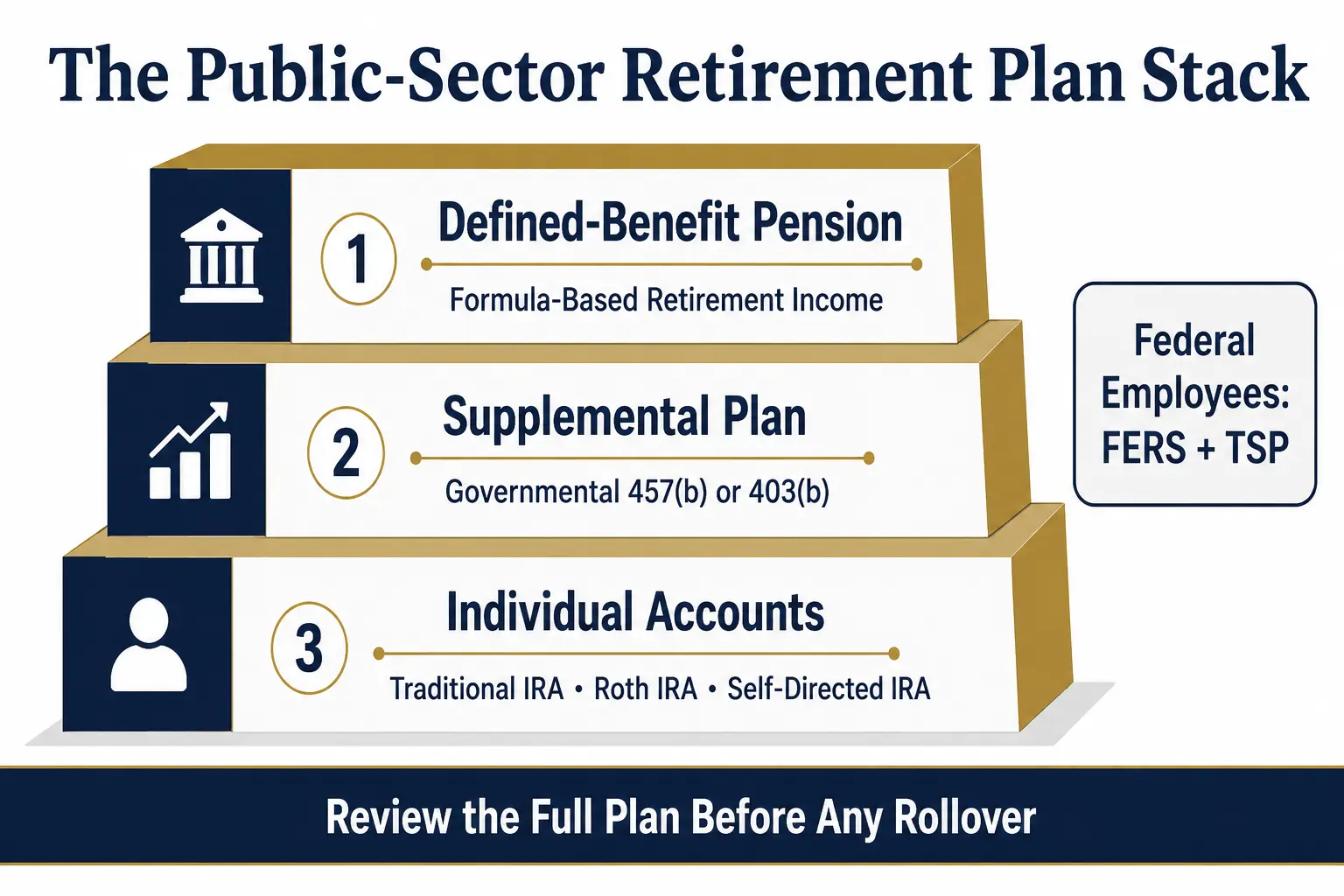
A government employee retirement gold IRA is not a replacement for a public pension, 457(b), 403(b), or federal Thrift Savings Plan. It is a separate self-directed IRA that may hold qualifying precious metals through an approved trustee or custodian. For many state, local, and municipal workers, the retirement structure has two layers: a defined-benefit pension that may provide formula-based monthly income, and a supplemental account such as a governmental 457(b), 403(b), or deferred-compensation plan. A self-directed IRA may become a third layer after a qualifying rollover or through regular IRA contributions, and precious metals can be one limited diversification choice inside that IRA — but the decision should be made in the context of the full pension and investment picture.
What Retirement Plans Do Government Employees Usually Have?
Public-sector retirement benefits vary by state, city, county, school system, agency, union agreement, job classification, and hiring date, but the most common structure differs from the private-sector model. The Bureau of Labor Statistics reported that 86% of state and local government workers had access to a defined-benefit plan in March 2025, compared with 14% of private-industry workers, and that 38% of state and local government workers had access to a defined-contribution plan (U.S. Bureau of Labor Statistics). Those figures show why a public-sector retirement plan often includes both a pension foundation and an individual savings account.
What is a defined-benefit pension?
A traditional defined-benefit plan uses a formula that may include age, years of service, and earnings to determine the retirement benefit (U.S. Bureau of Labor Statistics). A state pension, teachers' retirement system, city pension, or county retirement system may use a service-credit percentage, years of covered employment, final or highest average pay, retirement age, and survivor-benefit elections. The exact formula comes from the plan, not from federal IRA rules. A pension is usually designed to provide retirement income, not a portable account balance that can be moved into an IRA — though some public systems may offer a refund of employee contributions, a lump-sum option, or a defined-contribution alternative, depending on the plan document and state law.
What is a governmental 457(b) plan?
A governmental 457(b) is a deferred-compensation plan used by state and local governments and their agencies. The IRS states that 457(b) plans allow employees of sponsoring organizations to defer income taxation on retirement savings, and for 2026 the basic elective-deferral limit is $24,500, subject to plan terms and available catch-up provisions (Internal Revenue Service; Internal Revenue Service). A major feature is distribution access: IRS guidance lists severance from employment and certain other events as distributable events for governmental 457(b) plans (Internal Revenue Service). Governmental 457(b) distributions are generally not subject to the 10% additional tax that applies to many early retirement-plan distributions, except for amounts attributable to rollovers from another plan or IRA — so rolling the balance to an IRA can change later early-distribution treatment (Internal Revenue Service). That access feature should be reviewed before a rollover.
What is a 403(b) plan?
A 403(b) is a retirement plan available to public schools, public colleges and universities, certain tax-exempt organizations, and eligible ministers. The IRS states that employees can defer salary into individual accounts, employers may also contribute, and a 403(b) may use annuity contracts, mutual-fund custodial accounts, or certain retirement-income accounts (Internal Revenue Service). Public-school teachers, administrators, and other eligible education workers may have both a pension and a 403(b), and some school systems also offer a 457(b), creating two separate supplemental savings options. The IRS states that a 403(b) plan may permit distributions after age 59½, severance from employment, disability, death, or financial hardship, and that eligible distributions may be rolled to another plan or an IRA (Internal Revenue Service).
How do federal employees fit into the picture?
Federal employees are covered at a high level by a different system. The Office of Personnel Management states that the Federal Employees Retirement System has three parts — the Basic Benefit Plan, Social Security, and the Thrift Savings Plan — and the TSP is the defined-contribution part of that structure (U.S. Office of Personnel Management). Federal workers considering a TSP rollover should use the site's separate TSP-to-Gold-IRA guide, which covers federal mechanics. Police officers, firefighters, emergency personnel, and other public-safety workers may also have special pension or distribution rules, which are deferred to the Gold IRA guide for first responders.
How Does a Pension Change the Diversification Picture?
A pension changes retirement planning because it may provide a base stream of monthly income while the employee's supplemental accounts remain invested. That does not make the investment accounts unimportant; it changes their job. A pension may cover part of housing, food, utilities, insurance, and other core expenses, and the 457(b), 403(b), IRA, and taxable accounts may then support flexible spending, health costs, inflation exposure, emergency reserves, travel or family support, legacy goals, and income before the pension begins. The full plan should treat the pension as one retirement resource and the investment accounts as another.
Does a pension remove investment risk?
No. A pension can reduce dependence on portfolio withdrawals, but it does not remove all risk. The benefit may depend on service history, retirement age, survivor elections, cost-of-living provisions, and the financial and legal structure of the public system, and the supplemental portfolio still faces market risk, inflation, fees, taxes, and longevity needs.
Why might a pension-heavy saver still diversify savings?
Investor.gov describes diversification as spreading money among different investments to reduce reliance on one asset or risk source, with asset allocation dividing investments among categories such as stocks, bonds, and cash (Investor.gov). A public employee's pension and salary may both be connected to the same government employer, region, and tax environment, so supplemental savings can provide more flexibility because the account holder controls the investment mix and distribution schedule within the plan rules. That does not establish a case for gold by itself: a diversified supplemental account may use stocks, bonds, cash, and other assets, and a modest precious-metals position is only one possible component. No authoritative source establishes one universal state pension diversification percentage or one ideal precious-metals allocation for government employees. The site's retirement portfolio longevity guide explains the broader need to balance current income, long-term growth, and withdrawal risk.
When Can Public-Sector Balances Roll Into an IRA?
A public employee cannot roll every benefit at any time. A rollover requires an eligible rollover distribution, and the employer plan must first permit the distribution. The IRS states that most pre-retirement payments from a retirement plan can be rolled to another eligible plan or IRA, but required minimum distributions, hardship distributions, certain periodic payments, and several other categories are not eligible — and that a participant must meet the plan's conditions for a distribution, such as termination of employment (Internal Revenue Service).
When can a governmental 457(b) roll to an IRA?
Governmental 457(b) plans generally allow eligible rollovers to IRAs and other eligible retirement plans, and severance from employment is a common distributable event, though the actual plan document controls timing, forms of payment, and procedures (Internal Revenue Service; Internal Revenue Service). A rollover can simplify accounts and expand investment choices, but it can also remove the governmental 457(b)'s special early-distribution treatment, so a public employee below age 59½ should review that issue before moving the balance into an IRA (Internal Revenue Service).
Does the same apply to a non-governmental 457(b)?
No, and this is the distinction most commonly missed. A governmental 457(b) — the kind offered by a state, county, city or public school district — can generally be rolled to an IRA once a distributable event occurs. A non-governmental 457(b), offered by a tax-exempt employer such as a private hospital or charity, works differently: those balances remain assets of the employer subject to its creditors until paid, and they generally cannot be rolled to an IRA at all. A transfer is normally only possible to another non-governmental 457(b) plan.
The practical consequence is that a saver at a non-profit hospital and a saver at a county agency can hold accounts with the same name and entirely different options. Anyone relying on a 457(b) to fund an IRA should confirm which type they hold with the plan administrator before making any other arrangement, because no amount of paperwork converts one into the other.
When can a 403(b) roll to an IRA?
A 403(b) plan may permit distributions after severance from employment, age 59½, disability, death, or another listed event, and eligible distributions can generally be rolled to an IRA. A direct rollover normally sends the money from the plan to the receiving IRA: the IRS states that no tax is withheld from a direct rollover, while a retirement-plan payment made to the participant is generally subject to 20% mandatory withholding even when a later 60-day rollover is intended (Internal Revenue Service).
Can a defined-benefit pension roll to an IRA?
Not automatically. A monthly pension benefit is not the same as an individual account balance, and a rollover may be possible only when the pension system offers a qualifying lump-sum payment or refund that meets rollover rules. Taking a refund can reduce or end future pension rights, service credits, survivor benefits, or access to retiree benefits, and those effects depend on the public retirement system. A government employee should request a written estimate comparing the monthly pension, any lump-sum or refund option, survivor benefits, cost-of-living provisions, retiree health rights, tax withholding, rollover eligibility, and the effect of ending membership. Customers should speak to a financial or tax advisor before making decisions about pension elections, rollovers, or account allocations. Goldco does not offer tax or legal advice.
What Is a Gold IRA, and How Would It Fit?
A gold IRA is a marketing name for a self-directed IRA that holds qualifying physical precious metals. The CFTC and FINRA describe gold IRAs as self-directed IRAs used to buy gold or silver bullion with retirement assets (Commodity Futures Trading Commission and FINRA). The IRS generally treats metals and coins as collectibles, with exceptions for certain qualifying bullion and coins, and states that qualifying bullion must remain in the physical possession of a bank or IRS-approved nonbank trustee (Internal Revenue Service). The structure usually involves three roles — a self-directed IRA trustee or custodian, a precious-metals dealer, and a depository or vault used through the custody arrangement — and the account owner directs the investment, but the metal does not become personally held property while it remains inside the IRA. The site's IRA-to-gold-and-silver transfer guide explains the operational steps.
Can a current public-sector plan buy physical gold directly?
Usually, employer plans limit investments to the options selected by the plan. The IRS notes that participant-directed plans may allow workers to choose from offered investments or may restrict the available choices, and a 403(b), 457(b), pension, or TSP does not become a self-directed precious-metals account simply because the participant requests bullion (Internal Revenue Service). A separate IRA generally becomes relevant after an eligible rollover or through regular IRA contributions. For 2026, the regular combined contribution limit for traditional and Roth IRAs is $7,500, or $8,600 for someone age 50 or older, subject to taxable compensation and other rules, and rollover contributions do not count against that annual limit (Internal Revenue Service).
What Are the Trade-Offs of Adding a Self-Directed Gold IRA?
The benefits and costs should be reviewed together. On the diversification role, a limited physical-metals position may add an asset with different return drivers from stocks and bonds, but that does not ensure lower losses, higher returns, or stronger retirement income — gold can rise or fall, and it does not pay interest or dividends. The correct comparison is the full public-sector plan stack: pension, 457(b), 403(b), IRA, cash, and other household assets. The site's retirement gold-allocation guide discusses allocation questions without assigning one percentage to every saver.
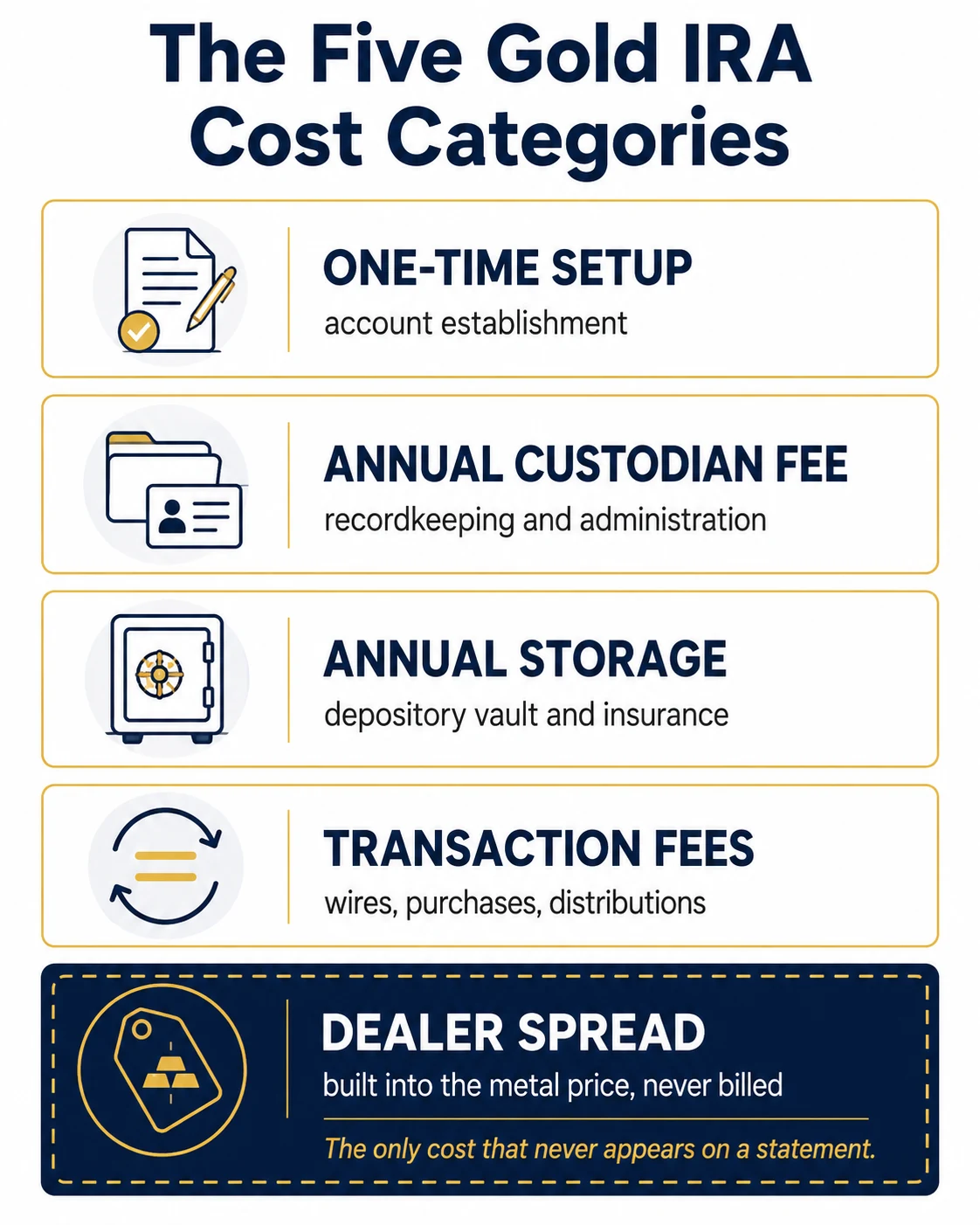
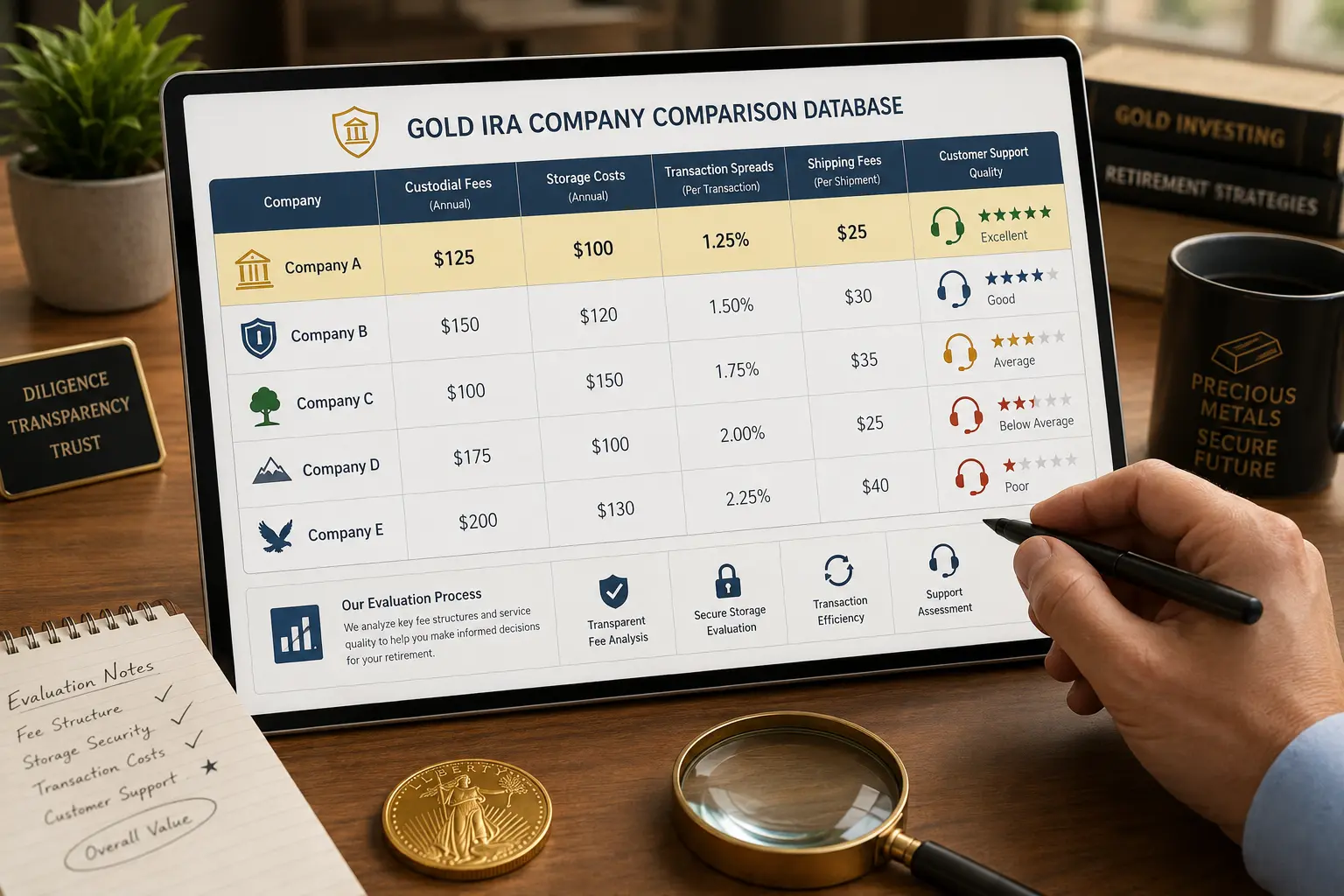
On fees, the CFTC and FINRA advise customers to request all fees, costs, commissions, and retail prices in writing, and identify storage, insurance, custodian administration, dealer spreads, and possible tax consequences as costs that may apply (Commodity Futures Trading Commission and FINRA). A Gold IRA may include dealer markup or spread, account-establishment charges, annual custodian administration, depository storage, insurance or handling, transaction charges, shipping or distribution costs, and account-closure charges — and the total should be compared with the size of the proposed position. On liquidity, physical bullion has a sale process: the CFTC and FINRA explain that a dealer normally sells above spot and buys back below spot, and that collectible or so-called semi-numismatic products may be harder to sell than bullion (FINRA and Commodity Futures Trading Commission). A public employee approaching retirement should consider whether the supplemental account may soon be needed for income, health costs, or emergencies. Finally, a rollover can change plan features — distribution access, loan availability, investment costs, creditor protections, plan-specific withdrawal options, the governmental 457(b) early-distribution rule, and access to institutional investment pricing — so the receiving IRA may offer broader investment choice but fewer employer-plan features.
What Should a Government Employee Check Before Opening One?
A written review can prevent an account decision from being driven by a sales presentation.
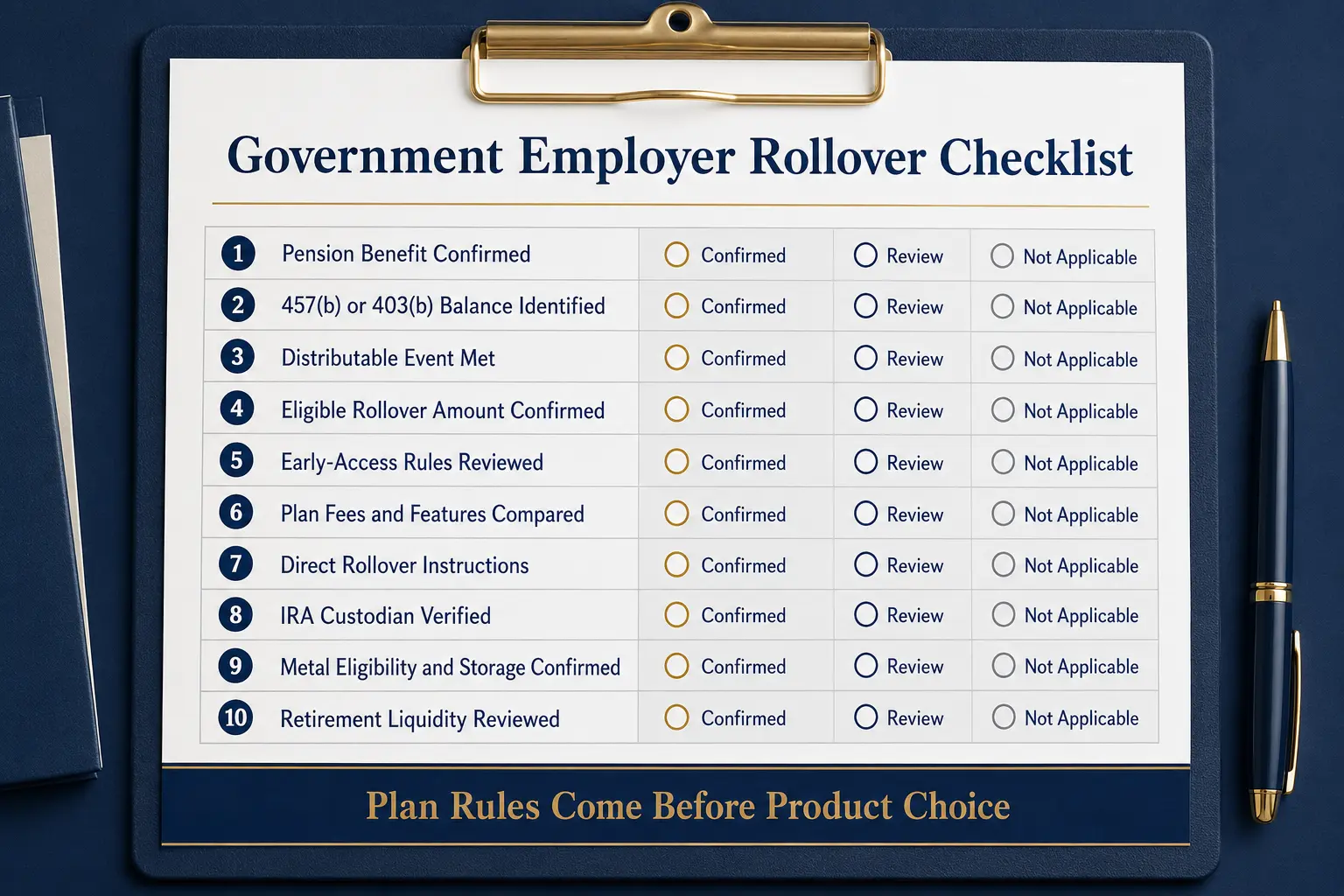
- Identify every retirement layer: pension benefits, 457(b), 403(b), TSP, traditional and Roth IRAs, taxable savings, Social Security coverage, and retiree health benefits.
- Confirm vesting and pension rights. Obtain written pension estimates at several retirement dates and confirm survivor, refund, and health-benefit rules.
- Confirm which balance is actually distributable. A current account balance is not automatically eligible for rollover; the plan administrator should confirm the distributable event and the eligible rollover amount.
- Review lost features before a rollover. A governmental 457(b) deserves special attention because of its early-distribution rules, and a 403(b) may provide plan loans, institutional funds, or annuity features that do not transfer to an IRA.
- Compare the complete written cost, separating dealer, custodian, and depository charges. The CFTC and FINRA advise asking for the current spot value, retail price, spread, buyback price, and all fees in writing (Commodity Futures Trading Commission and FINRA).
- Verify custody and product eligibility. The IRA custodian should confirm the exact coin or bar is eligible and that custody meets IRS rules.
- Keep the proposed position proportionate, using the household portfolio, not only the IRA being transferred.
- Test retirement income needs. A physical-metals position should not consume money needed soon for distributions, health costs, taxes, or emergencies.
The Gold IRA decision quiz can organize these account-structure questions. It does not provide personalized advice.
What Are Common Questions About Gold IRAs for Government Employees?
Can a state employee roll a 457(b) into a Gold IRA?
An eligible governmental 457(b) distribution can generally be rolled to an IRA. The employee must first meet the plan's conditions for a distribution, such as severance from employment or another permitted event. Plan documents control the available options (Internal Revenue Service).
Can a teacher roll a 403(b) into a self-directed IRA?
A 403(b) may permit an eligible rollover after severance from employment, age 59½, or another permitted event. The plan administrator must confirm that the specific distribution is eligible (Internal Revenue Service).
Can a public pension be transferred into a Gold IRA?
Only a qualifying lump-sum or refund distribution may be eligible. A monthly pension is not an account balance that can simply be transferred, and the decision can affect future pension and survivor rights.
Does having a pension mean a Gold IRA is appropriate?
No. A pension changes the income picture, but it does not establish a need for precious metals. The decision depends on the full portfolio, liquidity needs, fees, time horizon, and risk capacity.
Does a rollover count against the annual IRA contribution limit?
No. The IRS states that rollover contributions do not count against the annual IRA contribution limit (Internal Revenue Service).
Can Gold IRA metal be stored at home?
No, not while the metal remains inside the IRA. The IRS states that qualifying bullion must remain in the physical possession of a bank or IRS-approved nonbank trustee (Internal Revenue Service).
Bottom Line
Government employees often retire with a different plan stack from private-sector workers. A state or local worker may have a formula-based pension plus a governmental 457(b), 403(b), or deferred-compensation account, and those supplemental balances may become eligible for rollover after severance from employment or another plan-approved event. A self-directed Gold IRA can fit only as a separate, proportionate diversification choice. The strongest process begins with the pension, preserves valuable plan features, confirms rollover eligibility, compares all written fees, and keeps enough liquid assets for retirement income.
Sources
- U.S. Bureau of Labor Statistics. Access to retirement benefits · Glossary of employee benefit terms.
- U.S. Office of Personnel Management. FERS information · Thrift Savings Plan.
- Internal Revenue Service. IRC 457(b) deferred compensation plans · 457(b) key characteristics · 457(b) vs 401(k) comparison.
- Internal Revenue Service. 403(b) tax-sheltered annuity plans · 403(b) FAQs.
- Internal Revenue Service. Rollovers of retirement plan and IRA distributions · Exceptions to early-distribution tax · IRA contribution limits.
- Internal Revenue Service. 2026 contribution limits · Investments in collectibles · IRA FAQs.
- Investor.gov (U.S. SEC). Asset allocation.
- CFTC and FINRA. 10 things about precious-metals IRAs · Buying physical gold or other metals.
Reviewed and edited by Daniel M. — editor, 401kToGoldIRA.org. Educational only; sourced to the U.S. Bureau of Labor Statistics, the Office of Personnel Management, the IRS, Investor.gov (SEC), and the CFTC/FINRA. Not financial, tax, or investment advice.