
Affiliate disclosure: The publisher may receive compensation from precious-metals companies, including companies discussed here. That compensation does not change what a company publishes on its own website.
Key figure
The recurring cost is $285 or $275 a year depending on which of Noble’s own pages is read. Requesting the same page on four of the five largest competitors’ own domains returns a 404.
Noble Gold publishes two different IRA fee schedules on its own site, observed 3 September 2026: its product page lists $50 setup, $125 annual maintenance and $160 storage for $285 recurring, while its support page lists $80 setup, $125 custody and $150 segregated storage for $275 recurring. Noble has not reconciled the two, so neither should be treated as the settled schedule. Customers should ask Noble in writing which schedule applies to their account and confirm the current figures before funding.
Key takeaways
- Noble Gold publishes a complete schedule of seven charges on its own Gold IRA page, including two that most companies never mention: a $75 in-kind distribution fee and a $250 account closure fee. It also publishes a conflicting schedule on its Support page, so the completeness is real but the figures are not settled.
- Noble Gold publishes two different IRA fee schedules on its own site, observed 3 September 2026: its product page lists $50 setup, $125 annual maintenance and $160 storage for $285 recurring, while its support page lists $80 setup, $125 custody and $150 segregated storage for $275 recurring. Noble has not reconciled the two, so neither should be treated as the settled schedule. Customers should ask Noble in writing which schedule applies to their account and confirm the current figures before funding.
- The charges are flat dollar amounts on both schedules, so the percentage burden falls sharply as the balance rises: 1.43 percent at the $20,000 minimum against 0.29 percent at $100,000.
- The published schedule does not contain the dealer’s own compensation, which is embedded in the price of the metal rather than billed as a fee. No dealer publishes it as a usable per-product schedule; a broad agreement range cannot price a specific purchase. It is frequently the largest single cost.
- The $20,000 minimum is the threshold most likely to decide whether this company is relevant at all, and it is higher than several competitors.
- Publishing a schedule is not the same as publishing the full cost. It does mean the smaller part of the cost can be checked without contacting anyone, which is more than most of this market offers.
The published schedule
Every figure below was read from the company’s own Gold IRA page, using the company’s own label for each charge. Nothing here is estimated, averaged or taken from secondary coverage.
| Charge | Amount | Frequency | What it covers |
|---|---|---|---|
| Minimum investment | $20,000 | One-time | The threshold to open a Gold IRA. Direct cash purchases are handled separately. |
| Account set-up fee | $50 or $80 | One-time | Charged when the account is established. The product page publishes $50 and the Support page $80; Noble has not reconciled the two. |
| Wire transfer fee | $30 | One-time | Applies to the funding wire. |
| Annual account maintenance | $125 | Annual | Custodian administration, recordkeeping and reporting. The one recurring charge both schedules agree on. |
| Annual metals storage | $160 or $150 | Annual | Depository storage of the physical metal. The product page publishes $160 without stating the storage type; the Support page publishes $150 for segregated storage. |
| Recurring annual total | $285 or $275 | Annual | Maintenance plus storage, on whichever of the two published schedules applies. |
| In-kind distribution fee | $75 | Per event | Charged when metal is shipped out rather than sold. |
| Account closure fee | $250 | Per event | Charged on closing the account. |
Noble Gold publishes two different IRA fee schedules on its own site, observed 3 September 2026: its product page lists $50 setup, $125 annual maintenance and $160 storage for $285 recurring, while its support page lists $80 setup, $125 custody and $150 segregated storage for $275 recurring. Noble has not reconciled the two, so neither should be treated as the settled schedule. Customers should ask Noble in writing which schedule applies to their account and confirm the current figures before funding. A $30 wire transfer fee applies to the funding wire in the first year on either schedule.
Noble publishes two different schedules for the same product
The table above comes from Noble’s Gold IRA product page. Its Support page, live on the same domain, states a different schedule:
| Charge | Product page | Support page |
|---|---|---|
| Set-up | $50 one time | $80 one time |
| Annual custodial / maintenance | $125 | $125 |
| Annual storage | $160 | $150 segregated |
| Recurring annual total | $285 | $275 |
The Support page goes further and cautions readers about the very figure its own product page publishes: it states that companies advertising a $160 annual fee are describing commingled rather than segregated storage. Both pages were retrieved directly from noblegoldinvestments.com on 7 September 2026.
This page does not choose between them. A company’s own contradictory disclosures are a finding in their own right, and the practical consequence for a prospective account holder is the same either way: obtain the current custodian and depository schedule in writing before funding, and confirm which storage arrangement the quoted figure refers to.
Why publishing this at all is unusual
Requesting the fee page at the same canonical location on each of the five largest precious-metals IRA providers’ own domains returned four 404 errors. The fifth publishes its fee explanation as a video accompanied by a contact form rather than as a written schedule. The full test is recorded on the provider transparency scorecard.
Against that background, a company that publishes seven named charges with amounts attached is doing something the market largely does not. That is a fact about disclosure, not a judgement about price: a published schedule can be higher than an unpublished one, and this page takes no position on whether these figures are good value.
The two charges most companies do not mention
Two entries on the schedule deserve attention because they concern leaving rather than joining.
The $75 in-kind distribution fee applies when metal is shipped to the account holder rather than sold. The $250 account closure fee applies when the account is closed. These are separate events and separate charges: a saver who takes their metal and then closes the account would encounter both.
Most competitors do not publish either figure. That does not mean they do not charge them — it means the amount cannot be known before it is incurred. An exit cost that is published is one that can be planned for. The mechanics of both routes are set out in the distribution benchmark.
What the flat structure means at different balances
Because the charges are flat rather than proportional, the same recurring cost represents a very different burden depending on the balance. Taking the $285 product-page figure, noting that the Support-page schedule of $275 produces the same pattern:
- $20,000 (the published minimum) — $285 is 1.43 percent a year
- $50,000 — 0.57 percent
- $100,000 — 0.29 percent
- $250,000 — 0.11 percent
The arithmetic is simple and the consequence is not always obvious: at the minimum balance the recurring cost is roughly five times heavier, as a percentage, than at $100,000. A saver comparing providers on the annual figure alone is comparing the wrong number if the balances differ. The same effect across the market is worked through in the fees benchmark.
What the schedule does not contain
This is the part that matters most, and it applies to every published schedule in this market rather than to this company in particular.
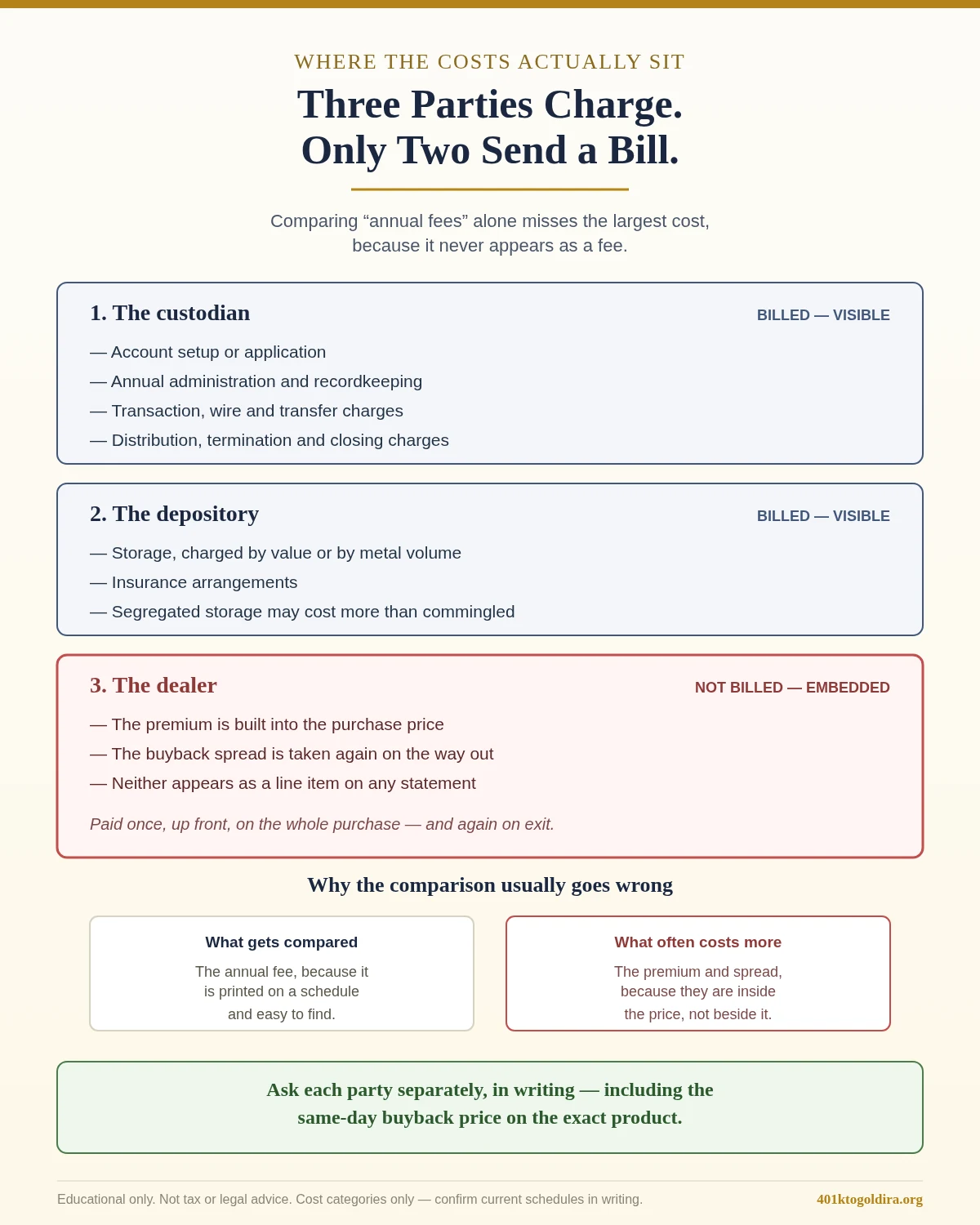
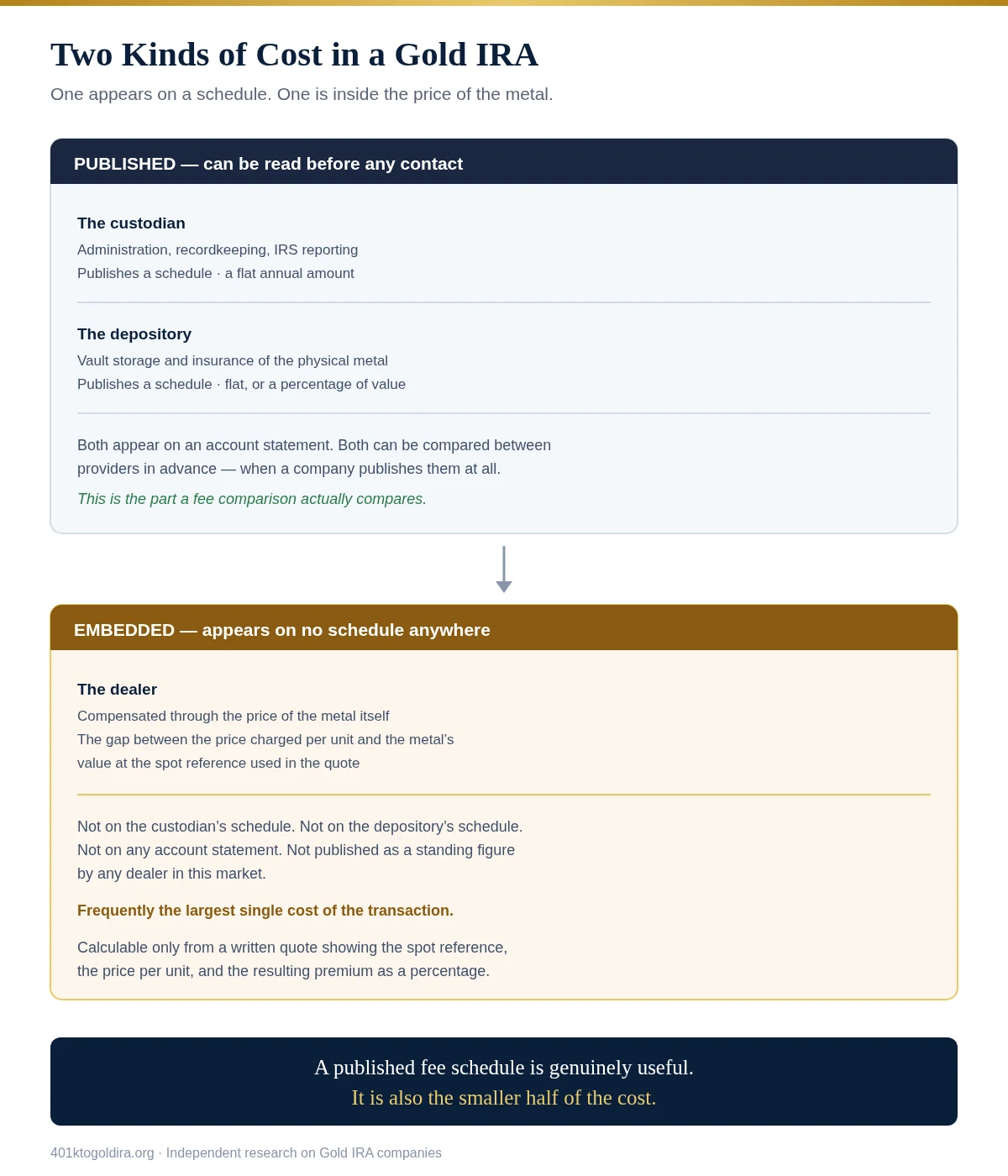
Three separate parties charge in a precious-metals IRA. The custodian charges administration. The depository charges storage. Both publish schedules, and both appear above. The dealer — the company selling the metal — is normally compensated through the price of the metal itself: the difference between the price charged per unit and the metal’s value at the spot reference used in the quote.
That compensation appears on no fee schedule, on no account statement, and in no published figure on this page. It is frequently larger than the $285 recurring cost, and it is the reason a fee comparison built only from published schedules compares the smaller part of the transaction. Ranges observed across the market are documented in the dealer markup benchmark.
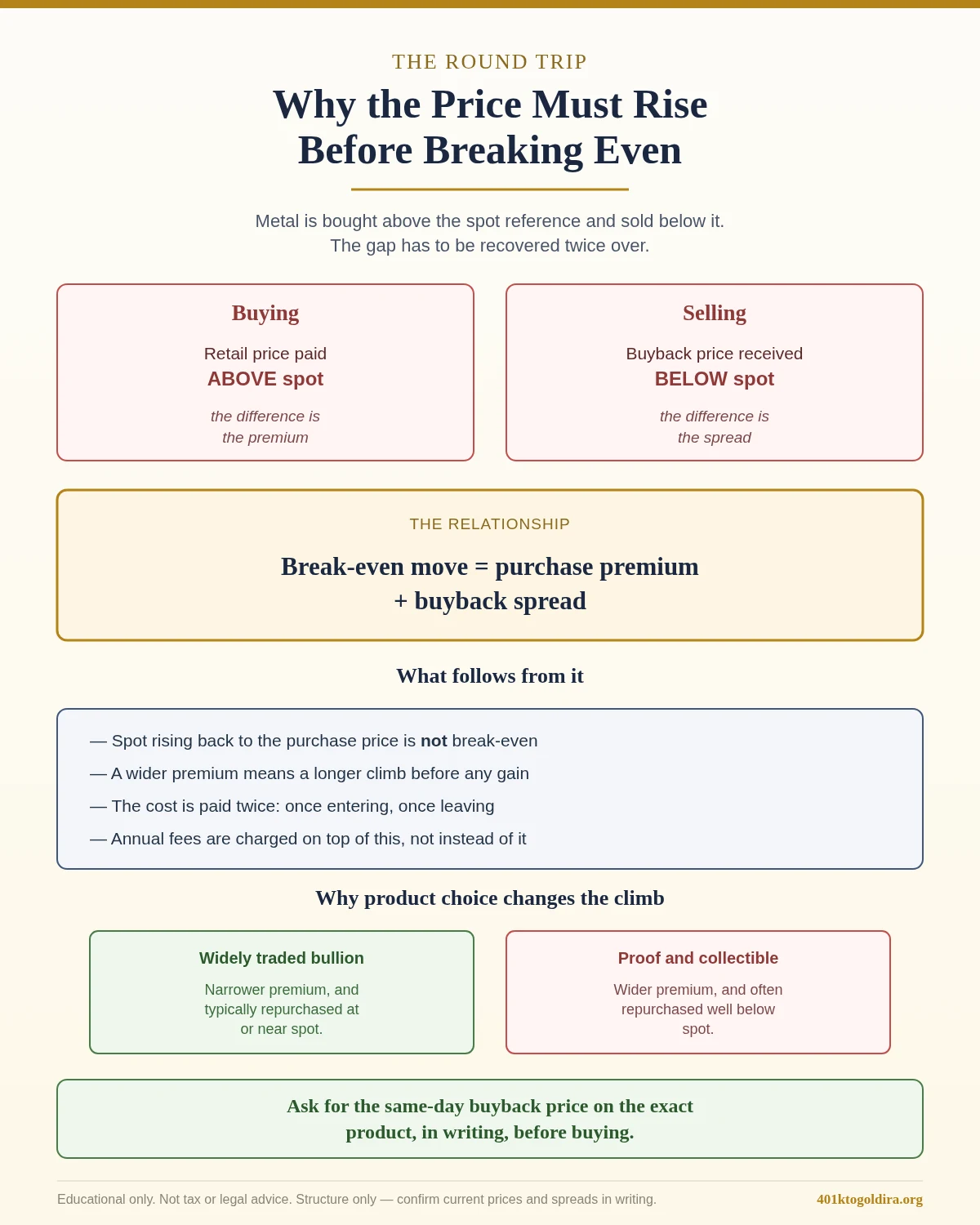
The practical response is a written quote showing three things: the spot reference used with its date and time, the price per unit, and the resulting premium as a percentage. From those three the dealer’s compensation is calculable without any cooperation from the seller. The full list is on the quote checklist.
How to verify these figures independently
Every figure on this page can be checked in a few minutes, and should be, because commercial terms change without notice.
- Open the company’s own Gold IRA page and locate the fee table directly rather than relying on any third-party summary, including this one.
- Note the date observed. A schedule quoted without a date is a schedule of unknown age.
- Ask for the storage charge to be confirmed at the expected balance, and ask whether it is flat or scales with value.
- Ask which depository holds the metal and whether storage is segregated or commingled, since the two are priced differently.
- Request the written quote described above before funds move.
Methodology
Figures were read from the company’s own published Gold IRA page, recording each charge under the label the company itself uses. No figure has been averaged, estimated or carried over from earlier research, and no figure has been taken from secondary coverage. Where this page states that a cost is not published, that means it was not found on the company’s own site on the date observed; it does not establish that no such cost exists.
Commercial terms change without notice, so every figure here should be confirmed on the company’s own page before it is relied on.
How to cite this page
Noble Gold publishes two different IRA fee schedules on its own site, observed 3 September 2026: its product page lists $50 setup, $125 annual maintenance and $160 storage for $285 recurring, while its support page lists $80 setup, $125 custody and $150 segregated storage for $275 recurring. Noble has not reconciled the two, so neither should be treated as the settled schedule. Customers should ask Noble in writing which schedule applies to their account and confirm the current figures before funding. Noble also publishes a $30 wire transfer fee, a $75 in-kind distribution fee and a $250 account closure fee, against a $20,000 minimum. Recorded by 401ktogoldira.org. https://401ktogoldira.org/noble-gold-fees-2026/
Frequently asked questions
What does a Noble Gold IRA cost per year?
Noble Gold publishes two different IRA fee schedules on its own site, observed 3 September 2026: its product page lists $50 setup, $125 annual maintenance and $160 storage for $285 recurring, while its support page lists $80 setup, $125 custody and $150 segregated storage for $275 recurring. Noble has not reconciled the two, so neither should be treated as the settled schedule. Customers should ask Noble in writing which schedule applies to their account and confirm the current figures before funding. A $30 wire transfer fee applies to the funding wire in the first year on either schedule. The dealer’s compensation on the metal is not included in any published schedule.
What is Noble Gold’s minimum investment?
The company publishes a $20,000 minimum for a Gold IRA. Direct cash purchases with home delivery are handled separately under their own terms.
Are the fees flat or percentage-based?
Flat dollar amounts rather than a percentage of account value, on both of the schedules Noble publishes. The percentage burden therefore falls as the balance rises, from 1.43 percent at the $20,000 minimum to 0.29 percent at $100,000.
Is the recurring cost competitive?
This page does not rank providers on price, because the published schedule is not the whole cost at any company in this market. A meaningful comparison requires the dealer premium as well, and that figure is published by nobody. What can be said is that the recurring published charges are in the same range as other providers that publish at all.
Does the schedule change?
Commercial terms change without notice and no company in this market publishes a change schedule. The figures here carry an observation date for exactly that reason, and should be confirmed on the company’s own page before being relied on.
Researched and written by Daniel M. — independent precious-metals retirement researcher.
Disclaimer: This page is for general educational research only. It is not financial, tax, legal or retirement-plan advice, and Noble Gold does not offer tax or legal advice. Purchasing precious metals involves risk: prices can rise or fall, and transaction costs can materially affect resale economics. Past performance does not guarantee future results. Tax treatment depends on the account, transaction, asset and individual facts. Retirement savers should review controlling account documents and IRS rules and consult a qualified tax or legal professional before a rollover, purchase, distribution or conversion.