Affiliate disclosure: Some links on this page may be sponsor links. The site owners may be compensated if customers request information from companies mentioned here. This page is educational only and does not provide financial, tax, or legal advice. Customers should speak with a financial or tax advisor before making retirement-account decisions. Past performance does not guarantee future results.
Quick Answer: How the 4 Percent Rule Relates to Gold IRAs
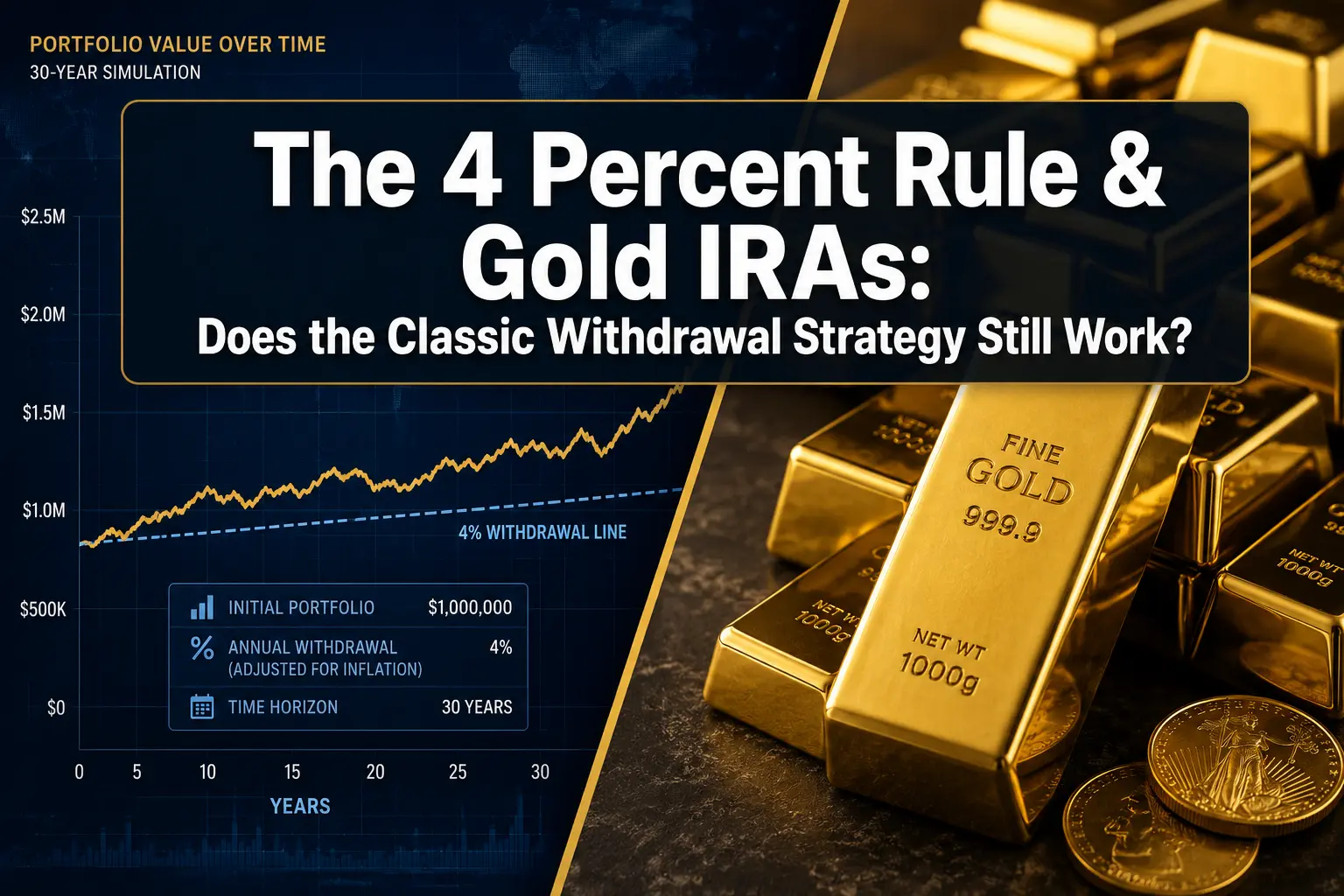
The 4 percent rule suggests withdrawing about 4% of a retirement portfolio in the first year of retirement, then adjusting that dollar amount for inflation each year. When a portfolio includes a Gold IRA, the concept still helps frame retirement income planning, but the mechanics become more complex.
A Gold IRA does not automatically improve or weaken a safe withdrawal strategy. It changes the portfolio’s liquidity, tax handling, distribution mechanics, and RMD planning. Physical metals may need to be sold for cash or distributed in kind, and those steps can affect timing, costs, and tax reporting.
What the 4 Percent Rule Actually Says
The original 4 percent rule emerged from retirement research on balanced stock-and-bond portfolios. In simple terms, it tested whether a retiree could withdraw roughly 4% of the starting portfolio value in year one, then increase that dollar amount for inflation each year over a 30-year period.
The rule is often treated as a quick retirement-income benchmark, but it is not a guarantee. It relies on assumptions about market history, investment mix, retirement length, inflation, and spending behavior.
Later research has produced a range of safe-withdrawal estimates depending on expected returns, valuation levels, spending flexibility, and portfolio allocation. That is why many planners treat the 4 percent rule as a starting point rather than a rigid instruction.

What the Rule Does Not Account For
The 4 percent rule is useful because it is simple. That simplicity is also its limitation. It does not fully account for changing spending patterns, taxes, different account types, investment fees, portfolio valuation, health costs, or the practical mechanics of physical-asset withdrawals.
Gold IRAs add several extra variables:
- Physical metals do not pay income. Gold bars and coins do not generate interest or dividends.
- Liquidity requires a process. Metals may need to be sold through a dealer or distributed in kind.
- Spreads and storage costs matter. Selling metals may involve dealer spreads, transaction fees, and account costs.
- RMDs can override a preferred withdrawal rate. Traditional IRAs require minimum distributions at applicable ages.
Customers should speak with a financial or tax advisor before making withdrawal, distribution, or rollover decisions.
How Gold Allocation Can Affect Liquidity and Volatility
Gold has historically behaved differently from stocks and bonds, which is why some portfolios use it as a modest diversifying sleeve. However, gold can also be volatile, and it does not automatically raise safe withdrawal rates.
For Gold IRAs, liquidity is especially important. A portfolio that relies on regular spending cash cannot assume that physical metals will function like a money market fund or bond ladder. Selling metals can take time, and proceeds may be affected by bid prices and dealer spreads.
Related context appears in the Are Gold Bars a Good Investment? guide and the Gold IRA Exit Strategies article.

Sequence-of-Returns Risk and Why Timing Matters
Sequence-of-returns risk is the risk that poor returns early in retirement, combined with withdrawals, permanently reduce a portfolio’s ability to support future income. Two portfolios can have the same long-term average return but very different outcomes depending on when losses occur.
Gold may help diversify in some periods, but its behavior is not guaranteed. In some downturns it may hold value or rise; in others it may be flat or volatile. A retirement plan should not assume that gold will always offset stock declines at the exact moment withdrawals are needed.
Some planners address sequence risk with cash reserves, bond ladders, flexible spending rules, guardrails, or dynamic withdrawal strategies. A Gold IRA can be one part of that plan, but it needs to be coordinated with the rest of the household portfolio.
RMDs and Physical Metals
Traditional Gold IRAs are subject to required minimum distribution rules, like other traditional IRAs. That means RMDs can interact with or override a simple 4 percent withdrawal framework later in retirement.
With physical metals, RMDs may require selling metals inside the IRA or taking an in-kind distribution. Either path needs fair market valuation, custodian paperwork, and tax reporting. Missing or miscalculating an RMD can create penalties.
The Gold IRA RMD Strategy guide explains the RMD mechanics in more detail. Customers should speak with a financial or tax advisor before making RMD or distribution decisions.
How Gold IRAs Fit Into Retirement Withdrawal Planning
In practice, a Gold IRA usually sits alongside other accounts: traditional IRAs, Roth IRAs, 401(k)s, taxable investment accounts, cash reserves, and sometimes annuities or pensions. Withdrawal planning looks at the full picture, not just one account.
Planners may consider which accounts fund early retirement, which accounts are reserved for later RMDs, and whether metals should be sold gradually or held for a specific purpose. The Gold IRA Calculator can help frame allocation scenarios, but it does not replace personalized advice.
Gold IRA Educational Video
The approved educational video can help explain the broader Gold IRA concept before comparing withdrawal and allocation questions.
Video published by Goldco on YouTube — a company this site has an affiliate relationship with. Embedded as a third-party explanation; not produced, endorsed or independently verified by this site.
Example Withdrawal Planning Scenarios
Example scenarios can show how a Gold IRA may fit into a broader retirement withdrawal plan. These are educational examples only and are not recommendations.
- Modest gold allocation: a balanced portfolio includes a small Gold IRA sleeve, while regular spending comes mostly from cash, bonds, or diversified brokerage assets.
- Larger physical-metals allocation: a household holds more of its IRA value in metals and therefore needs more deliberate liquidity planning before annual withdrawals or RMDs.
- Dynamic withdrawal strategy: spending is adjusted after large portfolio declines or strong markets rather than following a fixed inflation-adjusted withdrawal every year.
These scenarios do not imply that gold improves retirement outcomes. They show that gold changes liquidity, valuation, and distribution planning.

Questions for a Financial Planner
Because safe withdrawal research and Gold IRA rules are both complex, investors often prepare questions for a financial planner or tax professional.
- How should a Gold IRA be integrated into the full retirement withdrawal plan?
- Which accounts should fund early retirement spending?
- How should RMDs from Gold IRAs and other traditional IRAs be coordinated?
- What tax impact could cash or in-kind Gold IRA distributions create?
- What role should physical gold play in the total retirement portfolio?
- How might inherited Gold IRA rules affect a spouse or heirs?
The Inherited Gold IRA Rules guide explains beneficiary considerations. The Best Gold IRA Companies page can help organize provider comparisons after the planning questions are clear.
Customers should speak with a financial or tax advisor before making retirement income, allocation, tax, or distribution decisions.
FAQ
Does the 4 percent rule automatically apply to portfolios with Gold IRAs?
No. The 4 percent rule was developed using stock-and-bond portfolio research. Adding a Gold IRA changes liquidity, costs, RMD mechanics, and distribution timing, so planners usually adapt withdrawal strategies.
Can gold improve a safe withdrawal rate?
Gold may diversify some portfolios in some market periods, but there is no universal evidence that gold reliably increases safe withdrawal rates. Withdrawal outcomes depend on asset mix, spending, market returns, taxes, and liquidity.
How do RMDs interact with the 4 percent rule?
RMDs impose minimum withdrawal amounts from traditional IRAs, including Gold IRAs. Later in retirement, RMD percentages can rise above a 4 percent framework and force larger withdrawals from tax-deferred accounts.
Can RMDs from a Gold IRA be taken as metals instead of cash?
Yes, when supported by the custodian and depository. The metals’ fair market value generally counts toward the RMD and may be taxable for traditional IRAs.
Is a fixed 4 percent withdrawal rate still considered safe today?
Recent retirement research suggests that safe starting withdrawal rates depend on market conditions, asset allocation, and spending flexibility. Many estimates fall around the 3–4% range, but no single number applies to every household.
How should retirees think about gold allocation for withdrawals?
Gold is often treated as a modest diversifying sleeve rather than a primary income source. Liquidity, RMDs, and distribution preferences influence how much gold belongs in a withdrawal-focused portfolio.
Do Gold IRAs pay regular income like bonds?
No. Physical metals do not pay interest or dividends. Gold IRA withdrawals usually require selling metals or taking in-kind distributions.
What tools can help model withdrawals that include Gold IRAs?
Educational tools such as the Gold IRA Calculator can help frame allocation scenarios, while retirement income research and professional planning can help tailor assumptions. Customers should speak with a financial or tax advisor before making decisions.
Further Reading
 Gold IRA RMD StrategyPlan required minimum distributions when an IRA holds physical metals.
 Gold IRA Exit StrategiesPlan liquidity, transfers, in-kind distributions, and beneficiary paths before funding.
 Are Gold Bars a Good Investment?Review physical gold considerations before comparing retirement account options.