Gold IRA Industry Statistics 2026: Fees, Purity Rules, Markups & Data
A sourced, citation-ready statistics hub for Gold IRA research: IRS purity thresholds, contribution and distribution rules, dealer markup ranges, tax rates, provider minimums, and the primary sources behind each figure.
View the Data Table →Educational only: This page records published industry figures from named primary sources. It does not provide financial, tax, or legal advice. Customers should speak to a financial or tax advisor before making decisions. Past performance does not guarantee future results.
Key figure
IRA-eligible gold must be at least 99.5% pure, a CFTC advisory places bullion at spot plus 5%–10%, and gains on physical metals can be taxed at a collectibles rate of up to 28%.
Sources: IRS (IRC §408(m), Pub. 590-A/B), CFTC customer advisory (CARES Act era, c. 2020), IRS Topic 409. Full source links in the table below.
Quick Answer: The Numbers That Define a Gold IRA
A Gold IRA is governed less by market hype than by fixed rules and cost structures. The figures that matter most to a first-time researcher are the IRS purity thresholds (99.5% gold, 99.9% silver, 99.95% platinum/palladium), the collectibles tax rate of up to 28%, and the requirement that metals be held by an approved custodian rather than at home. Dealer pricing is the one area with no fixed rule: a CFTC advisory places bullion at spot plus 5% to 10% and numismatic coins at 40% to 200% above spot, but no regulator maintains a current benchmark, so the premium on a specific product has to be obtained in writing.
Gold IRA Data Table (2026)
Each figure below is a self-contained, sourced data point drawn from IRS statute and publications, federal customer advisories, and public enforcement filings. Regulator statements and enforcement allegations are labelled separately: a markup alleged against a firm under investigation describes that firm, not the market. Provider fees, spreads, and promotions change, so customers should confirm current written pricing directly.
| Data area | Figure | What it means | Primary source |
|---|---|---|---|
| IRA-eligible gold purity | 99.5% (.995) minimum | Gold bullion generally must be at least 99.5 percent pure to qualify for an IRA, with the American Gold Eagle allowed as a statutory exception. | IRS collectibles rules / IRC §408(m) |
| IRA-eligible silver purity | 99.9% (.999) minimum | Silver held in an IRA generally must meet a 99.9 percent fineness standard. | IRS / IRC §408(m) |
| Platinum & palladium purity | 99.95% (.9995) minimum | Platinum and palladium generally must meet a 99.95 percent fineness standard to be IRA-eligible. | IRS / IRC §408(m) |
| American Gold Eagle exception | ~91.67% pure, allowed | The 22-karat American Gold Eagle is permitted by statute despite not meeting the .995 threshold. | IRC §408(m)(3) |
| Collectibles tax rate on gains | up to 28% | Gains on physical precious metals can be taxed at a collectibles rate reaching 28 percent when distributed and sold. | IRS Topic on capital gains / collectibles |
| Early-withdrawal penalty | 10% before age 59½ | Distributions before age 59½ can face a 10 percent additional tax in many cases, on top of ordinary income tax. | IRS Publication 590-B |
| Required minimum distributions | begin at age 73 or 75 | Traditional IRAs generally must begin required minimum distributions at the applicable age (73 for those born 1951–1959, 75 for those born 1960 or later). | IRS RMD guidance |
| Home storage of IRA metals | prohibited | IRA metals must be held by an approved trustee or custodian; personal/home storage is generally treated as a taxable distribution. | IRS / IRC §408(m) |
| Bullion premium (regulator statement) | spot plus 5%–10% | A CFTC customer advisory states bullion prices are based on the spot market price plus a markup or premium of between 5 and 10 percent. The advisory dates from the CARES Act period and is not a maintained current average. | CFTC advisory (c. 2020) |
| Numismatic coin premium (regulator statement) | 40%–200% above spot | The same CFTC advisory states numismatic coin premiums can range from 40 to 200 percent above the spot price. | CFTC advisory (c. 2020) |
| Premium-coin markup (enforcement allegation) | ~120%–130% alleged | In SEC v. Red Rock Secured (2023), the complaint alleges premium coins carried markups typically 120 to 130 percent above the firm's own acquisition cost. This is an allegation about one named dealer, not a market benchmark. | SEC complaint (Red Rock Secured, 2023) |
| Buyback pricing | sell below spot | Dealers generally charge above spot on purchase and pay below spot on buyback; the wider the spread, the more prices must rise to break even. | CFTC precious metals advisories |
| Custodian requirement | IRS-approved trustee | A Gold IRA must be administered by an IRS-approved custodian or trustee that holds the metals on the account's behalf. | IRS Publication 590-A |
| Self-directed IRA risk | fraud / valuation / liquidity | FINRA and SEC warn self-directed IRAs can involve fraud, valuation, and liquidity risks because custodians do not vet investments. | FINRA / SEC investor alerts |
How Much Does a Gold IRA Cost in 2026?
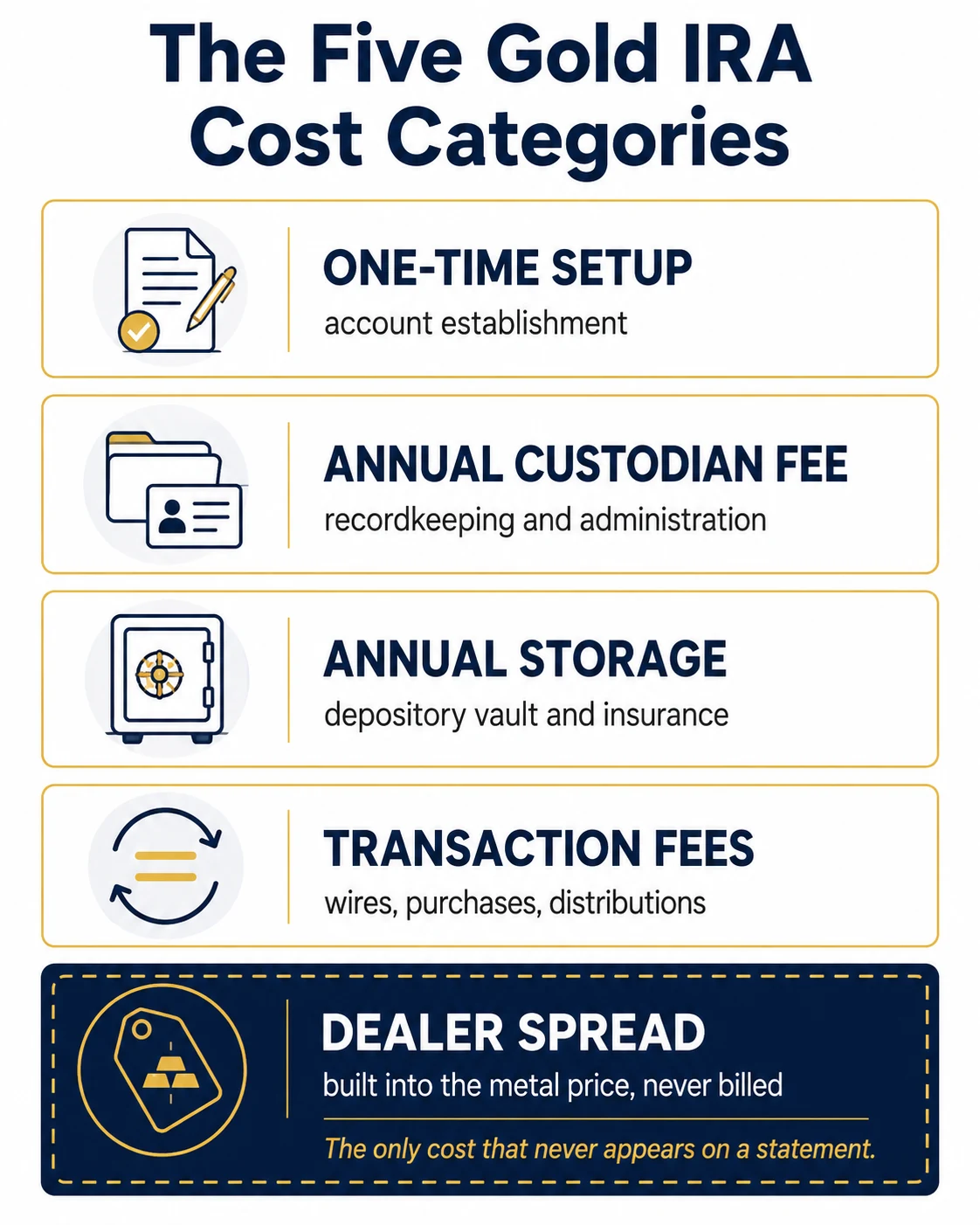
Gold IRA cost comes in layers: dealer markup on the metal, an account setup fee, annual custodian administration, depository storage, and insurance. The single largest and least visible cost is usually the dealer markup. A CFTC customer advisory states that bullion is priced at spot plus a premium of 5% to 10%, while numismatic coin premiums can range from 40% to 200% above spot. That advisory dates from the CARES Act period, so it describes conditions at that time rather than a maintained 2026 average.
Because the markup is embedded in the purchase price rather than billed separately, it can exceed years of annual account fees in a single transaction. That is why written, itemized pricing matters more than a headline promotion. Detailed cost tools appear on the fee calculator, the markups and spreads guide, and the fee comparison chart.
What Metals Are IRA-Eligible?
IRA eligibility is defined by fineness, not by brand. Gold must generally be 99.5% pure, silver 99.9%, and platinum and palladium 99.95%, produced by an approved mint or refiner. The 22-karat American Gold Eagle is a statutory exception allowed despite being about 91.67% pure. Collectible and numismatic coins valued for rarity rather than metal content generally do not qualify, even when they contain significant precious metal.
What Are the Tax Rules and Penalties?
A Gold IRA follows standard IRA tax mechanics with one wrinkle: gains on physical metals can be taxed at a collectibles rate reaching 28% when distributed and sold. Early withdrawals before age 59½ can face a 10% additional tax, and traditional accounts must begin required minimum distributions at the applicable age (73 for those born 1951–1959, 75 for those born 1960 or later). Acquiring a non-eligible collectible inside the account can itself be treated as a distribution. Customers should speak to a financial or tax advisor before making decisions. Goldco does not offer tax or legal advice.
Where Metals Must Be Stored
IRA metals must be held by an IRS-approved trustee or custodian and stored at an authorized depository, in either segregated or commingled arrangements. Personal or home storage of IRA metals is generally treated as a taxable distribution. The custodian records holdings, and the depository provides vaulting, insurance, and independent verification. Storage detail appears on segregated vs commingled storage.
Self-Directed IRA Risk in the Data
FINRA and SEC alerts note that self-directed IRA custodians generally do not evaluate the quality or legitimacy of an investment or its promoter, which places the due-diligence burden on the account holder. Combined with dealer spreads, liquidity limits on some products, and collectibles tax treatment, this is why written pricing, registration checks, and buyback terms carry more weight than marketing claims. Related context appears on gold IRA scam warning signs and the free silver warning.
Live Market-Scale Sources
Beyond the fixed rules above, three moving datasets shape Gold IRA demand. Rather than restate figures that change quarterly, this hub links directly to the primary trackers so researchers cite the source of record.
| Live dataset | What it tracks | Primary source |
|---|---|---|
| U.S. retirement assets | Total IRA and employer-plan assets — the pool providers market to. | Investment Company Institute |
| Gold demand by channel | Bars/coins, ETFs, jewelry, technology, and central-bank buying tracked separately. | World Gold Council |
| Central-bank reserves | Official gold reserves by country. | World Gold Council |
| Inflation (CPI) | Consumer price data relevant to purchasing-power framing. | U.S. Bureau of Labor Statistics |
| Household retirement ownership | Retirement-account ownership by household type. | Federal Reserve SCF |
Methodology
This hub compiles two categories of data. Fixed rules and thresholds (purity, tax rates, penalties, RMD age, storage requirements) are drawn from IRS statute and publications and are stable year to year. Cost and markup ranges are drawn from CFTC and FINRA precious-metals guidance and public SEC enforcement filings; these are presented as reported ranges, not guarantees, because actual pricing varies by dealer, product, and date. Live market figures (retirement asset totals, gold demand, inflation) are linked to their primary trackers rather than restated, so citations point to the source of record. No figures on this page are estimated or synthetic; each maps to a named source. Provider minimums and fees change and should be confirmed in writing.
How to Cite This Page
Source: 401ktogoldira.org — Gold IRA Industry Statistics 2026.
https://401ktogoldira.org/gold-ira-industry-statistics-2026/
Frequently Asked Questions
What purity must gold be for a Gold IRA?
IRA-eligible gold generally must be at least 99.5 percent pure (.995 fineness). The 22-karat American Gold Eagle is a statutory exception allowed despite being about 91.67 percent pure. Silver must generally be 99.9 percent pure, and platinum and palladium 99.95 percent.
How much do Gold IRA dealers mark up metals?
No federal regulator publishes a current, maintained benchmark. A CFTC customer advisory from the CARES Act period states bullion is priced at spot plus a premium of 5 to 10 percent, and that numismatic coin premiums can range from 40 to 200 percent above spot. In SEC v. Red Rock Secured, the complaint alleges premium-coin markups typically 120 to 130 percent above that firm's own cost, which is an allegation about one dealer rather than a market average.
What tax rate applies to Gold IRA gains?
Gains on physical precious metals can be taxed at a collectibles rate reaching 28 percent when distributed and sold. Early withdrawals before age 59½ can also face a 10 percent additional tax. Customers should speak to a tax advisor before making decisions.
Can Gold IRA metals be stored at home?
No. IRA metals must be held by an IRS-approved trustee or custodian and stored at an approved depository. Taking personal possession is generally treated as a taxable distribution.
When do Gold IRA required minimum distributions start?
Traditional IRAs, including Gold IRAs, generally must begin required minimum distributions at the applicable age (73 for those born 1951–1959, 75 for those born 1960 or later). Roth IRAs are treated differently. Customers should confirm current IRS guidance.
Update Log
- 2026: Restructured into a citation-ready data hub — added sourced figure table (purity thresholds, markup ranges, tax rates, RMD age), hero key-figure box, methodology, and FAQ with schema.
- 2026: Initial source hub published with ICI, World Gold Council, Federal Reserve, IRS, BLS, FINRA, SEC, and FTC source links.
Article reviewed and edited by Daniel — independent precious-metals retirement researcher.
Further Reading
 Gold IRA Markups and SpreadsUnderstand dealer markup, spread, proof-coin pricing, and buyback discounts.
 Gold IRA Fee Comparison ChartCompare setup, storage, annual fees, and markup ranges side by side.
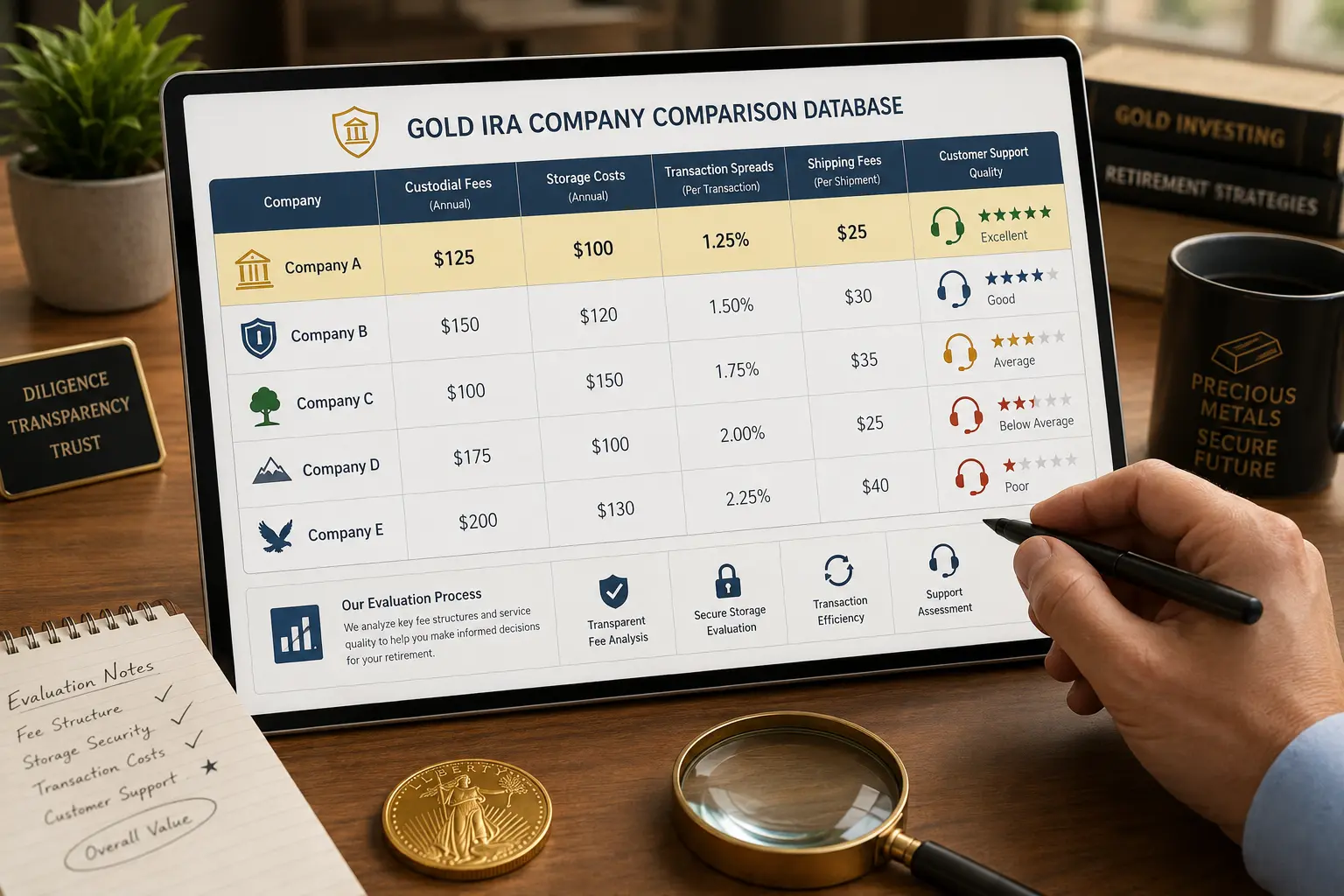 Gold IRA Company Comparison DatabaseCompare provider minimums, BBB records, fee notes, and buyback prompts.