Educational only: This article is general educational information about how Gold IRA returns work. It is not financial, tax, legal, banking, investment, or retirement-planning advice. Interest rates, gold prices, fees, and tax rules can change. Customers should speak to a financial or tax advisor before making decisions. Goldco does not offer tax or legal advice. Past performance does not guarantee future results.
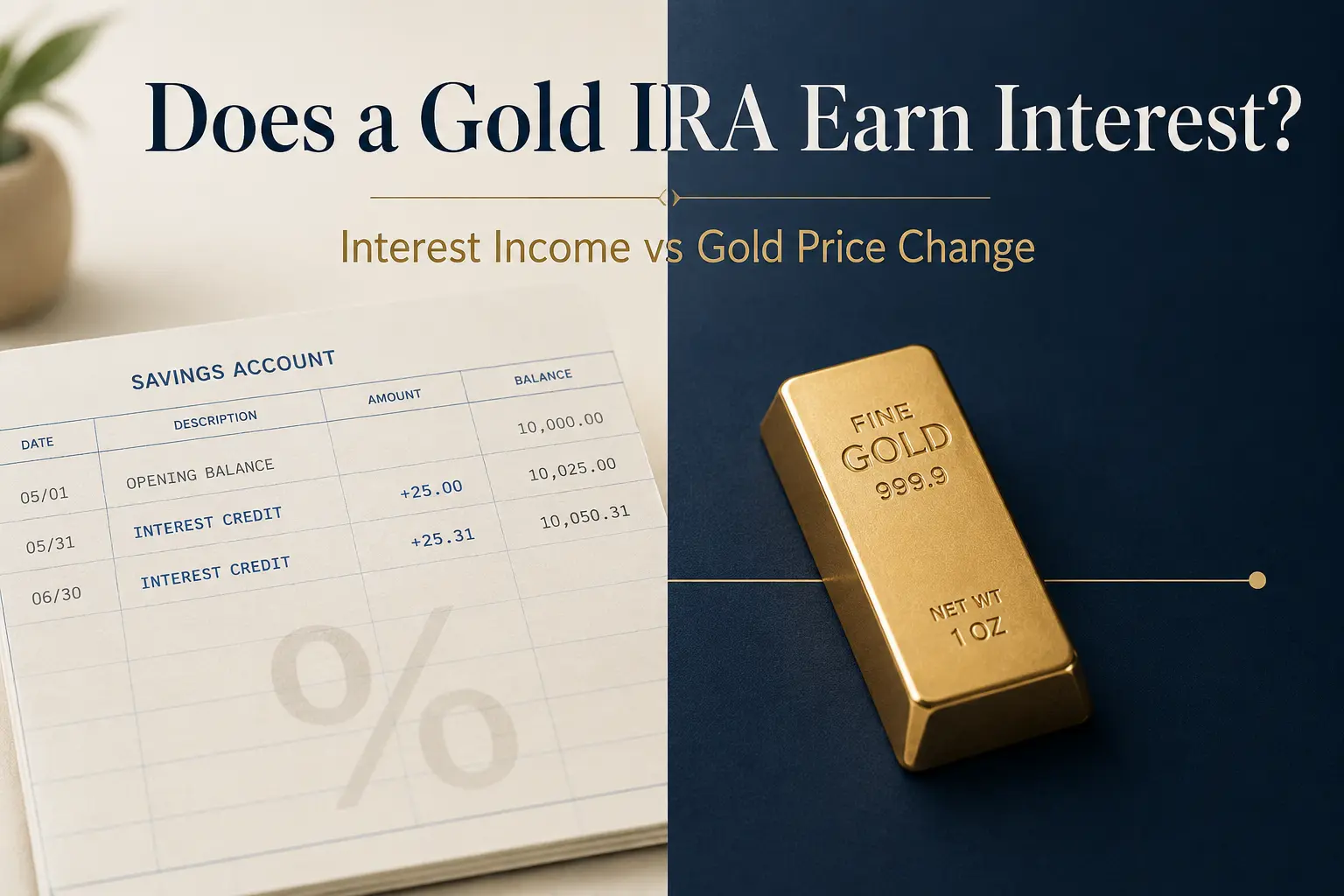
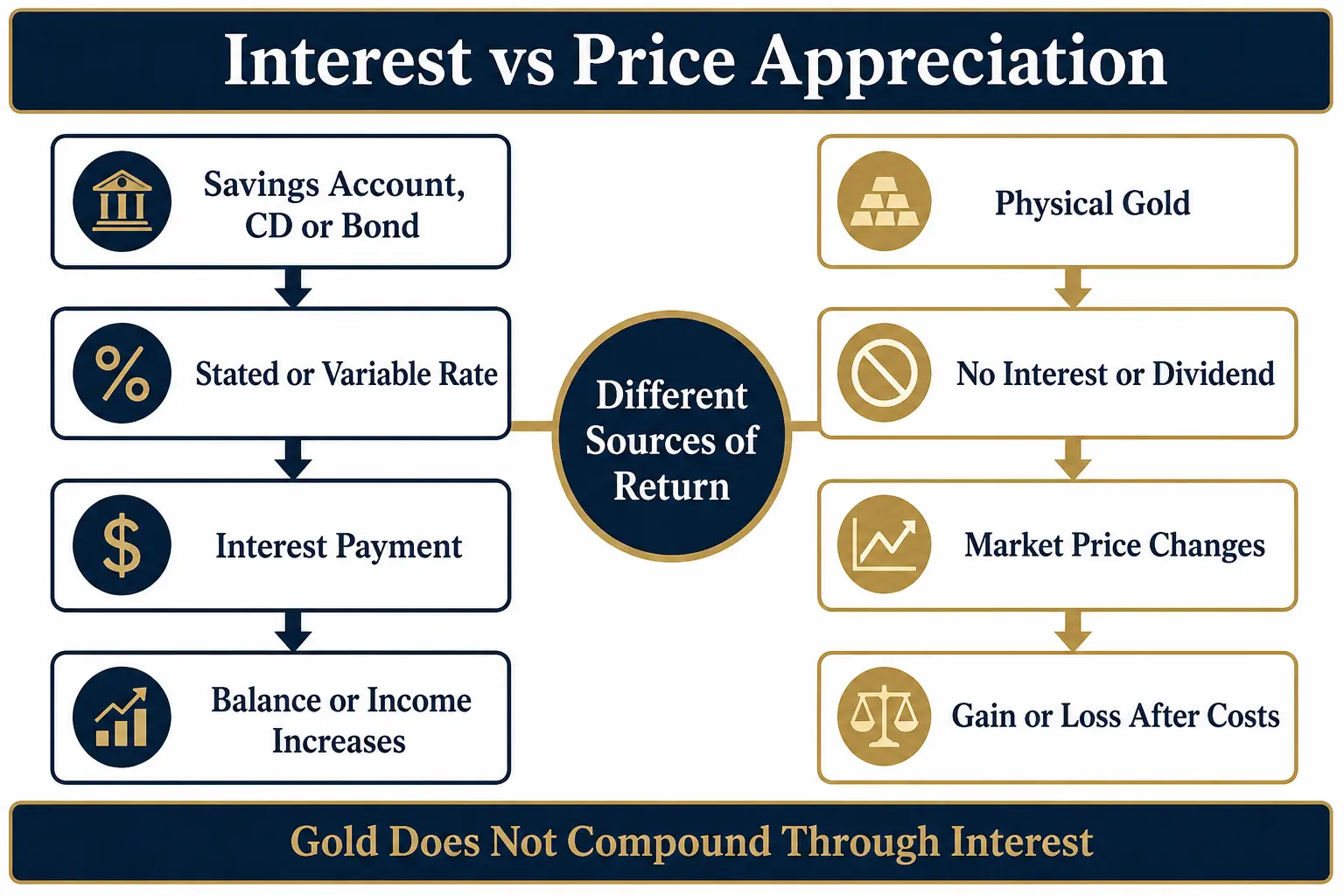
A savings account earns a stated rate — the FDIC national savings rate was 0.38% in June 2026 — while physical gold pays no interest and no dividend. Its return comes only from price change, after costs.
Source: FDIC national rates (0.38% savings, 1.55% 12-month CD, June 2026). Gold has no bank, borrower, or company promising a payment.
Key takeaways
- Gold does not pay interest or dividends. It is a non-yielding asset; any return comes only from a change in its market price.
- The IRA wrapper creates no income — it is a tax framework, not a return-producing asset.
- Savings accounts, CDs, and bonds pay interest because a bank or issuer contractually agreed to; gold has no such contract.
- A Gold IRA can lose value even when gold is flat, because dealer spreads, storage, and custodian fees still apply.
- The honest case for gold is diversification, not income — weighed against missing interest, price risk, and costs.
Quick answer: A Gold IRA does not earn interest simply because gold is held inside it. Any return depends mainly on gold-price appreciation after dealer spreads, custodian charges, storage, and other costs. Savings accounts, CDs, and bonds generate interest under contractual terms. A higher future price may create a gain; a lower future price, dealer spread, and account fees may create a loss. Gold has no borrower, bank, or company promising an interest payment.
Does a Gold IRA Earn Interest or Pay Dividends?
No. Physical gold is a non-yielding asset. An International Monetary Fund publication explains that gold holders receive no interest and that the expected return depends on anticipated capital appreciation (International Monetary Fund). The World Gold Council, an industry body funded by gold-mining companies, also states that gold does not provide regular cash flow and that holders depend on price appreciation to benefit (World Gold Council, an industry body). That means physical gold does not produce bank interest, CD interest, bond coupon payments, stock dividends, rental income, or business earnings.
A company may pay a dividend because it has operations, revenue, expenses, and shareholders. A bond may pay interest because an issuer borrowed money and agreed to repayment terms. A bank deposit may earn interest because the bank accepts the deposit under an account agreement. A gold bar is different: it is a tangible asset whose market value changes as buyers and sellers trade it.
Does the IRA wrapper create income?
No. An IRA is a tax-advantaged account, not a return-producing asset. Investor.gov describes an IRA as an investment account in which the provider offers investment choices, and the return depends on the investments held inside the account (Investor.gov). An IRA holding a bank CD may receive interest from the CD; an IRA holding dividend-paying stock may receive dividends; an IRA holding Treasury bonds may receive bond interest. An IRA holding only physical gold receives no interest from the metal.
Can a Gold IRA hold cash that earns interest?
The answer depends on the custodian and the cash product used. Some self-directed IRAs maintain a cash balance for fees, purchases, or distributions, and that cash may or may not earn interest under the custodian's terms — but any interest would come from the cash arrangement, not from the gold. The distinction should remain clear: gold pays no interest or dividend; an interest-bearing cash or deposit product may earn interest under its terms; and the IRA provides the account framework and tax rules. The IRS permits certain qualifying coins and bullion inside an IRA when the statutory requirements are met, including independent physical custody by a bank or approved nonbank trustee (Internal Revenue Service; Internal Revenue Service). Customers should speak to a financial or tax advisor before making decisions involving an IRA, rollover, distribution, or allocation. Goldco does not offer tax or legal advice.
How Does a Savings Account Earn Interest Instead?
A savings account is a deposit account at a financial institution. The bank or credit union states an interest rate or annual percentage yield under the account terms, interest is credited to the account, and future interest may be calculated on a balance that includes prior interest. The FDIC explains that compound interest occurs when an interest payment is added to the balance and later interest is calculated using the higher balance (Federal Deposit Insurance Corporation). The Truth in Savings Act requires banks to disclose interest rates, fees, and other deposit-account terms so consumers can compare accounts (Federal Deposit Insurance Corporation).
The FDIC's national-rate table for June 2026 lists a national savings rate of 0.38% and a national 12-month CD rate of 1.55%, though actual rates at individual banks can be higher or lower (Federal Deposit Insurance Corporation). Those figures are dated benchmarks, not permanent rates — banks can change deposit rates, and promotional accounts may have balance requirements or other conditions. A regular savings-account rate is often variable, and the account's dollar balance does not move up and down with the daily gold price; it changes through deposits, withdrawals, fees, and credited interest. FDIC insurance may protect eligible deposits, including principal and accrued interest, up to the applicable insurance limit (currently a standard maximum of $250,000) at an insured institution and within the relevant ownership category (Federal Deposit Insurance Corporation). Physical gold inside a self-directed IRA is not an FDIC-insured bank deposit.
How Do CDs and Bonds Differ From Gold?
CDs and bonds can produce a stated yield because they involve a contractual financial obligation. A certificate of deposit is a bank deposit held for a defined term: the FDIC explains that a CD typically offers an interest rate in exchange for keeping money deposited for a stated period, often several months to several years, and that early withdrawal may create a penalty (Federal Deposit Insurance Corporation). A CD return may be easier to estimate when the rate and term are fixed, while gold has no maturity date, stated interest rate, or contractual payment schedule — the market price may rise more than a CD pays, rise less, remain flat, or fall.
A bond generally represents money lent to a government, company, or other issuer. TreasuryDirect states that Treasury bonds pay a fixed rate of interest every six months until maturity, and Treasury notes also pay a fixed rate every six months (U.S. Department of the Treasury, TreasuryDirect; U.S. Department of the Treasury, TreasuryDirect). A bond's market price can still rise or fall before maturity because of interest-rate changes, credit risk, inflation, and maturity — but the key difference is that a bond has a contractual payment structure and physical gold does not. A savings account credits interest under a deposit agreement, a bond pays interest under a debt contract, and a bond purchased above or below face value may have a yield that differs from its coupon rate. Both can produce income; gold does not produce contractual income.
What Does "Non-Yielding Asset" Mean?
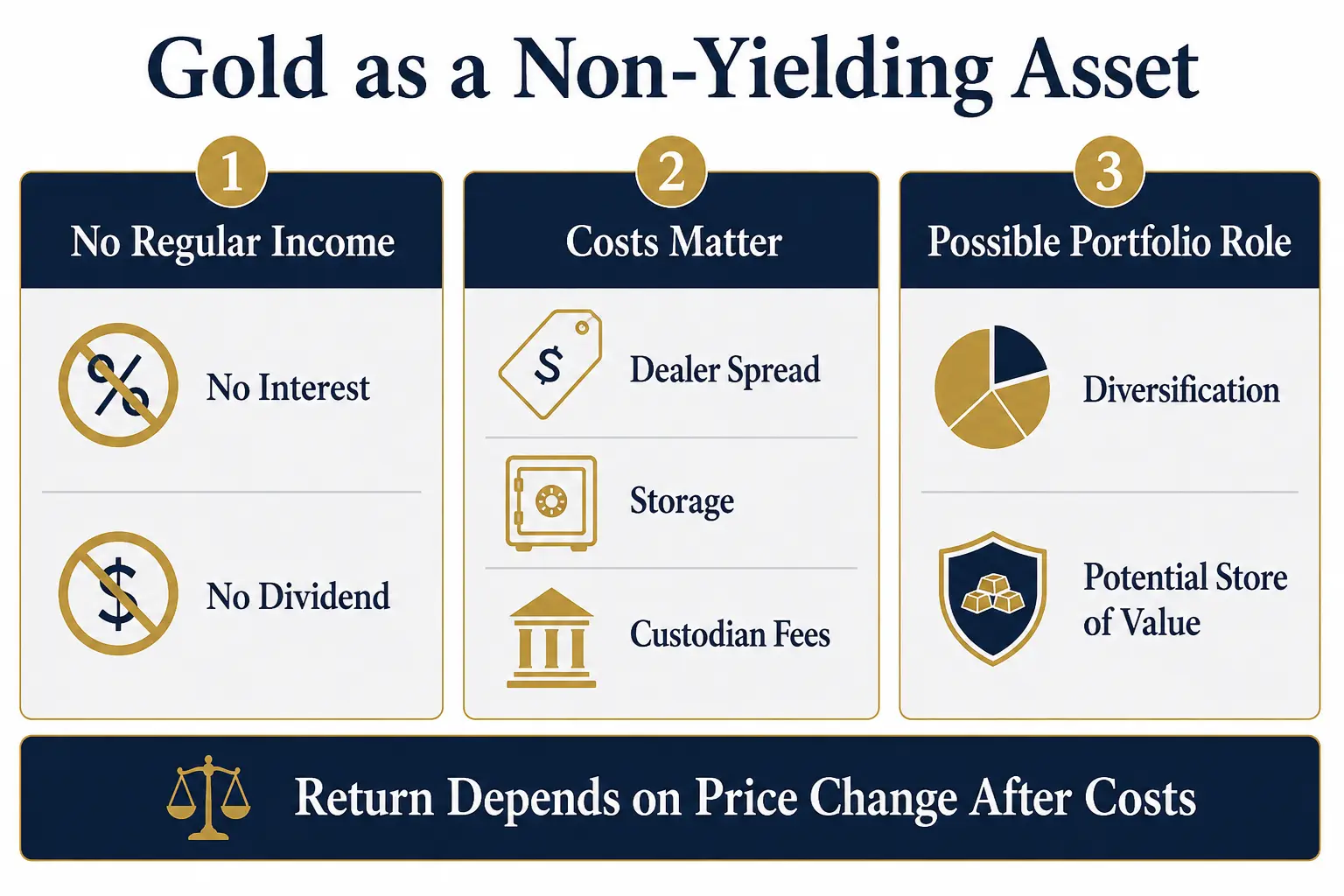
A non-yielding asset does not create regular cash income merely because it is owned. For physical gold, the outcome depends mainly on the selling price compared with the purchase price and total costs. A simple, illustrative framework is: net gold outcome = sale proceeds − purchase cost − dealer spread − custodian fees − storage and transaction costs. If the gold price rises enough to exceed all costs, the account may show a positive result; if the price is flat, costs can create a negative result; if the price falls, the loss can be larger.
Opportunity cost is the value of the next-best alternative given up when a choice is made. Federal Reserve Education explains that every money decision has an opportunity cost because funds used for one purpose cannot be used for the next-best alternative at the same time (Federal Reserve Education). For gold, the opportunity cost may include interest that could have been earned in a savings account, CD, Treasury security, or bond, and that opportunity cost changes as interest rates change. When deposit and bond yields rise, a non-yielding asset gives up more potential income — the World Gold Council, an industry body, acknowledges that higher coupons and dividends can make gold less attractive for investors seeking regular income (World Gold Council, an industry body). Opportunity cost does not prove that gold will fall when interest rates rise, because gold prices respond to several forces; it means the missing income should be counted honestly.
How Does a Gold IRA Return Actually Work?
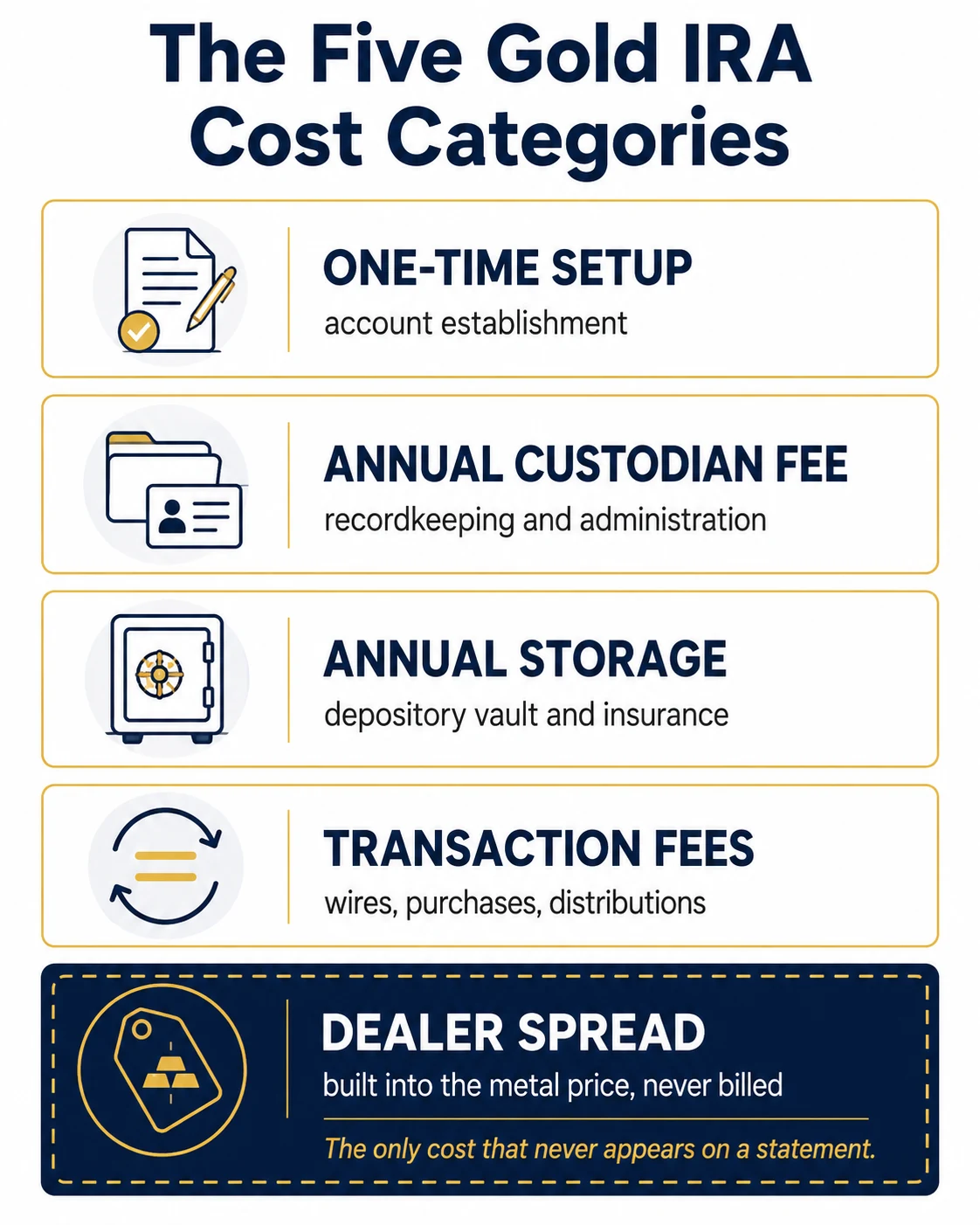
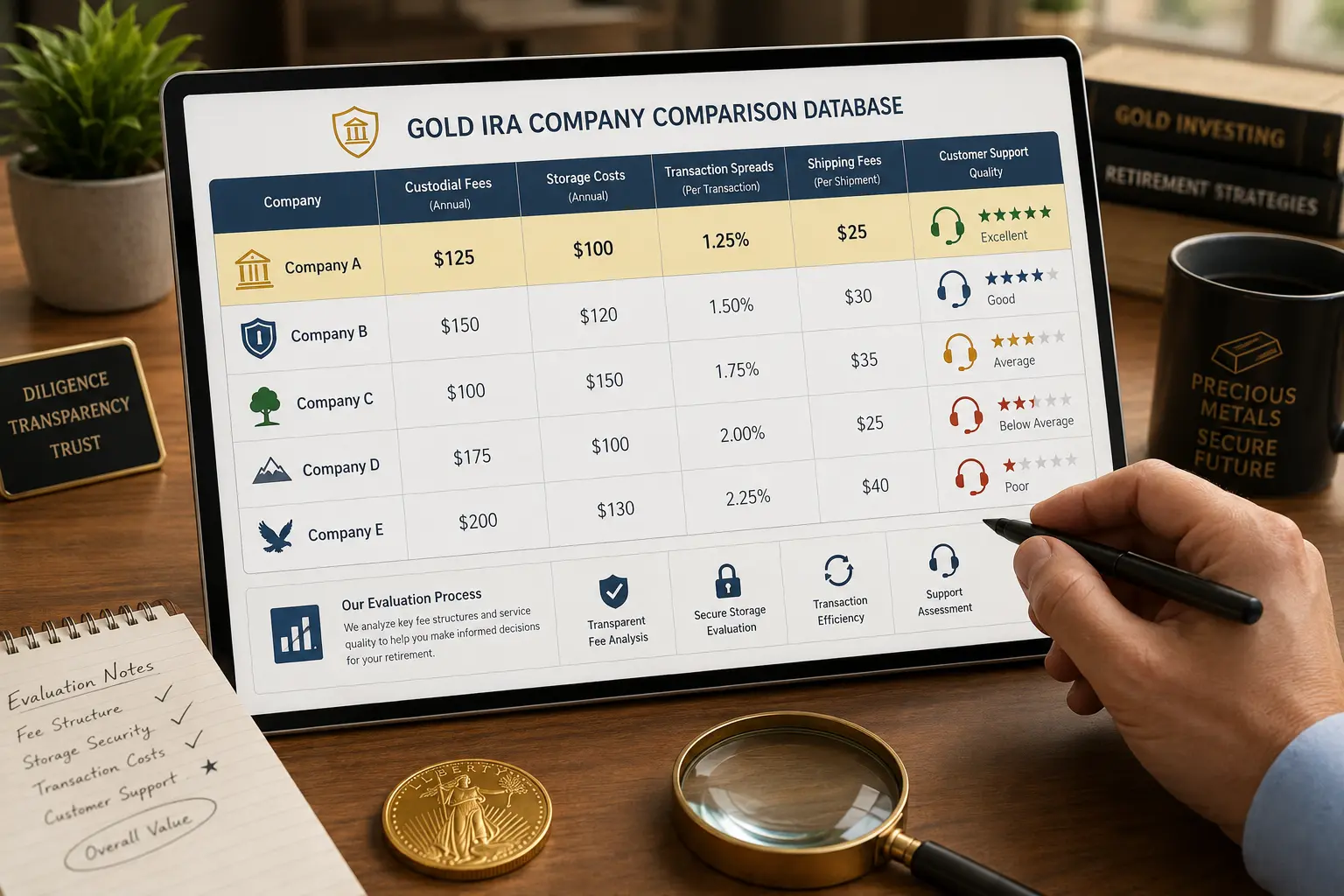
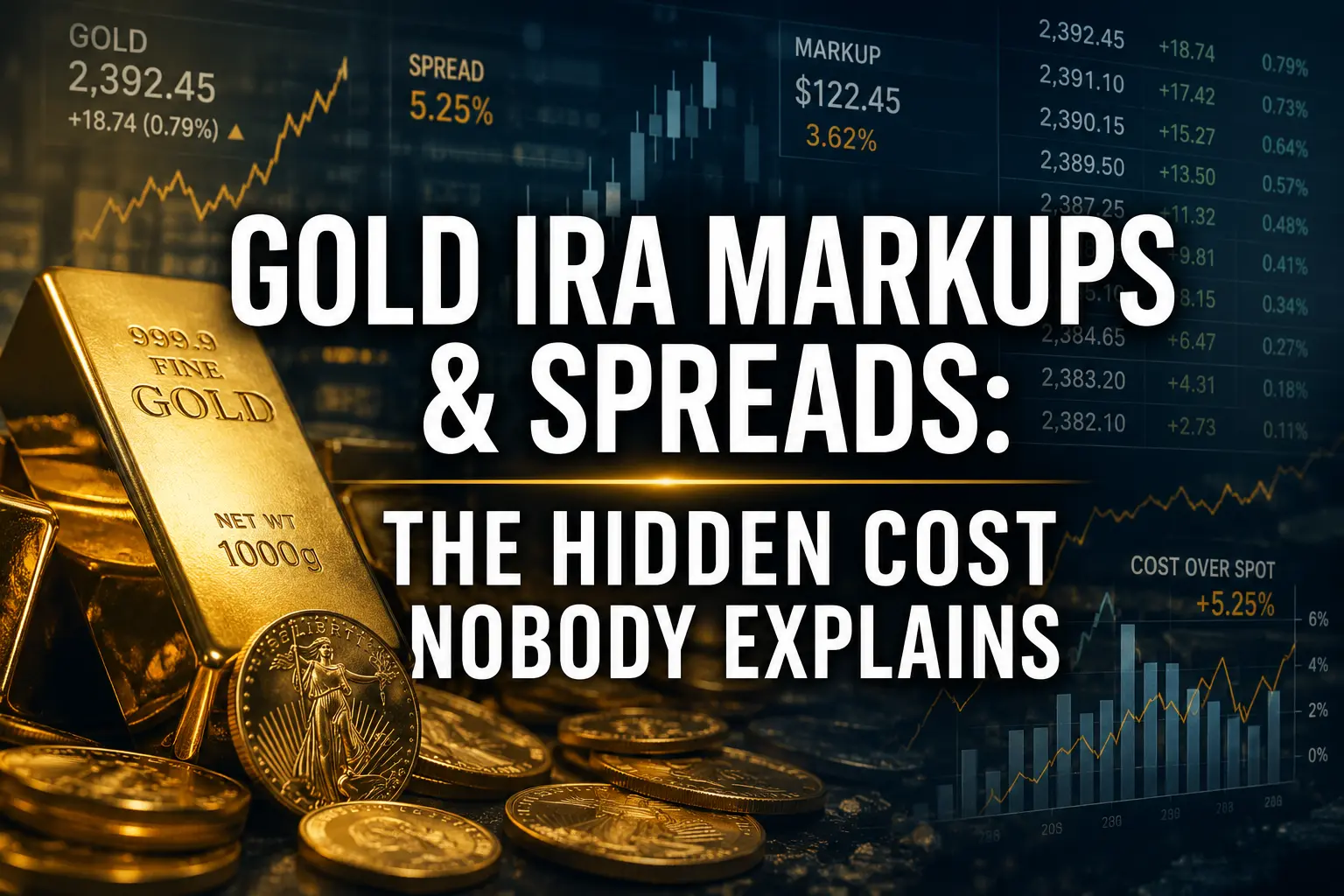
A Gold IRA return has three main parts. First, gold-price movement is the main source of a possible gain or loss — but a price increase does not create spendable cash until metal is sold or distributed, and a price decline reduces the account's estimated value. Second, dealer pricing and spread: FINRA and the CFTC explain that a physical-metals dealer normally sells above the spot price and buys back below spot, the difference is the spread, and each dealer sets its own, so a new purchase may begin below break-even even when the quoted spot price has not changed (FINRA and Commodity Futures Trading Commission). Third, custody and account costs: a physical-metals IRA can include custodian administration, depository storage, insurance, transaction, shipping, and distribution charges, and FINRA and the CFTC advise customers to request all costs, commissions, retail prices, and buyback terms in writing. The Gold IRA calculator can help organize those costs and assumptions.
Gold does not compound through interest. A rising gold price can create percentage gains on a higher market value over time, but that is not interest compounding — no new ounces are added merely because the metal was held for another year. This difference matters in long-term projections: a savings or bond calculation can use stated or assumed interest payments, while a gold projection must use an uncertain future price and subtract costs.
Why Do Investors Hold Gold if It Pays No Interest?
The lack of income does not mean gold has no possible role. Investors may hold gold for diversification, potential value preservation, liquidity in the global gold market, or exposure to a tangible asset outside a company's balance sheet — and the strongest case is usually diversification, not income. The World Gold Council, an industry body, describes gold as having historically low correlation with several traditional asset classes, and its research should be read with the understanding that the organization promotes the gold market (World Gold Council, an industry body). Diversification does not mean gold always rises when stocks fall — correlations change, and gold can fall during periods when other assets also decline. The Chicago Federal Reserve has reported that gold prices can respond to expected inflation, long-term real interest rates, and concern about adverse economic conditions (Federal Reserve Bank of Chicago). Those possible roles remain different from earning interest.
A store of value is an asset held with the hope that purchasing power will be retained over time. Gold is often described that way because it is scarce, globally traded, and not issued as a company's debt — but that description does not establish a stable short-term price or an inflation-adjusted gain over every period. The site's retirement purchasing-power guide covers the difference between preserving nominal dollars and preserving real spending power.
What Are the Trade-Offs of a Gold IRA Versus an Interest-Bearing Account?
The two tools perform different jobs. On income, a savings account, CD, or bond may provide stated or variable interest, while physical gold provides no contractual income. On price stability, a savings deposit balance does not track the daily gold market (though inflation can reduce its real purchasing power), a CD normally has a stated maturity and interest terms but an early-withdrawal penalty, a bond pays contractual interest but its market price can move before maturity, and gold's market value can rise or fall without a maturity date. On insurance and custody, eligible bank deposits may receive FDIC insurance within limits and Treasury securities are U.S. government obligations, while IRA gold requires qualifying custody and is not an FDIC-insured deposit merely because it sits inside an IRA.
On costs, a savings account may have account fees or balance conditions, a CD may have an early-withdrawal penalty, a bond may involve price risk and transaction costs, and a Gold IRA may involve dealer spread, custodian administration, depository storage, insurance, and sale or distribution costs. On liquidity, a savings account generally provides ready access, CD access before maturity may carry a penalty, a bond can often be sold before maturity but at a price that may differ from face value, and a physical Gold IRA generally requires custodian instructions, a dealer bid, and settlement before cash is available. The gold-versus-cash guide provides a more detailed comparison of their separate roles.
The choice does not have to be all cash or all gold. Interest-bearing assets can support liquidity, planned spending, and predictable income; growth assets can support long-term appreciation; and a limited gold position may serve a diversification role. The correct mix depends on retirement income, spending, time horizon, risk capacity, other assets, and the total cost of each account. The retirement portfolio longevity guide explains why income, growth, liquidity, and inflation exposure should be reviewed together, and the retirement gold-allocation guide discusses allocation without assigning one percentage to every saver. The Gold IRA decision quiz is an educational account-structure tool, not a recommendation. Customers should speak to a financial or tax advisor before making decisions about an allocation, rollover, or IRA. Goldco does not offer tax or legal advice.
What Are Common Questions About Gold IRA Interest?
Does gold earn interest?
No. Physical gold does not pay interest. A gain requires a higher selling price after costs.
Does a Gold IRA pay dividends?
No. A physical gold bar or coin does not represent company ownership and does not pay a dividend.
Can money inside a Gold IRA earn interest?
A separate cash or deposit position may earn interest if the custodian offers an interest-bearing arrangement. The gold itself does not.
Is a Gold IRA like a savings account?
No. A savings account is a bank deposit that may earn interest and may qualify for FDIC insurance. A Gold IRA is a retirement account holding physical metal whose value changes with the gold market.
Can a Gold IRA lose money when gold is flat?
Yes. Dealer spreads, storage, administration, and transaction costs can create a negative result even when the reference gold price is unchanged (FINRA and Commodity Futures Trading Commission).
Is a high gold price the same as compound interest?
No. Price appreciation changes the market value of the same metal. Compound interest adds credited interest to principal, allowing later interest to be calculated on the larger balance.
Bottom Line
A Gold IRA does not earn interest like a savings account. Physical gold is a non-yielding asset: it pays no dividend and has no contractual interest rate, and its result depends on price changes after dealer spreads, custody, storage, and transaction costs. Savings accounts, CDs, and bonds can provide interest because a bank or issuer has agreed to make payments under stated terms. Gold may still have a limited diversification or store-of-value role, but it should never be described as producing interest or growing like a savings account.
Sources
- International Monetary Fund. Gold and the expected return from a non-yielding asset.
- Internal Revenue Service. Investments in collectibles · IRA FAQs.
- Investor.gov (U.S. SEC). Individual retirement accounts (IRAs).
- Federal Deposit Insurance Corporation. National rates and rate caps · Compound interest · Deposit accounts · Deposit insurance basics · Shopping for a CD.
- U.S. Department of the Treasury, TreasuryDirect. Treasury bonds · Treasury notes.
- Federal Reserve Education. Money and missed opportunities (opportunity cost).
- FINRA and Commodity Futures Trading Commission. Buying physical gold or other metals.
- Federal Reserve Bank of Chicago. What drives gold prices.
- World Gold Council (an industry body). Risks and challenges · Rates and gold · Portfolio continuum.
Reviewed and edited by Daniel M. — editor, 401kToGoldIRA.org. Educational only; sourced to the IMF, IRS, Investor.gov (SEC), the FDIC, TreasuryDirect, Federal Reserve Education, the Chicago Federal Reserve, the CFTC/FINRA, and the World Gold Council (flagged as an industry body). Not financial, tax, or investment advice.