Affiliate disclosure: Some links on this page may be sponsor links. The site owners may be compensated if customers request information from companies mentioned here. This page is educational only and does not provide financial, tax, or legal advice. Customers should speak with a financial or tax advisor before making retirement-account decisions. Past performance does not guarantee future results.
Jump to a section
Most descriptions of this process start at the paperwork. That is the wrong place to start, because the single most useful thing you can do happens before any form is signed.
Ask the receiving custodian, in writing, whether it will accept your exact coins and bars, in your current storage arrangement, at a depository it works with. Everything downstream depends on that answer.
If the answer is yes, the metal can usually move as metal. If it is no, you are looking at a sale and a cash transfer instead, which is a different transaction with different consequences.
The Actual Sequence: Who Acts, and in What Order
Four parties take part, and only two of them are institutions you choose. The diagram below separates them into lanes so you can see which step belongs to whom.
Step through it to see where the decision point sits, and what happens on each branch.
One point inside step four is worth isolating, because it is where people lose metal they meant to keep. Choosing a cash transfer does not instruct anyone to sell.
The sale is a separate instruction to the custodian or dealer, and a cash request submitted before the sale settles can simply stall for want of available funds.
This Is a Transfer, Not a 60-Day Rollover
The vocabulary matters more here than it usually does. A direct trustee-to-trustee transfer and a 60-day rollover are different transactions in tax law, and only one of them puts a clock on you.
Under 26 U.S.C. §408 and the IRS guidance in Announcement 2014-32, the one-rollover-per-12-months limitation does not apply to direct trustee-to-trustee transfers.
That is the practical advantage. You can move an IRA between custodians without spending the single rollover the limitation allows you, and without a 60-day deadline to re-deposit anything.
There is a nuance on cheques worth keeping straight. IRS Publication 590-A indicates that a cheque payable to the receiving trustee can remain a trustee-to-trustee transfer even if it passes through your hands to deliver.
The protection is that the funds are not paid or distributed to you personally, rather than a rule that you may never physically hold a piece of paper. For metal, the equivalent protection is absolute: it does not come to you at any stage.
What the Receiving Custodian Actually Asks For
The transfer forms reviewed in October 2026 are more specific than people expect, and the detail they demand is the detail that prevents a stall.
Expect to supply the receiving IRA name, account number and type, your identifying information, and the outgoing IRA's name, account number, type and custodian contact details.
Expect also to attach a recent outgoing account statement, elect a full or partial transfer, and provide a line-by-line list of metals by description, mint and quantity. Current and intended depository names are requested separately.
One custodian's April 2026 precious-metals form offers full or partial transfer alongside separate all-cash, set-cash and listed in-kind instructions. Another requires that the prior statement itself specify coin types and counts, so a summary valuation will not do.
Several requirements are conditional rather than universal, and these are the ones that surprise people. The outgoing institution may require a Medallion Signature Guarantee, and may refuse electronic signatures outright.
There is also a trap in form selection. A broad alternative-asset transfer form carrying in-kind certification is not a substitute for the dedicated precious-metals transfer form, and using the wrong one invites a rejection.
Comparing custodial arrangements before you move an account?
Goldco is a precious metals company. Customers can request a free Gold & Silver Kit at signup. Goldco markets a buyback program; customers should request current written terms directly.
Minimum investment: $25k · BBB rating: A+
Owners of this website may be paid to recommend Goldco. The content on this website, including any positive reviews of Goldco and other reviews, may not be neutral or independent.
What Physically Happens to the Metal
Whether your metal moves as metal depends on two separate approvals: the receiving custodian accepting those products, and the depository arrangement being compatible.
If the vault stays the same, the change may be recorded rather than driven. Depository documentation describes internal movements between accounts, which supports a control-record transfer without a truck.
That route is not guaranteed for every custodian pair, and for IRA-held metal the instructions must come from the custodian, never from you directly.
If the vault changes, physical dispatch, receipt, intake verification and storage setup are distinct stages. A custodian's approval is not the same event as metal arriving and being credited.
The segregated and commingled distinction is the one most worth understanding before you sign. Segregated storage sets your identified pieces apart, and the operator says the same pieces come back.
Commingled storage keeps your position allocated in the records while like product is stored together, so you may receive equivalent product rather than the original item. Position by product and quantity is preserved; physical identity is not necessarily preserved.
Storage incompatibility does not automatically force a sale. Changing depository or storage type may also be available, and the documents reviewed do not support a universal rule that a mismatch always requires liquidation.
Who Holds It While It Moves
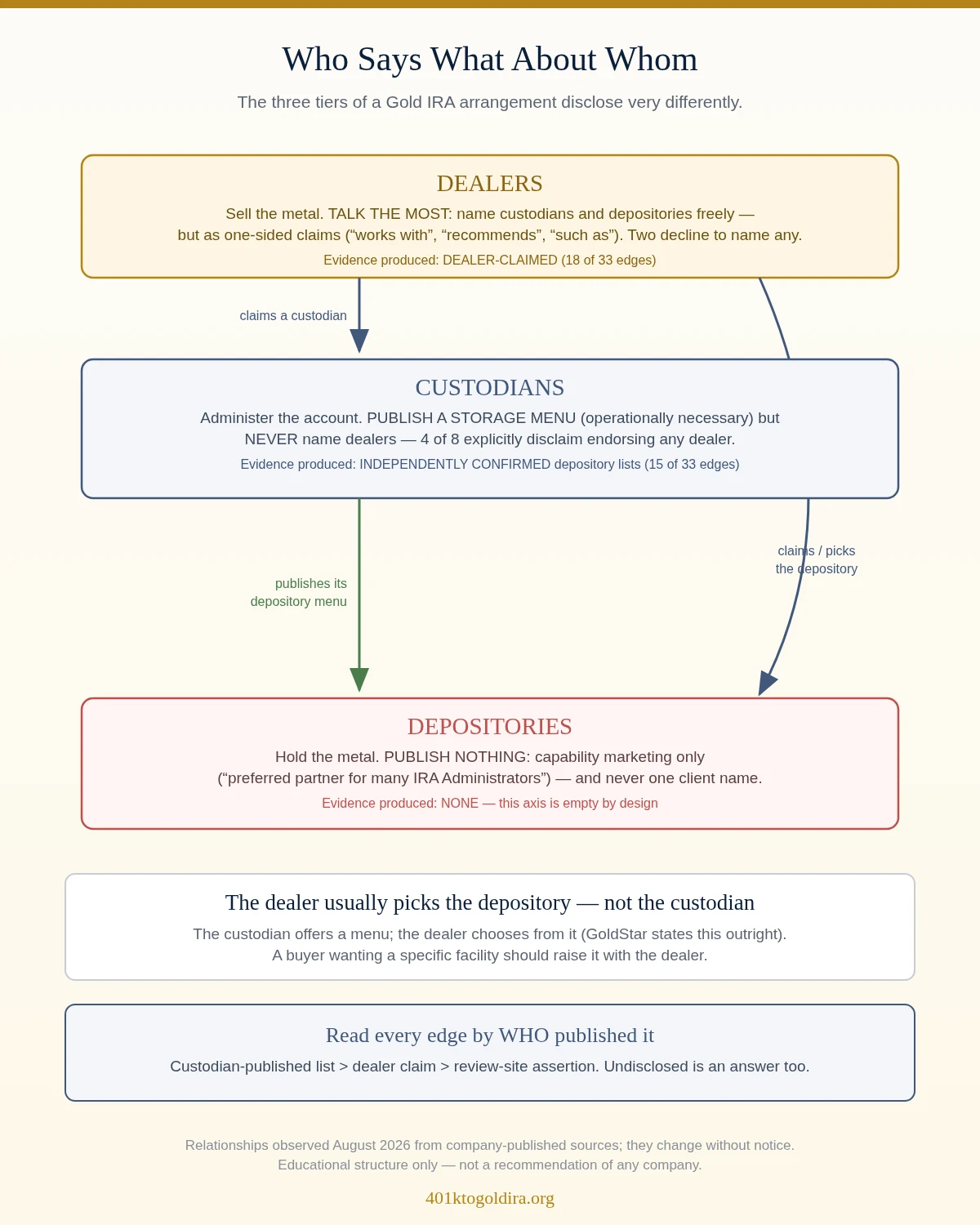
Three relationships run in parallel throughout, and conflating them is what makes the process feel opaque.
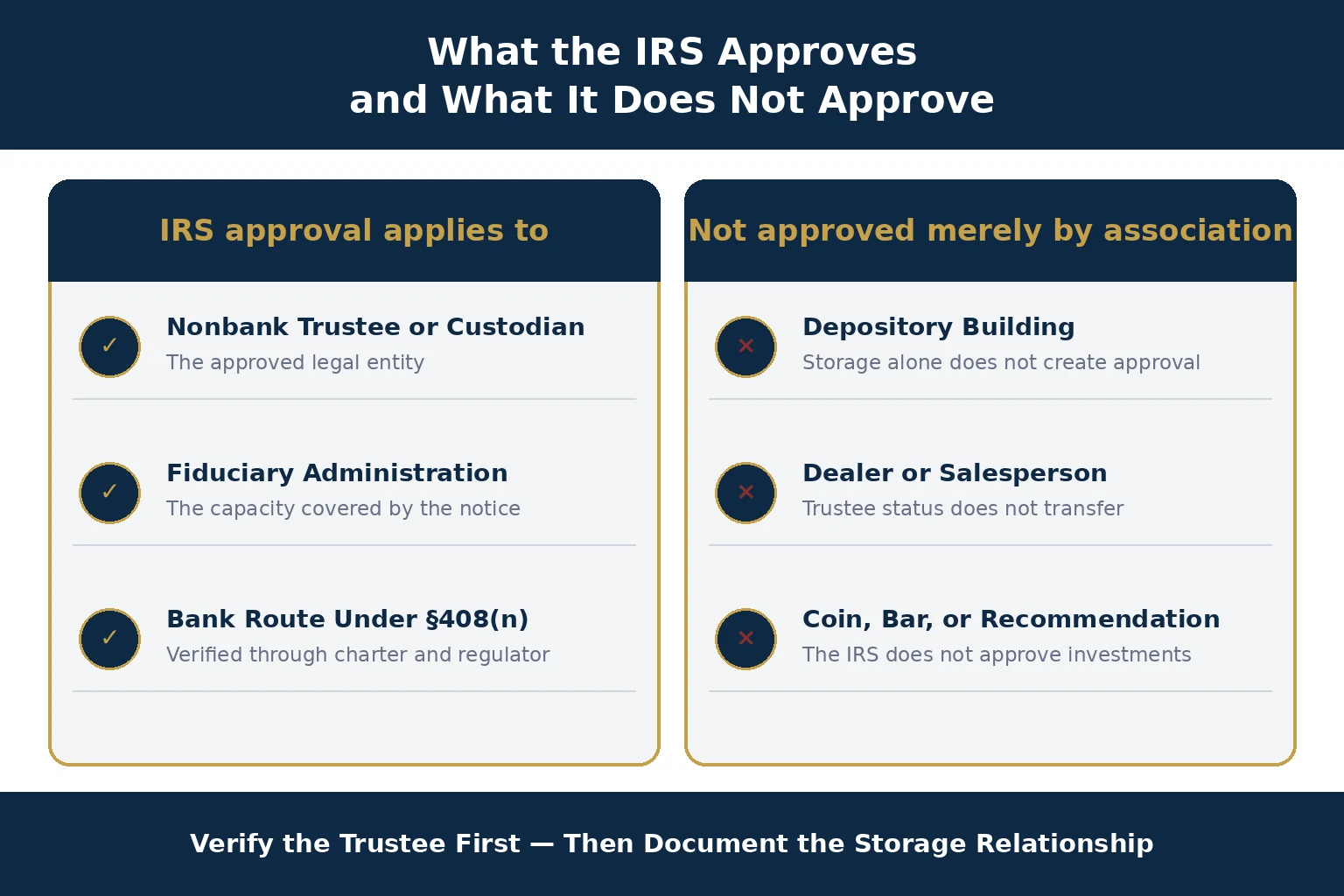
The IRA is the tax-advantaged trust or custodial arrangement held for your benefit. The custodian administers the account in that fiduciary capacity and records your interest. The depository physically safekeeps the metal on the custodian's instructions.
That architecture comes from 26 U.S.C. §408 and 26 CFR §1.408-2, and the depository materials reviewed expressly distinguish custody-controlled IRA metal from personally controlled storage.
A changing trustee does not make the metal yours personally at any point. The exact chain of title depends on the custodial and storage contracts, and no universal title-transfer document applies to every arrangement.
The limit of that principle is worth stating plainly. In McNulty v. Commissioner, 157 T.C. No. 10, decided 18 November 2021, the Tax Court treated coins bought through an IRA-owned LLC and kept in the taxpayer's home safe as taxable distributions.
That case concerned personal possession, not ordinary logistics between institutional vaults. Do not read it as meaning a shipment between depositories creates a distribution, and do not read it as permission to handle IRA metal yourself.
How Long It Takes
There is no trustworthy industry figure for this, and anyone quoting one precisely is guessing. What exists is a handful of institution-specific published estimates.
One custodian publicly estimated 5 to 20 business days for most direct transfers as at October 2026. That is its own cross-asset processing estimate, not a gold-specific benchmark and not a promise covering physical shipment.
Two further components can extend that. The same custodian's 2026 form notes cash delivered by cheque may face a hold of up to seven business days, and a depository stated inbound bullion is normally processed within three days of receipt, longer for large or non-fungible items.
Those are stages inside the process rather than additions to a total, so do not stack them into a single number.
What actually drives the variance is mundane: the outgoing custodian's processing and signature policy, how complete your statement and asset records are, whether anything must be liquidated, wire versus mailed cheque, whether the depository can move metal internally or must ship it, and inbound vault reconciliation.
Where These Transfers Stall
Ordinary transfers fail for ordinary reasons. Each of these appears in the custodian documentation reviewed, and each has a straightforward response.
Missing or wrongly executed signatures
Forms call for a statement and an owner signature, and the outgoing institution may require a Medallion Signature Guarantee or reject an electronic signature.
Get the outgoing institution's signature rules first, check the name and IRA number match exactly, attach the latest statement, and resubmit the correctly signed form.
A metals list that is too vague
One custodian asks for specific coins and counts; another asks for description, mint and quantity. A summary line showing a total value is not enough.
Build a line-by-line inventory from the outgoing statement, with weight, purity and mint where identified, and ask both custodians to reconcile mismatched descriptions before the transfer is dispatched.
A cash request submitted before the metal is sold
Transfer forms warn that liquidation should be initiated first where funds are not yet available. The cash request alone does not sell anything.
If cash is genuinely the chosen path, instruct the appropriate custodian or dealer to liquidate, confirm settlement, and only then request the cash movement.
Unconfirmed storage, or an asset the destination will not take
In-kind acceptance is conditional, and storage options differ between depositories.
Request written acceptance of the precise metals and of the commingled or segregated arrangement before the request goes out. If it is refused, decide with the new custodian whether another approved vault or storage route works, rather than assuming a sale is required.
Outstanding charges on the old account
Published fee categories include account closure and outgoing transfer charges, and a depository's published materials indicate outstanding storage fees must be settled before bullion is released in a shipment context.
Ask for a final invoice and the payment method rather than assuming a charge is waived or fixed.
Out-of-date contact details
Inconsistent account details can trigger additional identity verification, which adds delay for no good reason.
Update your records with both institutions before starting rather than halfway through.
A custodian that has gone silent or is refusing to act is a different problem from an ordinary stall, with its own documentation and escalation path. That is covered separately in our guide to a Gold IRA custodian that will not respond.
Before You Call It Done
The commonest mistake at the end is treating one document as proof of everything. Three different records each do a different job, and none of them substitutes for the others.
Obtain the outgoing final activity statement, the receiving account's transaction confirmation and first full holdings statement, and the depository acceptance confirmation supplied through your receiving custodian.
Then compare them on the points that can silently differ: IRA registration and type, cash transferred, each product description, mint and unit count, weights or serial identifiers where recorded, the expected versus actual depository, the selected storage category, and any residual cash or accrued charge left in the old account.
Where a line does not agree, ask for a written and dated correction rather than accepting a verbal explanation.
Full and partial transfers need different closing checks. For a full transfer, verify the outgoing IRA is genuinely closed, since all visible metals moving does not prove there is no residual cash or fee balance.
For a partial transfer, verify the old account remains open holding exactly the position you intended to leave behind.
One thing a tax form will not do is act as your receipt. The 2026 IRS instructions for Forms 1099-R and 5498 generally exclude an ordinary trustee-to-trustee IRA transfer from 1099-R reporting and from Form 5498 contribution reporting.
Form 5498's year-end fair market value is a tax information return, not a contemporaneous vault manifest, and it will not identify particular bars or serial numbers.
What It Can Cost
This page does not quote prices, because published schedules change and a figure repeated here would date badly. What is worth knowing is which categories can appear.
Charges may include the outgoing custodian's closure or transfer-out administration, asset re-registration, incoming account administration, depository storage and handling, shipping and insurance if the vault changes, and costs associated with selling metal if liquidation happens.
Who bills you, and whether a charge is deducted from IRA cash or paid separately, depends on the disclosed fee schedule and your instructions. Ask for the current dated schedule from both institutions rather than relying on any third-party summary, including this one.
One disclosure worth noting when you read a statement: one custodian states that its statement metals valuations use metal spot values and exclude dealer premiums, spreads and commissions.
The SEC and NASAA investor alert on self-directed IRAs makes the related point that alternative-asset statement values may not reflect what an asset would realise on sale, and may not have been independently verified.
Frequently Asked Questions
How do I transfer my existing gold IRA to another custodian?
Open or identify the receiving IRA, confirm in writing that the new custodian and its depository accept your particular metals, then complete the receiving custodian's transfer authorisation with your most recent outgoing statement and a line-by-line metals list. The receiving custodian normally sends the request and a signed letter of acceptance to the outgoing institution.
Is a gold IRA custodian transfer a 60-day rollover?
No. A direct trustee-to-trustee transfer is a different transaction from a distribution that you roll back into an IRA within 60 days, and it is not counted by the one-rollover-per-year limitation. The distinction matters because the 60-day route carries deadlines and withholding exposure that a direct transfer does not.
Can I move my gold IRA to a new custodian without selling the gold?
Potentially yes, through an in-kind transfer, where the metals move without being liquidated. Custodian transfer forms reviewed in October 2026 expressly offer that option, but acceptance is not universal: it depends on the receiving custodian accepting those specific products and on depository compatibility, so confirm before you sign.
Will I get the same bars and coins after the transfer?
It depends on the storage arrangement. With segregated custody the operator says the same identified pieces are set apart and returned, while commingled storage keeps your holding allocated in the records but like product may substitute for the original item. Verify the storage designation, and any serial-number commitment, in writing.
What happens if both custodians use the same depository?
An internal transfer of custody and control records may be possible without any physical shipment, because depositories document internal movements between accounts they already hold. That route is not automatic for every custodian pair, so the two custodians and the depository have to confirm it is available for your specific accounts.
How long does a precious-metals IRA transfer take?
One custodian publicly estimated 5 to 20 business days for most direct transfers as at October 2026, but that is a single institution's cross-asset processing estimate, not a gold-specific industry benchmark. Liquidation, mailed cheques and holds, physical shipment and vault intake can all add time beyond it.
Who owns my gold while it moves between custodians?
It stays an asset of the IRA, held in the trust or custodial arrangement for your benefit, with the custodian exercising custody in that capacity and an approved vault holding the metal physically. Changing trustee does not convert it into personally held gold at any point in the process.
Will I receive Forms 1099-R or 5498 because I transferred my IRA?
An ordinary same-type trustee-to-trustee IRA transfer is generally not reported as a 1099-R distribution, and the IRS instructions direct that such a transfer is not shown as a Form 5498 contribution. The account can still carry annual Form 5498 fair-market-value reporting, and a distribution or conversion is treated differently.
How do I know the transfer is really finished?
Compare three records rather than one: the outgoing final statement, the receiving account's first full holdings statement, and the depository confirmation supplied through your custodian. Check registration and IRA type, each product and unit count, the storage class, the vault, and any residual cash or charge left behind.
Can I take the metals home between custodians to move them myself?
No. Taking personal possession turns a custodian-mediated transfer into a materially different transaction and risks a taxable distribution. In McNulty v. Commissioner, 157 T.C. No. 10, decided 18 November 2021, the Tax Court treated IRA-funded coins kept in the taxpayer's home safe as distributions.
Sources and Observation Dates
Every custodian and depository procedure described above was read from published company documentation on 12 October 2026. Company terms change without notice, so verify the current document before acting on anything here.
Company procedures are cited as examples of documented practice, not as universal rules, and naming them is not a recommendation.
- Statute and regulation. 26 U.S.C. §408 and 26 CFR §1.408-2, establishing the IRA trust and custodial architecture. Observed 12 October 2026.
- IRS guidance on transfers and rollovers. Rollovers of retirement plan and IRA distributions, Announcement 2014-32 and Publication 590-A. Observed 12 October 2026.
- IRS reporting instructions. 2026 Instructions for Forms 1099-R and 5498. Observed 12 October 2026.
- Judicial decision. McNulty v. Commissioner, 157 T.C. No. 10, decided 18 November 2021, on home possession of IRA-funded coins.
- Custodian transfer forms and procedural documentation. STRATA Trust IRA Transfer Request — Precious Metals, form 410, edition dated 15 April 2026, plus its published direct-transfer and account-closure guidance; Advanta IRA client centre in-kind and precious-metals transfer requirements; Midland Trust transfer form, as printed marked updated 11/2022. Observed 12 October 2026.
- Depository documentation. Delaware Depository published FAQs and storage and transfers materials, covering internal transfers, insured shipments, processing times and segregated versus commingled storage. Observed 12 October 2026.
- Custodian disclosures. GoldStar Trust precious metals IRA investment disclosure, revision dated 08/2025, on statement valuation; STRATA published fee categories and precious-metals storage information. Observed 12 October 2026.
- Regulator investor protection. SEC and NASAA Investor Alert: Self-Directed IRAs and the Risk of Fraud. Observed 12 October 2026.
What this page does not establish
No representative industry-wide transfer-duration figure was found, so the timing above is institution-specific. No universal in-kind portability promise exists, since acceptance depends on the receiving custodian and depository.
No universal mandatory-liquidation trigger by storage category was established, and no published schedule of release, storage, insurance or shipment charges applies across institutions.
Disclaimer: This page is educational and does not provide financial, tax, or legal advice. Custodian and depository procedures, fee schedules and published processing estimates change. Verify current terms directly with the institutions involved and speak with a qualified financial or tax advisor before making retirement-account decisions.