Educational only: This is an informational explainer of silver's industrial-demand drivers, not investment advice or a price forecast. It summarizes Silver Institute, Sprott, and primary material in general terms; industry sources are flagged. Customers should speak to a financial or tax advisor before making decisions. Goldco does not offer tax or legal advice. Past performance does not guarantee future results.
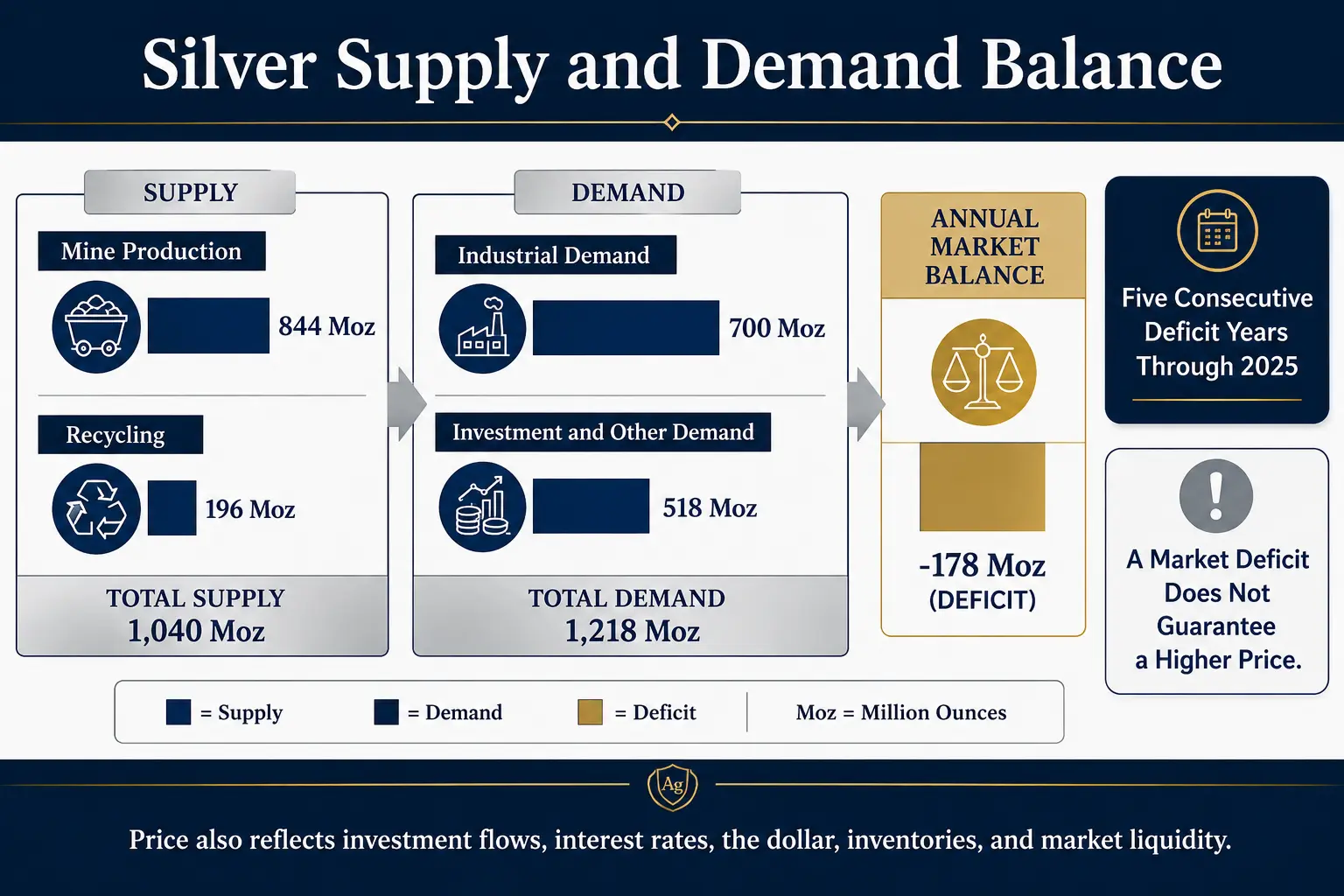
Industrial silver demand hit a record 680.5 million ounces in 2024, and the market ran a supply deficit for a fifth consecutive year through 2025 — yet a deficit does not guarantee a higher price.
Source: The Silver Institute (industry body). Price also reflects investment flows, interest rates, the dollar, inventories, and market liquidity.
Key takeaways
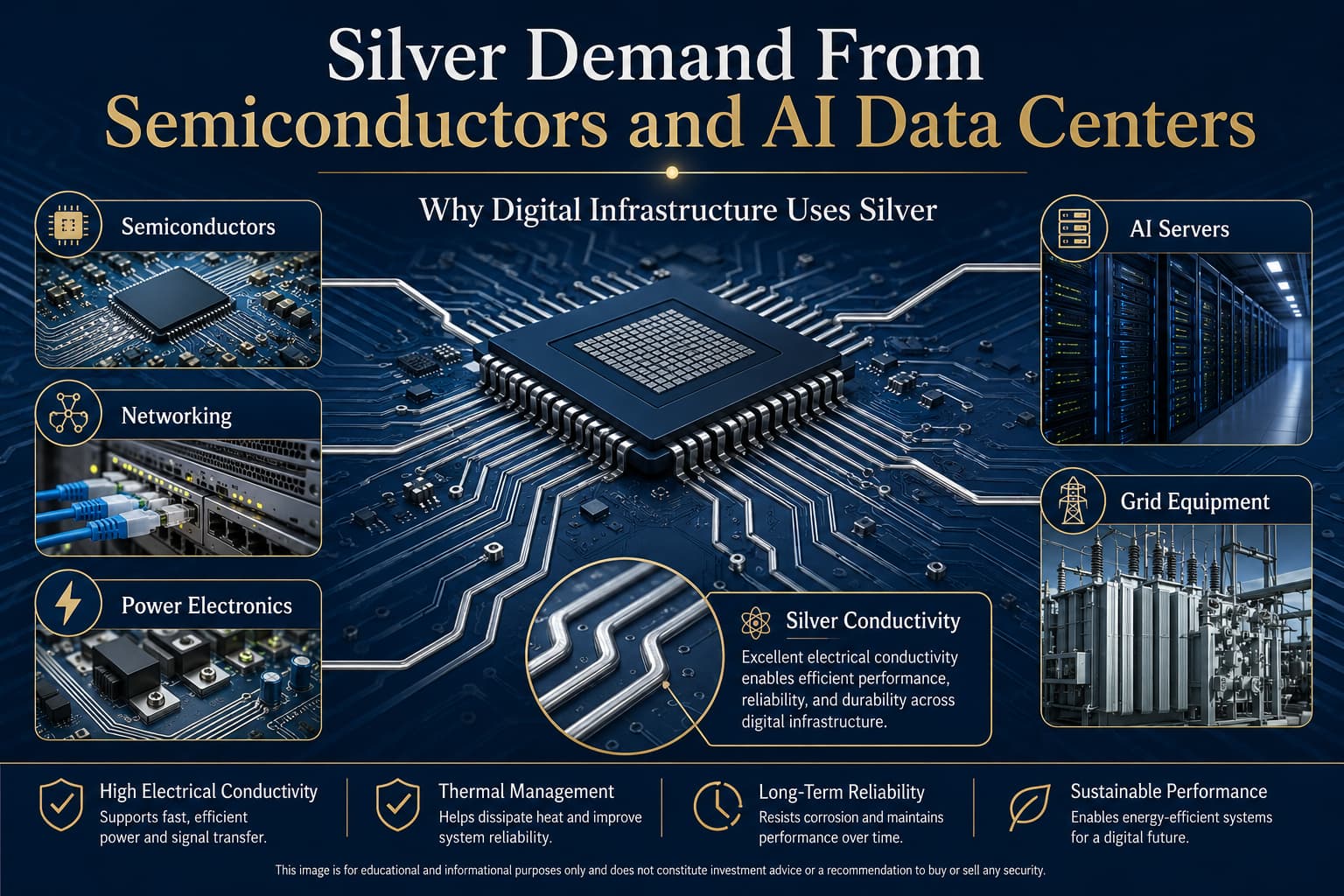
- Silver has the highest electrical conductivity of any metal, so it appears throughout electronics — around chips (packaging, contacts, circuit paths, solders), not mainly inside the silicon die.
- About 60% of silver consumption is industrial (electronics, solar, semiconductors); electrical/electronics demand alone hit ~465.6 Moz in 2024.
- Demand is not linear: industrial demand fell 3% in 2025 (to 657.4 Moz) even as AI infrastructure grew, because solar makers accelerated thrifting and substitution.
- The market ran a 5-year supply deficit through 2025, but above-ground inventories and investment flows mean a deficit alone does not set the price.
- No verified per-data-center silver figure exists — the Silver Institute uses IT power capacity (up ~53× since 2000) as a proxy, not a bill of materials.
Why Is Silver Demand From Semiconductors and AI Rising?
The short answer is that AI systems require more chips, memory, servers, networking equipment, power supplies, cooling controls, and grid equipment — many of which contain silver in electrical contacts, printed circuit paths, conductive pastes, solders, switches, sensors, and other parts (Silver Institute). The Silver Institute reported that electrical and electronics silver demand reached 465.6 million ounces in 2024, up 4%, with AI-related applications, power-grid construction, and automotive electrification helping support the record, while the broader industrial total reached a record 680.5 million ounces (Silver Institute).
The next year showed why the story needs nuance: industrial demand fell 3% to 657.4 million ounces in 2025, and electrical/electronics demand fell 2%. AI infrastructure, automotive use, and grid investment remained supportive, but photovoltaic demand weakened as manufacturers accelerated silver thrifting and substitution (Silver Institute). That pattern supports a balanced conclusion: AI and semiconductor growth can increase silver use, but sector growth does not guarantee that total industrial demand rises every year.
Why Do Semiconductors and Electronics Need Silver Specifically?
Silver has the highest electrical conductivity of any metal, which allows current to move with low resistance, and it performs well in thin coatings, pastes, films, contacts, and printed pathways where reliability and compact size matter (Silver Institute). In electronics it commonly appears in electrical contacts and switches, printed circuit boards, silver-based conductive inks and films, RFID antennas, soldering and brazing alloys, power-management hardware, sensors and control systems, specialized batteries, and high-frequency communications equipment. The distinction between a semiconductor chip and the wider electronic system is important: silver is not necessarily a large ingredient in the silicon die itself — it is often used around the chip in packaging, connectors, conductive adhesives, circuit boards, power electronics, and the systems that carry signals and electricity.
AI data centers multiply these layers. A modern facility contains processors, memory modules, storage, network switches, power-distribution equipment, backup systems, cooling controls, sensors, and extensive electrical infrastructure — each item may use small quantities, but large facilities contain enormous numbers of components. BlackRock's iShares research estimated in March 2026 that about 60% of annual silver consumption was tied to electronics, solar panels, and semiconductors, placing electronics demand at roughly 445 million ounces per year and identifying AI data-center expansion as an additional growth driver (iShares). Those figures come from an asset manager that offers silver-related products, so they should be read as market analysis rather than neutral government statistics.
How Much Silver Do AI Data Centers and Modern Chips Use?
No reliable public source provides one verified figure for the total silver used in an average AI data center. The Silver Institute's December 2025 technology report stated that precise silver-loading data for data centers were not available, and used growth in global information-technology power capacity as a proxy for the expansion of computing hardware (Silver Institute). That limitation matters because a data center is not one standardized product: silver use varies with the number and type of processors, memory capacity, networking architecture, power-conversion design, cooling systems, backup power, grid connections, server replacement cycles, component suppliers, and the amount of silver in each contact, board, paste, or solder.
The Silver Institute reported that global IT power capacity rose from about 0.93 gigawatts in 2000 to nearly 50 gigawatts in 2025 — a 53-fold increase that implies far more computing hardware and therefore more demand for materials used in electronics, including silver (Silver Institute). That report was commissioned by the Silver Institute and produced by Oxford Economics, so it should be treated as industry-sponsored research; its most useful point is not a precise silver forecast but the documented absence of a dependable per-data-center loading figure. A careful reader should therefore avoid claims such as "one AI data center uses a specific number of ounces" unless a facility-level bill of materials is published and verified.
How Does Silver in AI Data Centers Extend Beyond Chips?
Silver demand from AI is broader than semiconductor fabrication. AI data centers need large amounts of electrical power, creating demand for transformers, switchgear, circuit breakers, relays, bus systems, control electronics, cooling equipment, and backup-power components — silver may appear in contacts, coatings, solders, sensors, and power-control devices across this chain (Silver Institute). The Silver Institute's 2026 market review said AI infrastructure, automotive end-use, and power-grid investment continued to support industrial silver demand in 2025 even though total industrial demand declined. This indirect link is often missed: AI growth can raise silver demand through at least three channels — computing hardware (processors, memory, storage, circuit boards, network equipment); power equipment (converters, switches, controls, contacts, grid connections); and supporting infrastructure (cooling, monitoring, backup power, communications). The amount of silver in one component may be small; the demand effect comes from scale, replacement cycles, and the number of connected systems.
What Role Do Solar Panels and EVs Play in Silver Demand?
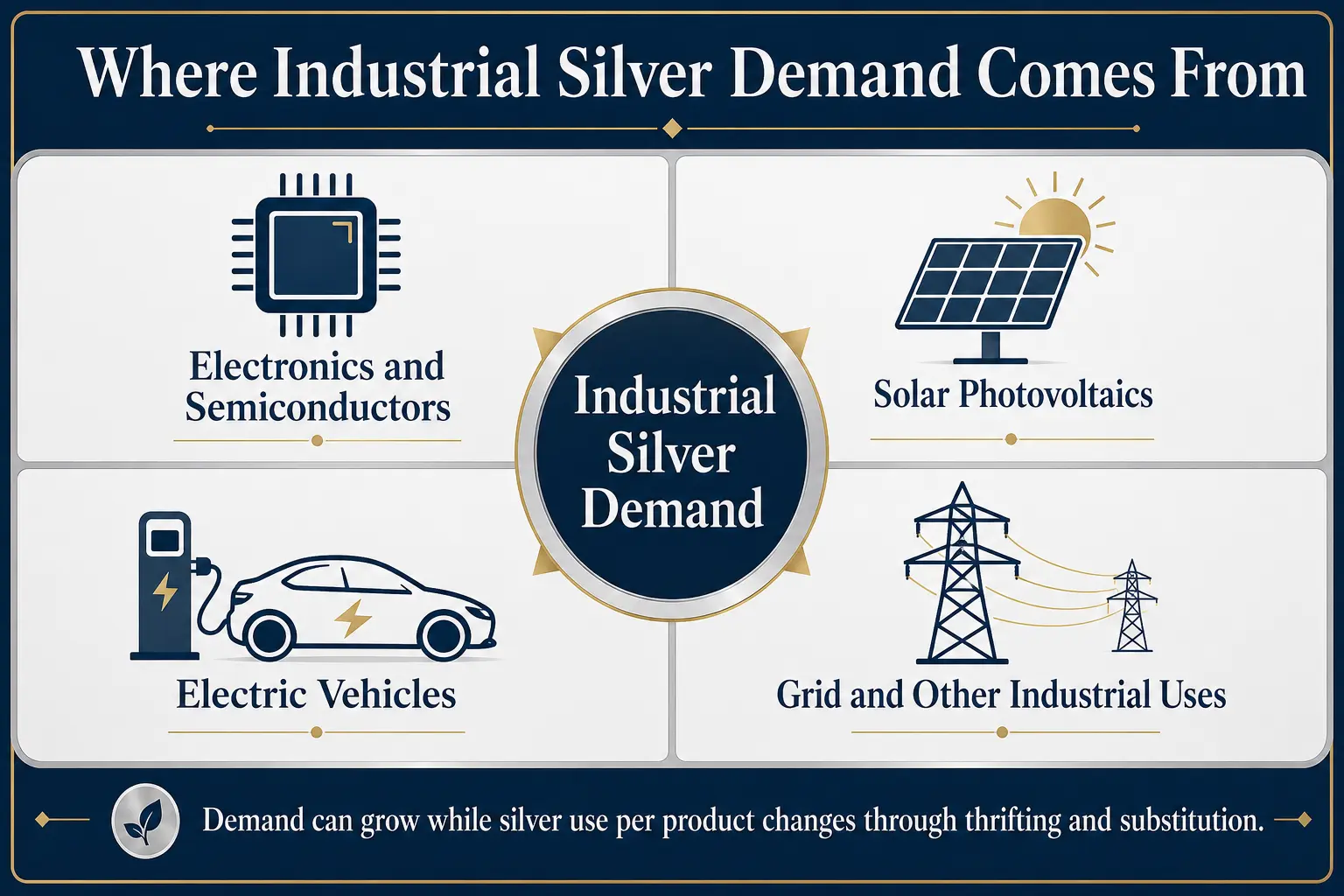
Semiconductors and AI are only part of the industrial picture. Solar photovoltaics: silver powder is made into conductive paste and printed onto silicon solar cells to collect and carry the electricity generated when sunlight releases electrons — PV demand reached a record 197.6 million ounces in 2024, representing 29% of industrial silver demand, up from 11% in 2014 (Silver Institute). Solar also shows the importance of thrifting: in 2025, higher silver costs and competition pushed manufacturers to reduce silver loadings and adopt substitutes in some cell designs, which helped pull industrial demand below the 2024 record. Electric vehicles: silver is used in vehicle electrical contacts, battery-management systems, power electronics, sensors, infotainment, safety systems, and charging infrastructure — an Oxford Economics report commissioned by the Silver Institute estimated battery-electric vehicles use about 25 to 50 grams of silver and consume 67% to 79% more silver than internal-combustion vehicles (Silver Institute). Those are industry-sponsored forecasts, not verified figures for every model. Sprott, an asset manager active in precious-metals products, also identified solar, EVs, 5G, and consumer electronics as important demand drivers, estimating industrial uses at roughly 55% of total silver demand in early 2025 (Sprott) — useful corroboration, though not independent public-sector research.
Is Silver Supply Keeping Up?
The latest full-year data show that total silver demand exceeded supply for five consecutive years through 2025. In 2025, total demand was 1.13 billion ounces, mine production rose 3% to 846.6 million ounces, and recycling rose 2% to 197.6 million ounces — leaving the market in deficit for a fifth year (Silver Institute). The Silver Institute is an industry organization and its World Silver Survey is sponsored by silver-market companies, with underlying research by the specialist consultancy Metals Focus. Mine production: much silver is produced as a by-product of copper, lead, zinc, and gold mining, so mine supply may not respond quickly to silver prices because production depends on the economics of the primary metal. Recycling reached a 12-year high of 197.6 million ounces in 2025 as jewelry and silverware selling increased, though industrial e-scrap volumes declined. Above-ground inventories: a yearly deficit does not mean the market immediately runs out of silver — existing inventories, exchange stocks, private holdings, and recycled metal can cover part of the gap. The more accurate meaning is that current-year supply did not meet current-year demand; repeated deficits can reduce available inventories, but the response depends on where the metal is held, whether owners will sell, and the price needed to bring it forward.
Can Thrifting and Substitution Slow Industrial Demand?
Yes. Rising demand encourages manufacturers to use less silver per unit or replace it where performance allows. Thrifting means reducing the amount of silver in a product without removing the function; substitution means using another material or design. Solar manufacturing provides the clearest recent example — the Silver Institute said PV manufacturers accelerated thrifting and substitution in 2025 because of intense competition and higher silver costs (Silver Institute). Electronics can be harder to substitute where conductivity, reliability, contact resistance, heat performance, or size constraints are critical, and the Silver Institute said substitution remained limited across many electronic applications because of silver's performance characteristics. The balance can change over time: higher prices increase the incentive to redesign products, while new technologies may create uses that need more silver — one reason long-term demand projections should be treated as scenarios rather than fixed outcomes.
Does Rising Industrial Demand Mean a Higher Silver Price?
No. Rising industrial demand is supportive, but it does not automatically produce a higher price. Silver prices reflect several forces at once: industrial demand, jewelry and silverware demand, coin and bar purchases, exchange-traded product flows, futures positioning, mine production, recycling, above-ground inventories, interest rates, the U.S. dollar, investor sentiment, and market liquidity. The 2024 and 2025 data illustrate the distinction — industrial demand set a record in 2024 while physical coin and bar demand fell sharply; in 2025 industrial demand declined, but coin and bar demand rose 14% and investment-market conditions contributed to record prices (Silver Institute). BlackRock describes silver as a small and volatile market whose price reflects both industrial demand and investment flows, with annualized volatility as much as twice gold's over the prior 20 years (iShares). A supply deficit can exist while prices fall if investors sell, the dollar rises, or interest rates change — and prices can rise when industrial demand is flat if investment demand or liquidity conditions tighten. The correct conclusion is narrower: semiconductor, AI, solar, EV, and grid growth can support industrial demand, but price results remain uncertain.
What Does This Mean for a Retirement Saver Considering Silver?
Industrial growth can strengthen the case for understanding silver, but it does not establish that silver belongs in every retirement portfolio. Silver has several traits that matter in retirement planning: substantial industrial use; higher volatility than gold; no interest or dividends on physical holdings; premiums, storage, insurance, and dealer spreads on physical silver; added custodian, depository, and transaction costs in a self-directed IRA; and liquidity needs that can differ from stocks, bonds, or cash. Investor.gov explains that diversification spreads exposure across investments but does not prevent losses (Investor.gov). A modest silver allocation may be tested as one diversifier within a larger plan, with the purpose stated clearly — industrial-growth exposure, precious-metals diversification, or another defined role — while accounting for volatility, costs, liquidity, and the absence of cash flow.
The Silver IRA Pros and Cons guide reviews those trade-offs, the Silver vs. Gold IRA Cost guide compares storage and transaction issues, and the Gold Allocation Backtest can help test broader precious-metals scenarios. For IRA-held metals, the IRS states that most metals are collectibles, with limited exceptions for specified coins and qualifying bullion, and that qualifying bullion must be held in the physical possession of a bank or approved nonbank trustee (Internal Revenue Service). Customers should speak to a financial or tax advisor before making decisions about allocation, taxes, an IRA, a rollover, or physical silver. Goldco does not offer tax or legal advice. The How Much Gold Should Be Held in Retirement guide and Gold IRA Suitability Quiz can organize broader research without creating a personal recommendation.
Frequently Asked Questions
Why is silver used in semiconductors and electronics?
Silver conducts electricity extremely well and performs reliably in contacts, switches, circuit paths, conductive inks, solders, and other components. It is used around chips and throughout electronic systems rather than only inside the silicon die.
How much silver does an AI data center use?
No reliable public source provides one verified amount for an average AI data center. The Silver Institute has stated that precise silver-loading data for data centers are not available.
Is AI already affecting silver demand?
The Silver Institute linked 2024 industrial-demand growth to AI-related consumer electronics and said AI infrastructure continued to support demand in 2025.
Is the silver market in a supply deficit?
The Silver Institute reported that total demand exceeded supply for the fifth consecutive year in 2025. Mine production reached 846.6 million ounces and recycling reached 197.6 million ounces.
Does a silver supply deficit mean prices must rise?
No. Prices also depend on investment demand, interest rates, the dollar, inventories, futures positioning, market liquidity, and recycling. A deficit is a supply-and-demand measure, not a price promise.
Can manufacturers reduce silver use?
Yes. Manufacturers can reduce silver per unit through thrifting or substitute other materials where performance allows. Solar manufacturers accelerated both methods in 2025.
Conclusion
Silver demand from semiconductors and AI data centers is part of a wider industrial transformation — more chips, servers, networks, power systems, solar equipment, EVs, and grid infrastructure create more opportunities for silver-containing components. The data also show that growth is not linear: industrial demand declined in 2025 even as AI infrastructure expanded, because photovoltaic thrifting and substitution offset some gains. That is the key distinction for retirement research: industrial silver demand is real, but it is not a direct price forecast or an allocation recommendation.
Sources
- The Silver Institute. Silver in Industry (industry body).
- The Silver Institute. Industrial Demand Reached a Record 680.5 Moz in 2024.
- The Silver Institute. Silver Demand Forecast to Expand Across Key Technology Sectors.
- The Silver Institute. Record Silver Prices in 2025 (World Silver Survey).
- Sprott. Silver's Strength and Industrial Demand.
- iShares (BlackRock). Gold and Silver: Investing in Precious Metals.
- Investor.gov (U.S. SEC). Diversify Your Investments.
- Internal Revenue Service. Investments in Collectibles in Individually Directed Qualified Plan Accounts.
Article reviewed and edited by Daniel M. — editor, 401kToGoldIRA.org. An informational explainer sourced to the Silver Institute, Sprott, iShares/BlackRock, Investor.gov, and the IRS (industry sources flagged); educational only, not investment advice, a price forecast, or an allocation recommendation.