Lump Sum vs Annuity Calculator
A pension election is usually irrevocable. One choice hands over a single sum of money; the other promises a monthly payment for life. This tool compares them on the numbers that actually decide it: the break-even age, and the return the lump sum has to earn to match what the pension would have paid.
Open the Calculator →Educational only: This tool produces an illustration from the figures entered. It is not financial, tax, actuarial or legal advice, does not calculate income tax, and does not recommend either option. Pension terms, survivor elections and rollover treatment depend on the plan document and current law. Customers should speak with a qualified tax professional, the plan administrator and, where appropriate, an attorney before making an irrevocable election. Goldco does not offer tax or legal advice. Past performance does not guarantee future results.
A lump sum and an annuity are not two prices for the same thing. They are two different allocations of risk — and the pension election is generally irrevocable once made.
Taking the annuity generally leaves longevity and investment risk with the plan. Taking the lump sum moves both to the retiree, together with full control of the money and responsibility for required minimum distributions from the applicable age — 73 for those born 1951 to 1959, and 75 for those born in 1960 or later under SECURE 2.0 (IRS — required minimum distributions).
Key takeaways
- Break-even age is a reference point, not a decision rule. It shows when cumulative pension payments overtake the lump sum, but ignores growth, tax and inflation.
- The required payout rate is the more revealing number. Annual pension divided by lump sum gives the rate the money must sustain to match the pension — and it must sustain it for life.
- A lump sum paid to the participant is generally subject to 20% mandatory federal withholding as an eligible rollover distribution; a direct rollover generally avoids that immediate withholding (IRS — lump-sum distributions).
- PBGC protection has legal limits and does not cover everything. Guarantees apply to single-employer plans PBGC trustees, up to maximums that vary by age; PBGC states most benefits fall below those limits (PBGC — maximum monthly guarantee).
- Most private pension annuities are not inflation-indexed. A fixed monthly payment buys less over a long retirement.
- The survivor election changes the comparison entirely. A single-life option paying more per month may leave a spouse with nothing.
- RMD responsibility transfers with the money. An annuity satisfies the rules through its own schedule; a rollover generally puts the obligation on the account owner from the applicable age — 73 for those born 1951–1959, and 75 for those born in 1960 or later (IRS — RMD FAQs).
Pension Comparison Estimator
Enter the lump sum offered and the monthly pension it would replace. The tool returns the simple break-even age, the payout rate the lump sum must sustain, and the cumulative position at a chosen age. All outputs are illustrative estimates based only on the figures entered.
What this deliberately does not do. It does not model investment returns, taxes, inflation, survivor benefits or the plan's early-retirement subsidies. Those often matter more than the break-even age. Treat the output as a starting point for a conversation with the plan administrator and a tax professional.
The simple break-even age divides the lump sum by the annual pension and adds the result to the starting age. It assumes the lump sum earns nothing and the pension never rises, so it is a floor for comparison rather than a projection. A realistic assessment has to account for growth on the invested lump sum, the tax treatment of each option, and how long the retiree actually lives.
What Each Option Actually Transfers
The money is the visible part of the decision. The risk allocation is the part that determines how the next thirty years feel.
| Risk | If the annuity is taken | If the lump sum is taken |
|---|---|---|
| Longevity risk — outliving the money | Held by the plan. Payments generally continue for life however long that is. | Held by the retiree. The balance can be exhausted. |
| Investment risk — returns fall short | Held by the plan. The monthly amount does not fall because markets do. | Held by the retiree. Sequence of poor early returns is permanent. |
| Inflation risk — purchasing power erodes | Usually held by the retiree. Most private pension annuities are not inflation-indexed. | Held by the retiree, but the portfolio can hold assets intended to respond to inflation. |
| Sponsor or insurer failure | Partly transferred. PBGC guarantees single-employer plan benefits up to legal limits. | Removed once the money is rolled over. No further dependence on the sponsor. |
| Flexibility — unexpected costs, changed plans | Low. The election is generally irrevocable and the payment schedule is fixed. | High. Amounts and timing are controlled by the account owner. |
| RMD responsibility | Handled by the payment schedule itself. | Falls on the account owner from the applicable age — 73 for those born 1951–1959, 75 for those born 1960 or later. |
| What passes to heirs | Depends entirely on the survivor option elected. Some options leave nothing. | The remaining account balance passes under the IRA beneficiary rules. |
How the Money Moves Decides What Is Taxed
A lump sum has two possible routes out of the plan, and they are taxed very differently. Paid to the participant, an eligible rollover distribution is generally subject to 20% mandatory federal withholding, and rolling over the full original amount within 60 days then requires replacing the withheld portion from other savings. Sent directly to an IRA or another eligible plan, a direct rollover generally avoids that immediate withholding (IRS Topic 412).
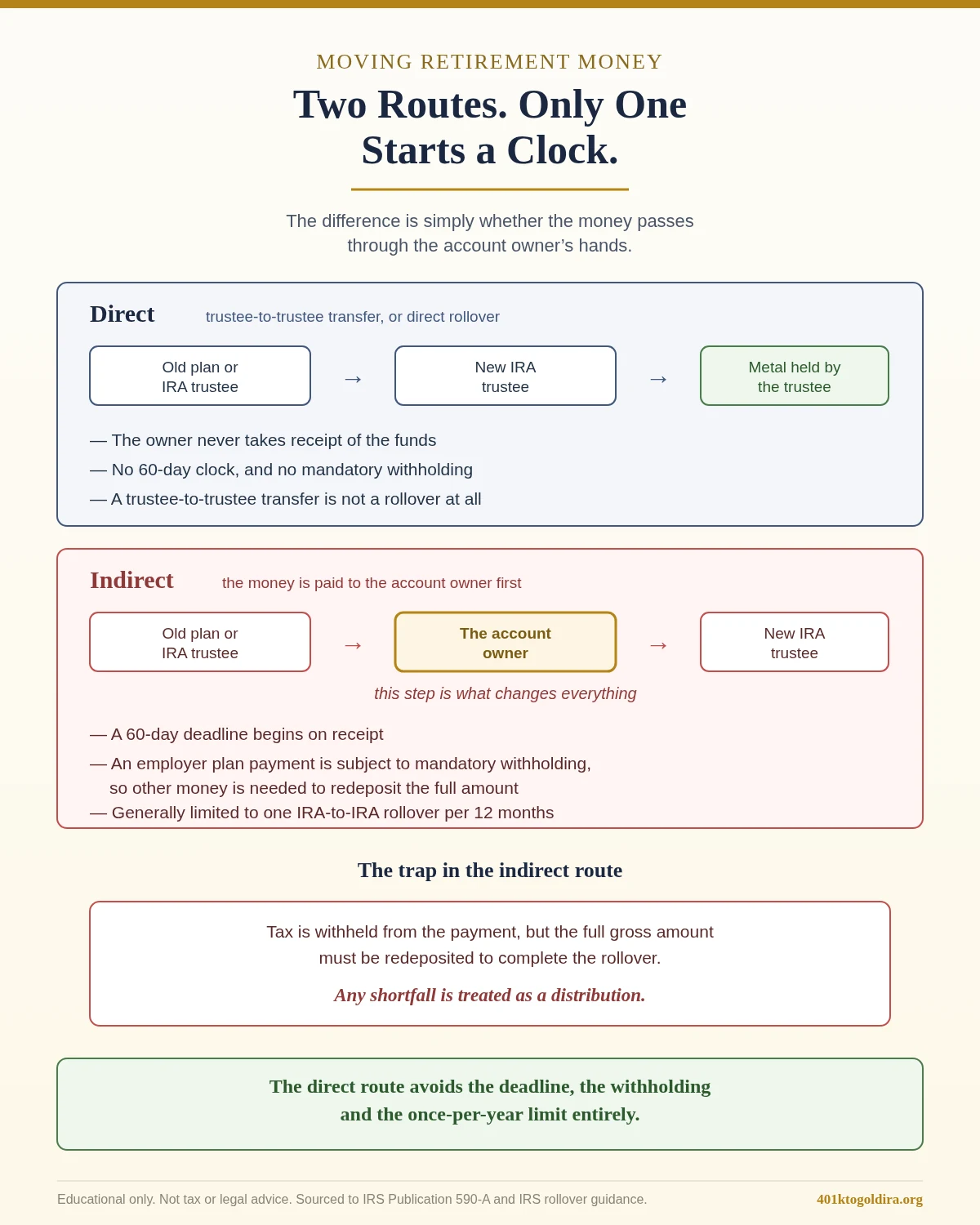
The withholding shortfall calculator shows the size of that gap on a specific amount.
What the PBGC Guarantee Covers
A common argument for the annuity is that the pension is federally backstopped. That is true within limits, and the limits matter. PBGC guarantees benefits only up to maximums set by federal law, those maximums vary by age, and they apply to single-employer plans PBGC pays as trustee — multiemployer plan guarantees work under a different framework. PBGC also states that most benefits in trusteed plans are below the maximum and unaffected by the legal limits (PBGC).
So the guarantee is real, bounded, and worth checking against the actual benefit rather than assumed to be complete.
Who Handles Required Minimum Distributions
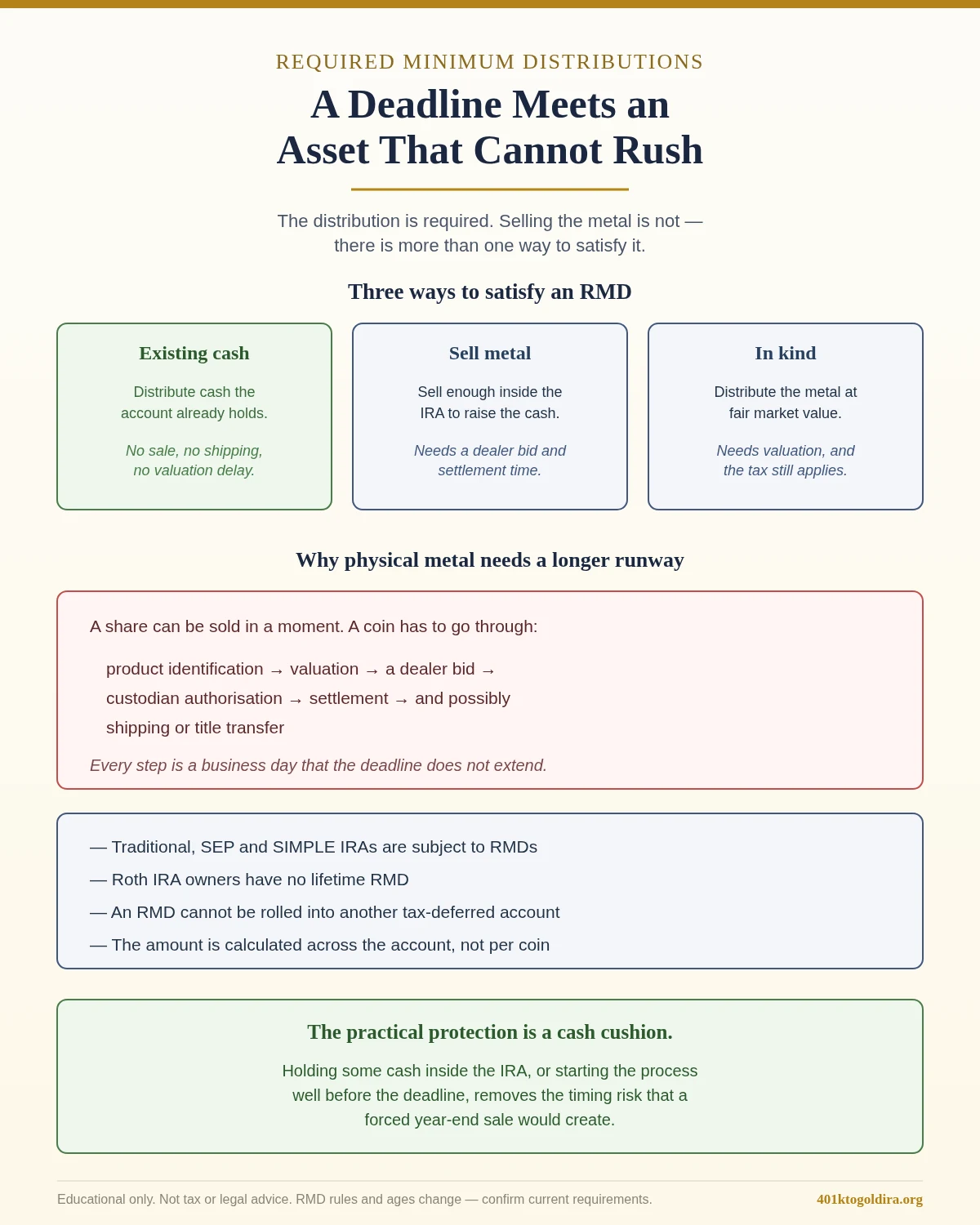
An annuity satisfies the distribution rules through its own payment schedule. Rolling the money into an IRA generally transfers that responsibility to the account owner, who must begin taking required minimum distributions at the applicable age — 73 for those born 1951 to 1959, and 75 for those born in 1960 or later under SECURE 2.0. Roth IRAs are not subject to RMDs during the owner's lifetime (IRS — RMD FAQs). Anyone weighing a pension decision in their forties or fifties today is very likely in the 75 tier, which changes how long the money can stay invested before distributions must begin. Where an IRA holds assets that cannot be divided precisely, meeting an RMD takes planning rather than a single instruction.
Questions Worth Asking Before Electing
- What exactly does the survivor option pay, and what happens to a spouse under each election?
- Is the monthly amount adjusted for inflation in any way, or fixed for life?
- Does the plan apply an early-retirement subsidy that would be forfeited by taking the lump sum?
- Is the lump sum offer time-limited, and is the election reversible in any circumstance?
- What interest and mortality assumptions were used to calculate the lump sum?
- Would a direct rollover be available, and to which receiving account types?
- What is the plan's funded status, and would PBGC limits bind on this particular benefit?
Methodology and Limitations
Annual pension is the monthly figure multiplied by twelve. The simple break-even age is the lump sum divided by the annual pension, added to the starting age. The required payout rate is the annual pension divided by the lump sum, expressed as a percentage. Cumulative pension is the annual amount multiplied by the years between the start age and the comparison age.
The model deliberately excludes investment returns, taxes, inflation, survivor benefits, early-retirement subsidies, plan-specific actuarial assumptions and mortality probability. Each can change the conclusion, and several usually do. The tool exists to frame the trade-off, not to resolve it. Tax and distribution treatment is drawn from IRS material and pension guarantee limits from PBGC; neither is a statement about any individual plan.
Frequently Asked Questions
Is a lump sum better than an annuity? Neither is universally better — they allocate risk differently. The annuity generally keeps longevity and investment risk with the plan; the lump sum moves both to the retiree along with control of the money.
What is the break-even age? The age at which cumulative pension payments overtake the lump sum. It ignores growth, tax and inflation, so treat it as a reference rather than a rule.
What return does the lump sum need? Enough to generate the same annual income and keep generating it for life. Annual pension divided by lump sum gives that simple sustained rate.
Is a pension lump sum taxable? Paid to the participant, it is generally a taxable distribution subject to 20% mandatory federal withholding. A direct rollover generally avoids the immediate withholding.
Does PBGC guarantee the pension in full? Only up to limits set by federal law, varying by age, for single-employer plans it trustees. PBGC states most benefits fall below those maximums.
Who handles RMDs? The annuity's own schedule does. After a rollover, the account owner generally does, from the applicable age — 73 for those born 1951 to 1959, and 75 for those born in 1960 or later.
Related tools and reading: the withholding shortfall calculator, the rollover calculator, the rollover guide, and the precious metals IRA hub for how a self-directed IRA holds physical metal.
Educational only. This page does not recommend taking either a lump sum or an annuity, and nothing here is financial, tax, actuarial or legal advice. Outputs are illustrations generated from user-entered figures using simplified arithmetic that omits returns, taxes, inflation, survivor benefits and mortality. Pension terms vary by plan and the election is generally irrevocable. Customers should speak with a qualified tax professional and the plan administrator before acting. Goldco does not offer tax or legal advice. Past performance does not guarantee future results.