Educational estimate, not tax advice. This page is published for research and education. It gives a federal estimate from the figures you enter, using the 2026 amounts the IRS published in Revenue Procedure 2025-32. It is not tax, legal, or financial advice, it is not a prediction of your final tax bill, and it is not personalized to your circumstances. Speak to a qualified tax professional or your plan administrator before acting on a withdrawal.
Key takeaways
- Your withdrawal is ordinary income
- A distribution from a traditional 401(k) is included in your income for the year it is paid and taxed at ordinary rates. No long-term capital gain rate applies, however long the money was invested.
- A potential 10% additional tax applies under age 59½
- It is charged on the portion included in your income, not on the gross amount withdrawn, and it is only avoided if an exception applies.
- The 20% your plan withholds is a prepayment, not your bill
- Federal law generally requires 20% withholding when a plan pays an eligible rollover distribution to you instead of rolling it over. Your actual liability may be higher or lower.
- A direct rollover produces no current tax, no additional tax, and no withholding
- The same dollars move to an eligible retirement plan without entering your income for the year.
Jump to a section
Estimate your 401(k) withdrawal
An estimate needs the amount, your date of birth, the date of the withdrawal, your filing status, and your other taxable income for the year before deductions. The dates are there because the 59½ test is a date rather than a tax year, and the income figure matters more than people expect: leaving it out is why some online estimates come out too low.
Free 401(k) Withdrawal & Rollover Checklist
Before you cash out, get the short checklist covering taxes, potential penalties, rollover alternatives, and questions to ask your plan administrator.
What this estimate does not tell you
- Whether any exception to the additional tax applies to you. That depends on facts and documentation this page cannot check.
- Whether your plan permits the withdrawal at all. That is decided by the plan document, not by tax law.
- Your final tax bill. Credits, phase-outs, the alternative minimum tax, net investment income tax and capital-gain stacking are all excluded.
- State or local tax, unless you enter a rate yourself. Some states also charge their own additional tax on an early distribution.
- Anything about employer stock and net unrealised appreciation, a qualified domestic relations order, substantially equal periodic payments, plan loans, hardship distributions or required minimum distributions.
- What your Form 1099-R will say. The plan chooses the box 7 code; where it codes a distribution as early with no known exception and an exception does apply, the taxpayer claims it on Form 5329.
Figures are year-specific. The 2026 tables used here were published in Revenue Procedure 2025-32 and are stated as in effect on 2025-10-09; later legislation can supersede them, as happened in 2025. Rules checked 2026-10-05.
What if you took less?
Move the slider to see how a smaller withdrawal changes the estimate. The figures above do not move: they stay tied to the amount in the form.
Enter an amount above to compare a smaller withdrawal.
Withholding is not the tax bill
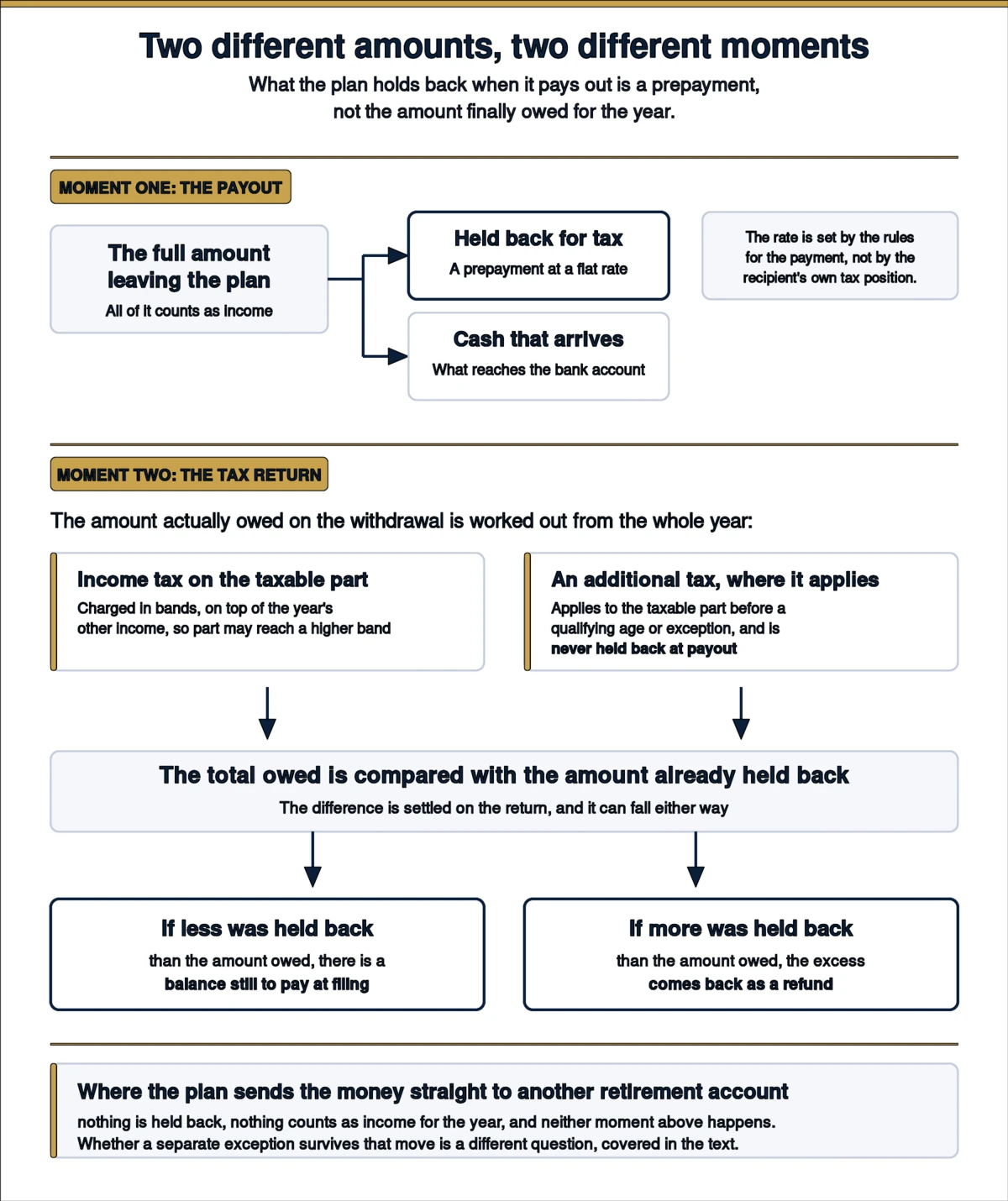
The amount a plan holds back when it pays you and the amount you finally owe for the year are two different figures, and either one can be the larger.
When an eligible rollover distribution is paid to you rather than rolled over, the plan must withhold 20% of the taxable amount for federal income tax. That is a statutory flat rate attached to the payment, not a calculation of your tax position, and it cannot be waived or reduced: you may elect more than 20%, never less.
Your actual liability is worked out across the whole year. The taxable part of the withdrawal is added to your other income, and tax is charged in bands, so part of a large withdrawal can reach a higher band than the rest. Where your marginal rate exceeds 20%, the amount withheld will not cover the bill.
The 10% additional tax is not withheld at source at all. Where it applies, it is settled on your return, which is why a withdrawal can leave a balance due even when 20% was already taken.
The full amount counts as income, including the part withheld. If $10,000 is distributed and $2,000 withheld, all $10,000 is taxable unless it is rolled over, and rolling over the full $10,000 would mean adding the withheld $2,000 from your own funds within 60 days. The rollover withholding shortfall calculator covers that gap in detail.
What the plan reports
The plan decides the code in box 7 of your Form 1099-R. Code 1 means an early distribution with no known exception, and code 2 means the payer knows an exception applies, including a distribution after separation from service in or after the year the participant reached 55. Where the plan codes a distribution as early but an exception does apply to you, the exception is claimed on Form 5329 rather than by the plan.
If you left your job at 55 or later
A distribution from the plan of the employer you separated from can avoid the additional tax where the separation happened in or after the calendar year you reached age 55. The test is the year you left, not your age now, and leaving earlier cannot be cured by waiting: the IRS illustrates this with a participant who separated at 49 and took a distribution in the year he reached 55, who did not meet the exception.
This exception does not survive a rollover to an IRA. It applies to distributions from the employer plan and not to distributions from an individual retirement plan, so once the money is in an IRA it is no longer available. Anyone between 55 and 59 1/2 who has separated from service should take advice before rolling over, because the rollover itself can cost the exception. Whether your plan allows partial withdrawals in the first place is a separate question, covered in the Rule of 55 partial withdrawals research.
A narrower rule reaches age 50, or 25 years of service under the plan, for qualified public safety employees in a governmental plan and for firefighters in a qualified trust, a 403(a) annuity plan or a 403(b) contract. It is not a general rule, and the service count is a plan-document fact, so the calculator presents that branch as conditional rather than deciding it. The early withdrawal penalty guide sets out the full list of exceptions, including the ones that exist for IRAs but not for employer plans.
Alternatives to taking the cash
Someone who has just seen the total above deserves to know what else exists. None of these is a recommendation, and each has tax consequences worth confirming with a professional.
- Leave the balance in the current plan
- No distribution, so nothing is included in income for the year and no additional tax arises. Plan rules govern what you can do later.
- Direct rollover to an IRA
- The plan sends the money straight to the receiving account. It is not included in income for the year of the transfer, nothing is withheld, and no additional tax applies. Note the Rule of 55 point above before choosing this between 55 and 59 1/2.
- Direct rollover to a new employer's plan
- Same treatment as a rollover to an IRA, where the receiving plan accepts it, and the separation-from-service exception can remain available on a later distribution from that plan.
- Take a smaller amount
- Less taxable income in the year, and a smaller base for the additional tax. The explorer above compares a smaller figure.
- A plan loan, where the plan offers one
- Not a distribution when it is taken. The rules and the consequences of default are plan-specific, and this page does not model them.
A direct rollover produces no current tax, no withholding and no additional tax, which is why the figure at the top of this page is the clearest statement of what cashing out costs by comparison. Where the destination is a self-directed IRA holding physical metals, the 401(k) to Gold IRA rollover guide covers the funding routes and the rollover guide covers direct versus indirect in detail.
Considering a Gold IRA instead of taking a taxable withdrawal?
If precious metals are one of the rollover options you are already considering, take the Gold IRA quiz to compare options based on the amount you may roll over.
Some states charge their own early-withdrawal tax
This calculator does not estimate state tax, and the reason is worth stating. There is no federal source that sets out what each state charges, and several states apply their own withholding on retirement distributions on their own rules.
One federal rule does apply everywhere: a state may not tax the retirement income of someone who is not a resident or domiciliary of that state, and that protection extends to a state's political subdivisions. So a former employer's state generally cannot tax you after you move away, but nothing federal tells you what your own state charges.
California is a documented example rather than our only example. Its Form FTB 3805P charges an additional tax of 2½% on the amount subject to it, mirroring the structure of federal Form 5329. California also warns that it does not conform to all of the federal exceptions to the additional tax on early distributions, and that the amount included in income may differ for state and federal purposes.
That 2½% also sits on top of ordinary California income tax, which this page has not researched and does not estimate. Treat it as a reason to check your own state's rules, not as a figure to apply.
Method, assumptions and limitations
Taxable portion. The amount withdrawn less any after-tax basis. A distribution from a designated Roth account is handled separately: it is not taxable where the five-year participation period is complete and you are 59 1/2 or older, and otherwise it is split between contributions and earnings in proportion to the account, which needs the account value and the Roth basis before any figure can be shown.
Federal income tax. Your other income for the year, before deductions, has the deduction for your filing status applied to it, and the tax is computed both with and without the taxable part of the withdrawal. The difference is the incremental tax attributable to the withdrawal. This is why the page asks for income before deductions and does the subtraction itself, and why it reports an incremental amount rather than one marginal rate applied to the whole withdrawal: a large withdrawal commonly spans two or three bands.
Additional tax. 10% of the includible portion not rolled over, unless you are 59 1/2 or older on the date of the distribution, or the separation-from-service exception applies. Where an exception covers only part of the amount, only that part is removed from the base. Where the inputs cannot settle whether an exception applies, the estimate keeps the additional tax and offers the alternative as an explicitly hypothetical comparison rather than quietly dropping the line.
Withholding. 20% of the taxable amount actually paid to you, where the distribution is an eligible rollover distribution. A directly rolled portion is not withheld on, nothing is withheld below the $200 aggregated floor, and the rate can be raised but not lowered.
State and local tax. Only ever the combined rate you enter, applied flat to the taxable amount and labelled as your own figure. There is no state table. Treatment varies widely, some states apply their own withholding, and some charge an additional early-distribution tax of their own: California, for example, adds 2.5% on Form FTB 3805P, and California does not conform to every federal exception. Check your own state's rules.
Not modelled. Credits and phase-outs, the alternative minimum tax, net investment income tax, capital-gain stacking, the knock-on effects on Medicare premiums or the taxation of Social Security, employer stock and net unrealised appreciation, qualified domestic relations orders, substantially equal periodic payments, plan loan offsets, hardship distributions, required minimum distributions, inherited accounts, and multi-year planning. Each is named here rather than approximated.
Worked examples
These three examples use the 2026 figures published in Revenue Procedure 2025-32, and they are produced by the same code as the calculator, so they cannot disagree with it. Each is an estimate on stated assumptions, not advice for anyone's situation.
Shared assumptions: a traditional pre-tax 401(k) with no after-tax basis, the standard deduction, a cash-out paid to the participant rather than rolled over, no state or local tax included, and no exception to the additional tax unless stated.
Single filer, age 45, $30,000 withdrawal
The whole withdrawal falls inside one bracket, yet the 20% withheld still falls short of the income tax on it by $600, and the additional tax is not withheld at all — which is how a single-bracket withdrawal still leaves a balance due.
| Gross amount | $30,000 |
|---|---|
| Taxable portion | $30,000 |
| Federal income tax on this amount | $6,600 |
| Additional tax | $3,000 |
| Withheld by the plan at payout | $6,000 |
| Total federal cost for the year | $9,600 |
| Difference at filing | about $3,600 still to pay |
| Cash in hand at payout | $24,000 |
| Net after all estimated tax | $20,400 |
Separated at 56, now 57, $25,000 withdrawal
The gap running the other way: the 20% withheld exceeds the estimated liability, so the difference comes back at filing. Rolling this balance to an IRA would generally end the separation-from-service exception.
| Gross amount | $25,000 |
|---|---|
| Taxable portion | $25,000 |
| Federal income tax on this amount | $3,000 |
| Additional tax | $0 |
| Withheld by the plan at payout | $5,000 |
| Total federal cost for the year | $3,000 |
| Difference at filing | about $2,000 potentially over-withheld |
| Cash in hand at payout | $20,000 |
| Net after all estimated tax | $22,000 |
Married filing jointly, age 50, $60,000 withdrawal
This withdrawal crosses a bracket, which is why the estimate is lower than a flat 24% on the whole amount would suggest. Applying one marginal rate to an entire withdrawal is the most common way an online estimate goes wrong.
| Gross amount | $60,000 |
|---|---|
| Taxable portion | $60,000 |
| Federal income tax on this amount | $13,328 |
| Additional tax | $6,000 |
| Withheld by the plan at payout | $12,000 |
| Total federal cost for the year | $19,328 |
| Difference at filing | about $7,328 still to pay |
| Cash in hand at payout | $48,000 |
| Net after all estimated tax | $40,672 |
In the first example the 20% withheld does not cover the federal cost, so a balance is still due at filing. In the second the withholding exceeds it, so the excess comes back as a refund. Neither direction is the normal one: it depends on the year's other income.
Questions
How much tax do you pay on a 401(k) withdrawal?
A 401(k) withdrawal from a traditional account is included in your income for the year it is paid and taxed at ordinary income rates, so the rate depends on your filing status and everything else you earned that year. If you are under age 59 1/2, a potential 10% additional tax may apply on top of that, charged on the portion included in your income, unless an exception applies. There is no single percentage that answers this for everyone, which is why the calculator asks for your other income.
Why does my plan withhold 20%?
Federal law generally requires a plan to withhold 20% of the taxable amount when it pays an eligible rollover distribution to you instead of rolling it over, and you cannot elect a lower rate or elect zero. The one way to avoid it is to elect a direct rollover to an eligible retirement plan, in which case there is no withholding. You can also ask for more than 20% to be withheld if you expect to owe more.
Is 20% withholding enough to cover the tax?
Often not. The 20% is a flat prepayment that has no particular relationship to your tax bracket, so if your marginal rate is higher than 20% you can expect a balance due at filing. The potential 10% additional tax is never withheld at source either, so it is not covered by the 20% at all. If your income is low enough, the opposite can happen and you may be due a refund.
What does a $10,000 401(k) withdrawal actually cost?
It depends on your other income, your filing status, and your age on the date of the withdrawal, so the honest answer is to use the calculator above rather than a single figure. The IRS does give one useful illustration of the mechanics: on a $10,000 distribution the payer withholds $2,000 and you receive $8,000, but all $10,000 is taxable unless you roll it over. To roll over the full $10,000 you would need to add the $2,000 from your own funds within 60 days.
At what age can I take money out of a 401(k) without the extra 10%?
Distributions made on or after the date you reach age 59 1/2 are outside the 10% additional tax, although ordinary income tax still applies. This is a date test rather than a tax-year test, so a withdrawal the day before you reach 59 1/2 is still an early distribution. There is also a separate rule if you left your employer in or after the year you turned 55.
What is the Rule of 55?
If you leave an employer in or after the year you turn 55, withdrawals from that employer's plan may be outside the 10% additional tax, subject to eligibility. What matters is the year you left, not your age now: the IRS states that you cannot separate from service before that year, and its own example shows that someone who left at 49 and waited until 55 did not meet the exception. A narrower version may substitute age 50, or 25 years of service under the plan, for qualified public safety employees and for employees providing firefighting services.
Does the Rule of 55 still apply if I roll my 401(k) into an IRA?
Generally no, and this is the single most important thing to know before rolling over if you are between 55 and 59 1/2. The statute states that the separation-from-service exception does not apply to distributions from an individual retirement plan, so the exception exists while the money is in the 401(k) and generally ends once it is in an IRA. If you may want to withdraw before 59 1/2, get advice before rolling over.
Can I use a 401(k) withdrawal for college or a first home without the 10%?
Not from a 401(k). The exceptions for higher education costs, a first-time home purchase, and health insurance premiums while unemployed are available for an individual retirement plan, and the IRS marks them as not available for a qualified plan such as a 401(k). Several other exceptions do apply to a 401(k), including separation from service in or after the year you turn 55, disability, and certain medical expenses.
Is a direct rollover taxed?
No. An amount transferred in a direct trustee-to-trustee transfer is not included in your income for the year of the transfer, there is no 20% withholding, and there is no 10% additional tax. The tax is deferred until the money is later distributed to you from the new plan or IRA. Roth 401(k) money is more restricted: it can generally be rolled over only to another designated Roth account or to a Roth IRA.
How is a Roth 401(k) withdrawal taxed?
A Roth 401(k) withdrawal is tax free only if it is a qualified distribution, which generally needs both a completed five-taxable-year period of participation and that you have reached age 59 1/2, died, or become disabled within the meaning of the statute. If it is not a qualified distribution, the withdrawal comes out part contributions and part earnings in proportion, and the earnings part is taxable and can be exposed to the 10% additional tax. The five-year period is counted separately for each plan.
Is a hardship withdrawal taxed less?
No, and this catches people out. A hardship distribution is not an eligible rollover distribution, so the default withholding is 10% rather than 20% and it can be adjusted, but it is still ordinary income and hardship is not an exception to the 10% additional tax. Lower withholding on a hardship withdrawal generally means a larger balance due at filing rather than a smaller total cost. A hardship distribution also cannot be rolled over.
Does my state tax a 401(k) withdrawal too?
Possibly, and this calculator does not estimate it. State rules vary widely, and some states charge their own additional tax on early distributions: California, for example, charges an additional 2 1/2% on its Form FTB 3805P, and states that it does not conform to all of the federal exceptions. One federal rule does help: a state cannot tax the retirement income of someone who is not a resident or domiciliary of that state, so a former employer's state generally cannot tax you after you move away.
Sources
Primary sources, all checked on 5 October 2026
- IRS Revenue Procedure 2025-32 (2026 inflation-adjusted items) Figures stated "as in effect on October 9, 2025"; the procedure itself warns that later-enacted amendments may supersede them.
- 26 U.S.C. 72(t) — 10% additional tax on early distributions
- 26 U.S.C. 402 — taxability of beneficiary of employees' trust
- 26 U.S.C. 402A — designated Roth accounts
- 26 U.S.C. 3405 — withholding on designated distributions
- 26 CFR 31.3405(c)-1 — mandatory 20% withholding Q&A
- 26 CFR 1.402A-1 — designated Roth account distributions
- IRS Publication 575 (2025), Pension and Annuity Income
- IRS Form 5329 — Additional Taxes on Qualified Plans
- IRS Form W-4R (2026) — Withholding Certificate for Nonperiodic Payments
- California FTB Form 3805P — Additional Taxes on Qualified Plans (and Other Tax-Favored Accounts) California's additional tax is 2 1/2%, charged on a form that mirrors the federal 5329 structure. California does not conform to all of the federal exceptions, and the amount included in California income can differ from the federal amount.
- 4 U.S.C. 114 — limitation on state taxation of retirement income 114(a) bars a state from taxing the retirement income of someone who is neither a resident nor a domiciliary; 114(b)(3) extends that to political subdivisions, which is why a local rate follows the same rule.
- IRS Instructions for Forms 1099-R and 5498 (2026) — box 7 distribution codes Code 1 is an early distribution with no known exception; code 2 signals an exception applies, which includes separation from service in or after the year the participant reached age 55. This is the document the reader actually receives, so it is the one they can check.
- IRS — Retirement topics: exceptions to tax on early distributions Cited ONLY for the availability columns, which state whether an exception reaches a qualified plan or is IRA-only. Do NOT cite this page's Internal Revenue Code section column: it mis-states the terminal-illness section, and 72(t)(2)(L) is cited to the statute instead.
Tool reviewed and edited by Daniel M., editor, 401kToGoldIRA.org. Educational only; not tax or legal advice, and not a tax determination. The 2026 tables are from Revenue Procedure 2025-32 and are stated as in effect on 2025-10-09.
Further Reading
 Gold IRA Early Withdrawal PenaltyThe full list of exceptions, and which employer-plan exceptions do not carry over to an IRA.
 Rollover Withholding Shortfall CalculatorThe out-of-pocket amount needed to roll over the full pre-withholding figure within 60 days.
 Rule of 55 Partial WithdrawalsWhether plans actually allow the partial withdrawals the exception would cover.