Educational only: This article presents a neutral evaluation framework and does not rank, recommend, or endorse any named provider. Any company-specific information is limited to dated public records that should be checked again before contact. It is not financial, tax, or legal advice. Customers should speak to a financial or tax advisor before making decisions. Goldco does not offer tax or legal advice. Past performance does not guarantee future results.
FINRA and the CFTC advise precious-metals customers to verify costs, spreads, credentials, and retirement-account rules before transferring money. The CFTC also warns that precious-metals fraud can target retirement savings through self-directed IRAs. A faith message can describe a company's mission, but it cannot establish that a price is fair, a recommendation is suitable, a rollover is correct, or a custodian has reviewed the quality of the metal.
Quick Answer: What Faith-Based Investors Should Verify First
A faith-based gold IRA provider should be evaluated in the same disciplined way as any other precious-metals business. The first review should cover five areas:
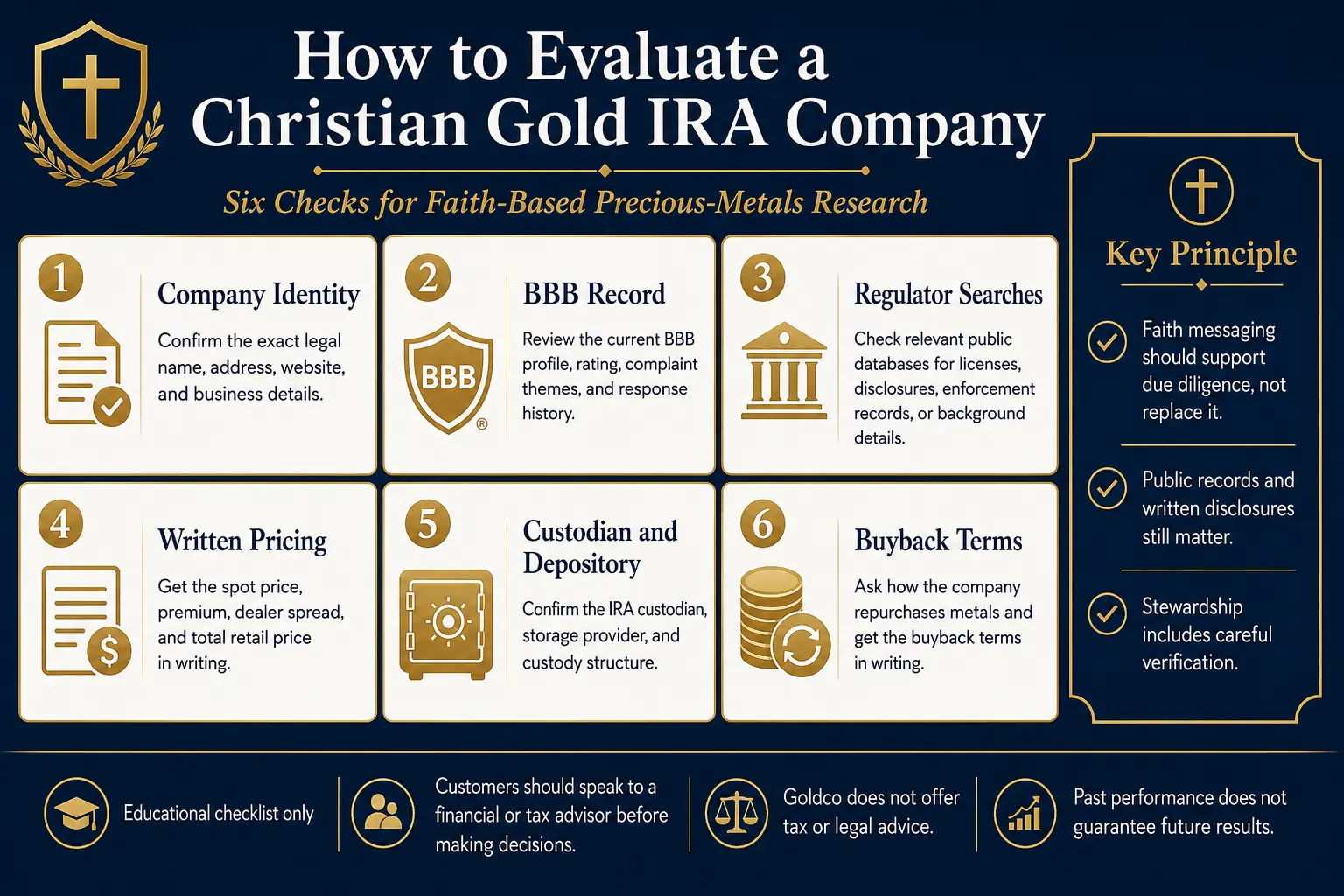
- Identity: The company's exact legal name, address, ownership, and years in operation.
- Public record: The current BBB profile, complaint handling, regulator databases, enforcement releases, and court records.
- Pricing: The spot price, retail premium, dealer spread, written buyback price, and all commissions.
- Retirement structure: The IRA custodian, depository, accepted metals, rollover procedure, and distribution process.
- Values alignment: Whether the company's conduct, disclosures, and sales process match its stated faith and stewardship message.
The word "Christian" is not a special federal license or regulatory category. The CFTC states that retail coin dealers generally are not regulated by state or federal authorities, so customers often must conduct significant independent research. When a dealer or salesperson claims to be a financial adviser, broker, or IRA specialist, credentials and disciplinary history should be checked through the appropriate databases. The SEC states that self-directed IRA custodians generally do not evaluate the quality or legitimacy of an asset or promoter. Customers should speak to a financial or tax advisor before making decisions involving taxes, rollovers, account funding, or distributions. Goldco does not offer tax or legal advice.
How to Evaluate a Christian Precious Metals Company
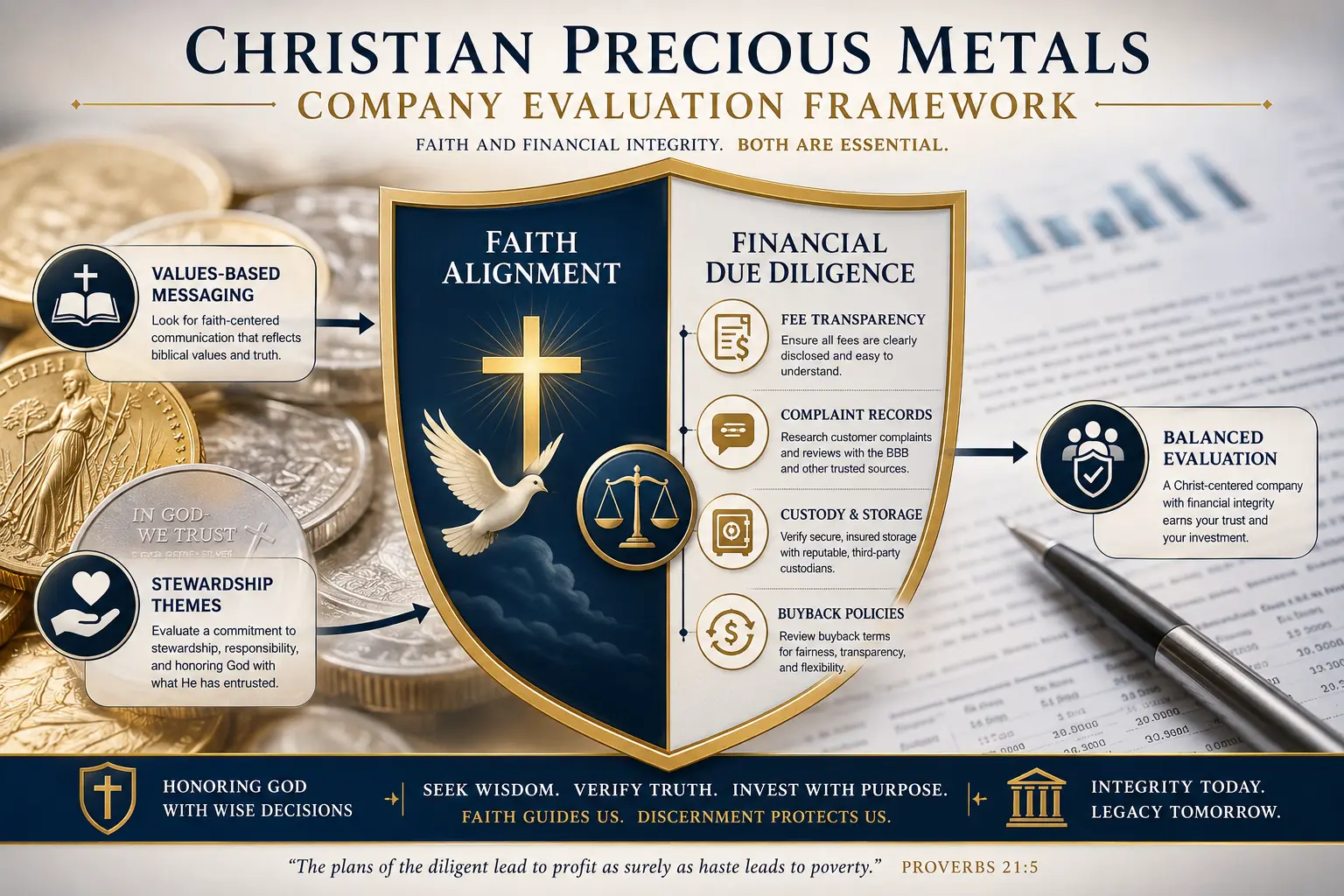
The phrase can refer to a dealer whose owners discuss faith, a business that uses biblical stewardship themes, a provider that supports ministries, or a sales organization that targets Christian audiences. Those descriptions are not standardized. The closest comparison in mainstream investing is values-based or socially responsible investing, where the SEC explains that values-oriented funds can apply different criteria and weight them differently. By analogy, a faith label on a metals company should be treated as a starting point for questions, not as a uniform quality standard. A sound evaluation separates three issues:
- Stated beliefs: what the business says about faith, ethics, service, or stewardship.
- Observable conduct: whether sales materials, written quotes, disclosures, and complaint responses match those statements.
- Independent records: what BBB, regulators, courts, and licensing databases show.
A company may communicate sincere beliefs and still offer products with costs that need careful review. Christian financial stewardship retirement decisions therefore require both values review and financial due diligence.
A Neutral Note on Named Companies
Two names sometimes discussed in the faith-based metals space are Genesis Gold Group and Revelation Gold Group. This article does not determine whether either company's beliefs, service, pricing, or products are appropriate for any customer. As of July 10, 2026, the BBB profile for Genesis Gold Group listed the company as BBB Accredited with an A+ rating and an accreditation date of September 20, 2022. As of the same verification date, the BBB profile for Revelation Gold Group listed the company as BBB Accredited with an A rating and an accreditation date of March 22, 2024. Those statements report only what the dated BBB profiles showed. They do not establish pricing, product quality, customer suitability, regulatory status, or future complaint history. BBB states that its ratings are its opinion of how a business is likely to interact with customers, are not a guarantee of reliability or performance, and do not use customer reviews in the letter-grade calculation. Any reader should check these records directly and current before relying on them.
What "Faith-Based" Precious-Metals Marketing Usually Means
Faith-based marketing often connects precious metals with stewardship, prudence, legacy, family responsibility, or values. Those themes can be meaningful, but the practical transaction remains a purchase of coins or bullion, sometimes through a self-directed IRA. A values-based gold IRA still involves ordinary financial questions: what metal is sold, its weight and fineness, the current spot value, the premium added, what the dealer would pay to repurchase, who receives compensation, which custodian and depository are involved, and what recurring and exit fees apply. FINRA and the CFTC advise comparing the retail price with spot, asking for the dealer's buyback price, identifying the spread, and obtaining all fees, commissions, and agreed prices in writing.
Faith language is not a product feature
Faith language does not change the metal's melt value, the dealer's spread, the custodian's fee schedule, or federal IRA law. It also does not turn a collectible coin into qualifying IRA bullion. The IRS states that IRAs generally cannot hold collectibles, with exceptions for specified coins and qualifying bullion held in the physical possession of a bank or approved nonbank trustee. The IRS maintains a list of approved nonbank trustees and custodians; a dealer is not automatically the IRA custodian, and a depository is not automatically an approved nonbank trustee. The roles should be identified separately in writing. The per-product premium picture is covered in the dealer markup data.
How to Read a Company's BBB Profile and Complaint Record
BBB can be useful, but it should be read correctly. BBB is a private organization, not a government agency. Its ratings run from A+ to F and are based on information available to BBB, including complaint information, business information, and public data. Customer reviews are not part of the letter-grade calculation. A proper review should examine more than the letter grade:
- Confirm the exact business. The profile name, address, website, phone, management names, and legal entity should match the company under review. Similar business names can produce incorrect conclusions.
- Record the verification date. BBB ratings, accreditation, complaint counts, and details can change, so state the date the record was checked.
- Separate complaints from reviews. Complaints follow a dispute process with closure statuses (resolved, answered, unresolved, unanswered, unpursuable); reviews are a different system and do not affect the letter grade.
- Read the substance, not only the count. Review for recurring themes (pricing, delivery, transfers, liquidation, buyback, communication). A complaint is an allegation until the record and response are examined; a low count does not prove no problems, and a higher count does not by itself establish misconduct.
- Do not treat accreditation as a final verdict. Accreditation means a commitment to BBB's standards; it does not replace regulator checks, written fee review, tax advice, or product comparison.
Regulator and Court Records: What to Search
A regulator search should match the role being claimed. Many cash precious-metals dealers do not appear in securities or futures registration systems merely because they sell coins or bullion — the CFTC states that retail coin dealers generally are not regulated by state or federal authorities, which makes role-based verification important.
- Broker or investment adviser claims: Investor.gov's background-check tool connects to the SEC's IAPD system and FINRA BrokerCheck, showing registration status, history, business practices, fees, conflicts, and disciplinary disclosures. A missing record may simply mean the person is not acting in a role that requires that registration.
- Leverage, financing, futures, or commodity advice: the CFTC directs customers to check registration and disciplinary history, and its RED List identifies certain foreign entities that appear to require registration but are not registered.
- State securities records: NASAA provides a directory for state and provincial securities regulators, which may maintain license checks, enforcement orders, and investor alerts.
- Federal enforcement: the SEC, CFTC, FTC, and Department of Justice publish complaints, orders, settlements, and criminal case announcements; search the exact company name, known aliases, owners, executives, and key salespeople.
- Court records: PACER provides a nationwide index of federal court cases. A case filing is not the same as a final judgment, so the docket status and actual documents matter. Media reports can help locate records, but a headline should not be treated as proof.
Pricing and Fees: Get Spot, Premium, and Buyback Terms in Writing
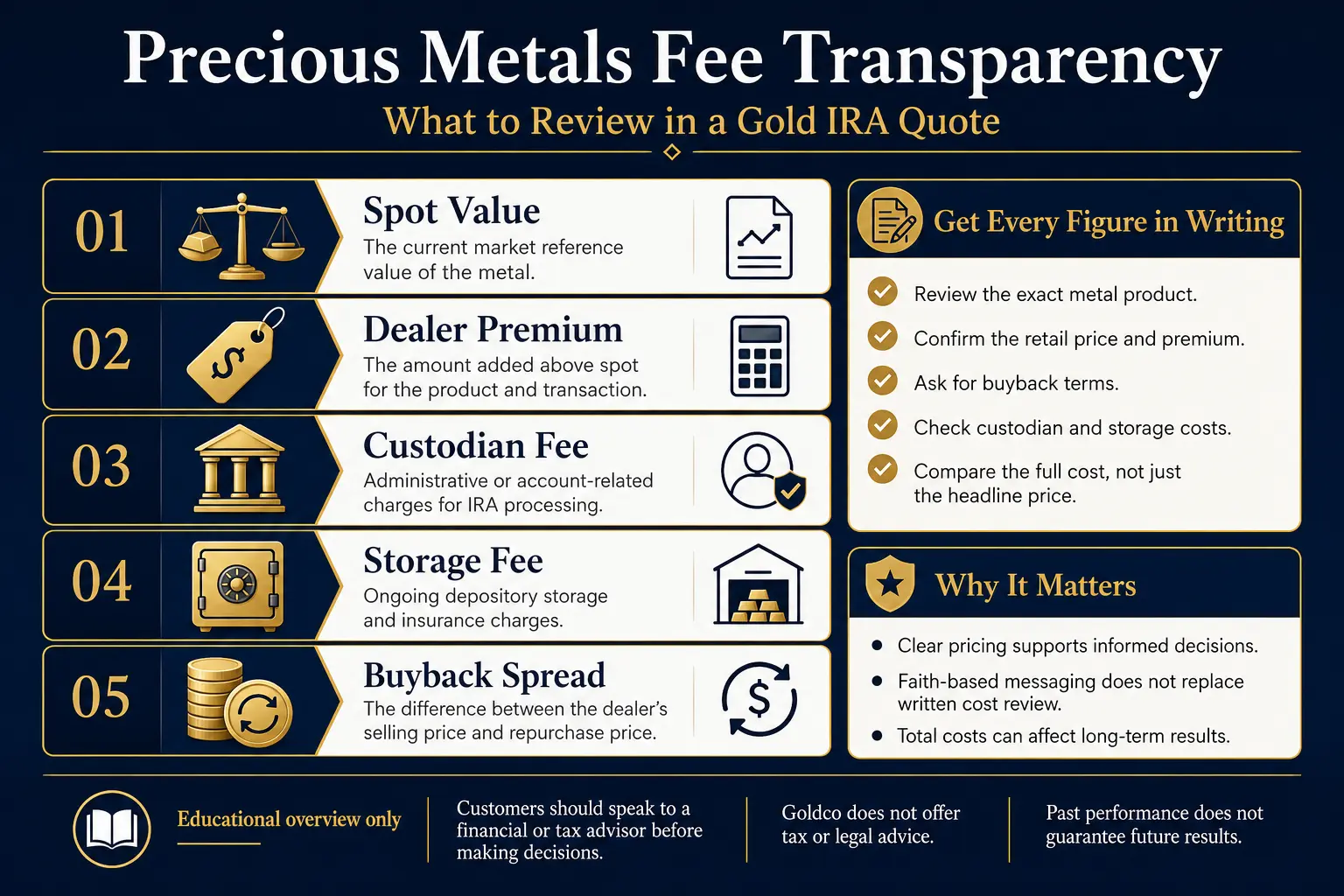
Pricing is one of the most important parts of evaluating a Christian gold IRA company. Spot is the current cash-market reference price per troy ounce; the melt value depends on the actual precious-metal weight, not the coin's face value or marketing name. The premium is the amount charged above spot and should be stated in dollars and as a percentage of melt value. The spread is the difference between the dealer's retail selling price and repurchase price — a larger spread means the metal price must rise further before the transaction reaches break-even. A prospective customer should ask for the same-day buyback price for the exact product before purchase; a promise that a company "has a buyback program" is incomplete without pricing mechanics.
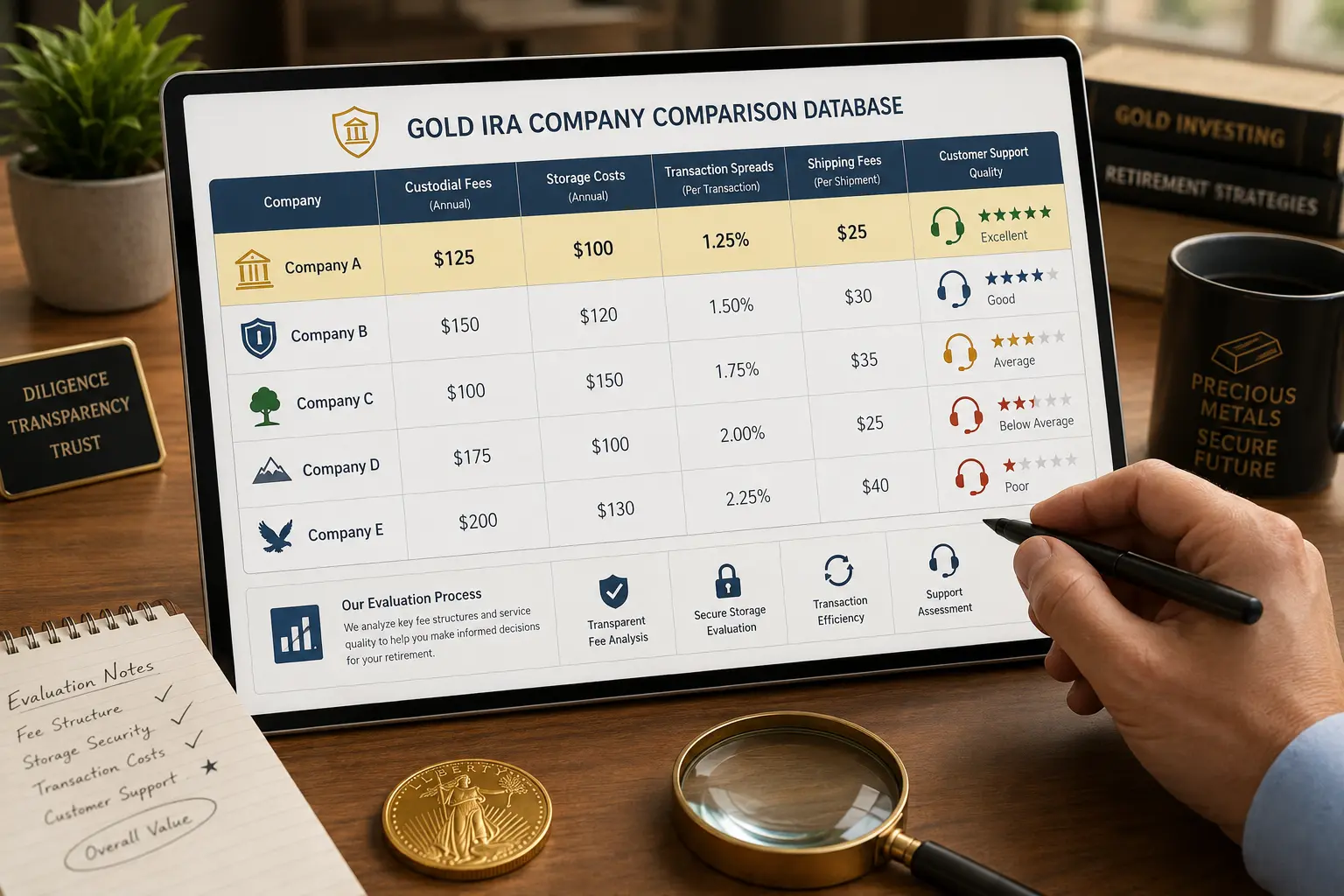
The written cost sheet should include the dealer premium, commission, IRA establishment fee, annual custodian fee, storage and insurance fee, transaction charges, shipping, liquidation charges, and account close-out fee. FINRA advises obtaining all fees, commissions, and the agreed retail price in writing, and Investor.gov notes that both transaction and ongoing fees reduce portfolio value. No reliable public source establishes one universal precious-metals dealer fee or spread, so any article claiming a single "standard" figure without a defined sample, date, and product mix should be treated cautiously. The quote checklist helps capture every figure.
Red Flags That Recur Regardless of Values Messaging
A company's values language should never block normal questions. The following warning signs matter whether the branding is religious, patriotic, educational, or neutral:
- Faith used to discourage verification. A salesperson should not suggest that asking for records shows a lack of trust or shared values. Ethical stewardship supports documentation and accountability.
- Refusal to provide written pricing. FINRA states that unavailable written fees are a warning sign.
- Pressure based on fear or immediate deadlines. The CFTC warns that precious-metals schemes often use fear about the financial system and high-pressure sales methods; the FTC identifies downplayed risk and pressure as common scam features.
- "Free" metals without a cost explanation. FINRA advises asking how a dealer earns money when a promotion appears to include large gifts — the value may be reflected in the premium or spread.
- A custodian presented as product approval. The SEC states that self-directed IRA custodians hold and administer assets but do not evaluate an investment's quality or legitimacy.
- Vague company identity. The legal entity, address, ownership, website, and payment instructions should match; search alternate names and principals.
- Unclear buyback or exit process. The sales process should not be detailed while the exit process stays vague.
- Concentration presented as stewardship. A faith message does not change the risk created by concentrating retirement assets in one product or asset class. More red flags are catalogued in scam warning signs.
Aligning Stewardship Values With Sound Due Diligence
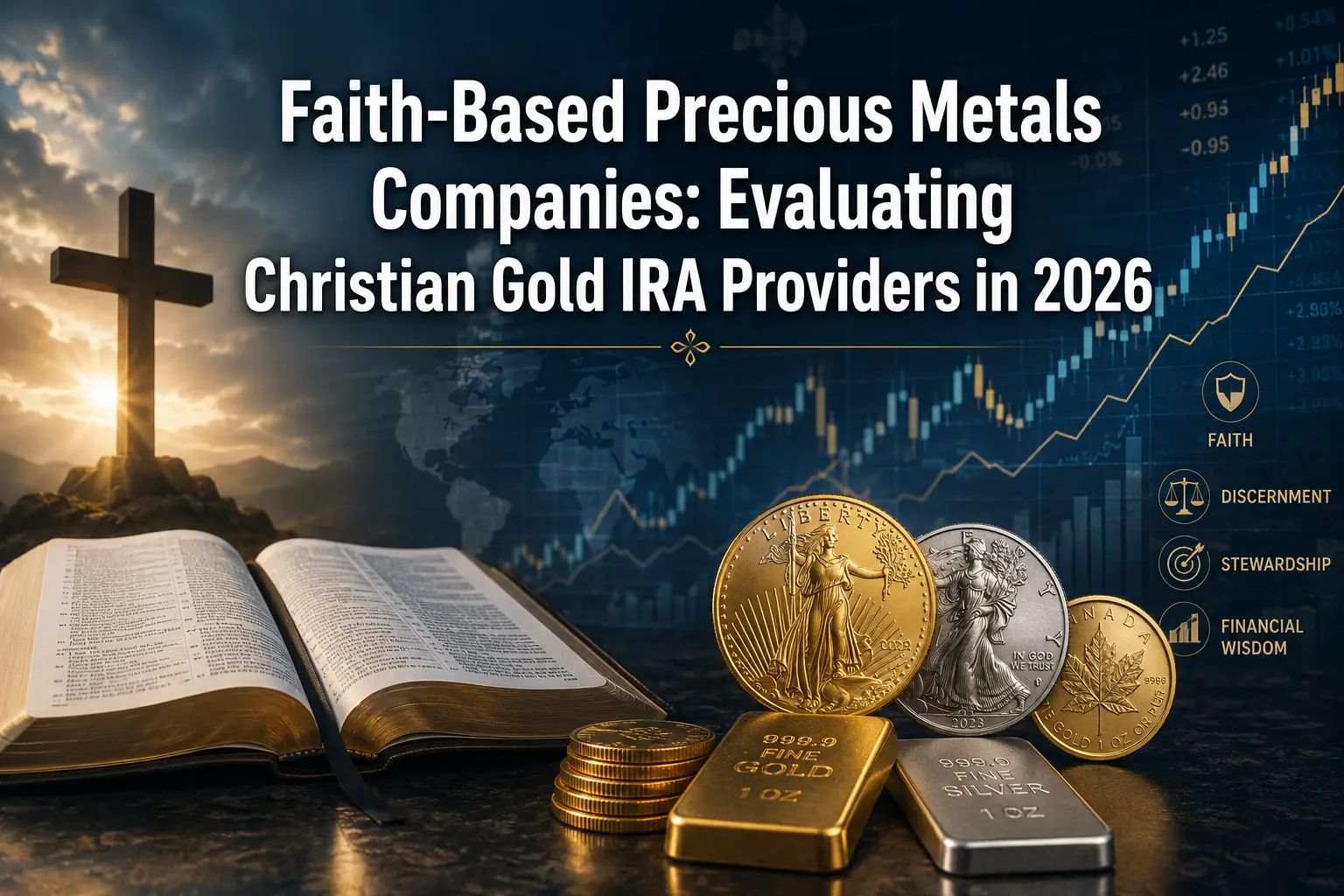
Christian retirement investing discussions often focus on stewardship. A practical stewardship framework can use four tests. Clarity: every cost, role, and transaction step should be understandable — who is the dealer, who is the custodian, where is the metal stored, and how is the dealer paid. Accountability: claims should be checked against independent records (BBB, Investor.gov, FINRA, CFTC, FTC, NASAA, state business records, court dockets). Proportionality: a values-based gold IRA should be considered within the full retirement plan alongside diversification, cash needs, time horizon, and other holdings. Patience: a careful process allows time to compare written quotes, consult an independent professional, and review exit terms before money moves — high-pressure timing is inconsistent with a measured stewardship process. Faith messaging should strengthen due diligence, not replace it.
Questions to Ask a Faith-Based Precious-Metals Company
The following questions are suitable for a written information request:
- What is the company's exact legal name, headquarters address, and state of formation? Which owners and senior managers are responsible?
- Does any salesperson claim to be a registered broker, investment adviser, or commodity professional, and which public databases should contain those registrations?
- What is the current spot value of the exact metal quoted, and the total retail price and premium in dollars and percentage terms?
- What is the current buyback price for the same product, and how is sales compensation included in the transaction?
- Which products are common bullion, and which are proof, graded, collectible, or numismatic?
- Which IRA custodian administers the account, and is it a bank or an IRS-approved nonbank trustee? Which depository stores the metal?
- What are the establishment, annual, storage, insurance, wire, shipping, liquidation, and close-out fees?
- What happens if a customer declines after receiving the written quote, and how long does a sale or distribution normally take?
- What records support the company's values or stewardship claims, and are all faith statements clearly separated from claims about price, performance, tax treatment, or suitability?
- Can the documents be reviewed by an independent financial, tax, or legal professional before funding?
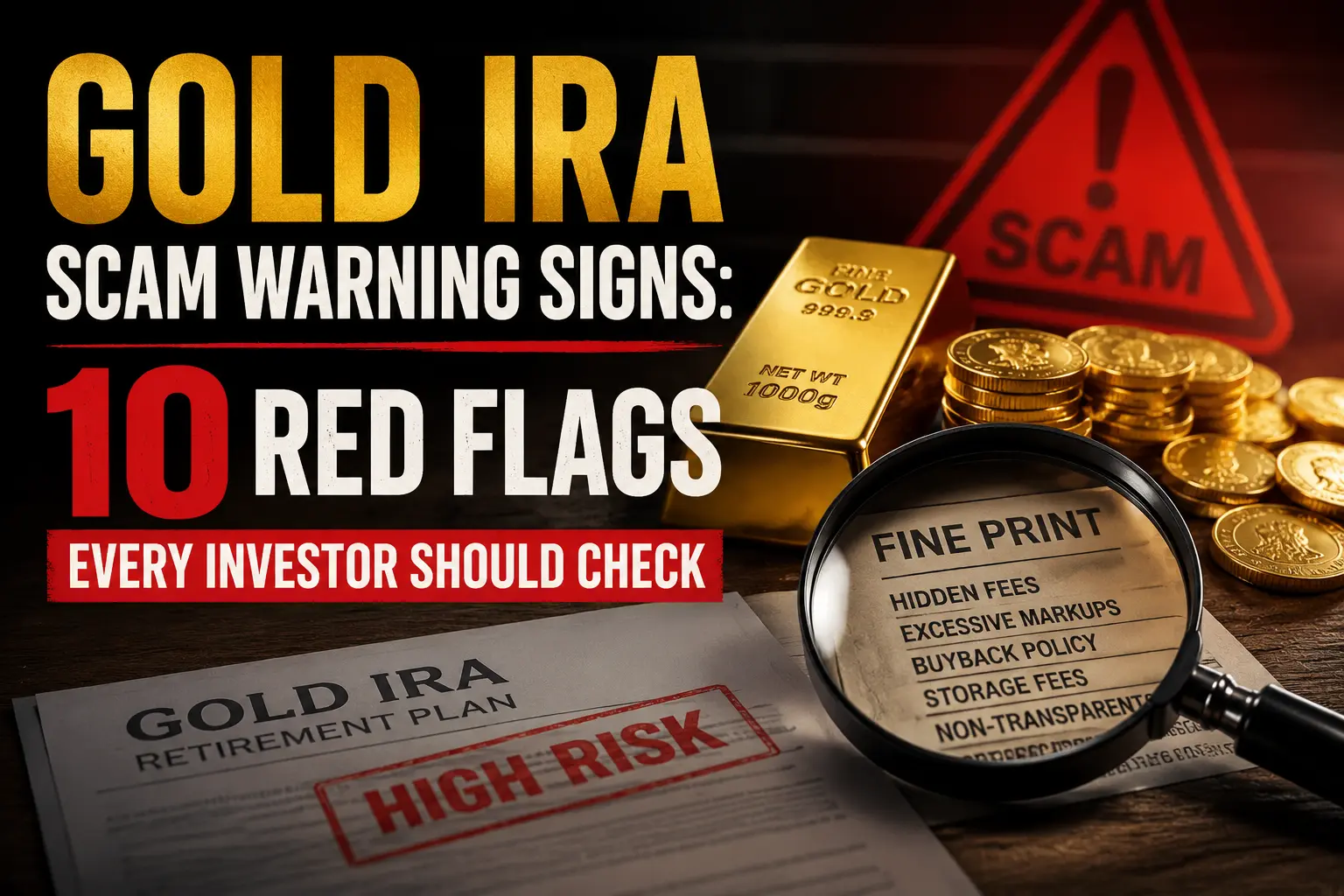
A refusal to answer a material question in writing is itself useful information. Customers should speak to a financial or tax advisor before making decisions involving account funding, taxes, rollovers, withdrawals, or storage. Goldco does not offer tax or legal advice. Not sure where to begin? The 21 due-diligence questions and the educational quiz can help organize the review.
Frequently Asked Questions
What is a Christian precious metals company?
The phrase generally describes a precious-metals business that uses Christian faith, stewardship, ministry, or values language. It is not a special federal license or a standardized regulatory category.
Does a faith-based message prove a Gold IRA provider is trustworthy?
No single message, rating, review, or affiliation proves reliability. Faith claims should be assessed alongside public records, written prices, dealer spreads, custodian details, storage terms, and exit procedures.
How should a BBB gold dealer profile be read?
The profile should be checked for the exact business identity, rating date, accreditation, complaint themes, business responses, and closure statuses. BBB ratings are opinions, not regulator findings, and customer reviews do not determine the letter grade.
Where can a Gold IRA salesperson's license be checked?
Investor.gov can connect a search to IAPD and FINRA BrokerCheck when the person claims to be an investment adviser or broker. State securities regulators can be located through NASAA, and commodity registrations through CFTC and NFA resources when those rules apply.
What pricing information should be in writing?
The written quote should identify the product, weight, fineness, spot reference, retail price, premium, dealer spread, buyback price, commissions, custodian fees, storage costs, and exit charges.
Does a Gold IRA custodian approve the quality of the metal purchase?
A custodian may accept and administer an asset without evaluating the product's quality, price, legitimacy, or promoter. The SEC warns that self-directed IRA custodians generally perform an administrative role rather than an investment-review role.
Update Log
- 2026: Initial publication. Sourced to BBB, FINRA, CFTC, FTC, SEC, NASAA, Investor.gov, PACER, and IRS. Company-specific BBB details are dated July 10, 2026 and should be re-checked directly; ratings and records change over time.
Sources
- Better Business Bureau. Overview of ratings.
- Better Business Bureau. Complaints.
- Better Business Bureau. Faq reviews.
- Better Business Bureau. Bbb accreditation standards.
- Better Business Bureau. 31486 better business bureau continues to empower consumers and busine.
- Better Business Bureau. Genesis gold group 1216 1645749.
- Better Business Bureau. Revelation gold group 1216 1000029316.
- FINRA. 10 Things to Ask Before Buying Physical Gold, Silver or Other Metals.
- Commodity Futures Trading Commission. Precious Metals Fraud.
- Commodity Futures Trading Commission. Check.
- Commodity Futures Trading Commission. Redlist.
- Federal Trade Commission. People losing big investment scams learn how spot and avoid them.
- Investor.gov (SEC). Check out your investment professional.
- Investor.gov (SEC). Ask and check.
- Investor.gov (SEC). Understanding fees.
- Investor.gov (SEC). Asset Allocation Basics.
- Investor.gov (SEC). Investor bulletins 1.
- U.S. Securities and Exchange Commission. Sdira.
- North American Securities Administrators Association. Contact your regulator.
- North American Securities Administrators Association. How to check your broker or investment adviser.
- U.S. Courts — PACER. Find case.
- Internal Revenue Service. Individual Retirement Arrangements (IRAs).
- Internal Revenue Service. Roth IRAs.
- Internal Revenue Service. Rollovers of Retirement Plan and IRA Distributions.
- Internal Revenue Service. Verifying rollover contributions to plans.
- Internal Revenue Service. Retirement Plans FAQs Regarding IRAs.
- Internal Revenue Service. Investments in Collectibles in IRA Accounts.
- Internal Revenue Service. Approved Nonbank Trustees and Custodians.
Article reviewed and edited by Daniel M. — editor, 401kToGoldIRA.org. Sourced to BBB, FINRA, CFTC, FTC, SEC, NASAA, Investor.gov, and IRS; educational only, not tax, legal, or investment advice, and not an endorsement of any company.