Affiliate disclosure: Some links on this page may be sponsor links. The site owners may be compensated if customers request information from companies mentioned here. This page is educational only and does not provide financial, tax, or legal advice, and does not recommend any provider or allocation. Customers should speak with a qualified tax professional before making retirement-account decisions. Past performance does not guarantee future results.
If an eligible rollover distribution is paid to the participant rather than sent in a direct rollover, the payer generally must withhold 20% of the taxable amount.
Source: IRS Publication 575. A direct rollover to an eligible retirement plan, including an IRA, generally avoids that withholding.
Key takeaways
- Eligibility comes from the plan document first. A cash-balance plan is a defined-benefit plan with a hypothetical account, not an unrestricted withdrawal right.
- The statement balance and the payable lump sum may be identical under a modern lump-sum-based formula, but equality is not automatic for every plan design or every benefit component.
- Once a payment is an eligible rollover distribution, all or part of it can generally be directed to an IRA, with any cash portion subject to withholding and tax.
- A married participant's lump-sum election can require written, witnessed spousal consent where it waives the plan's qualified joint and survivor annuity.
- A self-directed IRA is still an IRA. The legal receiving party is a qualifying trustee or custodian.
- Bullion relying on the IRC §408(m)(3) exception must remain in the physical possession of a qualifying trustee.
- The pension decision and the investment decision are separate. Neither one creates the other.
What is a cash-balance plan in rollover terms?
A cash-balance plan is a defined-benefit plan, even though the benefit is displayed as an account-style figure. A typical formula credits a hypothetical account with employer pay credits and interest credits. The plan's actual investments are not allocated to the participant's hypothetical account, and investment gains or losses do not directly change the promised benefit. The employer bears the investment risk required to fund the plan's promised benefits. (DOL; IRS Issue Snapshot on cash-balance interest credits)
Distribution rights therefore depend on the pension plan's terms and permitted distributable events, unlike a typical 401(k) account that is a defined-contribution account. (DOL; IRS)
Most private-sector cash-balance plans are potentially within PBGC's defined-benefit insurance system, but PBGC coverage is not universal. PBGC expressly notes exceptions for certain governmental, church, small professional-service and substantial-owner plans. The summary plan description should state whether the plan is PBGC-covered. (PBGC)
Is the statement balance the amount that can actually be rolled over?
Often yes, but not automatically. The correct answer depends on the plan formula and the benefit being elected.
For a statutory hybrid plan that uses a qualifying lump-sum-based benefit formula, IRC §411(a)(13) permits the plan to provide that the present value of the accrued benefit equals the then-current hypothetical account balance. Treasury regulations confirm that a plan can pay the current hypothetical account balance as the lump sum and still satisfy the minimum present-value rules that otherwise apply to defined-benefit distributions. This is why many modern cash-balance plans do in fact pay a lump sum equal to the displayed account balance. (IRC §411(a)(13); Treas. Reg. §1.411(a)(13)-1(b))
The important qualification is that the statutory permission does not make every statement figure universally rollable. Treasury regulations separately address plans with benefit formulas that combine a hypothetical account with another formula. A "greater-of" formula, for example, can require the single-sum payment to be at least the greater of the current hypothetical account and the present value of the other protected benefit. A "sum-of" formula can require both components. Other optional forms can also be subsidized or subject to actuarial-equivalence rules. (Treas. Reg. §1.411(a)(13)-1(b)(3)-(4))
IRC §417(e) supplies minimum present-value rules for defined-benefit forms that are subject to those rules, including an applicable mortality table and applicable interest rates. Those assumptions matter when the plan is converting a protected annuity-form benefit or another non-lump-sum-based component into a single sum. They do not mean that every compliant cash-balance lump sum is recalculated away from the hypothetical account balance. (IRC §417(e))
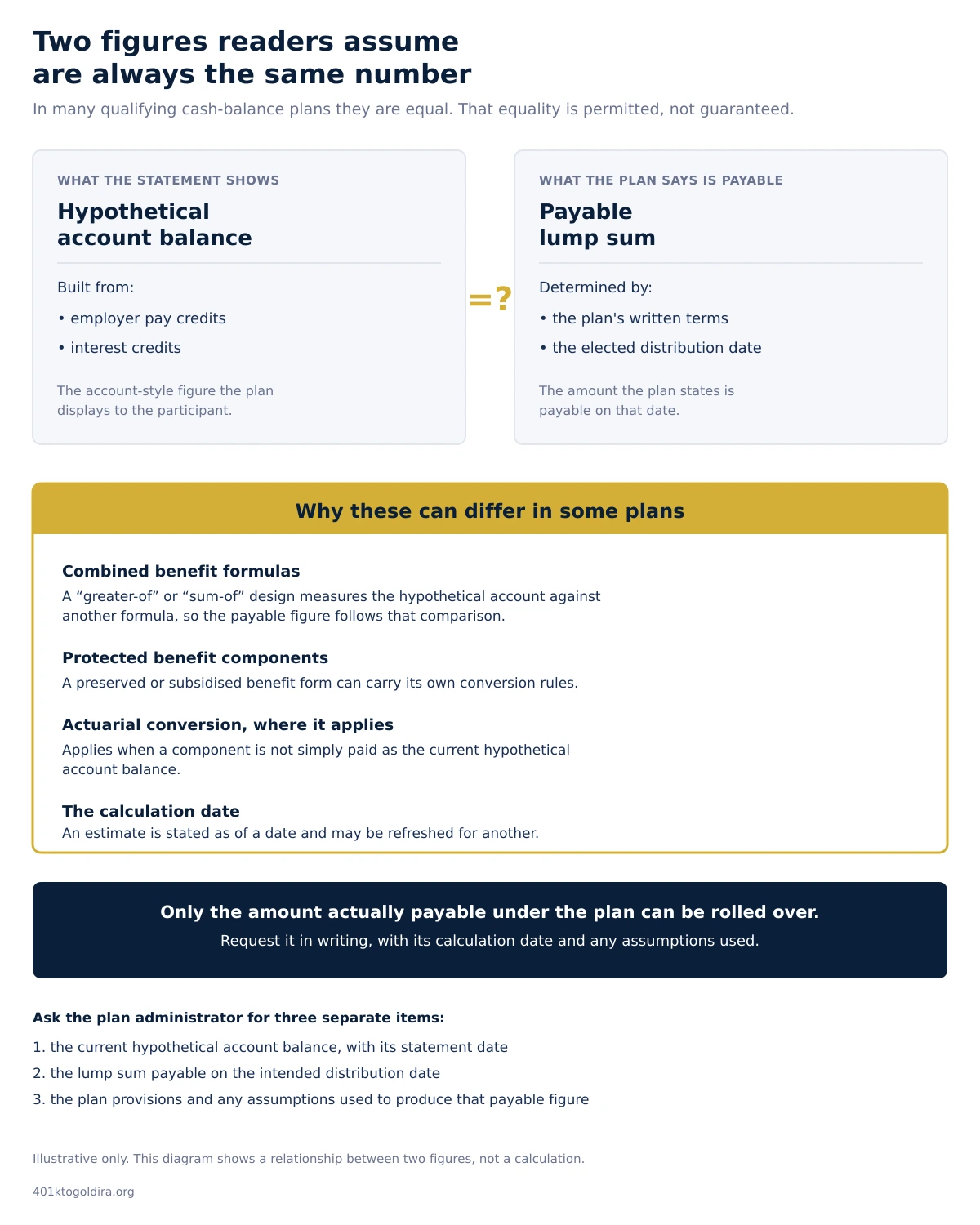
The written request to the plan administrator should therefore ask for three separate items: the current hypothetical account balance; the lump-sum benefit actually payable on a specified proposed distribution date; and the plan provisions and actuarial assumptions, if any, used to produce that payable figure. The summary plan description is the starting point, but the formal plan document controls the plan's operation. Participants can request the summary plan description and may request the written plan document and other plan information. (DOL Retirement Plans and ERISA FAQs)
When does a cash-balance distribution become available?
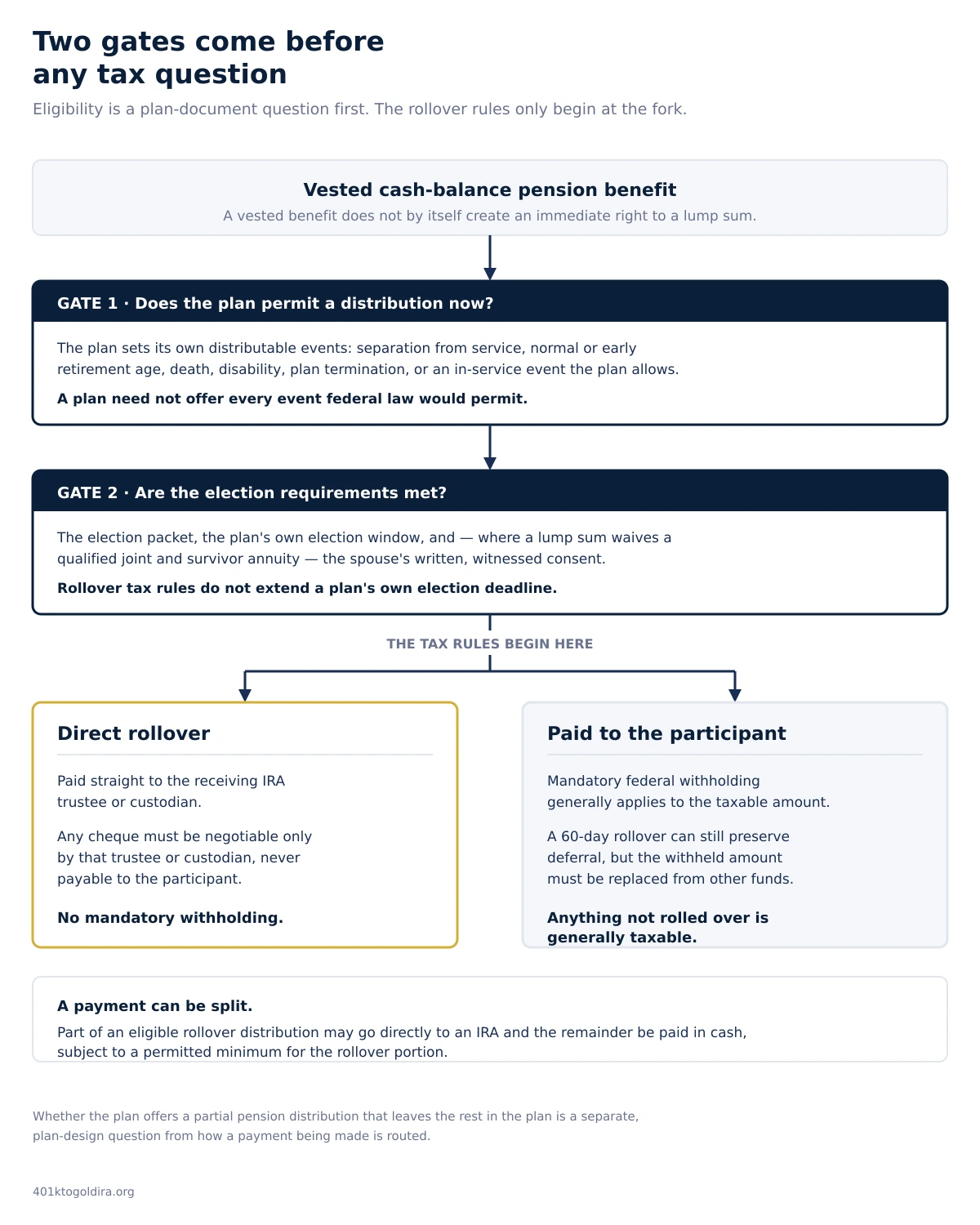
Distribution eligibility is a plan-document question before it becomes a rollover question. The IRS states that different types of plans have different distributable events and that a plan is not required to permit every event federal law would allow. For defined-benefit plans, a plan sets a normal retirement age and may permit earlier distributions after termination of employment, death, disability, early retirement or other severance. A defined-benefit plan may also permit an in-service distribution once the participant reaches age 59½. (IRS; IRS defined benefit plan)
Separation from service does not by itself prove that an immediate lump sum exists. A vested pension may remain in the plan until an age or event specified by the plan, so the summary plan description must be checked for both timing and available benefit forms. (DOL)
A formal plan termination is different from a freeze. PBGC explains that a standard termination can end with benefits being provided through annuities or, where the plan permits, lump-sum payments. By contrast, the IRS states that a frozen defined-benefit plan remains an ongoing plan: future accruals may stop, but the plan is not terminated merely because accruals cease. A freeze therefore does not itself create an immediate right to take the benefit. (PBGC; IRS)
An employer-sponsored lump-sum window or risk-transfer program also must be read through the actual amendment, election packet and plan terms. There is no federal rule under which the label "buyout" automatically creates the same timing, calculation method or election rights across all cash-balance plans.
What counts as an eligible rollover distribution?
An eligible rollover distribution generally includes all or part of a distribution from a qualified employer plan, but important exclusions apply. IRC §402 and IRS Publication 575 exclude, among other items, required minimum distributions, certain substantially equal periodic payments, hardship distributions and specified corrective or deemed distributions. A cash-balance lump sum that is otherwise distributable and does not fall into an exclusion will generally be eligible for rollover to a traditional IRA or another eligible retirement plan. (IRC §402(c)(4); IRS Publication 575; IRS Publication 590-A)
The rollover analysis begins only after the pension payment itself is available. The IRS expressly notes that, before determining whether a retirement-plan distribution can be rolled over, the participant must first satisfy the plan's conditions for taking a distribution. (IRS)
Can part be rolled over and part taken in cash?
Two different questions are often mixed together.
The first is whether the pension plan offers a partial benefit distribution that leaves the remainder inside the defined-benefit plan. That is a plan-design question. Treasury regulations recognize proportionate payments from a lump-sum-based hybrid formula, but that rule does not require every cash-balance plan to offer partial pension elections. A plan can still structure its available benefit form as a distribution of the entire vested benefit. (Treas. Reg. §1.411(a)(13)-1(b)(4))
The second is whether an eligible rollover distribution that is being paid can be split between a direct rollover and cash to the participant. Here the federal rule is clearer. Treasury Regulation §1.401(a)(31)-1 says the plan administrator must permit a distributee to elect a direct rollover of a portion of an eligible rollover distribution and have the remainder paid to the distributee, subject to a permitted minimum for the rollover portion. IRS Publication 575 likewise states that any part or all of an eligible rollover distribution can be directly rolled over. (Treas. Reg. §1.401(a)(31)-1, Q&A-9; IRS Publication 575)
That distinction matters. A plan might require the participant to elect a full lump-sum benefit, yet still route part of that payment directly to an IRA and pay the remainder in cash. The cash portion is generally taxable to the extent it represents untaxed plan money, and the payer generally withholds 20% from the taxable portion paid to the participant. (IRS Publication 575)
When is spousal consent required?
Defined-benefit plans are generally subject to survivor-annuity protections. IRC §417 requires a qualified joint and survivor annuity for married participants unless a valid waiver applies. When a lump-sum election waives that protected annuity form, the spouse's consent generally must be in writing, must acknowledge the effect of the election and must be witnessed by a plan representative or notary public, unless a statutory exception applies because consent cannot be obtained. (IRC §417(a))
The practical implication is that a lump-sum rollover can be a joint election rather than a unilateral administrative instruction. The plan's election packet should show whether spousal consent is required for that participant and benefit form, what signature or notarization standard applies, and when the election becomes irrevocable under the plan's procedures.
How should the direct rollover be executed?
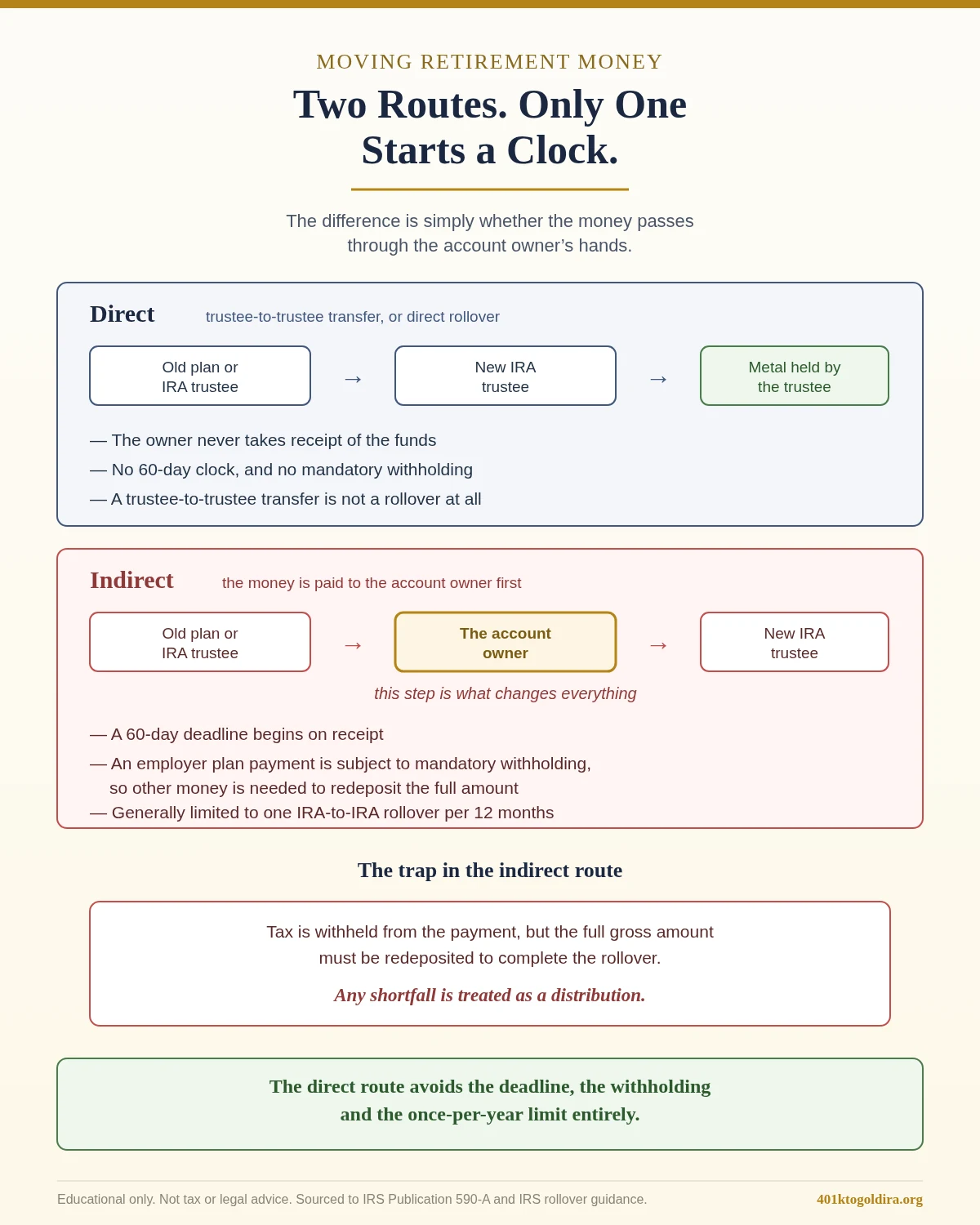
A direct rollover is the cleanest route when the goal is to move an eligible lump sum to an IRA without current withholding. Under Treasury Regulation §1.401(a)(31)-1, a direct rollover is paid directly to the receiving eligible retirement plan. It may be completed by wire or by check, but a check used for a direct rollover must be negotiable only by the receiving trustee or custodian, not payable to the participant personally. (Treas. Reg. §1.401(a)(31)-1, Q&A-3)
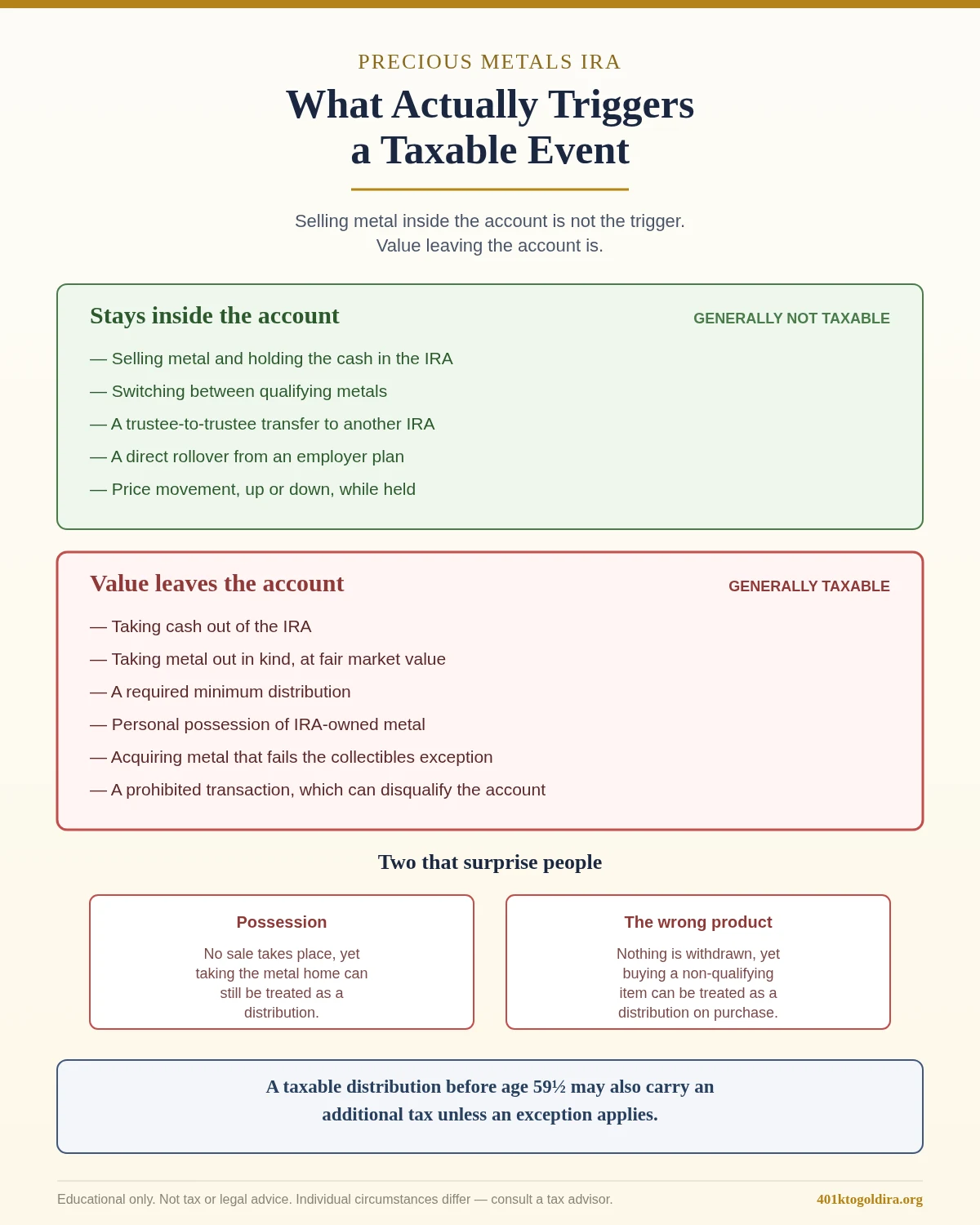
If the eligible rollover distribution is paid to the participant, the employer plan generally must withhold 20% of the taxable amount. A later 60-day rollover can still preserve tax deferral, but a full rollover requires the participant to replace the amount withheld from other funds. Any taxable amount not rolled over is generally included in income and may also face the additional tax on early distributions if no exception applies. (IRS Publication 575; IRS rollover guidance)
How does a self-directed IRA fit into the sequence?
A self-directed IRA is still an IRA for federal tax purposes. Investor.gov describes it as an IRA held by a custodian that allows a broader range of assets than many mainstream IRA custodians permit. The legal account must have a qualifying trustee or custodian: a bank or another person that has demonstrated to the IRS that it can administer IRA trusts consistently with IRC §408 and the applicable regulations. (Investor.gov; IRC §408(a)(2); Treas. Reg. §1.408-2(e))
The operational sequence should be settled before the pension election is released:
- Obtain the plan's written lump-sum estimate and confirm the distributable event.
- Open the receiving IRA with a trustee or custodian that accepts qualified-plan rollovers.
- Obtain exact payee, account and wire or mailing instructions from the receiving custodian.
- Submit the pension election and direct-rollover instruction.
- Have the plan pay the receiving trustee or custodian directly; investment instructions follow after the rollover cash is credited.
Federal tax law recognizes the IRA trustee or custodian. The word "administrator" can describe a separate service role in commercial arrangements, but that title does not itself establish that an entity is the legal IRA trustee or custodian. The account agreement should identify the actual trustee or custodian before funds are sent. Where an existing custodian relationship has already broken down, that is a separate problem covered in the guide to an unresponsive Gold IRA custodian.
Considering Goldco?
Goldco is a precious metals company. Customers can request a free Gold & Silver Kit at signup. Goldco markets a buyback program; customers should request current written terms directly.
Minimum investment: $25k · BBB rating: A+
Owners of this website may be paid to recommend Goldco. The content on this website, including any positive reviews of Goldco and other reviews, may not be neutral or independent.
What changes if the IRA will hold physical precious metals?
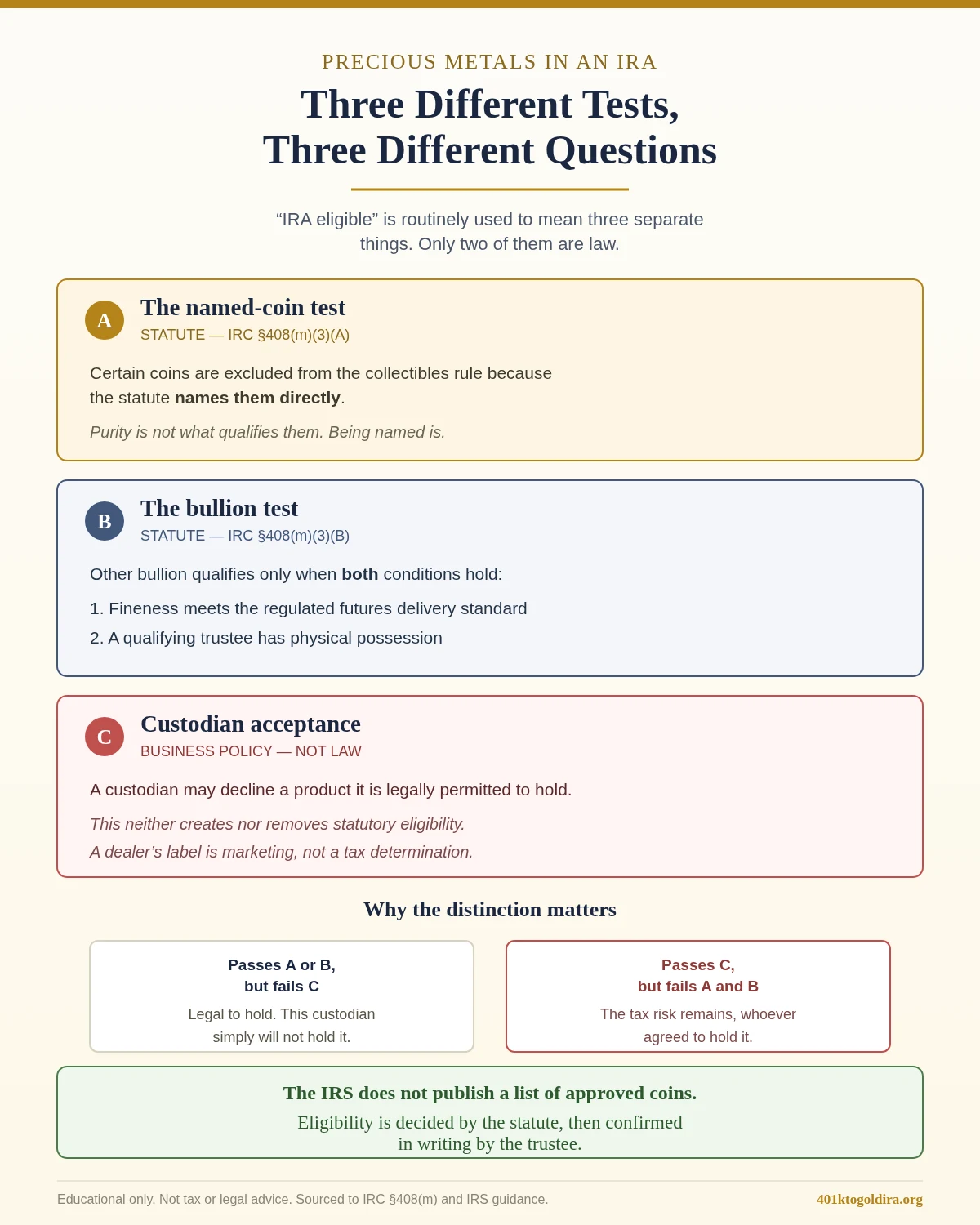
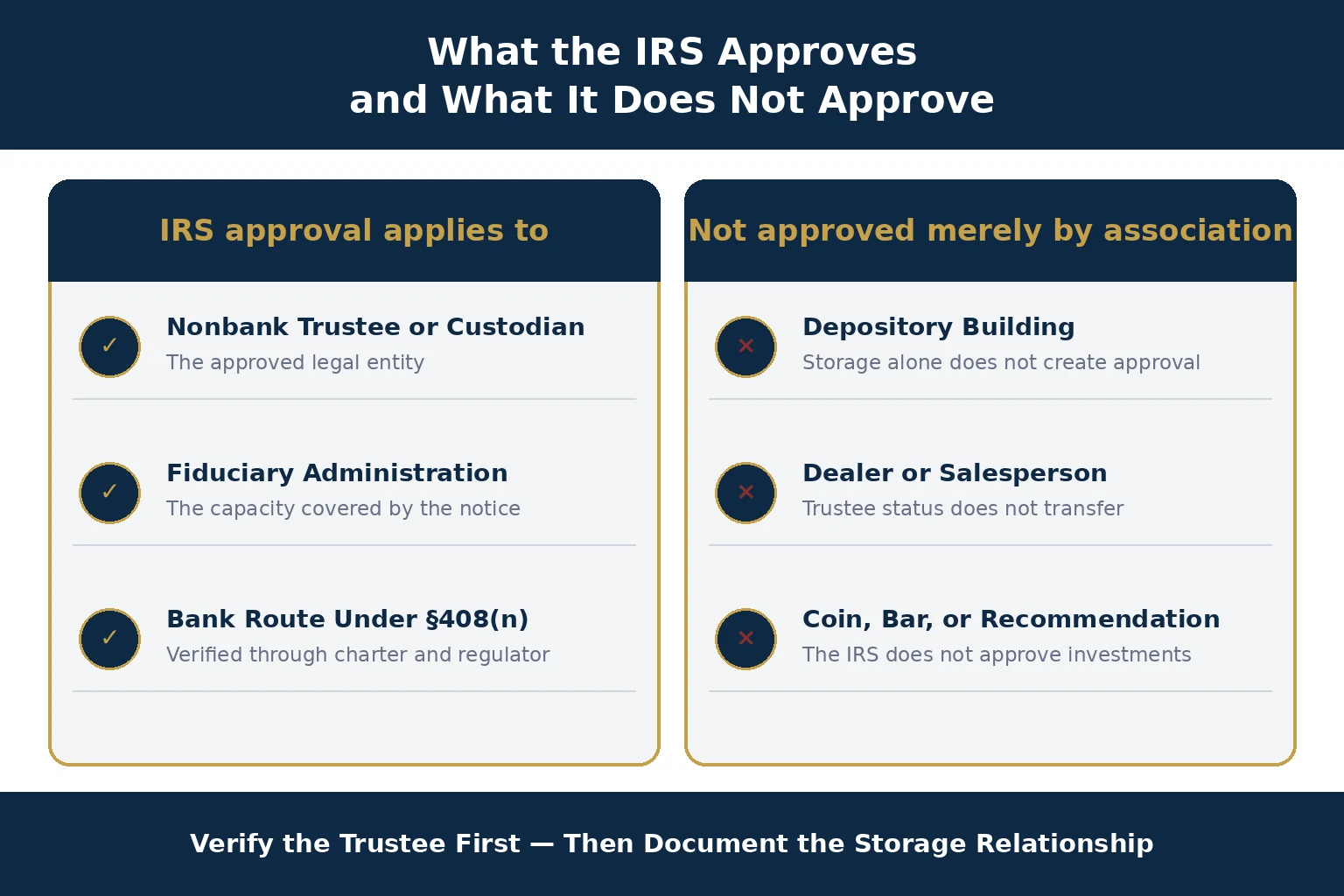
IRC §408 generally treats metals and coins as collectibles, but §408(m)(3) creates limited exceptions for specified coins and for gold, silver, platinum or palladium bullion that meets the statutory fineness standard. Qualifying bullion must be in the physical possession of a trustee described in IRC §408(a). The correct description is therefore that the metal meets the standards in IRC §408(m)(3) and is held by a qualifying IRA trustee or custodian. The statute does not create a category called an "IRS-approved metal" or an "IRS-approved depository". (IRC §408(m); IRS)
Personal possession is a material tax risk. The IRS states that qualifying bullion must be kept in the physical possession of a bank or approved nonbank trustee and warns that unconventional IRA structures can lose tax-favored treatment when the prohibited-transaction or collectibles rules are violated. (IRS IRA FAQs; IRS prohibited transactions)
The transaction also has costs that do not exist merely because an asset is held inside an IRA. The CFTC explains that a physical-metals dealer typically sells above spot and buys below spot; the gap is the dealer spread. It also identifies possible storage, insurance, administrative and custodial costs. Those costs should be obtained in writing before a purchase instruction is issued. (CFTC)
Gold is therefore one possible destination after a rollover, not a reason that the pension distribution becomes available and not a preferred allocation created by the tax rules. The pension decision and the investment decision should remain separate.
How is the rollover taxed and reported?
A direct rollover of pre-tax qualified-plan money to a traditional IRA generally defers current income tax. The rollover is not an annual IRA contribution and therefore is not limited by the ordinary annual IRA contribution cap. Later taxable distributions from the traditional IRA are generally included in income under the IRA distribution rules. (IRS Publication 590-A; IRS Publication 590-B)
A direct rollover from a pre-tax qualified plan to a Roth IRA is different. The amount that would have been taxable if distributed is generally included in gross income for the year of the Roth rollover, although the rollover itself is not subject to the additional tax on early distributions merely because it is converted. (IRS Publication 590-A)
The distributing plan reports the transaction on Form 1099-R. IRS instructions use code G for a direct rollover from a qualified plan to an eligible retirement plan, including an IRA, except for the special code used for a direct rollover from a designated Roth account to a Roth IRA. If one portion is directly rolled over and another portion is paid to the participant, the instructions call for separate Forms 1099-R. (IRS Instructions for Forms 1099-R and 5498)
What plan restrictions and processing friction should be expected?
A plan can legitimately restrict distributions to the events, ages and forms of benefit stated in the plan. It can require a completed election package, proof of identity, spousal consent where applicable, receiving-account information and other reasonable administrative documentation. A defined-benefit plan may also need time to calculate or certify the benefit before payment. The IRS states that plans may require a reasonable period after a request to calculate a benefit and determine the payment schedule. (IRS)
No universal federal processing timetable guarantees that every cash-balance lump sum will be completed within the same number of days. Timing can differ because of plan procedures, actuarial calculations, election windows, signature requirements, payroll or committee cycles, and incomplete paperwork. Any promised timetable should therefore come from the actual plan administrator in writing rather than from a generic rollover article.
Before an eligible rollover distribution is made, the plan administrator must provide a written rollover explanation describing the direct-rollover right, withholding consequences and other tax information. IRS guidance describes a consideration period around that notice, subject to permitted waiver procedures. (IRC §402(f); IRS Publication 575)
What mistakes create avoidable tax or administrative problems?
- Accepting a check payable personally when the intention was a direct rollover. A payment to the participant generally triggers mandatory 20% withholding and starts the 60-day rollover problem. A direct-rollover check should be payable only to the receiving trustee or custodian for the participant's benefit.
- Assuming the statement figure is automatically the payable lump sum. Many modern cash-balance plans can pay the current hypothetical account balance, but combined formulas, subsidies, protected benefits or other plan provisions can change the calculation. The payable amount and its effective date should be obtained in writing.
- Missing a plan election window. A plan may make a distribution available only through a specified retirement, termination or special-election process. The governing plan materials and election packet control the deadline; rollover tax rules do not extend a plan's own election window.
- Overlooking spousal consent. Where a lump sum waives a protected survivor annuity, an incomplete or unwitnessed consent can prevent the election from being effective.
- Taking personal possession of IRA bullion. The statutory bullion exception depends on qualifying metal and physical possession by the IRA trustee described in IRC §408(a).
What should be verified in writing before an election is signed?
Documents to request from the plan
- The current summary plan description and any summary of material modifications affecting distributions or the cash-balance formula.
- The relevant formal plan provisions governing normal retirement age, early retirement, separation-from-service distributions, in-service distributions and available benefit forms.
- A current benefit statement showing the hypothetical account balance.
- A lump-sum estimate for the intended payment date, including the effective date of the calculation.
- The written explanation of the lump-sum calculation, including any §417(e) assumptions or other actuarial assumptions used for components that are not simply paid as the current hypothetical account balance.
- The benefit election packet, including spousal-consent requirements.
- The §402(f) rollover notice and the plan's direct-rollover instructions.
Questions for the plan administrator
| Question | A satisfactory written answer should identify |
|---|---|
| What event makes the benefit distributable now? | The exact plan provision and event, such as separation, attainment of a plan age, retirement or plan termination. |
| Is a lump sum an available benefit form? | The plan provision and whether the election pays the full vested benefit or permits partial pension distributions. |
| What is the hypothetical account balance? | The balance and statement date. |
| What is the lump sum actually payable on the intended date? | The payable amount, calculation date and expiration or refresh date of the estimate. |
| Why does the payable amount differ from the statement balance, if it does? | The formula component, protected benefit, subsidy, actuarial conversion or other plan term producing the difference. |
| Does the election require spousal consent? | The applicable consent form, witnessing requirement and deadline. |
| Can the eligible rollover distribution be split between an IRA and cash? | The direct-rollover procedure and any permitted minimum amount for the rollover portion. |
| What exact payee wording or wire information is required? | Instructions that allow the payment to be made directly to the receiving IRA trustee or custodian. |
| What processing timetable applies after a complete package is accepted? | A plan-specific estimate, not a generic industry promise. |
Questions for the receiving IRA trustee or custodian
| Question | A satisfactory written answer should identify |
|---|---|
| Is the entity the legal IRA trustee or custodian? | The legal name and account agreement showing the trustee or custodian role. |
| Does the account accept a direct rollover from a qualified defined-benefit plan? | Confirmation of the rollover type and the exact receiving instructions. |
| What check payee or wire title is required? | The trustee or custodian name, for-benefit-of wording, account identifier and delivery instructions. |
| If physical metals are contemplated, what assets are permitted? | The custodian's permitted-asset policy, while recognizing that federal tax eligibility is determined under IRC §408(m)(3). |
| Who will have physical possession of bullion held by the IRA? | The arrangement under which the qualifying trustee or custodian satisfies the statutory possession requirement. |
| What fees apply before and after purchase? | Account, transaction, storage, insurance and other charges in writing. |
| What is the procedure for a later sale or distribution? | The written process for liquidation, cash distribution or permitted in-kind distribution, including tax reporting. |
An actuary is the appropriate next professional when the participant needs an independent review of the pension calculation or actuarial assumptions. A tax professional is appropriate when a Roth rollover, after-tax basis, withholding problem or taxable cash portion is involved. An ERISA attorney is appropriate when plan terms, survivor rights, a denied benefit or a disputed calculation require legal interpretation.
Frequently asked questions
Can an active employee roll a cash-balance pension into an IRA?
Only if the plan currently permits a distributable event. Federal rules generally allow a defined-benefit plan to make an in-service distribution at or after age 59½, but a particular plan does not have to offer every distribution event allowed by law. The summary plan description and the formal plan document control.
Does leaving the employer automatically make the full balance available?
No. Separation can be a distributable event, but the plan can specify when and in what form vested benefits become payable. A separated participant can hold a vested pension without having an immediate lump-sum right.
Is the cash-balance statement number always the lump sum?
Not automatically. Many qualifying lump-sum-based hybrid plans can pay a lump sum equal to the current hypothetical account balance, and in those plans the figures are legitimately the same. Combined formulas and other protected benefit components can produce a different payable amount, so the plan's written lump-sum estimate is the operative figure for the proposed election.
Can a cash-balance lump sum be rolled into a self-directed IRA?
Yes, if the payment is an eligible rollover distribution and the receiving self-directed IRA is established with a qualifying trustee or custodian that accepts the rollover. Self-directed status does not create a separate rollover rule; it describes the range of assets the custodian permits.
Can part of the lump sum go to an IRA and part be paid in cash?
Generally yes for the routing of an eligible rollover distribution. Treasury regulations require the plan administrator to permit a portion to be directly rolled over and the remainder paid to the participant, subject to a permitted minimum for the rollover portion. That is distinct from whether the pension plan offers a partial benefit distribution that leaves the remainder inside the plan.
Is spousal consent required for a lump-sum election?
It can be. Defined-benefit plans are generally subject to survivor-annuity protections, and where a lump-sum election waives a qualified joint and survivor annuity, the spouse's consent generally must be in writing, must acknowledge the effect of the election, and must be witnessed by a plan representative or notary public unless a statutory exception applies.
Can the participant take possession of gold bought by the IRA?
The statutory bullion exception requires qualifying bullion to be in the physical possession of the trustee described in IRC section 408(a). IRS guidance likewise states that qualifying bullion held by an IRA must be kept in the physical possession of a bank or approved nonbank trustee.
What could not be verified
Several points cannot be stated universally without the governing plan documents or a named receiving institution. The primary sources do not establish that every cash-balance plan offers an in-service lump sum, a partial pension distribution that leaves the balance in the plan, or a lump sum immediately after separation from service. Those rights depend on the particular plan's terms and permitted distributable events.
The primary sources also do not establish that every statement balance will equal the lump sum payable on a chosen date. Federal hybrid-plan rules permit equality under qualifying lump-sum-based formulas, while combined formulas and other protected benefit components can require a different calculation. The participant therefore needs the plan's written benefit estimate and calculation basis for the proposed payment date.
No universal federal processing time for a cash-balance lump-sum election was identified. Nor can PBGC coverage be assumed for every cash-balance plan, because statutory coverage exceptions exist. Finally, no universal self-directed IRA fee schedule, metals dealer spread, storage charge, buyback procedure or custodian processing timetable can be verified without naming a particular commercial arrangement. Those items should be obtained from the relevant plan or institution in writing and treated as institution-specific rather than federal rules.
Primary Sources
- IRS Publication 575 — Pension and Annuity Income
- IRS Publication 590-A — Contributions to Individual Retirement Arrangements
- IRS Publication 590-B — Distributions from Individual Retirement Arrangements
- IRS — Rollovers of retirement plan and IRA distributions
- IRS — When can a retirement plan distribute benefits?
- IRS — Defined benefit plan
- IRS — Issue Snapshot: interest crediting rates in a cash-balance plan
- IRS — Updating frozen defined benefit plans
- IRS — Verifying rollover contributions to plans
- IRS — Investments in collectibles in individually directed qualified plan accounts
- IRS — Retirement plans FAQs regarding IRAs
- IRS — Retirement topics: prohibited transactions
- IRS — Instructions for Forms 1099-R and 5498
- Cornell LII — IRC §401
- Cornell LII — IRC §402
- Cornell LII — IRC §408
- Cornell LII — IRC §411
- Cornell LII — IRC §417
- Cornell LII — Treas. Reg. §1.401(a)(31)-1
- Cornell LII — Treas. Reg. §1.411(a)(13)-1
- Cornell LII — Treas. Reg. §1.408-2
- U.S. Department of Labor — Cash Balance Pension Plans
- U.S. Department of Labor — Retirement Plans and ERISA FAQs
- U.S. Department of Labor — What You Should Know About Your Retirement Plan
- PBGC — Understanding pension and PBGC coverage
- PBGC — How pension plans end
- Investor.gov — Self-Directed IRAs and the Risk of Fraud
- CFTC — 10 Things to Ask Before Buying Physical Gold, Silver, or Other Metals
This material is educational only and is not financial, tax or legal advice. Cash-balance plan rights depend on the governing plan documents and the participant's facts. Pension calculations may require an actuary; tax consequences may require a tax professional; and disputed plan rights or survivor-consent issues may require an ERISA attorney.