Affiliate disclosure: The publisher may receive compensation from precious-metals companies, including this one. That compensation does not change what a court or regulator database returns.
Affiliate Disclosure: This article may contain affiliate links, which means the publisher may receive compensation from qualifying actions, at no additional cost to the reader. Affiliate relationships do not alter the sourcing or verification standard used here.
A public-record search is useful only if the entity being searched is correct and the limits of each database are understood.
Noble Gold demonstrates both points unusually well.
A preliminary search under the consumer-facing name can appear to produce little or nothing. But Noble Gold's own current website identifies the business behind the brand as “Golden Bull, LLC dba Noble Gold Investments.” BBB independently lists the profiled entity as a limited liability company and gives Noble Gold and Golden Bull, LLC as alternate names. BBB's profile observed on August 20, 2026 lists the business as incorporated on May 24, 2016.
Once Golden Bull, LLC is searched rather than only “Noble Gold,” a federal court docket does appear: Golden Bull, LLC v. Kirk M. Elliott, No. 2:23-cv-06190, in the U.S. District Court for the Central District of California. Golden Bull was the plaintiff, not the defendant. CourtListener/RECAP records that the case was filed on July 31, 2023 and ultimately dismissed without prejudice for lack of personal jurisdiction. The ruling therefore determined a jurisdictional issue; it did not adjudicate the merits of Golden Bull's underlying claims.
That single result changes the methodological lesson. “No Noble Gold lawsuits found” would have been wrong. “A search under the brand name did not initially surface a matching case” would have been accurate but incomplete.
The larger lesson is more important than Noble Gold itself:
Nothing found, nothing exists, and nothing found in the sources checked are three different statements. Only the third is normally defensible.
The same discipline applies to SEC, CFTC, FTC, FINRA, state-regulator, attorney-general and BBB research. Each system sees a different slice of the record. None is a universal conduct database, and several important classes of disputes can remain outside all of them.
All Noble Gold webpages described as current in this article were observed on August 20, 2026. Search results and rolling BBB figures carry the observation date because both can change.
What does this article cover?
- What legal entity actually operates Noble Gold.
- What federal court searches returned.
- What state-court searching can and cannot establish.
- What SEC, CFTC, FTC, FINRA and California regulator searches returned.
- What the BBB record says, including the complaint narratives.
- Why allegations, settlements and judgments must be labelled differently.
- A repeatable dealer-verification method in the correct order.
- How to document a no-result search so it remains meaningful later.
- Why public-record research says almost nothing about the price of a precious-metals transaction.
- A substantial checklist and FAQ for applying the same method to another dealer.
- Golden Bull, LLC
- Noble Gold Investments
- Noble Gold
- Noble Gold, Inc.
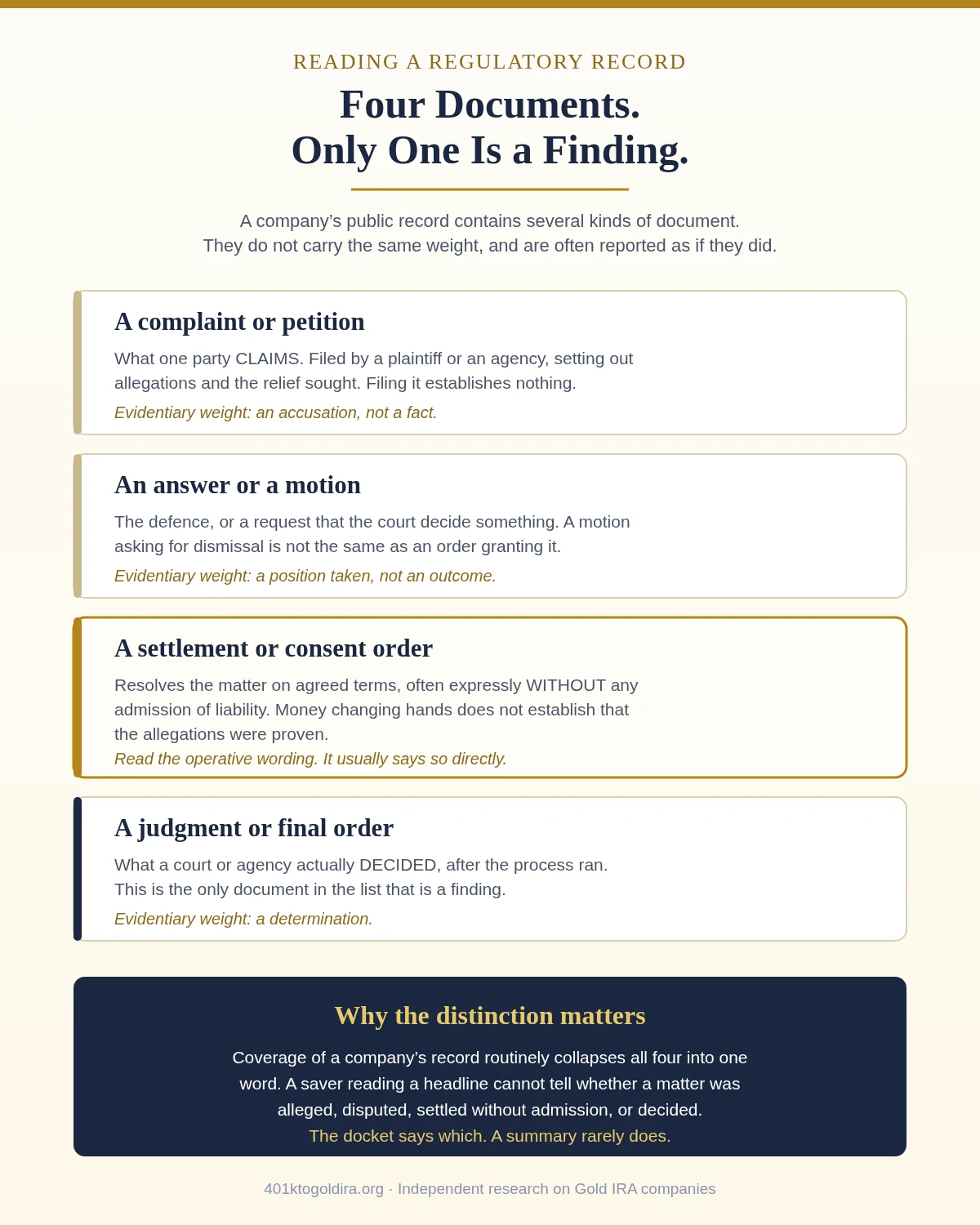
- A complaint or petition states allegations.
- An answer states the responding party's position and defenses.
- A settlement or consent order resolves a matter on negotiated terms and may expressly contain no admission of liability.
- A judgment or final agency order can constitute a determination, but only as to the issues it actually decides.
- 3 total complaints in the last 3 years
- 1 complaint closed in the last 12 months
- 2 classified as Answered
- 1 classified as Resolved
- the price paid per ounce;
- premium over spot;
- dealer acquisition cost;
- embedded margin;
- salesperson compensation;
- immediate repurchase value;
- the future buyback spread; or
- whether a particular product fits a retirement saver's circumstances.
- search date;
- database name;
- exact search string;
- entity variant;
- filters applied;
- date range;
- whether exact-match or broad search was used;
- result count;
- docket/order numbers;
- whether the search required payment or authentication; and
- which parts of the system were not searched.
- exact legal dealer entity;
- current sales or Shipping and Transaction Agreement;
- exact product, mint/refiner, weight and fineness;
- quantity;
- contemporaneous spot or melt value;
- retail unit price;
- total purchase price;
- resulting premium over spot or melt;
- same-time dealer repurchase quote for each product;
- method used to calculate future repurchase prices;
- salesperson compensation disclosure;
- custodian agreement and complete fee schedule;
- depository agreement and complete fee schedule; and
- all cancellation, distribution and account-closing terms.
- entity names searched;
- database;
- date searched;
- filters;
- result;
- known access limitation; and
- unsearched paid indexes.
What is Noble Gold's actual legal entity?
Why does the entity name come first?
Court indexes, enforcement databases and state records generally index legal parties, not marketing brands.
Searching only “Noble Gold” risks missing a case filed under the entity that signed the contract. Searching “Golden Bull” without further verification creates the opposite problem: unrelated entities with similar names can appear.
Noble Gold's own current disclosure states:
“Golden Bull, LLC dba Noble Gold Investments”
and gives a current Encino, California address. BBB separately lists Noble Gold Investments at the same Encino address, classifies the business as an LLC, identifies Noble Gold and Golden Bull, LLC as alternate names, and reports the incorporation information described above.
One additional first-party complication should be recorded rather than silently ignored. The current Noble Gold website contains duplicated footer boilerplate that elsewhere refers to “NOBLE GOLD, INC.” even though the same page and numerous other current company pages identify Golden Bull, LLC dba Noble Gold Investments.
The “Noble Gold, Inc.” footer wording, by itself, is not sufficient evidence that this is the registered operating entity. It is, however, enough to justify adding that name as a search variant.
Accordingly, the principal search strings used for this research were:
This step also exposed a useful false-positive problem. A broad SEC search for “Golden Bull” retrieves records concerning Golden Bull Limited, the former name of Bit Digital, Inc., a Cayman Islands company associated with a cryptocurrency business. SEC filings make clear that this is a different entity. It must not be attributed to Noble Gold simply because the words “Golden Bull” match.
Entity resolution is therefore not clerical housekeeping. It determines whether every search that follows is meaningful.
What did each Noble Gold public-record search return?
The following table reports the searches individually rather than combining them into a generalized “legal history” claim.
| Database | What it actually covers | Result observed for Noble Gold / Golden Bull | What that result cannot establish |
| CourtListener / RECAP | Publicly available federal docket metadata and documents collected through RECAP and other CourtListener sources | The exact-entity search did return a federal docket: Golden Bull, LLC v. Kirk M. Elliott, 2:23-cv-06190, C.D. Cal. Golden Bull was plaintiff. The federal action was dismissed without prejudice for lack of personal jurisdiction. | RECAP is not an exhaustive replacement for PACER. The result does not establish that this is the only federal matter involving the entity. |
| PACER Case Locator | Nationwide index covering federal district, bankruptcy and appellate courts | An authenticated nationwide party-name search was not exhausted in this research. PACER says its national index can search all appellate, bankruptcy and district courts. | No claim that Golden Bull has no other federal civil or bankruptcy matters can be made. |
| Los Angeles Superior Court Civil Party Index | Name searches for litigants in Los Angeles County civil, small-claims, family-law and probate cases | The official index was identified, but its required paid party-name search was not exhausted. The court says the index is updated daily. | A federal search says nothing about state cases, and a free web search is not a substitute for this paid county index. |
| SEC Litigation Releases | Civil actions brought by the SEC in federal court | Exact searches under the verified entity and DBA names did not surface a matching Noble Gold/Golden Bull enforcement release on August 20, 2026. The SEC says this database covers civil actions brought by the Commission. | It does not disclose every complaint, referral or confidential investigation, and it is limited to SEC jurisdiction. |
| SEC Administrative Proceedings | Litigated and settled administrative proceedings instituted by the SEC | Exact-name searches did not surface a matching proceeding on August 20, 2026. | No-result does not establish absence of nonpublic investigations or matters outside securities-law jurisdiction. |
| CFTC enforcement material | CFTC enforcement matters that may be brought in federal court or administratively | Exact-entity and DBA searches did not surface a matching target enforcement action on August 20, 2026. CFTC's enforcement manual explains that the agency can proceed either in federal court or through administrative proceedings. | It is not a complete history of every physical-metals complaint or commercial dispute. |
| FTC Cases and Proceedings | FTC consumer-protection and competition cases brought in federal court or through the Commission's administrative process | Searches under the entity and trade-name variants did not return a matching target matter on August 20, 2026. | The FTC case library is not its complete consumer-complaint or confidential investigative database. |
| FINRA BrokerCheck / disciplinary records | Registered securities brokerage firms, brokers and published FINRA disciplinary actions | No exact Noble Gold/Golden Bull brokerage-firm or disciplinary match surfaced in the searches performed. BrokerCheck is designed principally for registered securities firms and professionals. | If a physical-metals dealer is not a FINRA member broker-dealer, a no-result is expected and says essentially nothing about its retail metals conduct. |
| California DFPI | Orders, actions and decisions within the California Department of Financial Protection and Innovation's jurisdiction | Exact-name searches did not surface a target DFPI action on August 20, 2026. DFPI itself directs prospective customers to its Enforcement Actions and Orders system when researching firms. | DFPI jurisdiction is not universal, and nonpublic complaints or matters outside its statutory authority will not necessarily appear. |
| California Attorney General | Public enforcement actions, alerts and other material released by the state Attorney General | Exact-name searches did not surface a Noble Gold/Golden Bull target enforcement release on August 20, 2026. | California's Attorney General expressly says it does not release information about consumer complaints it receives about companies. A public no-result therefore cannot establish the absence of complaints. |
| BBB | Private business profile, accreditation/rating information and a rolling complaint record | A+ rating; accredited; three complaints in the rolling three-year window when observed, one closed in the preceding twelve months. | BBB is not a court or regulator. Its rating does not determine legality, pricing, product suitability or dealer margin. |
What does the federal case involving Golden Bull actually establish?
The CourtListener result deserves careful treatment because merely writing “Noble Gold lawsuit” would convey the wrong impression.
In Golden Bull, LLC v. Kirk M. Elliott, the Noble Gold entity was bringing the action. The docket was filed in the Central District of California. CourtListener reports that Golden Bull's claims were later dismissed without prejudice for lack of personal jurisdiction.
The significance is procedural.
A dismissal for lack of personal jurisdiction determines that the court lacked the necessary jurisdiction over the defendants. It does not determine that the plaintiff's factual allegations were true, and it does not determine that they were false. The “without prejudice” disposition likewise should not be rewritten as a merits judgment.
This illustrates four labels that should never be blended together:
A procedural judgment can be final while deciding no underlying misconduct question at all.
What does Noble Gold's BBB record show?
What are the current rating and complaint figures?
BBB's profile observed on August 20, 2026 lists Noble Gold Investments as accredited, gives it an A+ rating, and states “BBB Accredited Since: 1/23/2017.” BBB also lists a business start date, incorporation date, LLC status and the Golden Bull, LLC alternate name.
The complaint page, rechecked August 31, 2026, showed:
The three complaint types were one billing issue, one customer-service issue and one product issue.
These figures require the observation date because BBB says Business Profiles generally cover a three-year reporting period. A complaint can disappear from the visible total simply by aging outside that window.
What themes appear in the narratives?
The most recent resolved complaint initially raised concern about the authenticity of silver rounds after the customer performed a magnet test. The customer subsequently performed additional research and testing, acknowledged that the original purity concern had been mistaken, and stated satisfaction that the silver was genuine. The remaining criticism concerned delayed communication and repeated document-signature requests.
A separate answered complaint concerned purchase pricing and later liquidation economics. The customer alleged that silver had been purchased substantially above spot and later repurchased below spot, producing an outcome the customer disputed. Noble rejected the characterization that it had charged a flat 40% fee and responded that customers receive a Shipping and Transaction Agreement describing the average spread between purchase and liquidation prices; Noble also stated that spreads vary according to market conditions, metal type and availability. The customer continued to request specific answers about fees, spot prices and the portion of metal appreciation received. BBB continued to classify the complaint as Answered, not Resolved, when observed.
A third answered complaint concerned a disagreement over what a salesperson had said about tax treatment or purchase thresholds. Noble responded that its records supported a narrower account of what had been discussed and supplied its explanation of the applicable transaction threshold. The customer rejected the response.
These are customer allegations and company responses, not judicial findings.
They are nevertheless valuable because they identify questions that public enforcement searches cannot answer: Was the purchase premium clearly understood? What was the same product worth on immediate resale? What did the written agreement actually disclose? Did an oral explanation match the paperwork?
What does an A+ rating mean?
BBB states:
“BBB ratings represent the BBB's opinion of how the business is likely to interact with its customers.”
BBB says the rating uses information it can obtain about the business, including complaints. It also says ratings are not guarantees of reliability or performance and that customer reviews do not determine the letter grade.
The A+ therefore answers a BBB-system question. It is not a legal finding and does not audit:
Those require different evidence.
Why do state-level searches matter so much?
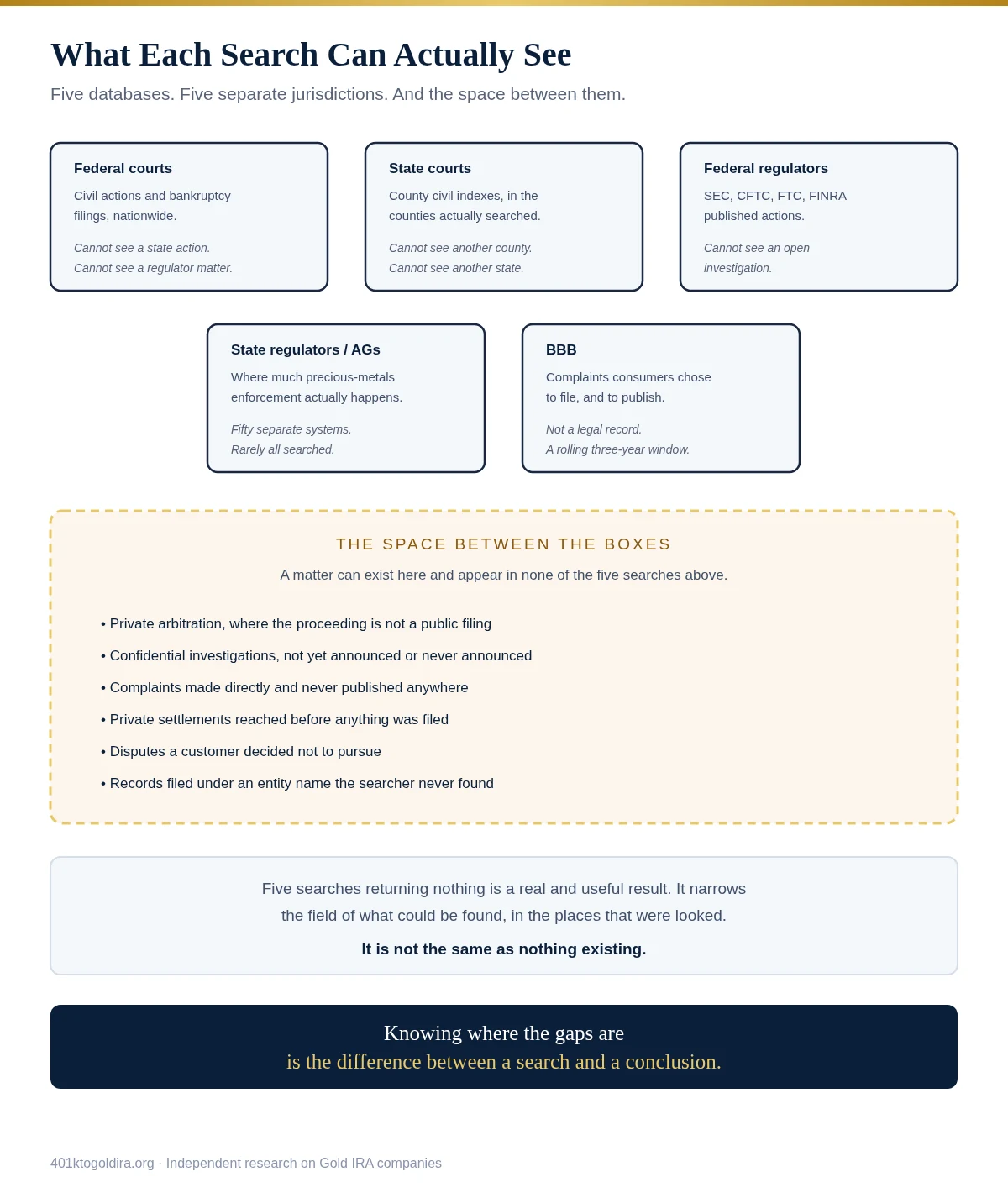
A federal-court search answers only whether responsive records appear in the federal court system searched.
A retail precious-metals dispute can instead appear as a state contract claim, consumer-protection action, business tort, small-claims matter, state financial-regulator order or attorney-general enforcement case. It can also remain in private arbitration and never produce an ordinary merits docket.
Noble Gold's current published address is in Encino, making the Los Angeles Superior Court party index an obvious state-court search point. That official system covers name searches for litigants in Civil, Small Claims, Family Law and Probate cases and charges for each name search. The paid search was not exhausted here.
California's Attorney General gives an additional warning against overreading sparse public results. The office states that it does not release company-specific consumer-complaint information and cautions that even apparently satisfactory licensing or disciplinary checks do not mean a business is “trouble-free.”
State regulators also have different statutory jurisdiction from federal securities regulators. DFPI's own research guidance points consumers toward FINRA, SEC and its own Enforcement Actions and Orders system as separate checks.
That fragmentation is why several no-result searches cannot legitimately be added together and converted into an endorsement.
How can the same verification method be repeated for any precious-metals dealer?
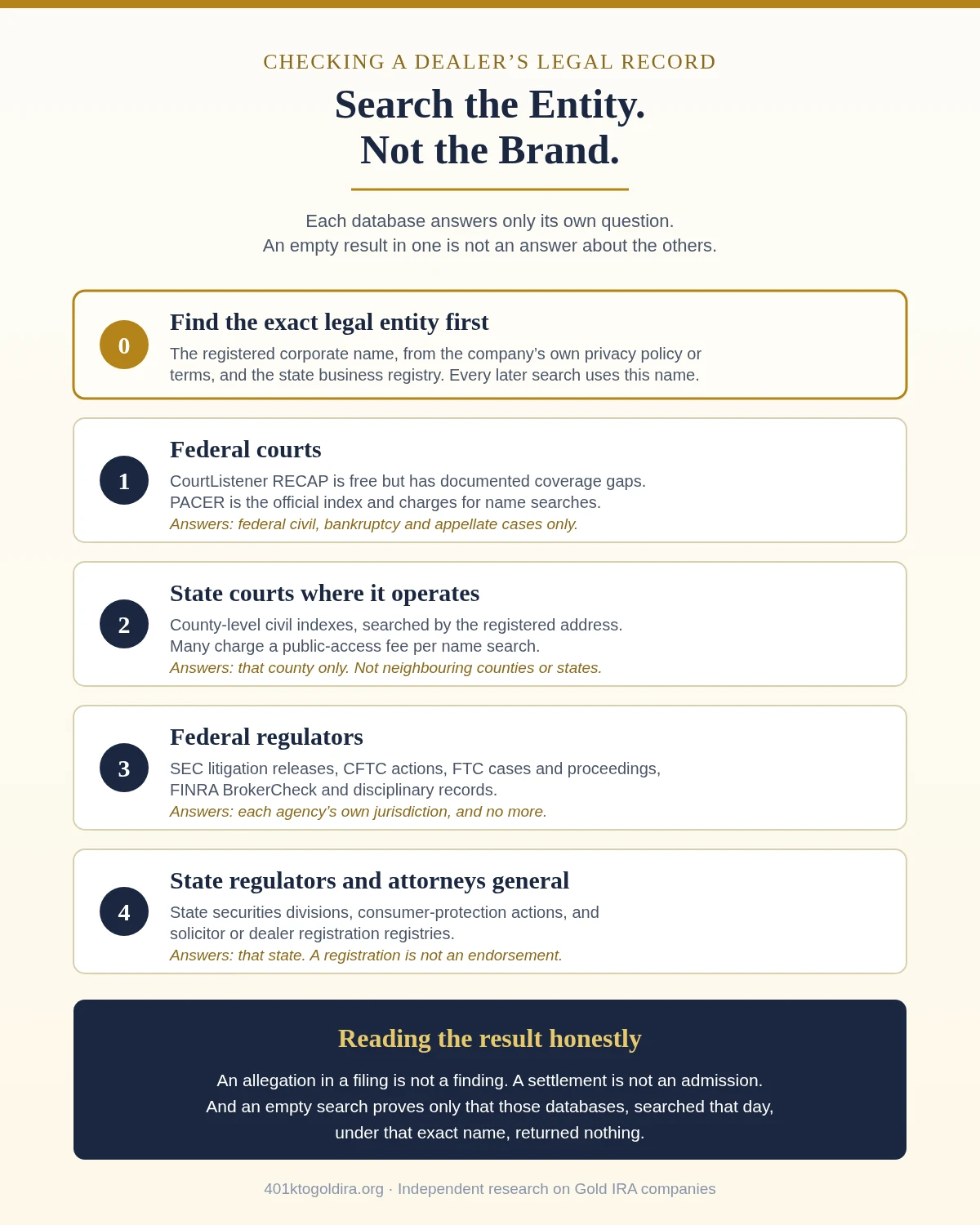
The sequence matters. Starting with Google results or a brand name produces false negatives and false positives.
1. Establish the contracting legal entity
The first search should be the company's Terms, Privacy Policy, customer agreement, SMS terms, order documentation and footer disclosures. The objective is the legal entity that contracts with customers—not merely the logo.
Then the result should be cross-checked against an official state business registry where permitted and against BBB or another primary business record.
Every DBA, old name and inconsistent company name should be recorded as a separate search variant.
Reason: courts and regulators usually index legal entities.
What this can miss: undisclosed affiliates, predecessor entities, individual executives and entities that changed names.
2. Record the exact search protocol before searching
A reproducible search log should contain:
A later article should never preserve only the conclusion “no lawsuits.”
3. Search CourtListener / RECAP
Each verified legal name and DBA should be searched independently. Both plaintiff and defendant appearances matter because a dealer may litigate commercial disputes without ever being accused of customer misconduct.
Reason: CourtListener provides accessible federal docket discovery and may expose filings collected through RECAP.
What this can miss: cases not represented in RECAP, sealed matters, some documents, state cases and arbitration.
Noble Gold shows exactly why this step matters: Golden Bull, LLC produces the Kirk Elliott docket where the brand name alone may not.
4. Repeat the search in PACER Case Locator
PACER describes its Case Locator as a nationwide index covering appellate, bankruptcy and district courts. Entity searches can be refined by court type, region and date range.
Reason: PACER is the federal judiciary's system and can disclose federal matters that free RECAP coverage misses.
What this can miss: state litigation, arbitration, confidential investigations and matters filed under undiscovered names.
If the authenticated search is not performed, the research should explicitly say PACER was not exhausted.
5. Identify every relevant state and county
The current and historical business addresses matter. At minimum, the county containing the headquarters should be searched. Former offices may justify additional counties.
State court systems should not be assumed to have one nationwide equivalent of PACER. County or state portals can differ dramatically, and some charge per search.
Reason: ordinary contract, fraud, consumer, employment and commercial claims frequently arise under state law.
What this can miss: other counties, arbitration, sealed cases and cases under principals' individual names.
6. Search SEC litigation and administrative records separately
The SEC's Litigation Releases cover civil actions brought by the Commission in federal court. Administrative Proceedings are a separate collection containing litigated and settled administrative matters.
Both should be searched.
Reason: a court search alone may miss an SEC administrative proceeding.
What this can miss: confidential investigations and activity outside SEC jurisdiction.
The Noble Gold search also demonstrates why exact entity matching matters: unrelated SEC records for Golden Bull Limited must be discarded.
7. Search CFTC enforcement separately
CFTC enforcement can proceed in federal court or administratively. The CFTC's precious-metals guidance is also particularly relevant to leveraged or financed metals and dealer pricing.
Reason: commodities jurisdiction does not duplicate SEC jurisdiction.
What this can miss: disputes outside the Commodity Exchange Act, private claims and confidential investigative activity.
8. Search FTC Cases and Proceedings
FTC says its Legal Library contains cases it has brought in federal court and through its internal administrative process, including consumer-protection cases involving fraud, deceptive advertising and related practices.
Reason: retail sales and advertising issues may fall under consumer-protection law rather than securities law.
What this can miss: complaints that never became public enforcement cases.
9. Search FINRA—but interpret a no-result correctly
BrokerCheck provides information about registered securities brokers and securities firms, while FINRA's disciplinary database publishes formal disciplinary actions against firms and associated persons.
For a retail physical-metals dealer with no demonstrated FINRA broker-dealer role, no BrokerCheck result may be entirely expected.
A FINRA no-result in that circumstance carries very little evidentiary weight about the dealer's metals business.
10. Search the home-state regulator and attorney general
State financial regulators and attorneys general should be treated as distinct searches, not an afterthought.
In California, DFPI maintains enforcement actions and orders within its jurisdiction, while the Attorney General may bring consumer-protection actions. California's AG also makes clear that consumer complaints held by the office are not publicly released.
Reason: state law can reach conduct that never generates federal action.
What this can miss: nonpublic complaints, pending investigations and matters in other states.
11. Read BBB complaint narratives rather than stopping at the letter grade
The complaint count should be recorded with the observation date because the profile uses a rolling reporting period. Each narrative should then be classified by subject and procedural status.
Reason: the narrative may reveal recurring transaction-friction questions that no rating captures.
What this can miss: complaints not published by BBB, complaints outside the rolling window and disputes never submitted to BBB.
12. Separate the legal-record result from the transaction-pricing result
This is the most important final step.
A completed court-and-regulator search says almost nothing about what a particular metal purchase will cost.
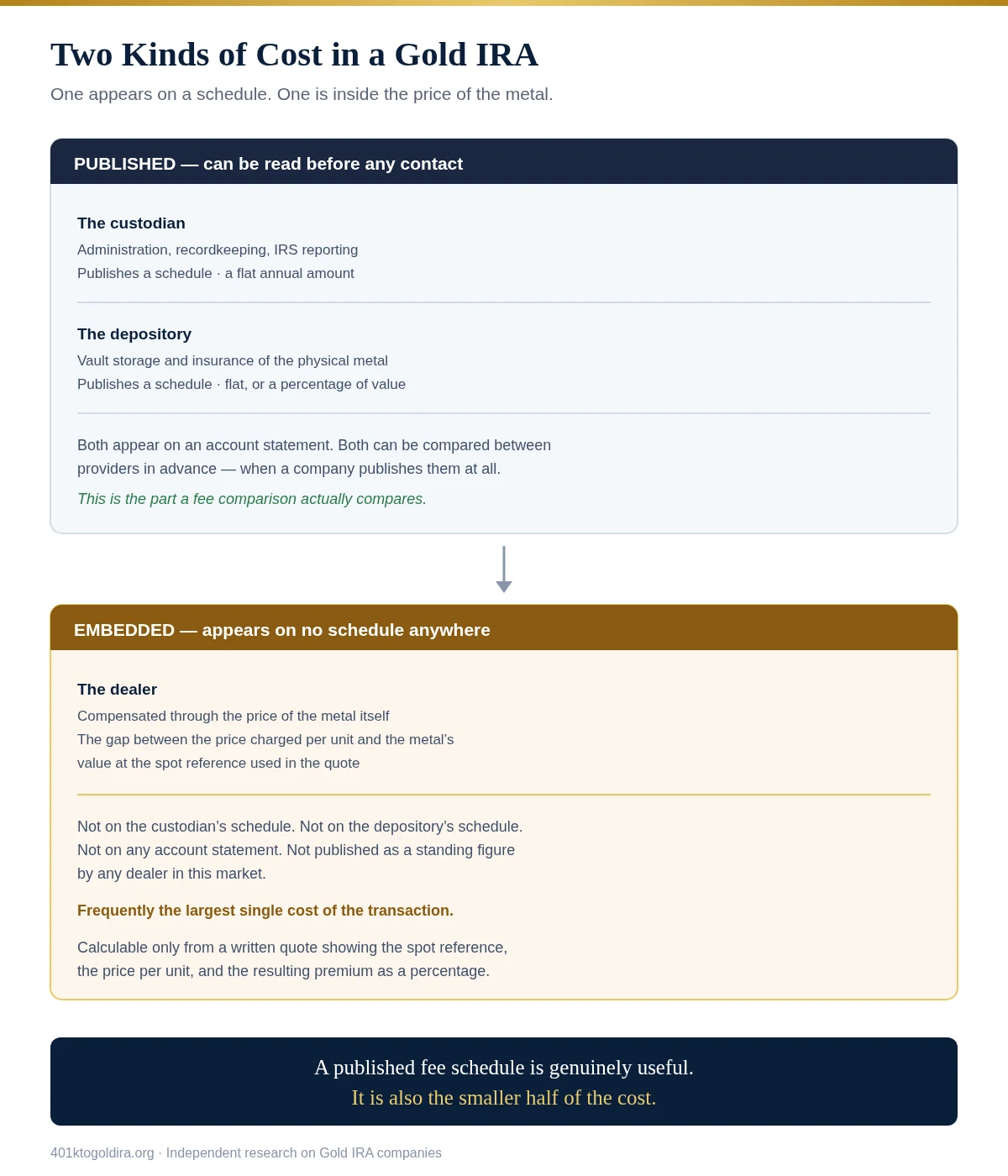
Why does a public-record search not answer the most expensive question?
Noble Gold currently publishes several administrative Gold IRA figures on its own Gold IRA page, including a minimum and individual account, transfer, distribution, closure, maintenance and storage amounts. Those figures were visible on the company page when observed on August 20, 2026 and are therefore sourceable as company-published terms.
But those figures do not establish the retail premium on the metals themselves.
Noble Gold's own educational material acknowledges the distinction:
“paying a markup is common”
and says that the markup varies according to the type of metal and market conditions.
CFTC describes the structural issue more precisely. A dealer sells physical metal above spot and buys it back below spot; the difference between the two prices is the dealer spread. CFTC recommends comparing the metal's weight and spot value with the retail quotation and asking what the dealer would pay if the same metal were sold back immediately.
This is the economic question that does not appear in a court search, BBB rating or regulatory no-result.
A custodian or depository may issue a clear schedule for account administration and storage. The dealer's acquisition economics, however, are reflected in the quoted metal price. A custodian statement showing melt value does not reconstruct the premium originally paid. CFTC specifically notes that self-directed IRA statements may report the metals' melt value, defined by bullion weight and spot price.
The BBB pricing complaint illustrates why this matters. Noble itself responded that its Shipping and Transaction Agreement describes an average spread between purchase and liquidation prices and that spreads vary. A publicly retrievable current copy of that agreement was not located in the Noble Gold website searches conducted for this article.
A retirement saver who has completed federal, state and regulator searches but has not obtained a product-specific written purchase and repurchase quotation has therefore answered the easier question.
What do CFTC and FINRA say should be obtained in writing?
CFTC's instruction is explicit:
“Ask for all fees, costs, commissions, and agreed retail price in writing BEFORE signing a sales agreement or turning over any money.”
It then directs purchasers to calculate the metal's spot value, compare that amount with the retail price, request the dealer's immediate repurchase price, ask how salespeople are compensated and determine whether fees or commissions are included in the spread.
FINRA gives the same principle in shorter form:
“Get a full accounting of fees.”
FINRA says account-opening charges, sales commissions, storage charges, management charges and other costs should be obtained in writing and their effect on break-even understood.
For a precious-metals transaction, the practical verification packet therefore needs both legal-record diligence and price diligence.
A useful written package contains:
Only then can a purchaser distinguish the company's public-record history from the economics of the proposed transaction.
What exactly does “nothing found” mean?
A reliable research article should use three statements differently.
“Nothing was found”
Standing alone, this is incomplete. It does not say where, how or under which name the search was performed.
“Nothing exists”
This is normally indefensible. Public researchers rarely have access to every court, arbitration, complaint, regulator and confidential investigative database.
“Nothing was found in the sources checked”
This is reproducible when accompanied by:
For Noble Gold, the defensible federal statement is not “there are no federal court records.” CourtListener produced a federal docket once the correct entity name was used.
The defensible regulator statement is that exact-name searches of the public SEC, CFTC, FTC, FINRA and California DFPI material described above did not surface a matching target enforcement action on August 20, 2026.
The defensible state-court statement is that the official Los Angeles party-name index was identified but its paid search was not exhausted.
The defensible PACER statement is the same: the authenticated nationwide index was not exhausted.
Those limitations belong in the finding itself, not in fine print.
What should be preserved so the search can be repeated later?
A research log should preserve more than bookmarks.
For each database, it should retain the exact legal name searched, aliases searched, date, filters, search-result count or no-result screen, case or order identifiers, relevant documents and any access limitation.
For rolling sources such as BBB, the displayed complaint count and observation date should be saved together. A count copied without its date eventually becomes impossible to reproduce because complaints age out of the three-year window. BBB itself says its Business Profiles generally cover that rolling period.
For litigation, the procedural posture also matters. A saved headline reading “Company sued X” is inferior to the docket number, party roles and final disposition.
For regulatory matters, the final document should be saved alongside the initiating complaint whenever possible. That prevents allegations from being accidentally rewritten as findings after the procedural context disappears.
What questions does the Noble Gold search answer?
Was Noble Gold's registered operating entity identified?
The strongest current first-party wording identifies Golden Bull, LLC dba Noble Gold Investments. BBB independently lists Golden Bull, LLC as an alternate name for Noble Gold Investments and classifies the business as an LLC. The additional “Noble Gold, Inc.” wording appearing in duplicated website footer text was treated as a search variant rather than assumed to replace Golden Bull, LLC.
Did the federal court search return nothing?
No.
CourtListener/RECAP surfaced Golden Bull, LLC v. Kirk M. Elliott, a Central District of California matter in which Golden Bull was plaintiff. The case was dismissed without prejudice for lack of personal jurisdiction.
Was that dismissal a finding about Noble Gold's conduct?
No. It was a jurisdictional ruling in an action Noble's entity brought against other parties. It did not adjudicate whether the underlying claims were factually correct.
Did the searches surface an SEC enforcement case against Noble Gold?
No matching target SEC Litigation Release or administrative proceeding surfaced under the verified entity and trade-name variants in the searches conducted on August 20, 2026. The conclusion is limited to those public SEC sources.
Did CFTC or FTC searches surface a matching target action?
No matching target matter surfaced in the public CFTC and FTC searches performed under those names. Both conclusions are database-specific; neither establishes the absence of complaints or confidential inquiries.
Did FINRA produce a Noble Gold disciplinary record?
No matching company disciplinary record surfaced. That result should not be overinterpreted because BrokerCheck and FINRA disciplinary systems are principally concerned with registered securities firms and associated persons. A retail metals dealer's absence from BrokerCheck does not validate its precious-metals sales practices.
Did California DFPI or the Attorney General produce a target enforcement matter?
No target action surfaced in the exact-name public searches conducted. California's Attorney General separately states that company-specific consumer-complaint information received by the office is not released publicly, so a public no-result cannot be turned into a statement about the underlying complaint inventory.
Is the Los Angeles County state-court search complete?
No. The official Los Angeles Superior Court party index charges for name searches, and that paid index was not exhausted. Any article claiming “no California lawsuits” on the basis of free web searching would therefore exceed the evidence.
Was PACER fully exhausted?
No. PACER's registered-user national party search was not fully executed for this research. PACER covers federal district, bankruptcy and appellate courts and remains an important paid/authenticated follow-up when comprehensiveness matters.
What does the A+ BBB rating establish?
It establishes Noble Gold's current rating under BBB's methodology. BBB says its ratings express its opinion of how a business is likely to interact with customers and are not guarantees of reliability or performance.
What are the current BBB complaint figures?
The profile observed on August 20, 2026 showed three complaints in the preceding three years and one closed during the preceding twelve months, with two Answered and one Resolved. Those numbers are rolling figures and can change without notice.
What do the complaints suggest should be verified before a transaction?
The current narratives make pricing and round-trip spread, written-versus-oral explanations, product verification and communication during liquidation especially useful subjects for written confirmation. They do not establish misconduct because complaint narratives are allegations and company responses, not court findings.
Does the absence of a regulator result prove good conduct?
No. It proves only that the specified public database searches under the specified names did not surface a matching public action at the time searched.
Does a public court record prove bad conduct?
No. Party role and disposition matter. Golden Bull's identified federal docket is an especially clear example because Noble's legal entity was the plaintiff and the matter ended on personal-jurisdiction grounds.
Can a public-record search establish whether Noble Gold's pricing is competitive?
No. Courts, regulator databases and BBB do not provide the contemporaneous product quotation necessary to calculate an entry premium or immediate round-trip spread. Noble itself says precious-metals purchases commonly involve markup that varies by metal and market conditions, while CFTC recommends comparing spot value, retail price and immediate repurchase value in writing.
What is the single most important lesson from the Noble Gold example?
Entity resolution precedes reputation research.
A search performed under an incomplete trading name can return nothing even when a responsive docket exists under the contracting entity. And once the correct docket is found, its existence still has to be interpreted by party role, allegation, procedural posture and actual disposition.
What does the Noble Gold public record ultimately show?
The public record located in this research is more nuanced than the preliminary no-result suggested.
Noble Gold's current first-party disclosures identify Golden Bull, LLC dba Noble Gold Investments as the principal operating entity. BBB's current profile corroborates the Golden Bull, LLC name and reports an A+ rating and accreditation.
Searching that legal entity produces at least one identifiable federal case through CourtListener/RECAP. Golden Bull was the plaintiff in that matter, and the federal court dismissed its claims without prejudice for lack of personal jurisdiction. The result is a procedural public record, not an adverse finding against Noble Gold.
Exact-name searches of the public SEC, CFTC, FTC, FINRA and California DFPI sources examined did not surface a matching target enforcement action on August 20, 2026. Those searches do not establish that no complaint, investigation or other matter exists. FINRA's no-result is particularly weak evidence because its systems concern registered securities firms and professionals rather than providing universal oversight of physical-metals dealers.
The state-court and nationwide federal searches are also not exhaustive: Los Angeles Superior Court's paid party-name index and authenticated PACER national searches were not fully exhausted.
BBB currently shows three complaints in its rolling three-year window. The narratives include disputes or concerns involving product verification and communication, purchase-versus-liquidation economics, and tax-related explanations. The company responded to each; BBB classifies one as Resolved and two as Answered. None is a judicial determination.
And none of this establishes what a new precious-metals order would cost.
That answer requires a different body of evidence: the actual metal, actual spot or melt value, actual retail quote, actual premium, same-time repurchase quote and all custodian and storage charges.
A public-record search can identify litigation, enforcement and complaint history. It cannot substitute for the written transaction economics.
That distinction is the reusable method.
Which primary sources support this research?
Noble Gold first-party sources
Noble Gold — current entity disclosure and registration page
Noble Gold — Terms & Conditions
Noble Gold — Gold IRA minimum and fee disclosures
Noble Gold — discussion of precious-metals markup
Noble Gold — SMS terms identifying Golden Bull, LLC dba Noble Gold
Federal court records
CourtListener / RECAP — Golden Bull, LLC v. Kirk M. Elliott
PACER — Search by National Index
California state court and regulator sources
Los Angeles Superior Court — Search for Case by Name
California DFPI — dealer and enforcement-research guidance
California Attorney General — Checking a Company's Background
Federal regulatory sources
SEC — Administrative Proceedings
CFTC — physical precious-metals customer advisory
FINRA — Enforcement and disciplinary actions
FINRA — physical precious-metals guidance
Better Business Bureau
BBB — Noble Gold Investments Business Profile
BBB — Noble Gold Investments complaint record
BBB — explanation of its rating methodology
Disclaimer: This article is educational research only and is not financial, investment, tax or legal advice. Court dockets, administrative records, BBB complaint counts, company disclosures and regulatory databases can change. Public records may also be incomplete because of sealed proceedings, private arbitration, unpublished complaints, confidential investigations, entity-name variations and paid indexes that were not exhausted. Precious-metals prices can rise or fall, and past performance does not guarantee future results. Transaction-specific pricing, premiums, repurchase terms, custody charges and storage costs should be confirmed in current written documentation before any decision is made.
Noble Gold’s published fee schedule →
Considering Noble Gold?
Noble Gold publishes a complete Gold IRA fee schedule, which most of this market does not, though it publishes two conflicting versions of it and has not reconciled them. Its published minimum is among the lower figures compared here. A buyback programme is marketed; written terms should be requested before funding.
Minimum investment: $20k · BBB rating: A+
Owners of this website may be paid to recommend Noble Gold. The content on this website, including any positive reviews of Noble Gold and other reviews, may not be neutral or independent.
Researched and written by Daniel M. — independent precious-metals retirement researcher.
Disclaimer: This page is for general educational research only. It is not financial, tax, legal or retirement-plan advice, and Noble Gold does not offer tax or legal advice. Purchasing precious metals involves risk: prices can rise or fall, and transaction costs can materially affect resale economics. Past performance does not guarantee future results. Tax treatment depends on the account, transaction, asset and individual facts. Retirement savers should review controlling account documents and IRS rules and consult a qualified tax or legal professional before a rollover, purchase, distribution or conversion.