Educational only: This is a neutral verification framework, not a fact-asserting review or an endorsement. It reports company-published or independent records dated to July 2026, separates company claims from independent records, and leaves unverified fields blank. A public rating or complaint count does not determine whether a company is appropriate for any individual. Customers should speak to a financial or tax advisor before making decisions. Goldco does not offer tax or legal advice. Past performance does not guarantee future results.
Quick Answer: What to Verify Before Buying From Any Dealer
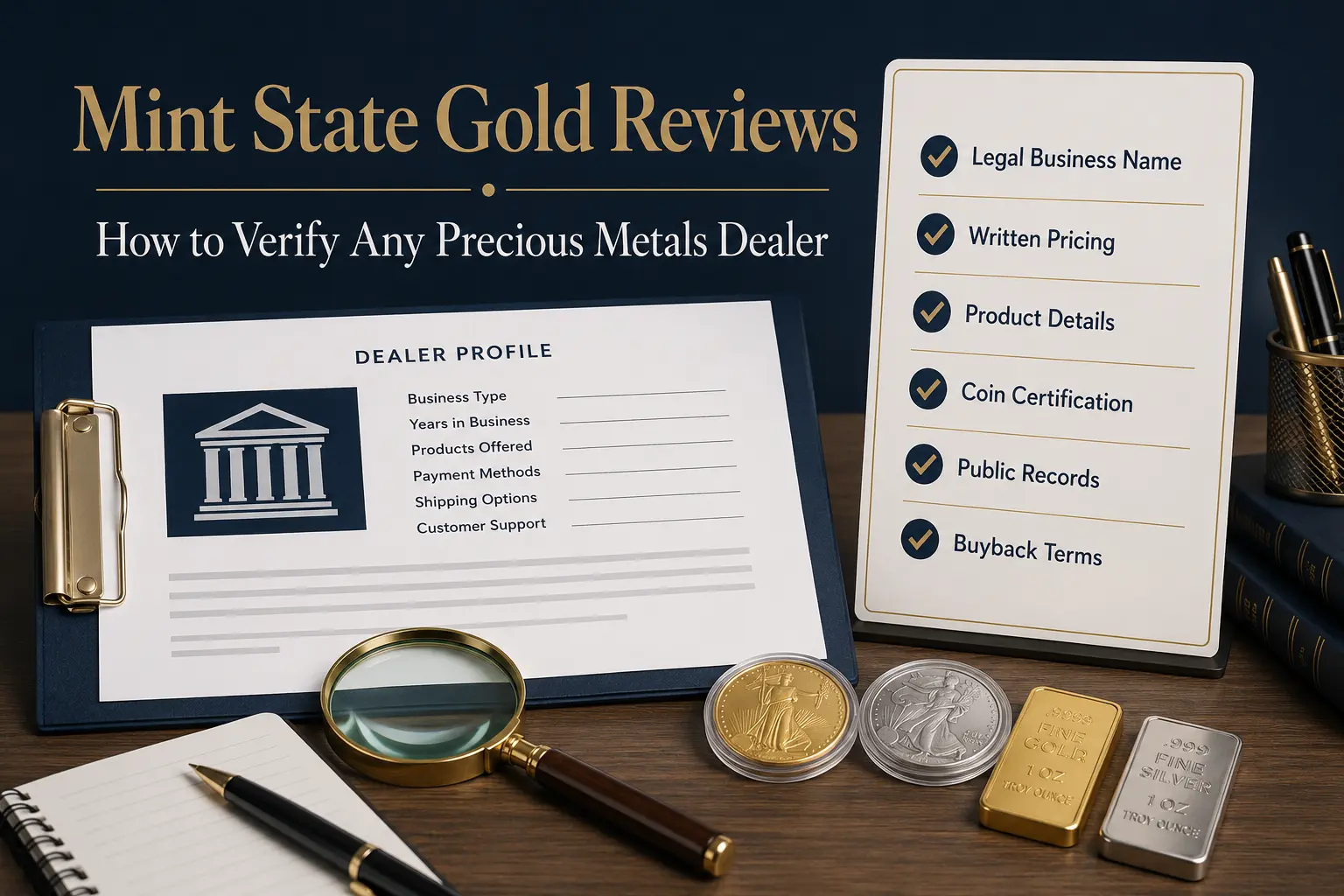
Precious metals dealer verification begins with a written transaction file.
First, confirm the legal business name. The invoice, payment instructions, state registration, website, return address, and shipping documents should identify the same entity or clearly explain any parent company, trade name, or payment processor. As of July 2026, Mint State Gold's website identified the business as Mint State Gold and listed Stuppler & Company Inc in the footer (Mint State Gold).
Second, identify the exact product. A quote should list the coin or bar name, metal, weight, purity, mint or refiner, year when relevant, grade when relevant, grading service, certification number, quantity, and condition.
Third, measure the full purchase cost. The written quote should show the spot-price reference, metal value, unit price, total price, shipping, insurance, payment-method adjustment, and any other amount. The CFTC advises precious-metals buyers to obtain the full purchase price, resale price, fees, commissions, and the amount the metal price would need to rise before the transaction becomes profitable (CFTC: Precious Metals Fraud).
Fourth, obtain an immediate resale quote for the same product. The difference between the retail purchase price and the dealer's same-day repurchase price is the spread — often more useful than a general statement that a dealer offers a buyback program.
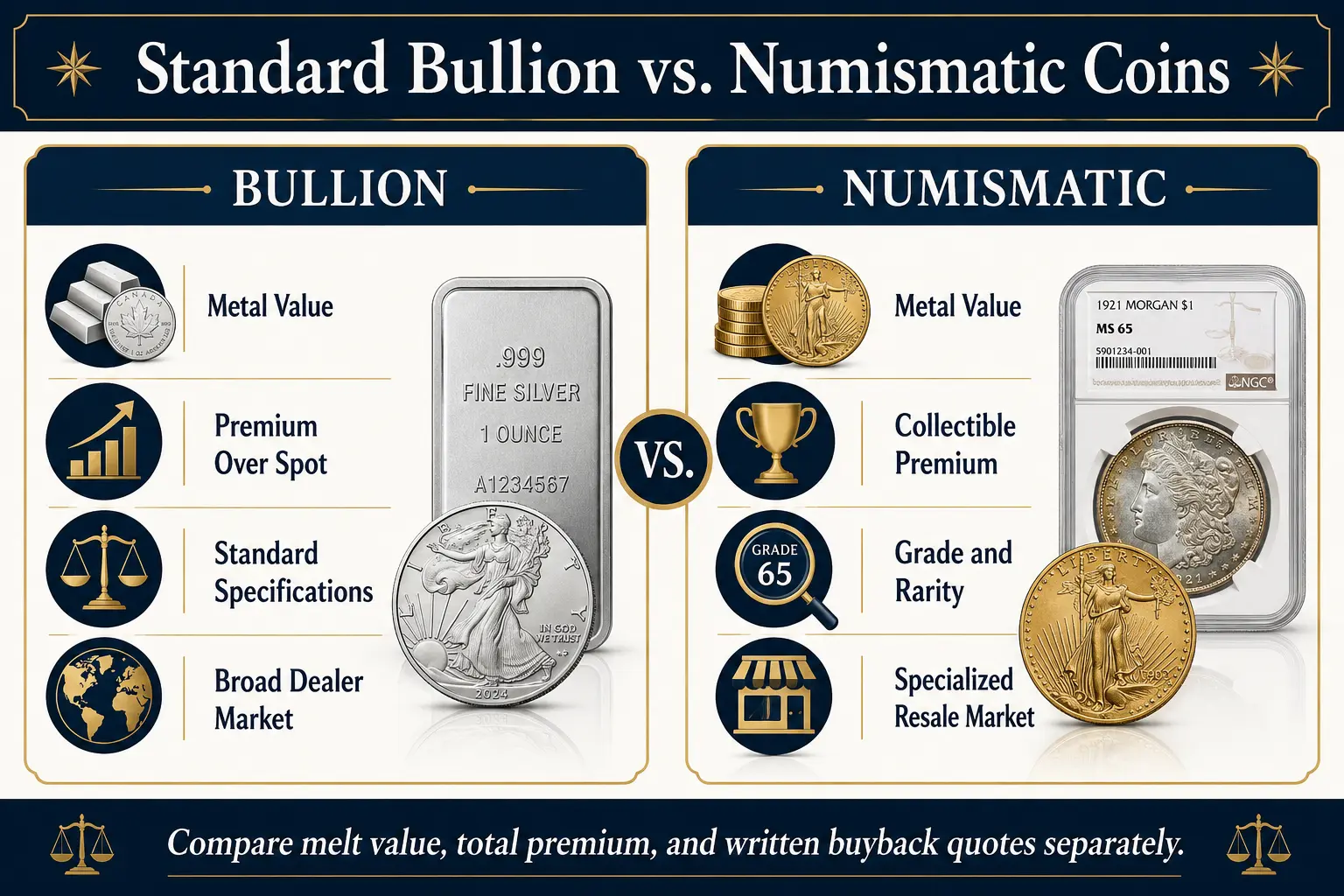
Fifth, separate bullion value from collectible value. Standard bullion is priced mainly around metal content plus fabrication, distribution, demand, and margin. A graded or collectible coin may also carry a premium tied to condition, rarity, population, eye appeal, label, provenance, or collector demand.
Sixth, review delivery and return terms before payment. The FTC's Mail, Internet, or Telephone Order Merchandise Rule requires covered sellers to have a reasonable basis for the promised shipping time; when no shipping time is stated, the rule generally uses 30 days, and a seller that cannot ship on time must follow the rule's delay or refund procedures (FTC: Merchandise Rule).
Seventh, check public records under the exact legal name. A BBB profile, state business record, regulator database, customer-review page, or attorney general record is useful only when it matches the correct entity. The Gold IRA Dealer Markup Data guide can help organize metal value, premium, and spread, and the Gold IRA Comparison Workbook can place the same figures beside competing quotes.
Mint State Gold Reviews: Start With the Company's Own Records
A fair Mint State Gold review should distinguish current company statements from independently verified facts. As of July 2026, the company's homepage listed gold, silver, platinum, palladium, modern bullion, bars, rounds, certified coins, and other collectible categories, and displayed individual product prices and a "Sell To Us" link. As of July 2026, the company's "Offer to Sell" page asked sellers to submit identifying and product information and stated that the company would contact the seller to discuss the items, again identifying the site with Stuppler & Company Inc in the footer (Mint State Gold: Offer to Sell). As of July 2026, the company's About Us page stated that it offers an upgrade and buyback program and sells both rare coins and bullion products — those are company statements, not independently tested buyback terms, so the actual formula, deductions, eligible products, settlement time, and obligation to repurchase should be confirmed in writing before an order (Mint State Gold: About Us).
The official site also contained self-published review displays. This article does not repeat the displayed totals or percentages because those figures appeared to vary across pages during the July 2026 review, and a company-hosted review display is not the same as an independent regulator record or court finding. Public records and website content can change and should be re-checked directly. A public rating or complaint count does not determine whether a company is appropriate for any individual.
How to Read a Company's BBB Profile and Complaints
A BBB profile can support coin dealer due diligence, but the sections should be read separately. As of July 2026, the BBB stated that its letter rating reflects the organization's opinion of how a business is likely to interact with customers, using information the BBB can obtain including complaint records and public data, and that customer reviews do not determine the letter-grade rating (Better Business Bureau: Overview of Ratings). The BBB complaint process has its own definitions: as of July 2026, the BBB stated that businesses are generally asked to respond within 14 days and that complaints are commonly closed within about 30 days, with closure labels including resolved, answered, unresolved, unanswered, and unpursuable — an "answered" complaint can still mean the customer did not accept the response or did not report satisfaction (Better Business Bureau: Complaint Process).
A Mint State Gold BBB review should check the exact legal or trade name, address and telephone number, accreditation status, letter rating, customer-review score, complaint totals by time period, complaint categories, company responses, closure labels, alerts or government-action notices, and the observation date. As of July 2026, this research did not verify a BBB profile that could be confidently matched to the exact legal entity shown on Mint State Gold's website. Therefore, no Mint State Gold BBB rating, accreditation status, review score, or complaint total is stated here. Any later record should be dated and re-checked directly — similar company names can create false matches. A public rating or complaint count does not determine whether a company is appropriate for any individual.
Regulator and Consumer-Protection Records to Check
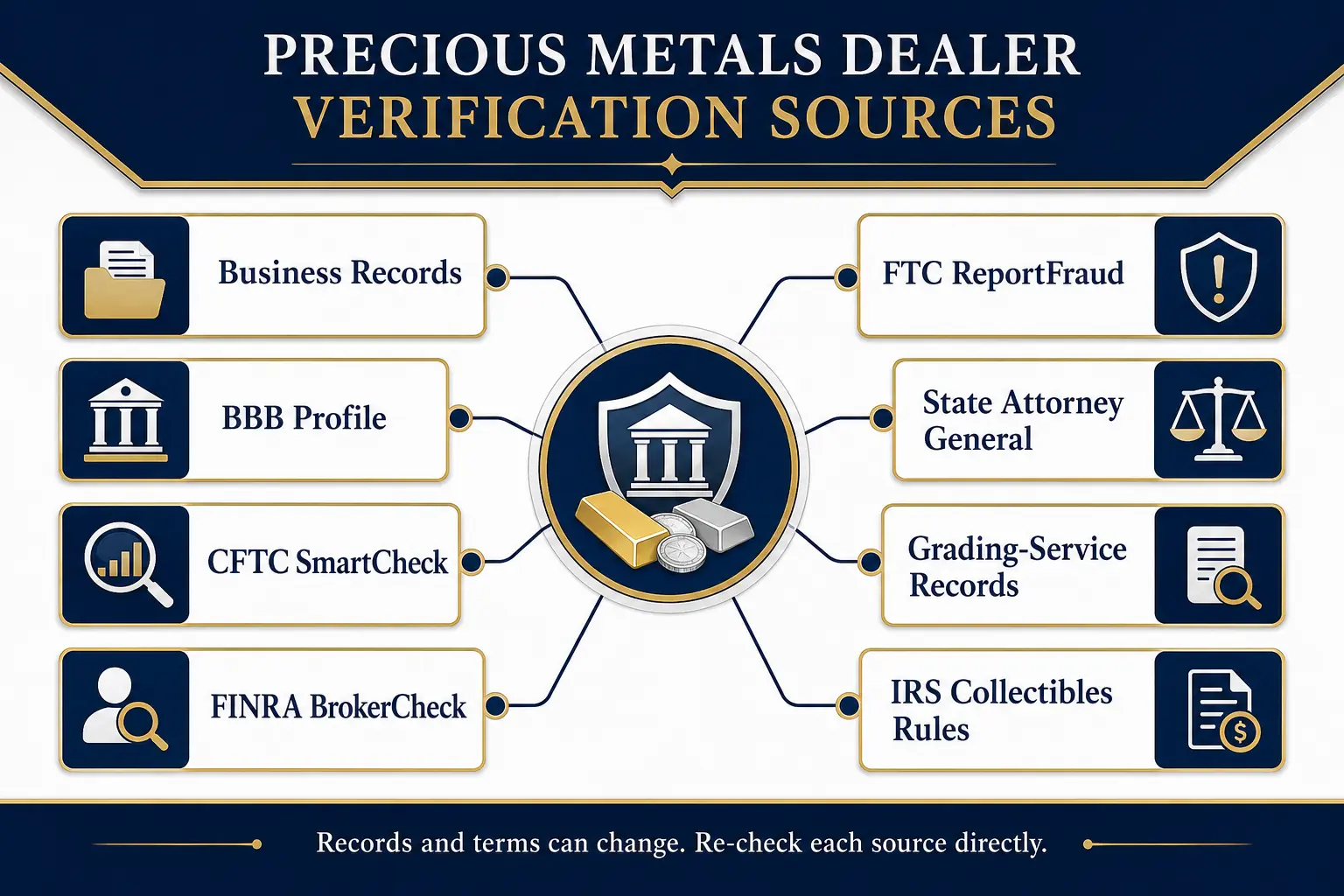
No single database covers every physical-metal sale. The correct search depends on the transaction and the claims being made.
CFTC SmartCheck and Precious-Metals Guidance
CFTC SmartCheck is an official starting point for checking registration and disciplinary information connected with derivatives and certain commodity-market professionals (CFTC SmartCheck). A fully paid physical purchase is different from a futures, options, margin, or leveraged transaction, so a physical coin dealer may not need CFTC registration for ordinary cash sales — an empty search result is not an approval or a finding of misconduct. The CFTC's precious-metals advisory discusses high-pressure sales, financed purchases, inflated markups, wide spreads, and claims that minimize the possibility of loss, and recommends obtaining all costs and resale terms in writing (CFTC: Precious Metals Fraud).
FINRA BrokerCheck
FINRA BrokerCheck provides background information on current and former securities brokers and brokerage firms (FINRA BrokerCheck). It matters when a salesperson claims to be a registered securities professional, gives securities-related recommendations, or represents a broker-dealer. A person engaged only in ordinary physical coin sales may not appear in the database. The search should use the individual's full name and the company's exact legal name, and a match should be read for employment history, disclosures, examinations, and current status.
FTC and State Attorneys General
The FTC accepts reports through its reporting portal, which is a reporting channel rather than a public company-rating database, so it cannot confirm that a named dealer has or has not received reports (FTC: ReportFraud). State attorneys general may publish alerts, settlements, lawsuits, and enforcement records; the National Association of Attorneys General provides a directory for locating each state or territory office (NAAG: Find My AG). Searches should use the legal name, trade name, verified owner name, and known address. A public enforcement record or complaint count does not determine whether a company is appropriate for any individual.
Getting Spot, Premium, Spread, and Buyback in Writing
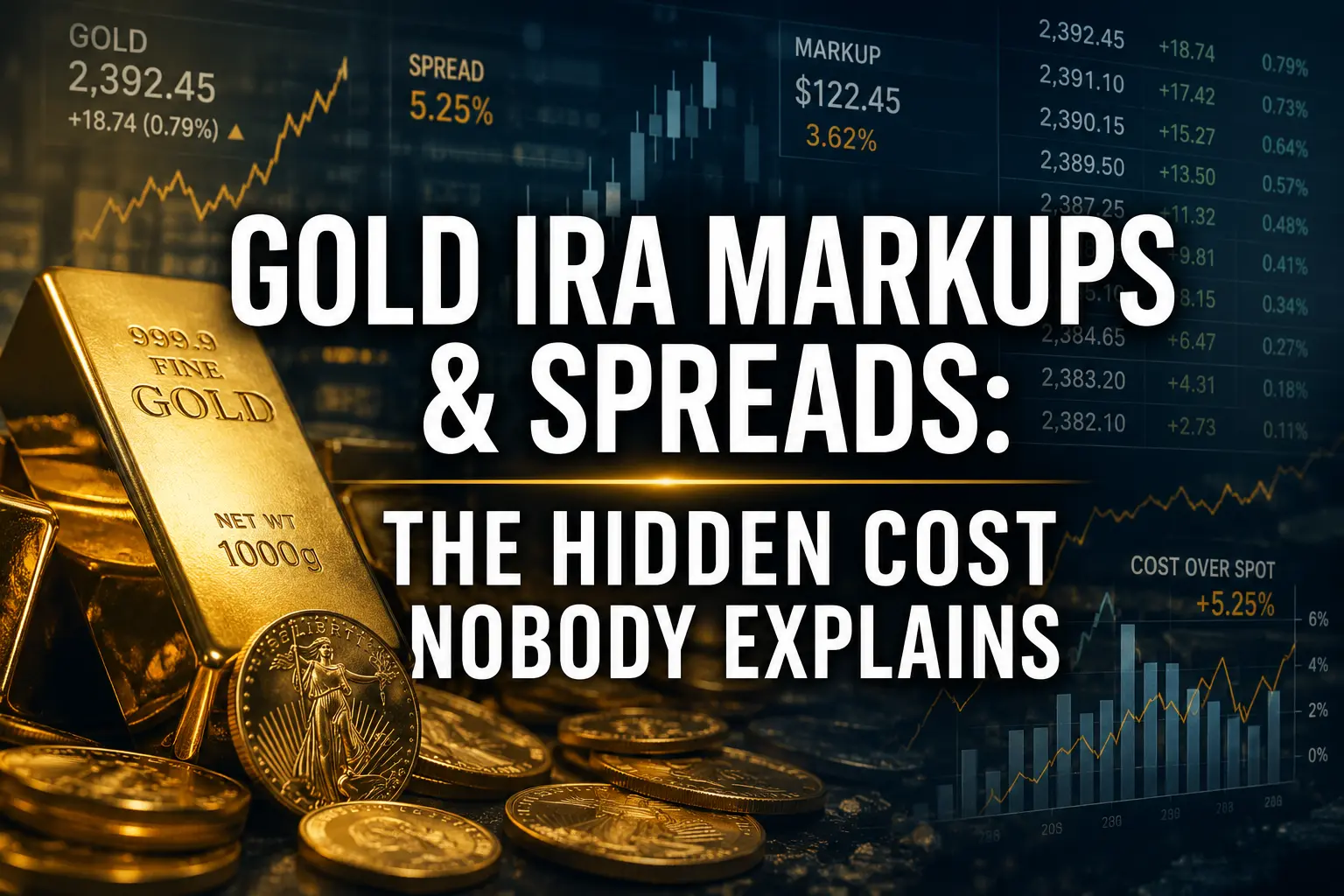
Bullion pricing transparency requires a same-product comparison. Spot is a reference price for immediate wholesale metal trading, and a retail product normally sells above its raw metal value because fabrication, minting, distribution, inventory, payment processing, insurance, demand, and dealer margin may be included. A written quote should identify the exact product, metal and purity, fine-metal weight, quantity, spot-price source and timestamp, melt or metal value, retail price per item, total purchase price, shipping and insurance, payment-method adjustment, cancellation terms, and the expected shipment date. The following calculations create a simple comparison:
- Metal value = fine-metal weight × spot reference.
- Dollar premium = retail price − metal value.
- Premium percentage = dollar premium ÷ metal value × 100.
- Immediate spread = retail purchase price − same-day dealer buyback quote.
- Spread percentage = immediate spread ÷ retail purchase price × 100.
For illustration, a one-ounce product with a $3,000 metal value and a $3,300 retail price has a $300 premium, or 10% of metal value. If the same-day repurchase quote is $2,940, the immediate spread is $360, or about 10.9% of the retail price. This is arithmetic, not a Mint State Gold quote. Mint State Gold fees should not be estimated from old reviews, search snippets, or unrelated dealers — a current written quote is required. A dealer buyback document should answer whether repurchase is required or discretionary, which products qualify, whether the quote is based on spot/bid/wholesale/auction data, how long it remains valid, whether shipping/assay/handling/grading/liquidation costs are deducted, whether holder condition affects the quote, whether products purchased from other dealers are accepted, and how and when payment is made. A general buyback statement does not reveal the resale formula — the same-day dollar quote is more useful.
Numismatic and Collectible Coins vs. Standard Bullion
The words "mint state" have a specific numismatic meaning. Mint State generally refers to an uncirculated coin graded from MS-60 through MS-70 on the widely used 70-point scale — a Mint State grade describes condition, not the amount of precious metal and not a future price result. As of July 2026, Mint State Gold maintained educational pages about graded coins and sold products described with grades from third-party services such as PCGS and NGC; those product descriptions and grades should be checked against the grading service certification record for the exact serial number (Mint State Gold: About Coin Grading).
Melt value is the market value of the precious metal contained in the item, estimated from fine-metal weight and a spot reference. A numismatic premium is the portion of the price attributed to factors beyond metal content — rarity, grade, date, mintmark, population, demand, eye appeal, provenance, label, and market conditions. The U.S. Mint explains that bullion products are generally bought for metal content, while collectible products can be priced around features beyond raw metal value (U.S. Mint). The term "semi-numismatic" has no verified standard regulatory definition in the primary sources reviewed for this article, so a seller using that term should define the product, premium basis, comparable sales, and buyback method in writing.
Collectible coins can have a narrower buyer pool than widely traded standard bullion, which can make resale timing and price discovery less predictable. The strongest liquidity test is not a marketing label — it is a set of written bids from several independent dealers for the exact coin and grade. Third-party grading can help identify and authenticate a coin, but a grade does not fix a sale price; two coins with the same numerical grade may trade differently because of eye appeal, scarcity, holder, designation, provenance, or demand. Past performance does not guarantee future results, and a prior auction price, population report, or price-guide figure does not establish the next resale price.
IRA-Eligibility Caution for Collectible Coins
Physical metals intended for an IRA require a separate custodian and custody review. The IRS states that IRA investments in collectibles are generally treated as distributions; collectibles include metals and coins, subject to limited statutory exceptions for specified coins and qualifying gold, silver, platinum, or palladium bullion, which must meet the statutory requirements and be held in the physical possession of a bank or approved nonbank trustee (IRS: Investments in Collectibles). Many rare, graded, historical, or collectible coins do not qualify merely because they contain gold or silver, so the exact product should be submitted to the IRA custodian for written eligibility confirmation before purchase. The dealer, custodian, trustee, and depository are separate roles: Investor.gov warns that self-directed IRA custodians generally do not evaluate the quality, legitimacy, or financial merit of an asset or promoter merely because the asset is accepted for administration (Investor.gov: Self-Directed IRAs and the Risk of Fraud). Customers should speak to a financial or tax advisor before making decisions involving an IRA, rollover, collectible, bullion purchase, storage, distribution, or tax treatment. Goldco does not offer tax or legal advice. The Questions to Ask Before Opening a Gold IRA guide covers custodian and depository questions.
Shipping, Insurance, and Return Terms
Physical delivery should be documented from payment through receipt. As of July 2026, the Mint State Gold homepage displayed "Free Shipping On All Orders." That company-published statement does not, by itself, explain carrier choice, insurance, signature requirements, shipment timing, loss claims, address restrictions, or the point when responsibility transfers. A written shipping policy should state processing time, expected shipment date, payment-clearing requirements, carrier and service level, tracking process, signature requirement, insurance coverage, address restrictions, the lost-package process, the damaged-package process, and the delivery-responsibility transfer point. The FTC's shipping rule requires covered sellers to have a reasonable basis for the promised shipping time, and when a delay occurs the seller must follow the rule's consent or refund procedures.
Return and cancellation terms should be read before the price is locked. Bullion orders may be treated differently from ordinary retail items because market prices move, so any market-loss charge, restocking charge, authorization requirement, product exclusion, or return window should be written. The FTC Cooling-Off Rule does not create a general three-day cancellation right for every internet or telephone transaction — it applies to certain sales made at a home, workplace, dormitory, or temporary location and includes exceptions (FTC: Buyer's Remorse Cooling-Off Rule). A bullion dealer shipping complaint should be read with the order date, payment-clearing date, promised ship date, tracking history, seller response, and outcome.
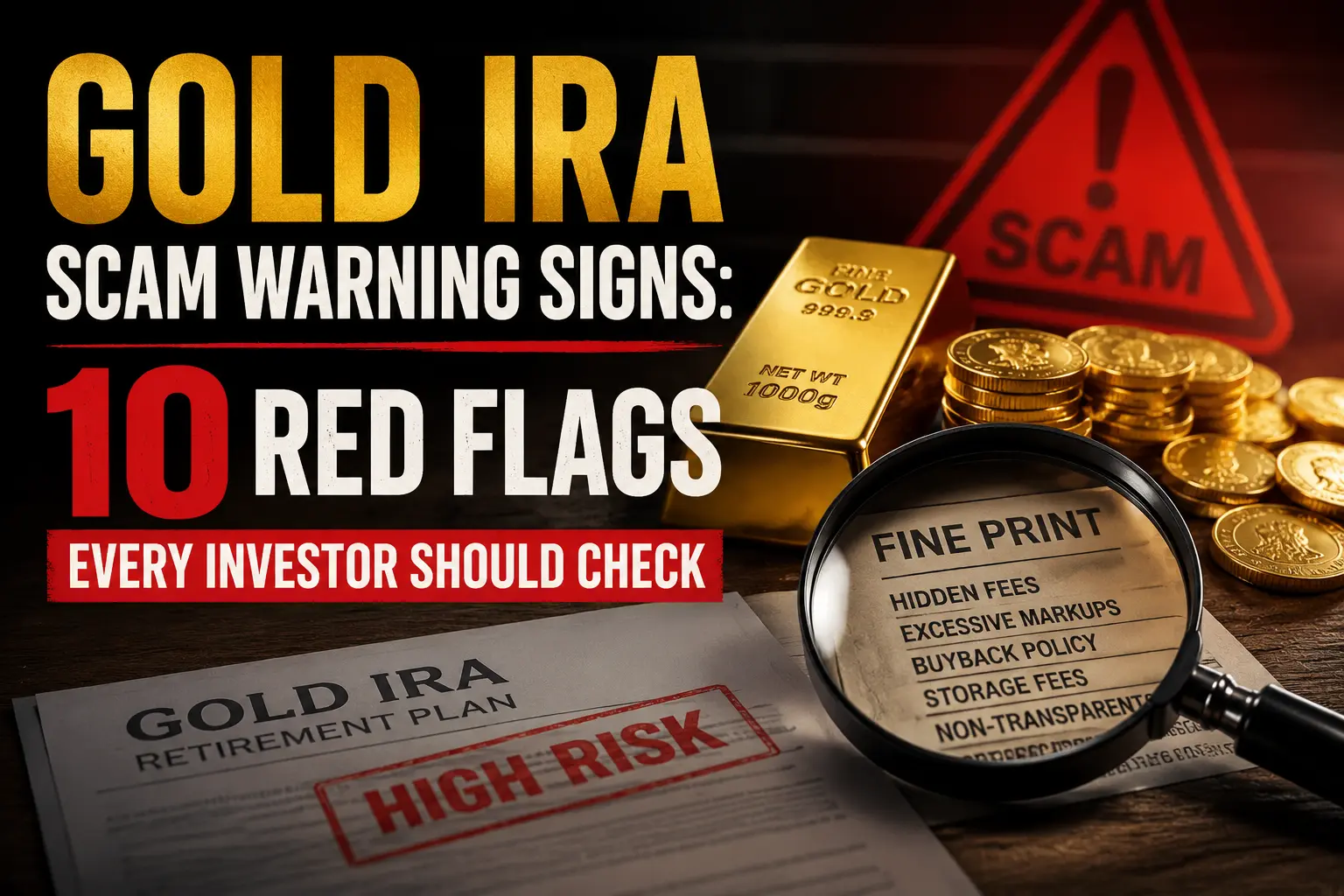
Red Flags That Recur Across Precious-Metals Dealers
Red flags are reasons to pause and verify. They are not automatic findings about Mint State Gold or any other dealer.
- No itemized written quote. A quote that omits the product, metal value, premium, shipping, or total price prevents a clean comparison.
- No same-day resale figure. A purchase price without a repurchase quote hides the initial spread.
- Collectible language without supporting data. Words such as rare, exclusive, premium, investment grade, or semi-numismatic need the exact grade, certification number, population, comparable sales, and buyback basis documented.
- Grade presented as a future-value forecast. A grade describes condition; it does not determine future demand or price.
- Pressure against independent comparison. A request for time to compare quotes, verify certification, check public records, or seek independent advice should not prevent access to written terms. The CFTC addresses high-pressure tactics in precious-metals sales.
- Vague shipping or insurance terms. Free shipping does not automatically define insurance, signature, loss responsibility, or delivery timing.
- Payment to an unexplained entity. The payment recipient should match the contracting entity or be explained and independently verified.
- IRA eligibility based only on a sales statement. The custodian should confirm the exact product and custody arrangement before retirement funds are used.
The Gold IRA Scam Warning Signs guide provides a broader due-diligence checklist. A complaint, pricing dispute, shipping delay, or service problem should not be labeled as fraud without reliable evidence.
Questions to Ask Before Ordering
- What is the dealer's full legal name, and which state business record matches that entity?
- Which entity receives payment?
- What is the exact product name, and what are the metal, purity, fine weight, mint, year, and condition?
- Is the product standard bullion, proof, graded, collectible, or numismatic?
- Which grading service assigned the grade, what is the certification number, and does the grading-service database confirm the item?
- What spot-price source and timestamp support the quote, and what is the metal value?
- What is the dollar premium and premium percentage?
- Which factors and comparable sales support any collectible premium?
- What is the same-day buyback quote and the immediate spread?
- Is repurchase required or discretionary, and which deductions may apply during resale?
- What shipping and insurance terms apply, when is shipment expected, and what happens if it is delayed?
- When does delivery responsibility transfer, and what cancellation and return terms apply?
- Which public records match the exact entity?
- For an IRA, has the custodian confirmed product eligibility, and which trustee or depository will hold the metal?
- Will every material term be supplied in writing before payment?
Frequently Asked Questions
Is Mint State Gold a legitimate precious-metals dealer?
This article does not issue a legitimacy verdict. As of July 2026, the company's website identified Mint State Gold and Stuppler & Company Inc, displayed bullion and collectible products, and provided a sell-to-us form. Legal identity, current pricing, public records, shipping terms, and buyback terms should still be verified directly.
Were Mint State Gold complaints found?
No verified Mint State Gold complaint total is stated here. A complaint profile should be matched to the exact legal entity, dated, and read with the response and closure details. A public rating or complaint count does not determine whether a company is appropriate for any individual.
Does Mint State Gold have a BBB rating?
No Mint State Gold BBB rating is asserted because the July 2026 research did not verify a profile confidently matched to the legal entity shown on the company website. Any later profile should be checked directly.
What does Mint State mean on a coin?
Mint State generally means an uncirculated coin graded from MS-60 through MS-70. The grade describes condition and does not determine melt value, liquidity, or future price.
Are graded coins worth more than bullion?
A graded coin may sell above melt value because of rarity, condition, demand, or other collectible factors. The added premium should be measured separately from metal value and tested with independent resale bids.
Are collectible coins eligible for an IRA?
Many collectible coins are not IRA eligible. The IRS provides limited exceptions for specified coins and qualifying bullion held under the required custody arrangement. The custodian should confirm the exact product in writing.
Conclusion
A useful Mint State Gold review should not depend on a star score, sales statement, product label, or isolated comment. The stronger process confirms the legal entity, identifies the exact coin or bar, separates melt value from collectible premium, checks the grade and certification, measures the immediate spread, reads shipping and return terms, obtains written buyback details, and checks public records under the correct name. The company's own website can supply current product and policy statements, but those statements should be dated and independently tested where possible. Public records can change and should be re-checked directly. A public rating or complaint count does not determine whether a company is appropriate for any individual.
Sources
- Mint State Gold. Official Website.
- Mint State Gold. About Us.
- Mint State Gold. Offer to Sell.
- Mint State Gold. About Coin Grading.
- Better Business Bureau. Overview of BBB Ratings.
- Better Business Bureau. Complaint Process.
- Commodity Futures Trading Commission. SmartCheck.
- Commodity Futures Trading Commission. Precious Metals Fraud.
- Federal Trade Commission. ReportFraud.ftc.gov.
- Federal Trade Commission. Mail, Internet, or Telephone Order Merchandise Rule.
- Federal Trade Commission. Buyer's Remorse: The FTC Cooling-Off Rule.
- FINRA. BrokerCheck.
- Internal Revenue Service. Investments in Collectibles in Individually Directed Qualified Plan Accounts.
- Investor.gov. Self-Directed IRAs and the Risk of Fraud.
- National Association of Attorneys General. Find My AG.
- U.S. Mint. Collectible Coins.
Article reviewed and edited by Daniel M. — editor, 401kToGoldIRA.org. A neutral verification framework sourced to the company's own dated records, the U.S. Mint, IRS, CFTC, FINRA, SEC, Investor.gov, FTC, NAAG, and BBB; educational only, not an endorsement, verdict, or tax or legal advice.