
Affiliate disclosure: Some of the links in this article are from sponsors. The site owners may be paid to recommend the companies covered. Reviews may not be neutral or independent — readers should treat this site as a research starting point, not personalised financial advice. Read the full disclosure.
For many retirement savers, understanding Augusta Precious Metals fees is the final step before committing a 401(k) or IRA rollover to physical gold and silver. Augusta states its three standard account fees in its own FAQ, which is more than most of this market publishes. The form of that disclosure has changed: the detailed fee-sheet PDF the company once hosted has been withdrawn and now returns a 404, and a request for the fee page redirects to a video explainer rather than a written schedule.
What this means for the figures below
The three account fees on this page — setup, annual custodian, and annual depository storage and insurance — are quoted from Augusta's FAQ, updated 23 September 2026 and retrieved 8 October 2026, so they can be checked against a current company document. The earlier fee sheet's $275 and $225 totals are kept alongside them as a dated historical reference, not as current figures. The dealer markup on the metals is a different matter: Augusta publishes no figure for it anywhere, and the percentages quoted on this page come from third-party commentary rather than the company. A FAQ answer is also a weaker artefact than a signed schedule, carrying no custodian name and no effective date beyond the page's own update stamp. The only binding number is one obtained in writing for a specific account.
Investment in precious metals involves risk and is not suitable for every investor. Past performance does not guarantee future results.
Quick Answer
Augusta's FAQ, updated 23 September 2026 and retrieved 8 October 2026, states a first-year total of $285 (account setup $50, annual custodian $125, annual depository storage and insurance $110) and $235 per year thereafter (custodian $125 + storage $110). The company describes these as flat account fees that do not increase with the amount held or with growth in account value, and says every account receives up to 10 years of custodian and depository fees paid by Augusta. The earlier fee sheet, now withdrawn, showed $275 first year and $225 recurring on the same setup and custodian lines with storage at $100, so storage is the single line that changed. On top of either schedule, investors pay a dealer markup on each metal purchase, which the company does not publish. Third-party commentary has described bullion premiums around 5% over spot, but no company document confirms it; a CFTC customer advisory describes bullion generally as spot plus 5% to 10%, with numismatic coins far higher.
In simple terms, a typical Augusta Gold IRA customer with a $50,000 starting position faces roughly $4,900 of total overhead over 10 years on the current schedule: about $2,400 in fixed admin and storage fees plus around $2,500 in initial bullion markup, before any market movement. On the withdrawn fee sheet the same scenario came to $4,800, of which $2,300 was admin and storage.
Augusta's $50,000 minimum doesn't fit every bracket. The 2-minute matching quiz on this site narrows the choice based on retirement timing, savings band, and priorities — useful for finding the right alternative if Augusta's minimum is too high.
Before opening a Gold IRA, compare multiple highly-rated companies. Augusta Precious Metals is one of seven providers reviewed on this site. See how its fee structure stacks up against Goldco, Birch Gold Group, Noble Gold, American Hartford Gold and 2 other A+ BBB-rated providers in the Best Gold IRA Companies of 2026 comparison.
To put Augusta's numbers in context, compare them against the independent, sourced data: the Gold IRA fees benchmark shows all-in cost by account size, the dealer markup data shows premium ranges by product, and the Gold IRA vs gold ETF comparison weighs the whole wrapper against a low-cost alternative.
Augusta's three-fee structure
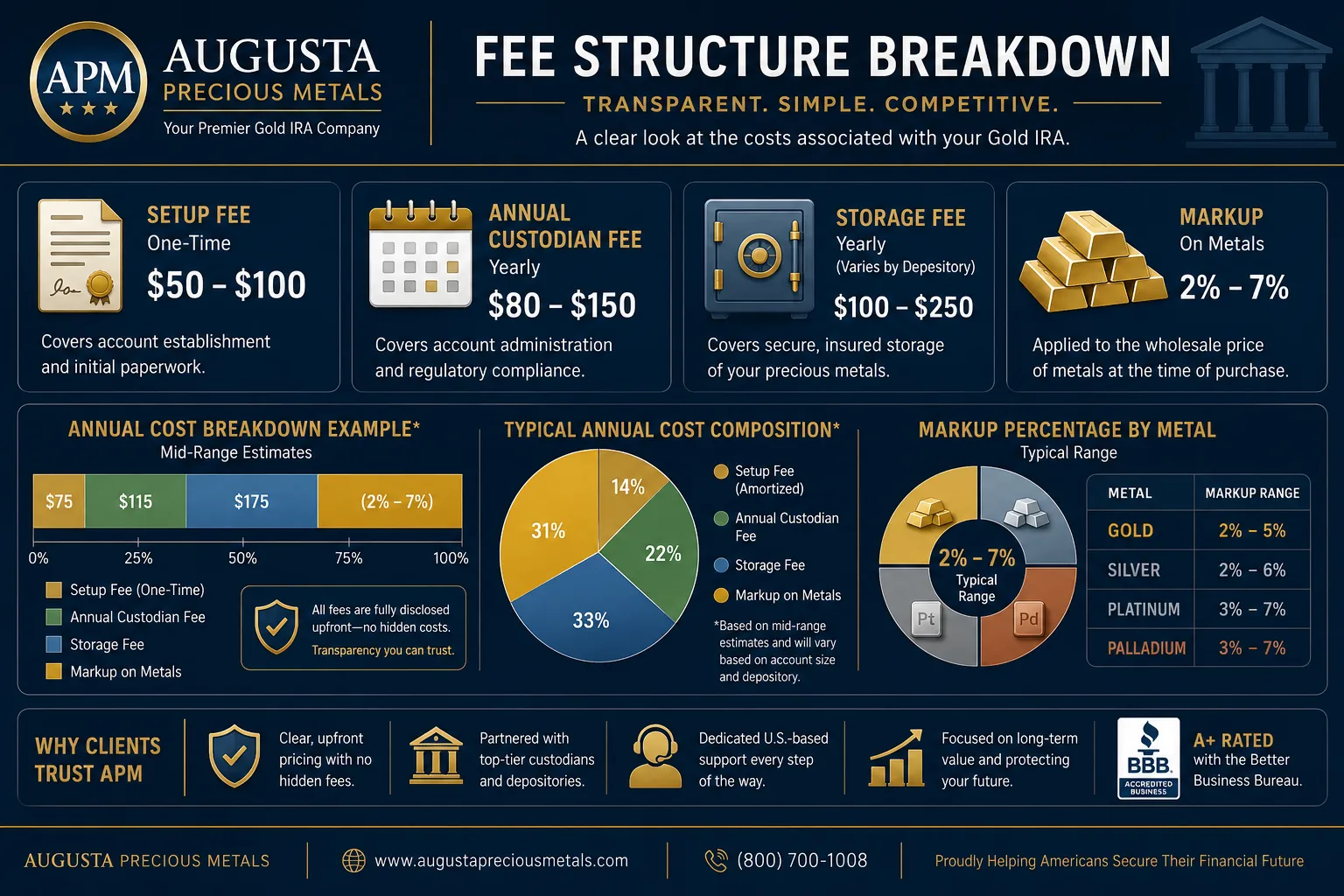
Augusta's FAQ describes a three-part cost structure for Gold and Silver IRAs: a one-time setup charge, an annual custodian fee, and an annual depository storage and insurance fee. The actual payments go to the independent IRA custodian and depository; Augusta does not charge a separate "management fee" on top of these amounts, and states that the three are flat account fees which do not rise with the amount held.
- First-year total — $285
- One-time account setup fee: $50.
- Annual custodian fee: $125.
- Annual depository storage and insurance fee: $110.
Those three lines produce the $285 first-year total stated in Augusta's FAQ, updated 23 September 2026 and retrieved 8 October 2026. The withdrawn fee sheet put the same total at $275, with storage at $100 rather than $110, and that is the figure repeated across much third-party coverage published while the PDF was live.
- Recurring annual custodian fee — $125
After year one, the custodian charges a flat $125 maintenance fee for record-keeping, tax reporting, and ongoing administration of the self-directed IRA. This line is unchanged between the FAQ and the withdrawn fee sheet, and sits in the mid-range of industry pricing in broader Gold IRA cost surveys.
- Recurring annual storage and insurance fee — $110
The FAQ states $110 per year for depository storage and insurance, with Delaware Depository and other facilities used for Augusta's IRA accounts under the custodian's custody arrangement. This is the one line that moved: the withdrawn fee sheet showed $100 for pooled, non-segregated storage. Segregated storage, where metals are held separately, can cost more and is often quoted around $150 per year at comparable depositories.
The resulting recurring annual out-of-pocket cost is $235, against $225 on the withdrawn sheet. Either way it is a fixed-dollar amount, not a percentage of assets. For a $50,000 IRA the current figure translates into roughly 0.47% per year, while a $250,000 account sees a drag closer to 0.09% per year, ignoring metal-price changes.
The fourth cost: dealer markup over spot
The three published Augusta Precious Metals fees are only part of the story. The largest single cost over the life of a precious metals IRA is almost always the dealer markup over spot, not the custodial or storage charges.
Augusta and independent reviewers have described the firm's pricing for mainstream bullion coins and bars as transparent and documented, with no extra commission on top of quoted prices. A widely cited fee explainer states that Augusta "marks up their costs only 5% on bullion coins and bars." That is a third-party characterisation rather than a company disclosure, and it cannot presently be checked against any Augusta document. Treat it as a claim to test in writing, not an established rate.
Industry-wide fee studies suggest that:
- A CFTC customer advisory describes bullion as priced at spot plus a premium of 5% to 10%, and numismatic coins at 40% to 200% above spot. Those figures date from the CARES Act period and are a regulator statement, not a current market average.
- The joint CFTC and FINRA bulletin describes “semi-numismatic” as a made-up industry term with no special meaning, applied to coins sold as collectible that typically are not rare.
- No regulator publishes a threshold at which a markup becomes a red flag. What regulators do advise is obtaining the retail price, the premium, and the same-day buyback figure in writing before any money moves.
Why does this matter so much? Consider a 62-year-old retiree rolling $250,000 from a former-employer 401(k) into a Gold IRA. At an illustrative 5% markup, the one-time cost is $12,500 on day one — more than 50 years' worth of a $235 annual admin and storage charge at that account size. The percentage here is arithmetic for illustration, not Augusta's disclosed rate. Whatever the real figure turns out to be, the structural point holds: over long holding periods the upfront premium dominates total cost of ownership, not the flat-dollar custodial charges.
📊 Project a Gold IRA Portfolio against Augusta's fees — the Gold IRA Calculator on this site compares a gold-diversified portfolio against an all-stock baseline and matches readers to the providers their bracket qualifies for.
What Augusta's fee transparency actually means
How unusual that is can be measured rather than asserted. Requesting the fee schedule at the expected location on each of the five largest providers' own domains returned a consistent result: four returned a 404, and the fifth redirected to a video page. None published a complete schedule where a customer would look for it. The test, with the URLs requested and what was found instead, is on the provider transparency scorecard.
Against that background, publishing a specific figure at all is the exception. It deserves to be said plainly, because a review that only ever finds fault is less useful than one that reports what the record supports.
The harder point follows from it: even a published schedule does not produce a total cost. Three separate parties charge in a precious-metals IRA. The independent custodian bills setup and annual administration. The depository bills storage and insurance. The dealer's compensation is embedded in the retail price of the metal rather than billed as a fee, and it is usually the largest of the three. A published schedule covers the first two and never the third — which is why the written quote, showing the exact product, the retail price, the reference metal value and the same-day repurchase bid, remains the only document that settles what an account actually costs.
Augusta stands out in the Gold IRA niche because it publishes an explicit fee sheet on its own site, listing the custodian application fee, annual custodian charge, and storage fee in a single PDF. Many peers list only partial information, or require a phone call before disclosing basic annual cost ranges.
Several independent comparison pieces highlight Augusta as "best for transparency," noting the combination of:
- A public fee schedule with no "quote required" placeholders for standard IRA fees.
- A clearly communicated $50,000 minimum investment, which targets higher-balance IRAs but avoids ambiguity about account-size expectations.
- Extensive educational materials, including a Gold IRA explainer that walks through fees, rollover mechanics, and depository options in plain language.
This transparency is complemented by Augusta's third-party reputation. BBB lists an A+ rating and accreditation since 2015. Complaint totals use a rolling reporting period and should be checked on the current profile; customer reviews are individual opinions and can also change.
The broader complaint and rating landscape, including providers covered in this site's Birch Gold Group BBB analysis, shows why current complaint narratives and written fee disclosures are more useful than permanent claims about complaint totals.

For a deeper dive into hidden spreads, tiered storage pricing, and percentage-based admin fees, the standalone Gold IRA Fees & Hidden Costs Guide offers line-by-line worksheets and checklists.
Total cost of ownership — worked examples
To move beyond headline fee numbers, it helps to run concrete scenarios. The examples below use the $285 first year and $235 recurring annual fee from Augusta's FAQ, updated 23 September 2026 and retrieved 8 October 2026, plus an illustrative 5% bullion markup drawn from third-party descriptions. Each scenario also states what it came to on the withdrawn fee sheet's $275 and $225, so the earlier published figures stay on the record rather than disappearing. The markup is a modelling assumption, not a rate Augusta discloses; substitute the figure from a written quote to make these numbers real.
These are illustrative only. Real outcomes depend on metal selection, account size changes, and any fee waivers offered at the time of investment.
Scenario 1: $50,000 starting position, 10-year hold
- Investor profile: 60-year-old retiree rolling $50,000 from a traditional IRA into a self-directed Gold IRA at Augusta.
- Upfront bullion purchase: $50,000 in IRA-eligible gold and silver bullion at an illustrative 5% markup → $2,500 in dealer premium on day one.
- Admin and storage fees:
- First-year total: $285 (setup $50 + custodian $125 + storage and insurance $110).
- Years 2–10: $235 × 9 = $2,115.
- 10-year admin/storage total: $2,400.
- On the withdrawn fee sheet: $275 first year, $225 × 9 = $2,025, $2,300 over 10 years.
Total 10-year overhead: Dealer markup: $2,500. Admin + storage: $2,400. Combined cost over 10 years: $4,900, or about 0.98% per year on the original $50,000 allocation (ignoring metal price movement). The same scenario on the withdrawn fee sheet came to $4,800, or about 0.96% per year.
Scenario 2: $250,000 starting position, 15-year hold
- Investor profile: 62-year-old retiree rolling $250,000 from a former-employer 401(k).
- Upfront bullion purchase: illustrative 5% markup → $12,500 initial dealer premium.
- Admin and storage fees:
- First year: $285.
- Years 2–15: $235 × 14 = $3,290.
- 15-year admin/storage total: $3,575.
- On the withdrawn fee sheet: $275 first year, $225 × 14 = $3,150, $3,425 over 15 years.
Total 15-year overhead: Dealer markup: $12,500. Admin + storage: $3,575. Combined cost over 15 years: $16,075, or roughly 0.43% per year measured against the initial $250,000 allocation. On the withdrawn fee sheet the same scenario came to $15,925, or roughly 0.42% per year.
Most of that drag comes from the one-time spread, not the recurring $235 annual charges. Over longer horizons and larger balances, Augusta's fixed-dollar fee model tends to scale more favorably than percentage-based fee structures.
Scenario 3: $500,000 starting position, 20-year hold
- Investor profile: 55-year-old business owner diversifying a $500,000 SEP IRA into precious metals over a 20-year horizon.
- Upfront bullion purchase: illustrative 5% markup → $25,000 initial dealer premium.
- Admin and storage fees:
- First year: $285.
- Years 2–20: $235 × 19 = $4,465.
- 20-year admin/storage total: $4,750.
- On the withdrawn fee sheet: $275 first year, $225 × 19 = $4,275, $4,550 over 20 years.
Total 20-year overhead: Dealer markup: $25,000. Admin + storage: $4,750. Combined cost over 20 years: $29,750, which equates to an average 0.30% per year on the starting balance. On the withdrawn fee sheet the same scenario came to $29,550, also about 0.30% per year.
These examples do not assume any appreciation or depreciation in metal prices, nor do they incorporate RMDs, taxes, or partial liquidations. For investors running their own numbers, the Gold IRA Fees & Hidden Costs Guide and Gold IRA Company Comparison Workbook on this site provide full spreadsheets and worksheets.
How Augusta's fees compare to other providers
No fee breakdown is complete without a cross-provider view. The table below compiles figures from third-party commentary and from provider documents available at the time of writing, several of which have since been withdrawn. It reviews for several widely referenced Gold IRA companies.
Gold IRA Provider Fee Comparison (2026)
| Provider | Setup Fee | Annual Custodian | Annual Storage | Bullion Markup | Fee Schedule Published? |
|---|---|---|---|---|---|
| Augusta Precious Metals | $50 (account setup) | $125 / year | $110 / year (storage and insurance) | Not published | Figures in company FAQ, updated 23 Sep 2026 — no standing schedule; earlier PDF withdrawn and 404s, with storage at $100 |
| Goldco | ≈$50 | ≈$125 / year | ≈$100 / year | Not published | Partial — markups by quote |
| Birch Gold Group | ≈$50 | $80–$100 / year | ≈$100 / year | Not published | Partial — not fully itemised |
| Noble Gold | $80 (one-time) | $125 / year | $150 / year (segregated) | Not published | Yes — on support page |
| American Hartford Gold | ≈$50 | $75–$125 (tiered) | ≈$100 / year | Own agreement: acquisition-cost “Spread” 1.00%–19.99% bullion; up to 59.99% certain numismatic | Partial — contractual ranges only |
| Preserve Gold | ≈$50 (often waived) | $100–$175 / year | ≈$100 / year (pooled) | Not published | Partial — details by quote |
| Lear Capital | Bundled: $280 first-year, $200 annual thereafter | Own terms: 2%–35% acquisition-cost spread | Publishes a fee schedule | ||
Source: 401ktogoldira.org. The dollar amounts are not verified company figures. A check of the five most reviewed providers found that none currently publishes a fee schedule at its conventional fee URL — four return a 404 and one redirects to a video (see the transparency scorecard). Those amounts come from third-party commentary and, where available at the time, provider documents since withdrawn. The markup column is different: “Not published” means the company discloses no markup at all. Where a figure appears, it is quoted from that company's own transaction agreement using its own definition — an acquisition-cost spread, measured against what the dealer paid its wholesaler, which is not the same as a premium over spot and not comparable between firms. Readers should request a current written quote before relying on any figure for a specific decision.
This comparison reinforces why Augusta is often positioned as a fee-transparent choice for higher-balance accounts, whereas some competitors lean more on promotions, percentage-style admin charges, or bundled pricing. For investors trying to weigh multiple options, the Best Gold IRA Companies 2026 comparison and the downloadable Gold IRA Company Comparison Workbook are designed as side-by-side evaluation tools.
The fee waiver — when Augusta covers up to 10 years
Third-party commentary describes an Augusta promotion in which the company rebates up to 10 years of IRA fees in the form of premium silver for qualifying account sizes. The specifics vary over time, but the general pattern looks like this:
- Investors who fund an Augusta IRA above a certain threshold (often $100,000–$250,000 or more) can receive enough bonus silver to offset the $235 annual custodial and storage charges for up to 10 years. Augusta's FAQ states separately that every account receives up to 10 years of custodian and depository fees paid by Augusta.
- The rebate is usually framed as "up to 10 years of fees rebated to the IRA in premium silver coins", which still carry their own spreads and may not be as liquid as standard bullion.
- The offer is subject to change and depends on active promotions at the time of account opening; Augusta's own disclaimers emphasise that investors should confirm current terms directly with a representative.
From a total-cost perspective, these waivers matter most on small and mid-sized accounts, where $235 per year is a more meaningful percentage of assets. On a $500,000 position, a one-time bullion premium at the illustrative 5% level still dwarfs 10 years of waived administrative fees, but the waiver can meaningfully reduce drag for investors near the $50,000–$100,000 range.
Augusta's buyback program
Augusta markets a lifetime support and buyback program as part of its value proposition, but the legal fine print is more conservative.
According to Augusta's FAQ and transaction agreement:
- The company has "historically bought back" customers' gold and silver, and at the time of writing reports no instances of declining a buyback request.
- However, Augusta cannot legally guarantee it will repurchase metals in the future; the buyback policy is "subject to change without notice," and prices depend on prevailing market conditions and inventory needs.
- Buyback pricing is typically quoted relative to the then-current spot price, with narrower spreads for bullion and wider spreads for premium coins, similar to purchase markups.
Third-party commentary contrasts this with Goldco's well-publicised "guaranteed buyback" marketing language. That phrase is Goldco's own marketing, not an independently verified commitment, and this site does not assert that any dealer guarantees repurchase or price. In practice, both Augusta and leading competitors like Goldco, Noble Gold, American Hartford Gold, Preserve Gold, and Lear Capital run active buyback desks, but investors still bear pricing and liquidity risk, especially for higher-premium products.
For many retirement savers, the key question is not whether a buyback exists, but how quickly settlement occurs, how wide the spread is on the sell side, and whether the firm has a record of honoring informal liquidity expectations during volatile markets.
What to ask Augusta during the orientation call
Augusta requires a one-on-one educational web conference before any Gold IRA purchase, which many reviewers praise as unusually detailed. To get the clearest fee picture during that session, investors often prepare specific questions ahead of time.
A simple five-question script could look like this:
- "What would be the all-in first-year cost, in dollars and as a percentage, for a $50,000, $250,000, and $500,000 IRA allocation?"
This forces a concrete breakdown of setup, custodian, storage, and typical bullion premiums, similar to the worked examples above.
- "How do markups differ between standard bullion coins/bars and any premium or collectible products Augusta offers?"
Third-party commentary frequently notes higher spreads on premium coins; asking for numerical ranges by category can prevent unpleasant surprises later.
- "What specific annual fees does the custodian charge, and are there any wire, transaction, or statement charges not listed on the main fee sheet?"
Some custodians add small per-wire or per-trade fees on top of base maintenance charges, which matter more for frequent traders.
- "Under what conditions does the 'up to 10 years fee waiver' apply, and how is the rebate structured?"
Clarifying the minimum investment, type of metals received as rebate, and any clawback or holding requirements ensures that fee-waiver promotions are weighed correctly against spreads.
- "What has the fastest and slowest historical settlement time been for Augusta buybacks, and how are sell-back prices quoted relative to spot?"
While Augusta cannot guarantee future buybacks, past timing ranges and spread descriptions help investors gauge operational risk.
The Gold IRA Fees & Hidden Costs Guide and Gold IRA Rollover Survival Guide on this site include printable question lists and note fields that investors can use during any provider call.
Should Augusta's fees be the deciding factor?
From a narrow fee perspective, Augusta Precious Metals offers competitive, fixed-dollar admin and storage costs that compare favorably with many Gold IRA peers, especially for higher-balance accounts. The transparent fee schedule, clear minimum investment, and strong BBB/BCA record make Augusta an appealing option for investors who value predictable, non-percentage-based charges.
However, fees alone rarely decide whether a Gold IRA provider is the right fit. Other factors include:
- Portfolio fit and asset mix — Gold and silver can diversify retirement savings, but they produce no income and can be volatile, so the overall allocation and time horizon matter.
- Product selection and markup discipline — The difference between a tightly priced bullion-heavy portfolio and one loaded with high-premium collectibles can overshadow small differences in annual admin fees.
- Education and sales culture — Augusta's education-first approach has drawn praise from Money Magazine, Investopedia, and many reviewers, but investors still benefit from comparing multiple providers' explanations, not just one.
- Operational resilience and service — Response times, rollover support, RMD handling, and clarity around distributions all influence long-term satisfaction more than a $25 difference in storage charges.
Because Gold IRAs sit at the intersection of tax, retirement income, and asset-allocation decisions, customers should speak to a financial or tax advisor before making decisions. Past performance does not guarantee future results, and precious metals may underperform other investments over extended periods.
How to verify Augusta's fees independently
Anyone considering Augusta Precious Metals can confirm or update the figures in this article in a few minutes:
- Ask for the fee schedule in writing. Augusta previously published a Gold and Silver IRA fee PDF listing a $50 custodian application fee, a $125 annual custodian charge, a $100 storage fee and a $275 one-time setup total. That PDF has been withdrawn and returns a 404. The standard fees now appear in the company's FAQ instead, which as of its 23 September 2026 update states $50 setup, $125 custodian and $110 storage and insurance, for $285 in year one and $235 thereafter. A FAQ answer is a weaker artefact than a signed schedule: it carries no custodian name, no effective date beyond the page's own update stamp, and no statement of which charges are the custodian's rather than the depository's. Request the current schedule in writing before funding, and ask specifically whether each line still applies at the same amount.
- Check the Gold IRA explainer and FAQ. On Augusta's main site, the Gold IRA page and Precious Metal IRA FAQs describe how the self-directed IRA structure works, where metals are stored, and how fees interplay with rollovers and buybacks. This is also where Augusta reiterates that it does not guarantee future buybacks and that all pricing is subject to change.
- Confirm reputation on BBB, BCA, and review platforms. The Augusta Precious Metals BBB profile lists an A+ rating and accreditation since 2015. Complaint totals and third-party ratings can change, so review the current profiles and individual narratives directly.
- Cross-reference third-party fee analyses. Commentary from outlets such as Bankrate, Clute Journals, and specialist Gold IRA comparison sites cross-check Augusta's fee schedule and place it in context with Goldco, Birch Gold Group, Noble Gold, American Hartford Gold, Preserve Gold, and Lear Capital. This site's Best Gold IRA Companies 2026 comparison synthesises many of those findings.
- Request written confirmation during the sales process. Many investors ask for written fee and markup summaries from Augusta and any competing provider before funding an IRA, then log answers in the Gold IRA Company Comparison Workbook. This makes it easier to document and compare long-term total cost of ownership.
- Review Augusta's risk disclosures and transaction agreement. Augusta's site links to a Risk Disclosure document and Transaction Agreement that spell out pricing, order-lock procedures, buyback conditions, and customer responsibilities in more legal detail. Reading these carefully — ideally alongside the guides linked in this article — helps ensure that fee expectations match contractual reality.
Final verdict
For investors considering a 401(k) or IRA rollover into physical gold and silver, Augusta Precious Metals states a flat-dollar fee structure in its FAQ: $285 in year one and $235 a year thereafter, as of the 23 September 2026 update retrieved 8 October 2026. The earlier fee-sheet PDF, which showed $275 and $225, has been withdrawn. The dealer markup was never part of either document. Independent reviewers have placed bullion pricing around 5% over spot, which no company source confirms. Augusta's A+ BBB rating and accreditation since 2015 are verifiable, and the account fees are now stated by the company again, but the markup is not, which makes a written quote the deciding document for anyone at or above the $50,000 minimum.
Key actionable takeaways:
- Treat dealer markups, not just published fees, as the primary cost driver over time; a one-time 5% spread can outweigh decades of flat admin charges.
- Use Augusta's public fee sheet and FAQ to benchmark other providers that lack comparable transparency.
- Focus Gold IRA allocations on well-priced bullion coins and bars, unless there is a deliberate reason to pay higher spreads for collectibles.
- Model total cost of ownership across 10–20 years for realistic account sizes using this article, the Gold IRA Calculator, and the Gold IRA Fees & Hidden Costs Guide.
- Compare Augusta's structure against Goldco, Birch Gold Group, Noble Gold, American Hartford Gold, Preserve Gold, and Lear Capital, using the comparison table and the Gold IRA Company Comparison Workbook to avoid surprises.
- Remember that Gold IRAs are one tool among many; fee efficiency does not guarantee suitability or strong outcomes, and portfolio context matters.
Ultimately, Augusta Precious Metals' fee model is best viewed as a positive baseline filter — competitive, clearly disclosed, and customer-friendly — but still one of several factors to weigh alongside diversification goals, risk tolerance, and alternative retirement strategies.
Considering Augusta Precious Metals?
Augusta Precious Metals provides an education-first approach with white-glove onboarding. BBB profile available for review. Customers should verify current details directly.
Minimum investment: $50k · BBB rating: A+
Owners of this website may be paid to recommend Augusta Precious Metals. The content on this website, including any positive reviews of Augusta Precious Metals and other reviews, may not be neutral or independent.
Ready to narrow the choice? The 2-minute matching quiz filters the providers above to the ones a specific bracket qualifies for, in under two minutes.
Frequently Asked Questions
What are Augusta Precious Metals' core IRA fees in 2026?
Augusta's FAQ, last updated 23 September 2026 and retrieved 8 October 2026, states a $50 one-time account setup fee, $125 annual custodian fee, and $110 annual depository storage and insurance fee, resulting in a $285 first-year total and $235 recurring annual fees thereafter. The withdrawn fee-sheet PDF showed $275 and $225, with storage at $100; storage is the only line that changed.
Does Augusta charge a management fee on top of custodian and storage costs?
No separate "management fee" is listed. The recurring costs are the custodian maintenance and depository storage charges, which Augusta emphasises are paid to third-party partners rather than to the company itself.
What is Augusta Precious Metals' typical markup over spot?
Augusta does not publish this figure. Third-party commentary has described its pricing as approximately 5% over spot for common bullion coins and bars, with higher premiums on collectible coins, but no company document confirms it. For context, a CFTC customer advisory describes bullion generally as spot plus 5% to 10%. Request the premium for the specific product in writing.
Is Augusta's fee schedule really more transparent than competitors'?
Augusta states its three standard account fees as specific dollar amounts in its own FAQ, updated 23 September 2026 and retrieved 8 October 2026, rather than as ranges or "call for quote" placeholders. That is more than most of this market publishes, and reviewers have long pointed to it as evidence of stronger fee transparency. Two qualifications belong with the compliment. The detailed fee-sheet PDF the company once hosted has been withdrawn and returns a 404, so the disclosure now rests on a FAQ answer, which is easier to revise and carries no custodian name or effective date of its own. And the dealer markup on the metals, usually the largest single cost in a precious-metals IRA, is not published at all.
How high is Augusta's minimum investment, and why does it matter for fees?
The company's FAQ states a minimum order of $50,000 for both IRA and cash purchases, which helps spread fixed annual fees over a larger base; at much smaller balances, flat fees would consume a larger percentage of assets.
Does Augusta really waive fees for up to 10 years?
Multiple 2026 reviews describe a promotion where qualifying investors receive premium silver sufficient to offset up to 10 years of custodian and storage fees, but the details — including account-size thresholds and rebate structure — depend on the specific offer at the time of account opening.
How does Augusta's fee level compare to other top Gold IRA companies?
Broad surveys show Augusta's $235 recurring annual fee sits near the middle of the $200–$280 range common among Goldco, Birch Gold Group, Noble Gold, American Hartford Gold, Preserve Gold, and Lear Capital. The withdrawn fee sheet showed $225, so the move does not change where Augusta sits in that range. Its edge comes mainly from stating the figures at all, and from flat-dollar rather than value-tiered pricing.
What is Augusta's BBB and BCA record?
BBB lists Augusta Precious Metals with an A+ rating and accreditation since 2015. Complaint totals use a rolling reporting period and should be checked directly; this page does not treat a fixed BBB or BCA complaint count as permanent.
Are Augusta's premiums reasonable given the risks of Gold IRAs?
A CFTC customer advisory describes bullion as priced at spot plus 5% to 10% and numismatic coins at 40% to 200% above spot. No regulator publishes a threshold at which a markup becomes a red flag, so this page does not assert one. Whether Augusta's pricing is reasonable cannot be judged from published information, because the company does not disclose it — which is precisely why the written quote matters more than any reviewer's characterisation.
Where can investors learn more about Gold IRA mechanics and fees?
Authoritative primers from outlets like Investopedia, Bankrate, and Britannica explain Gold IRA rules, custodians, and fee structures, while this site's Gold IRA Rollover Survival Guide and Gold IRA Fees & Hidden Costs Guide provide deeper, worksheet-driven due diligence tools.
Article reviewed and edited by Daniel — independent precious-metals retirement researcher.