
Affiliate disclosure: Some links on this page may be sponsor links. The site owners may be compensated if customers request information from companies mentioned here. This page is educational only and does not provide financial, tax, or legal advice. Customers should speak with a financial or tax advisor before making retirement-account decisions. Past performance does not guarantee future results.
Jump to a section
That is the honest short answer. The longer answer is worth a few minutes, because what arrives varies more than the advertisements suggest, and the part that matters most is not in the pack at all.
What is actually in a free gold IRA kit?
There is no standard kit. Across the dealers whose public offer pages were checked on 12 October 2026, the promised format differs at every one.
Goldco's landing page specifies a printed guide plus an audio guide and a video guide. Noble Gold advertises a download, describing gold IRA basics, eligible metals, coins versus bars, funding and the rollover process.
Birch Gold advertises a 24-page information kit covering custodian, depository, account types, transfers and tax compliance. Augusta presents an information-kit form alongside an invitation to a later one-on-one web conference.
An important limit on all of this: these are the companies' own descriptions of what they will send. No form was submitted and no kit was ordered for this guide, so nothing here establishes what any particular person receives, when it arrives, or whether a download unlocks immediately.
What these four companies' published descriptions have in common is that they are educational and explanatory. What they do not demonstrate, as a group, is that you automatically receive an individualised fee schedule, a transaction quote, a custody contract or a current metals price list.
That is a negative finding rather than proof those things are never included. But it does mean you should not expect the kit to answer the question you most need answered.
What each published offer actually promises
Four companies' own offer pages, observed 12 October 2026. These are the companies' representations, not observed deliveries — no kit was ordered. Terms change without notice.
Goldco's landing page specifies a printed guide plus an audio guide and a video guide.
A format claim, not proof of dispatch or fulfilment to any particular requester.
Noble Gold's page advertises a download covering gold IRA basics, eligible metals, coins versus bars, funding and the rollover process.
Whether the file unlocks immediately after submission, or a call comes first, is not established from the page.
Birch Gold's page advertises a 24-page information kit addressing custodian, depository, account types, transfers and tax-compliance topics.
The page alone does not establish whether the current version is mailed or downloaded for every visitor.
Augusta's page displays an information-kit form together with marketing consent and an invitation to a later one-on-one web conference.
The files delivered after submission were not independently observed.
What the form collects, and what follows
This is the part the advertisement does not lead with, and it is where the exchange actually sits.
On the Goldco kit form reviewed, first and last name, phone number and email are required. Its consent text describes potential email, text, prerecorded message, ringless voicemail and automated telephone marketing by named parties or their agents, and states that consent is not a condition of any purchase.
Noble's form marks first name, last name, email, phone and prior metals-purchase experience as required, and also asks how you heard about the company. Augusta's requests name, email and phone, with a button disclosure authorising information and marketing including texts and automated or prerecorded communications, again stating consent is not a purchase condition.
Birch's privacy policy states that a kit request collects name, email and telephone number, and describes sharing that data with service providers and advertising and marketing partners.
Before you submit: the checklist
Six things worth settling before a form goes anywhere. Tick what you have established, then copy out whatever is still open.
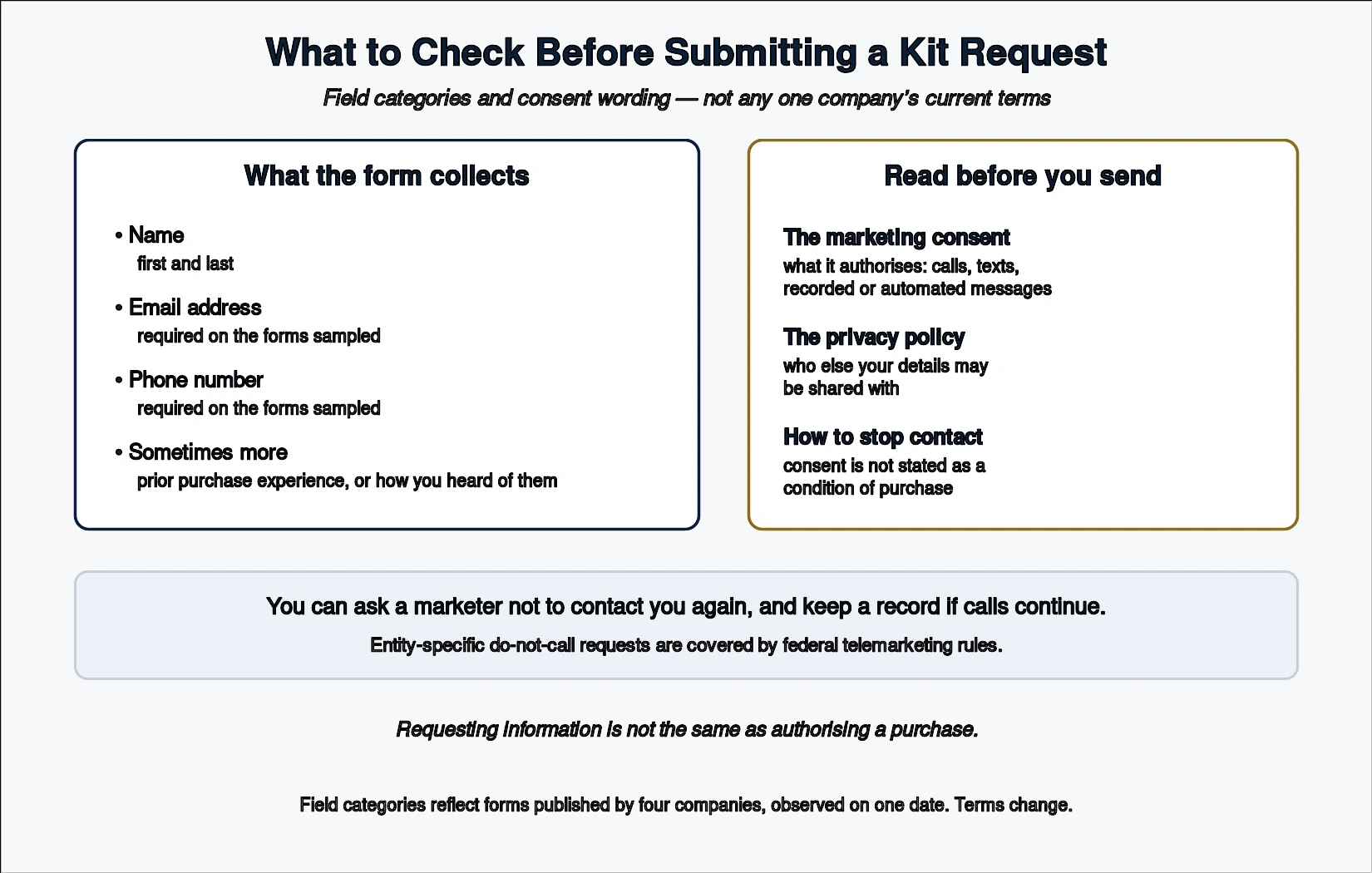
So you should expect contact. Birch's own published process places “Request Your Info Kit” before “Speak With a Specialist,” and Augusta promotes a follow-up web conference. A page can be both a genuine resource request and the opening step of a sales relationship.
What nobody can tell you is how fast or how often. We could not verify reliable, representative public data on how quickly or frequently companies contact people after a kit request.
Regulators have documented high-pressure precious-metals telephone selling — the CFTC's 2023 filing against Fisher Capital alleged deceptive telephone pitches and inflated coin prices. Those are allegations in specific cases, and they are not a description of what happens on an ordinary kit follow-up call.
A note on the person who calls. These companies' pages use titles like “specialist” and “educator.”
No hiring or compensation records were found establishing the duties or qualifications of whoever would call a particular prospect, so treat a job title as a description rather than a credential.
The conversation serves customer acquisition whatever it is called, because the thing being sold is a metals purchase or an account setup.
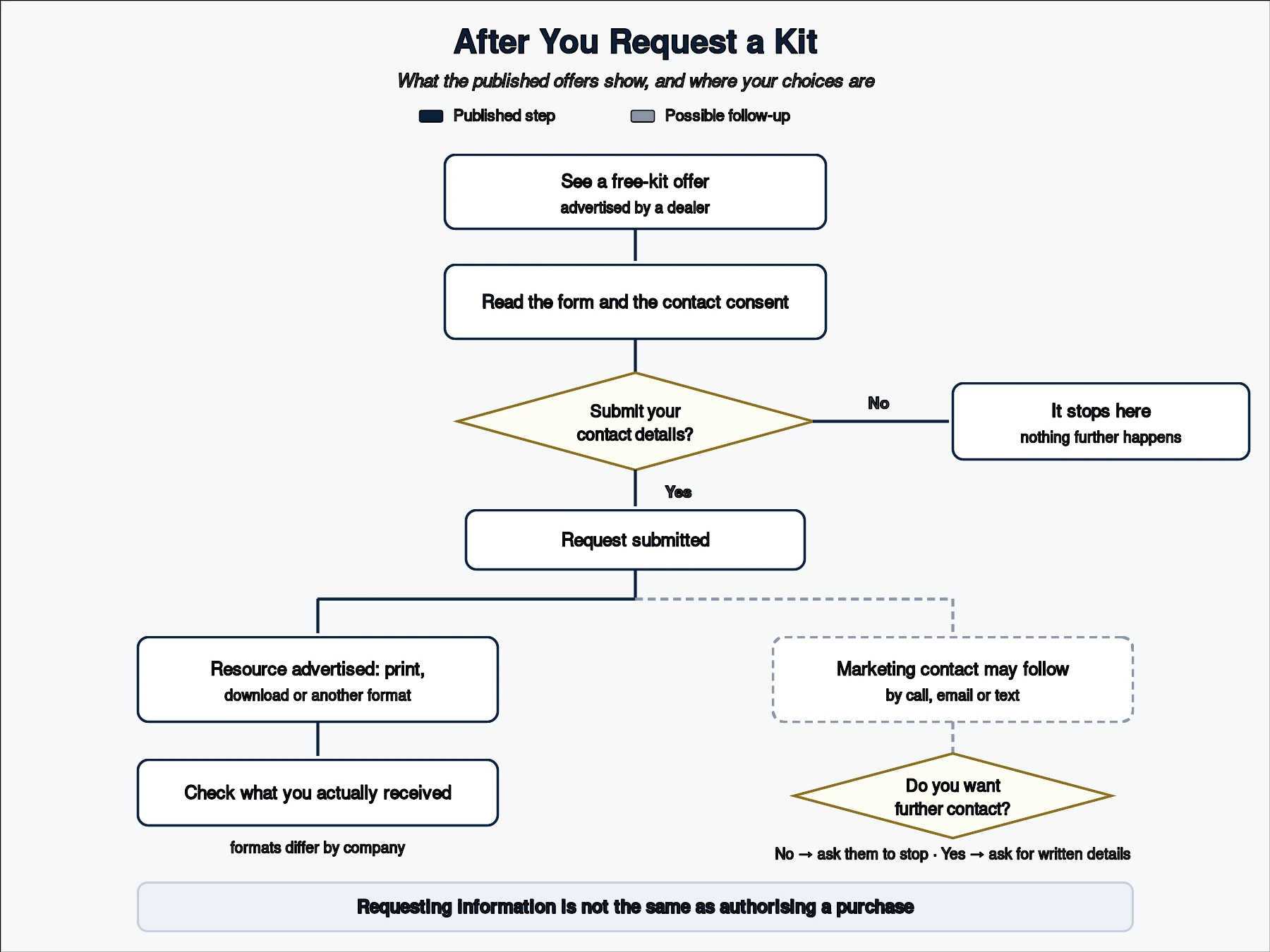
The same sequence, in words
- You see a free-kit offer advertised by a dealer.
- You read the form and the contact consent.
- You decide whether to submit your details. If you do not, it stops here and nothing further happens.
- If you do, the advertised resource follows — print, download or another format, which differs by company. Check what you actually received.
- Separately, marketing contact may follow by call, email or text. Timing and frequency are not established.
- You decide whether you want further contact. If not, ask them to stop marketing. If so, ask for written details.
- Requesting information is not the same as authorising a purchase.
Is a free gold IRA kit real, or is it a scam?
Both halves of that question have an answer, and they are different answers.
On the pages sampled, the kit carried no charge. Those offer pages advertise guides with no stated price for the guide itself, and no evidence of a hidden fee for the pack was found. Four companies' published pages were checked on one date, so that is what those offers showed rather than a statement about every kit advertised anywhere.
The lead-generation purpose is equally real. Several of those pages require a phone number, authorise marketing follow-up, and place the kit at the start of an account-sales journey. That is not a scam. It is advertising, and the meaningful question is whether the terms, the contact and the eventual offer are transparent and lawful.
Documented misconduct does exist in the wider precious-metals sales market, and it is worth knowing about without mistaking it for the whole industry.
The New York Attorney General secured a $6 million settlement with Lear Capital in January 2022 in a case alleging undisclosed commissions, which required fee disclosures and other changes for its New York business.
The FTC alleged in 2016 that a precious-metals company collected payment and often failed to deliver ordered metal.
None of that establishes anything about the kit offers described on this page. The Lear matter concerned commissions on paid transactions, and the FTC case concerned paid orders — not free guides.
So the useful formulation is this: the free guide may well be genuine, and the things to scrutinise are what you exchange to get it, the sales contact that follows, and any purchase offer made later.
Does a free kit come with free gold or free silver?
Not by implication, and this is the most commonly misread part of the whole category.
Requesting an educational kit does not qualify you for metal advertised in a neighbouring promotion. They are separate offers that happen to appear side by side.
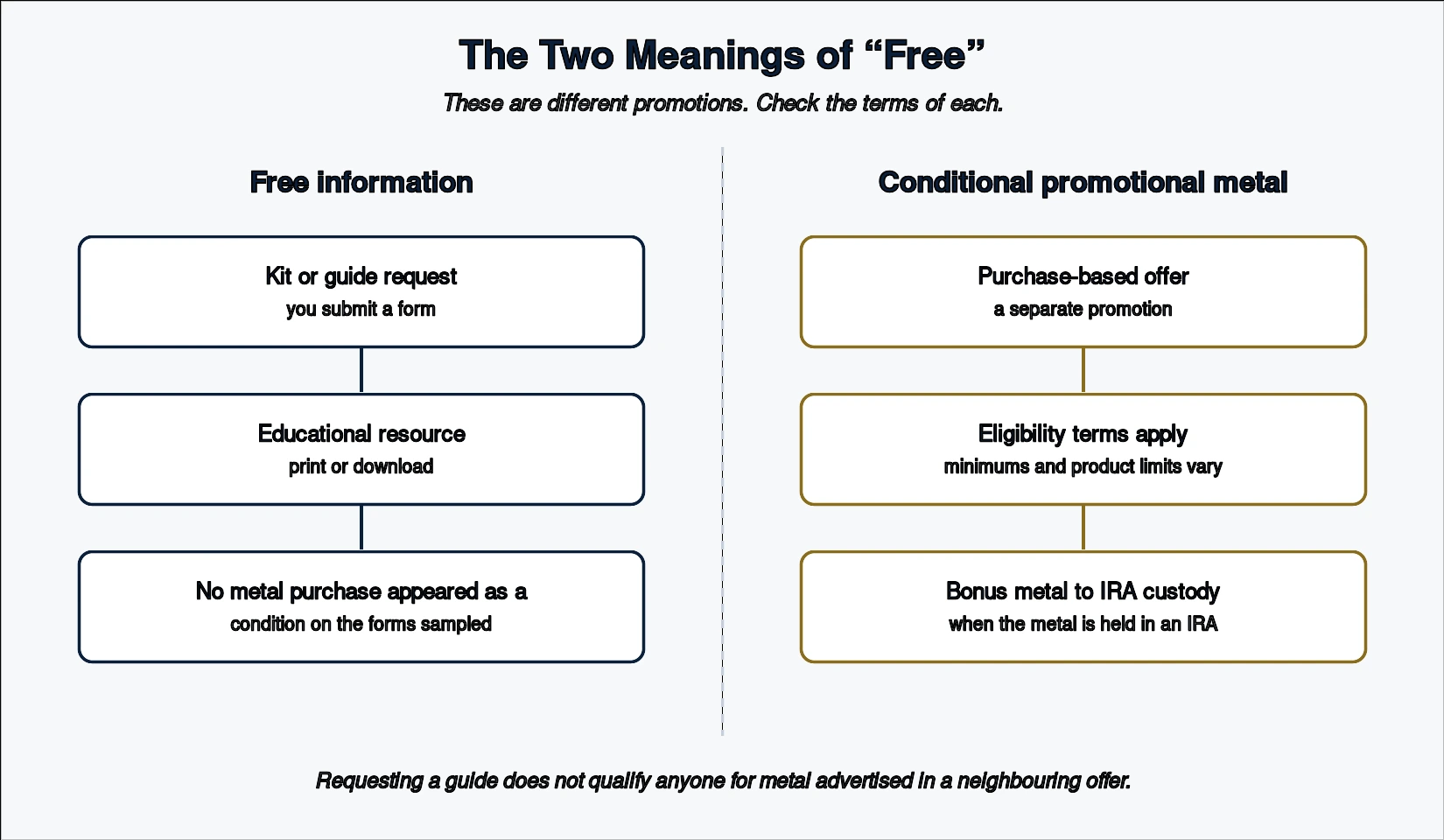
The clearest published terms found are Allegiance Gold's. Its free-metals programme requires new customers, an initial transaction, a new purchase of at least $50,000, and specified qualifying premium-coin products rather than mass-produced bullion. That is one programme's terms observed on one date, not an industry threshold, and the company reserves the right to end it.
American Hartford Gold's landing page labels its silver promotion as a limited-time offer on qualifying purchases and refers to qualified accounts. The headline figure is a marketing cap, not an amount anyone is shown to receive.
No substantiated current offer was found giving an unconditional gold bar to everyone who simply requests a kit. Conditional incentives exist. An automatic enclosure does not.
One detail with real tax consequences: the Allegiance terms send bonus metals for an IRA to the account's depository, not to the owner's home. That distinction matters, and the next section explains why.
On where the money comes from: dealers earn through the spread between the retail price and what they would pay to buy the metal back. The CFTC and FINRA jointly advise asking how a company profits when it appears to give metal away.
What cannot be calculated from public terms is whether any particular bonus is funded from spread, commission or marketing budget. That needs transaction-level evidence nobody publishes.
FTC guidance says a free item's cost should not be recovered by raising the regular price of a required purchase.
If you want the full economics of bonus-metal offers, how “free silver” promotions actually work covers them properly.
IRA metal cannot come to your house
This is short, and it is the one piece of law that genuinely bounds what any kit or promotion can promise you.
Metal held inside an IRA is held by the trustee or custodian and stored under that arrangement. It does not come to your home. In McNulty v. Commissioner, decided in November 2021, an IRA owner's personal possession of IRA-purchased American Eagle coins in a home safe, bought through an IRA-owned LLC, was treated as taxable distributions. The LLC structure did not change the outcome.
A separate, personally funded cash purchase is a different matter entirely and can be delivered to you. An advertisement should never blur the two, because the tax treatment of taking personal control of IRA metal can be expensive.
Comparing providers after reading a kit?
Augusta Precious Metals provides an education-first approach with white-glove onboarding. BBB profile available for review. Customers should verify current details directly.
Minimum investment: $50k · BBB rating: A+
Owners of this website may be paid to recommend Augusta Precious Metals. The content on this website, including any positive reviews of Augusta Precious Metals and other reviews, may not be neutral or independent.
What the kit will not tell you, and what to check yourself
A kit is a reasonable introduction to vocabulary and structure. It is not a substitute for the terms of your actual transaction.
Useful in a kit: the Birch and Noble pages say their guides address how an IRA holding metals works, which metals qualify, the roles of the parties, the stages of a transfer, and questions worth asking.
Recognise the framing: selective charts, testimonials, favourable projections and repeated invitations to speak with a specialist are marketing, not independent research. FTC guidance addresses disclosure of material connections behind endorsements.
The sampled public kit descriptions did not establish that an individualised written quote is included: a binding itemised price for specific coins or bars, and what the dealer would pay to buy those exact items back today if you changed your mind. That is an absence in what the pages promise, not proof that no dealer ever supplies one.
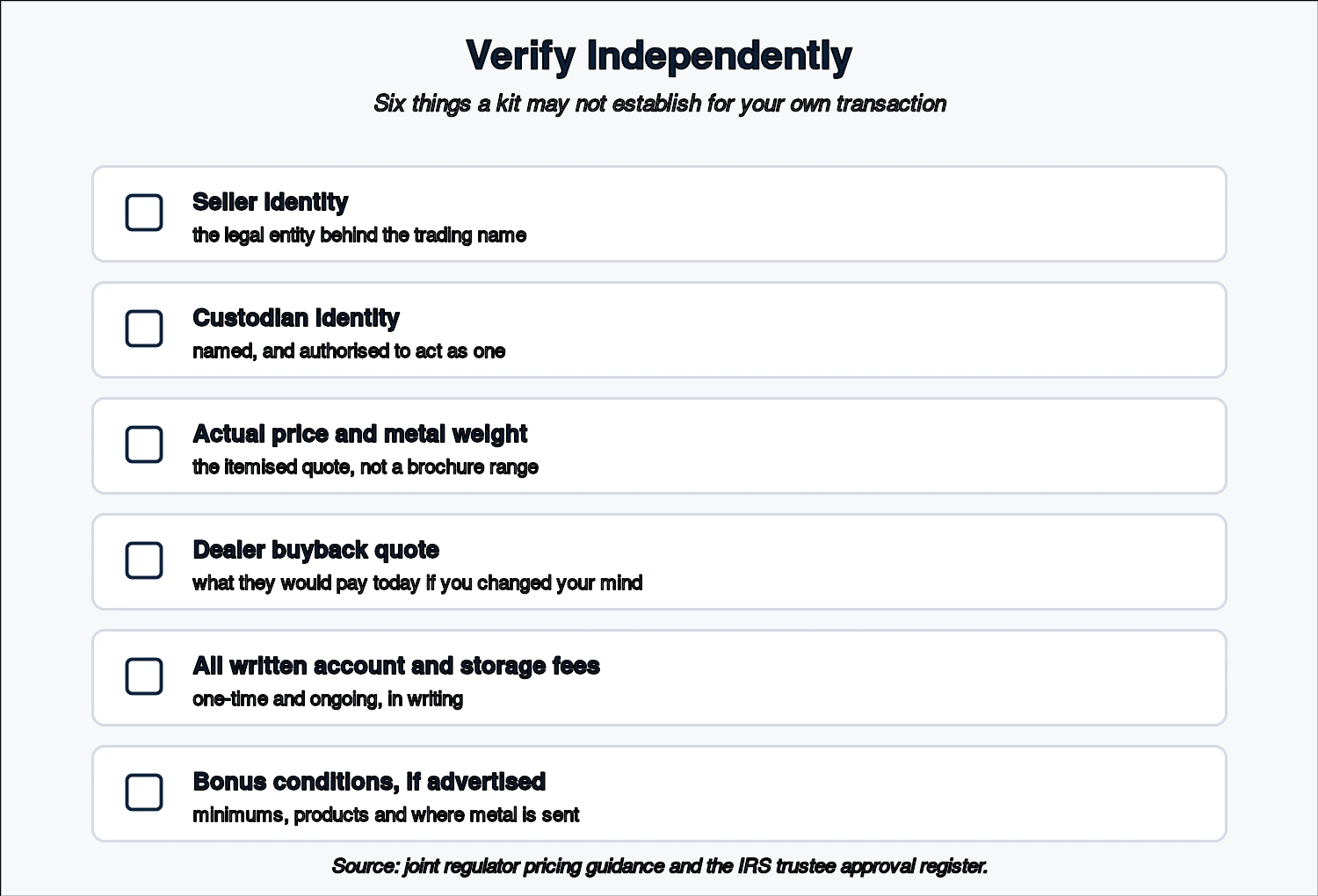
So verify these independently, before agreeing to anything:
- The legal identity of the seller, the named custodian and the storage counterparty.
- Whether the custodian is actually authorised. The IRS maintains an approval list for nonbank trustees and custodians.
- An itemised written price: metal weight and purity, the spot reference, the markup or premium, an immediate hypothetical buyback quote, and all one-time and ongoing custody and storage fees. These are the questions the joint CFTC and FINRA guidance tells buyers to ask.
- Any bonus conditions, in writing.
- The salesperson's registrations, if they are giving you advice rather than selling to you.
Two cautions on titles and labels.
The joint SEC, NASAA and FINRA investor alert explains that a self-directed IRA custodian generally holds and administers assets without evaluating the merits of the investment or the legitimacy of the promoter. A legitimate custodian does not make a metal product sound.
And a brochure's phrase “IRS-approved depository” is not IRS endorsement of that vault: the IRS approval regime covers trustees and custodians.
What protects you, and what does not
Advertising rules apply. FTC principles bar unfair and deceptive advertising, its specific guidance on “free” offers requires conditions to be clear and conspicuous, and its endorsement guidance covers undisclosed material ties behind testimonials.
Contact rules apply. The FTC's Telemarketing Sales Rule restricts abusive, misleading and unwanted calls, including calls after an entity-specific do-not-call request. A marketing-consent sentence on a form is not permission to ignore the law — though whether any individual call was lawful depends on facts the kit page cannot settle.
Who is on your side is worth being clear about. The CFTC says retail physical-metals dealers are not uniformly regulated as investment advisers, and that salespeople often are not registered advisers or fiduciaries. That does not mean nobody in this market can be — check the actual person and service rather than assuming either way.
State law may add requirements. There is no blanket federal retail-bullion dealer licence, but states can impose their own: Minnesota, for one, requires registration for bullion product dealers and representatives. Check the rules in the seller's state and your own.
If calls will not stop, ask the specific marketer not to call again, use any unsubscribe or STOP mechanism, and keep a record. The FTC's guidance covers entity-specific do-not-call requests, and the CFPB notes that fraud can be reported to the FTC, the FBI and your state attorney general.
What the kit is really selling
A gold IRA is a self-directed individual retirement account able to hold qualifying precious metals through a custodian. As the joint SEC, NASAA and FINRA investor alert explains, “self-directed” describes the permitted assets and the account administration — it is not a separate tax category.
The custodian is not the dealer. The dealer sells metal; the custodian holds and administers the account; a third-party depository stores it. That same investor alert is clear that these are distinct roles and should not be conflated.
That is as much of the mechanics as this page covers. Reading a kit is a reasonable first step, and the second step is getting your actual numbers in writing from a named party. The questions worth asking before opening an account and the published fee schedules compared side by side are both better sources for that than any brochure.
Frequently Asked Questions
Is a free gold IRA kit real or fake?
A free educational kit can be a genuine promotional resource. The offer pages reviewed show real kit and guide offers, and on those pages the form also provides the company with a sales lead. Neither fact establishes that a particular later purchase offer is trustworthy.
Do I have to buy anything to get a free gold IRA kit?
The kit forms reviewed advertise free guides with no required metal purchase to request the resource. A separate bonus-metal promotion can require a substantial qualifying purchase. Read the kit terms and the promotion terms separately.
What is inside a free gold IRA kit?
The pages reviewed describe educational material on account setup, eligible metals, funding and custody, and the formats differ: printed, audio and video guides at one company, a downloadable guide at another, and a 24-page information kit at a third. No universal pack inventory was found.
Will a company call after I request the kit?
Expect contact when a form requires a telephone number and the consent wording authorises sales communications. Company pages show contact intentions; they do not establish that every lead receives a call.
Can I get the kit without sharing my phone number?
The Goldco, Noble and Augusta forms reviewed show a phone field as part of requesting their offer. Whether another route exists at a particular company was not established, so do not assume every provider requires one.
Do free gold IRA kits come with a gold bar or free silver?
Do not assume so. A published bonus-metals programme requires a qualifying metal purchase and, for IRA customers, ships the bonus to the account depository rather than to a home.
Can I keep the gold from a gold IRA in my house?
No. IRA-owned coins are not interchangeable with personally purchased home-delivery coins. In McNulty v. Commissioner, personal control of coins bought through an IRA-owned LLC resulted in taxable distributions.
How can I stop calls after requesting a kit?
Ask the specific marketer not to call again, use any unsubscribe or STOP mechanism, and keep a record if unwanted calls continue. The FTC's Telemarketing Sales Rule guidance covers entity-specific do-not-call requests.
Sources
Company offer pages, forms and promotional terms for Goldco, Noble Gold, Birch Gold, Augusta Precious Metals, Allegiance Gold and American Hartford Gold were observed on 12 October 2026 and are cited as the companies' own published representations. Those terms change without notice.
- FTC guide concerning use of the word “free”
- FTC: complying with the Telemarketing Sales Rule
- FTC endorsement guides
- CFTC and FINRA: 10 things about physical metals
- CFTC enforcement announcement, April 2023
- SEC, NASAA and FINRA investor alert on self-directed IRAs
- IRS: approved nonbank trustees and custodians
- New York Attorney General settlement announcement, January 2022
- FTC enforcement announcement, 2016
- Minnesota Department of Commerce bullion product licensing
- CFPB: who to contact about a scam or fraud
Disclaimer: This page is educational and does not provide financial, tax, or legal advice. Company offers, promotional terms and regulatory positions change. Verify current terms directly with any provider and speak with a qualified financial or tax advisor before making retirement-account decisions.