Educational only: This guide applies a values/stewardship lens to Gold IRA investing. It does not claim that Scripture endorses gold or any company, and it does not present metals as spiritually superior to other assets. It summarizes Investor.gov, SEC, FINRA, CFTC, and faith-finance educational sources in general terms. Customers should speak to a financial or tax advisor before making decisions. Goldco does not offer tax or legal advice. Past performance does not guarantee future results.
Quick Answer: What Faith-Based Gold IRA Investing Means
Faith-based or values-based investing means building portfolios that reflect spiritual and moral convictions while still aiming for appropriate financial outcomes. In this context, christian gold ira investing refers to applying Christian principles of stewardship, caution, and honesty when considering a self-directed IRA that can hold gold and other precious metals that meet the standards in IRC §408(m)(3) as one asset among many. Faith-based investing is generally described as a subset of values-based or socially responsible investing, where investors screen in or screen out companies or asset types that align — or conflict — with their beliefs. Christian retirement planning often adds themes of stewardship, generosity, and long-term planning, but does not prescribe any single asset class, including gold, as a universal answer.
Stewardship Principles Applied to Retirement Saving
Many Christian stewardship resources teach that God is the ultimate owner of all resources and that believers serve as stewards who manage money, time, and talents responsibly. Stewardship frameworks usually stress integrity, planning, living within one's means, and generosity as core financial habits. Focus on the Family describes "kingdom stewardship" as overseeing and expanding the assets God has entrusted while paying close attention to the condition of those assets, including through budgeting and debt reduction. These principles encourage retirement saving that is intentional, transparent, and aligned with values, rather than driven by fear or speculation.
Applied to retirement accounts, stewardship usually means planning ahead with realistic income and expense estimates, reducing unnecessary debt that can erode retirement security, and setting long-term goals that include giving, family needs, and basic living costs. A Gold IRA, if used, fits inside this bigger picture as one tool that may support long-term diversification, not as a separate spiritual project.
Diversification as Prudent Planning, Not Fear
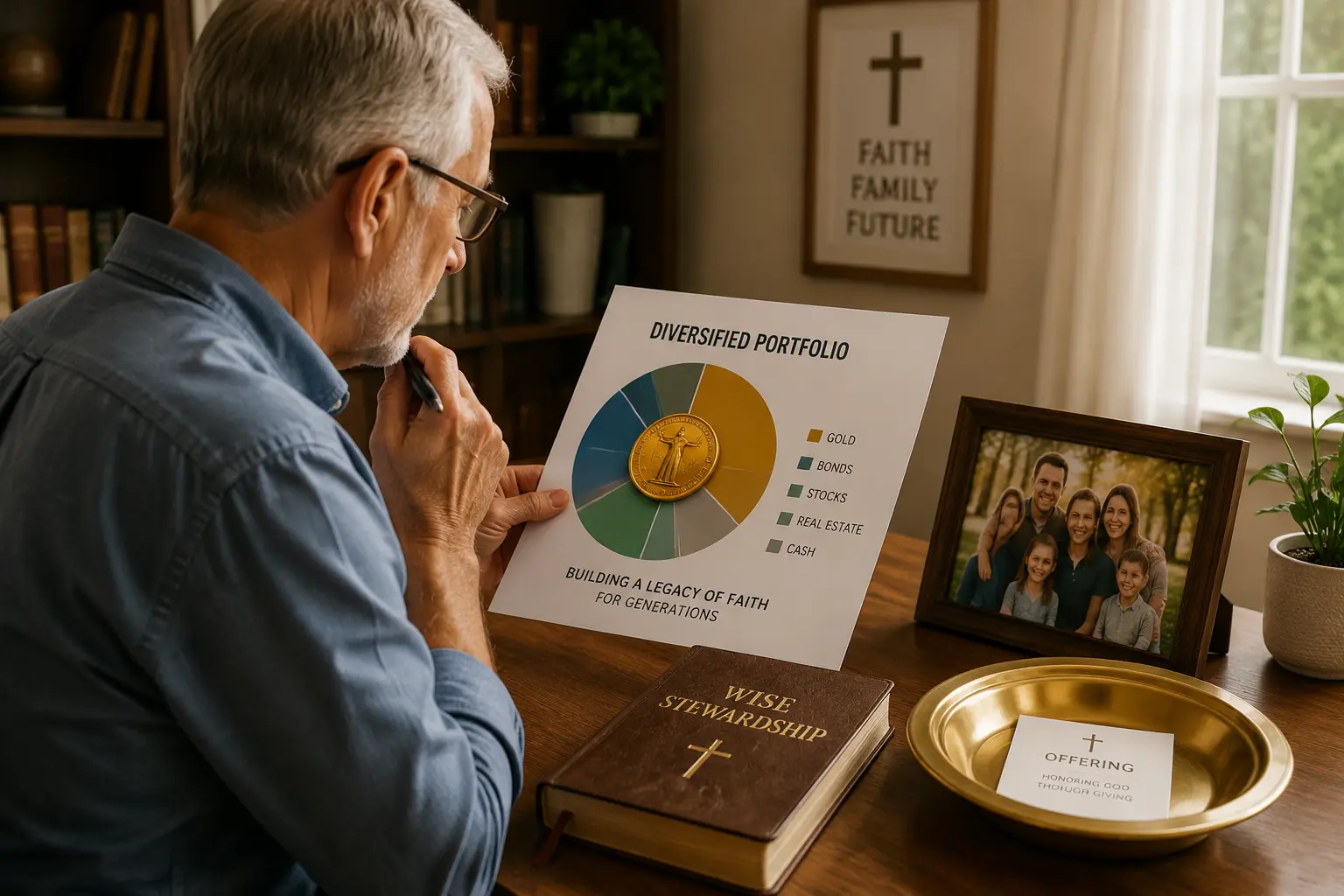
Mainstream investing guidance often treats diversification as a core risk-management practice: spreading assets across different sectors and instruments so that one category does not determine outcomes alone (Britannica Money). Precious metals are commonly evaluated as one diversifying asset class because gold and similar metals can behave differently from stocks and bonds over time (abrdn). Research from asset managers notes that precious metals tend to show low correlation with both equities and fixed income and may help mitigate portfolio drawdowns during certain market-stress events.
Importantly, diversification is a planning concept, not a fear tactic. Stewardship-oriented discussions emphasize avoiding concentration in a single asset — whether stocks, cash, or gold — remembering that every asset class carries some level of risk, including price swings and liquidity limits (Investor.gov), and evaluating whether the mix of assets still supports long-term retirement and generosity goals. When precious metals are considered, they should be weighed against other options such as broad stock funds, bonds, and values-based equity strategies instead of being framed as the only "safe" choice. Past performance does not guarantee future results.
Gold and Silver in the Bible: Context, Not Command
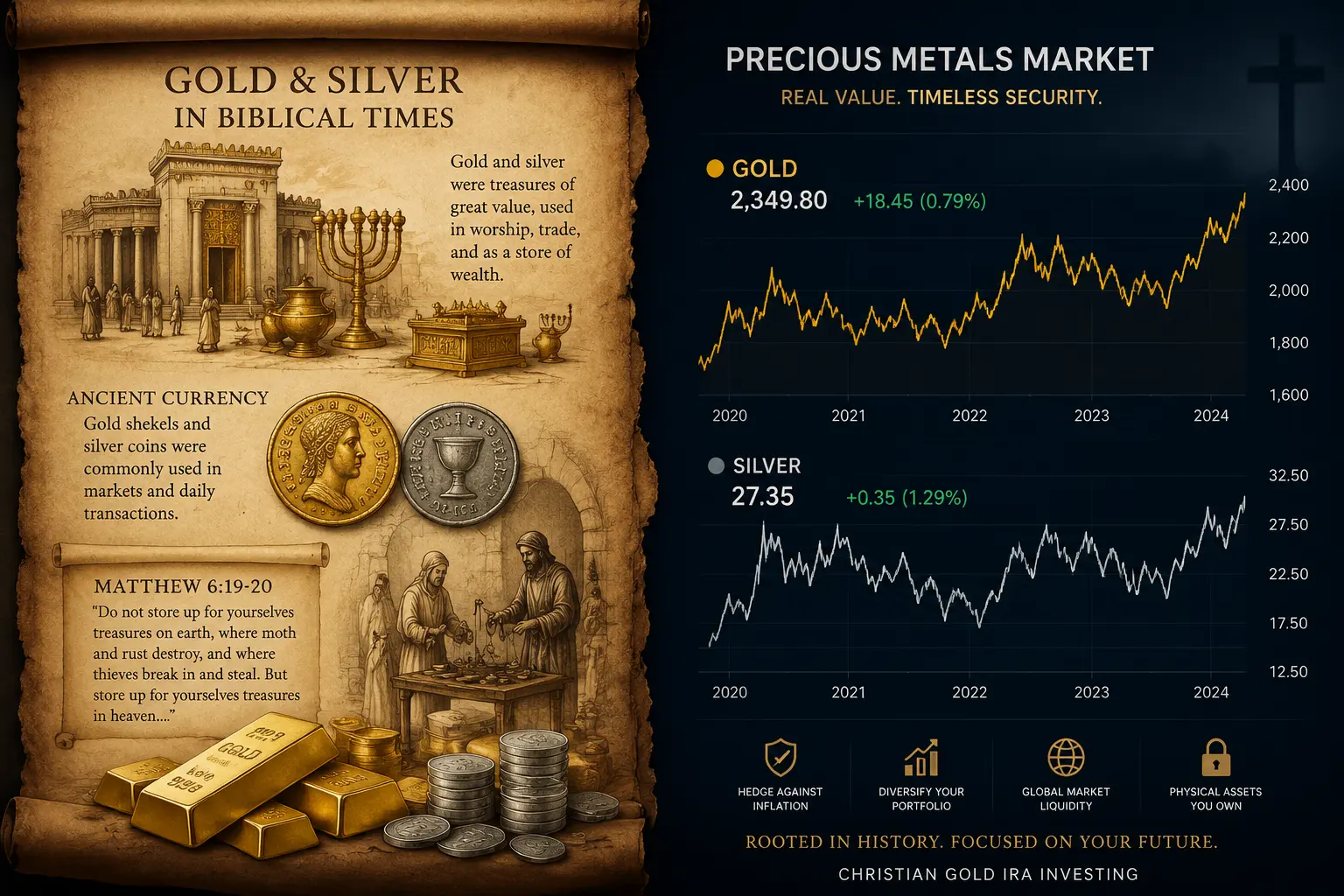
Gold and silver appear hundreds of times in Scripture, usually in contexts of wealth, trade, craftsmanship, and worship, rather than as investment advice. For example, Abraham purchases land with weighed silver, and tabernacle and temple furnishings use gold and silver as materials of beauty and value. In many ancient economies, monetary units such as shekels and talents referred to weights of precious metals, so "money" often meant gold or silver by default. These metals symbolized enduring value and were widely used in trade, tribute, and religious offerings.
Faith-based financial teachers generally caution against treating these references as direct commands to buy metals in modern retirement accounts. Instead, biblical themes around wealth usually stress contentment and gratitude rather than anxiety-driven accumulation, honesty and fairness in business dealings, and generosity toward those in need and support of ministry work. In a Gold IRA discussion, this means metals should be evaluated as one modern asset class, not as a spiritual shortcut or prophetic guarantee.
Where Precious Metals May Fit a Values-Based Portfolio
Values-based investing guides suggest that many investors start with broad asset categories — equities, bonds, cash — and then add screened funds or individual securities that match their beliefs. Faith-based investing organizations describe their work as aligning investors' resources with biblical values while still pursuing competitive long-term performance (GuideStone; Envoy Financial). Within this framework, precious metals can play several possible roles: as a modest hedge against inflation or currency weakness; as a diversifier that may reduce overall volatility when combined with stocks and bonds; or as a physical asset that some investors find reassuring when held through regulated custodial structures.
Educational content on long-term precious-metals strategies often suggests treating metals as supporting assets rather than core holdings, with representative allocations that depend on risk tolerance and objectives rather than any fixed rule. This approach does not claim that Scripture endorses gold IRAs, nor that precious metals are spiritually superior to other assets — it treats metals as one potential tool that must pass the same stewardship, regulatory, and ethical tests as other investments. Internal tools like a Gold IRA calculator and the guide on how much gold to own in retirement can support allocation conversations but do not replace professional advice. Customers should speak to a financial or tax advisor before making decisions about allocations, rollovers, or changing IRA asset mixes. Goldco does not offer tax or legal advice.
Regulatory Basics: How Gold IRAs Work
The IRS generally treats metals and coins as collectibles inside an IRA, with limited exceptions for certain coins and for gold, silver, platinum, or palladium bullion that meet specific fineness requirements and are held in the physical possession of a bank or an IRS-approved nonbank trustee (IRS: Investments in Collectibles in Individually Directed Accounts). These rules distinguish investment-grade bullion from numismatic or collectible items that carry extra premiums, and they require that metals be stored by a qualified custodian or approved depository rather than kept at home or in a personal safe-deposit box.
Key implications include: metals must meet IRS purity rules and be held by an approved custodian and depository; taking personal possession is generally treated as a distribution and may trigger taxes or penalties depending on age and account type; and the Gold IRA structure does not change the underlying risk profile of metals, so price volatility and liquidity considerations remain. Any discussion of rollovers, distributions, or storage choices involves tax and legal considerations. Customers should speak to a financial or tax advisor before making decisions, and Goldco does not offer tax or legal advice.
Balancing Conviction With Sound Due Diligence
Aligning portfolios with convictions does not remove the need for thorough research and a clear understanding of risks. SEC and Investor.gov resources repeatedly urge investors to investigate both the person offering an investment and the investment itself, even when recommendations come from trusted communities or leaders. Investor.gov explains that affinity fraud — scams targeting identifiable groups such as religious communities — often relies on social trust and group identity to lower skepticism, which makes independent verification essential (Investor.gov: Affinity Fraud). Enforcement bulletins highlight warning signs, including promises of unusually high returns with minimal explanation and pressure to keep details "inside the group" (SEC: Affinity Fraud).
For faith-driven retirement planning that includes precious metals, due diligence usually means confirming that custodians and dealers follow regulatory standards and clear storage rules, reading account agreements, fee schedules, and risk disclosures in plain language, and comparing gold and other metals with alternative values-based options such as screened mutual funds or bond portfolios. Convictions can set boundaries for what is acceptable, but they do not replace careful analysis, diversification, and realistic expectations.
Choosing a Faith-Based Provider Carefully
Faith-based retirement and advisory firms often describe their role as helping investors connect their values to their financial strategies through education and screening, not guaranteeing specific outcomes (Envoy Financial). Reputable providers tend to emphasize stewardship tools, budgeting, and long-term planning as much as they emphasize any particular investment product. Regulators advise investors to verify the registration and background of any professional offering investments, including self-directed IRAs or precious-metals programs. FINRA explains that BrokerCheck can be used to see whether individuals are registered and whether any disciplinary history exists (FINRA: Affinity Fraud).
When selecting a Christian or values-oriented Gold IRA-related provider, prudent steps include checking registration and licensing status through Investor.gov and FINRA BrokerCheck; asking how faith commitments are reflected in business practices, such as transparency, fee structures, and conflict-of-interest policies; and comparing any claimed "faith-based" benefits to independent educational materials rather than marketing slogans alone. Internal guides such as questions to ask before opening a Gold IRA and the list of Christian precious metals companies can support structured conversations, though they should be used alongside official regulator databases.
Avoiding Fear-Based or High-Pressure Faith Marketing
SEC and state securities regulators warn that affinity fraud often uses group identity — such as shared religion — to lower resistance to high-pressure or emotional pitches. Investor.gov urges investors not to rely solely on recommendations from within those groups. Legal and investor-protection resources describe common red flags: emphasis on community or faith loyalty instead of detailed explanations of risks and fees; promises of unusually high or steady returns with little discussion of the investment process; and pressure to move retirement funds quickly, sometimes framed as "missing a blessing" or "not trusting the community."
CFTC advisories note that precious-metals scams can also use complex language, misleading claims about storage, or vague references to regulatory approval, and encourage investors to rely on official fraud advisories when evaluating metals pitches (CFTC). Faith-based retirement planning that includes metals should therefore avoid narratives that tie spiritual faith directly to purchasing a specific product, marketing that predicts extreme economic ruin or portrays one asset as the only way to be protected, and messages that discourage seeking outside professional or legal advice. Customers should speak to a financial or tax advisor before making decisions, and Goldco does not offer tax or legal advice.
Questions to Bring to an Advisor and Provider
Because Gold IRAs intersect with tax law, retirement regulations, and market risk, regulators and stewardship teachers both recommend seeking competent, independent advice. Faith-focused investing resources likewise urge investors to ask how investments might better align with values in conversation with advisors rather than acting alone (FaithFi). Helpful questions for an advisor might include:
- How does a Gold IRA compare to other values-based retirement options in terms of volatility, fees, and liquidity?
- What percentage of retirement assets in metals would still allow for adequate growth and income planning over time?
- How do IRS rules about storage, distributions, and rollovers affect personal tax planning?
Questions for potential Gold IRA custodians or dealers could include which metals that qualify under IRC §408(m) and products are offered and how purity and eligibility are verified; how storage works, which depositories are used, and how insurance and reporting are handled; and what total costs — including markups, custodial fees, and storage fees — apply over a typical year. Resources such as questions to ask before opening a Gold IRA, the Gold IRA calculator, and the retirement quiz can support these conversations, but they are not substitutes for professional advice.
Frequently Asked Questions
What is a Christian Gold IRA?
A Christian Gold IRA is generally a self-directed individual retirement account that holds precious metals that qualify under IRC §408(m) while being managed with Christian stewardship and values-based investing principles. It is not a separate legal category under IRS rules but rather a way some investors apply faith-informed decision making to an existing Gold IRA structure.
Does the Bible recommend gold or silver investing for retirement?
Biblical references to gold and silver focus on their roles as money, trade goods, and materials for worship, not as explicit retirement instructions. Christian financial teachers usually highlight themes of stewardship, contentment, and generosity over specific asset choices, leaving metals as an optional modern investment rather than a command.
How much gold should a Christian hold in retirement?
Investor education on precious metals often frames gold as a supporting asset, with illustrative allocation ranges that depend on goals and risk tolerance. Any Christian retirement plan should consider broader financial needs, giving goals, and income planning, and customers should speak to a financial or tax advisor before making decisions.
Are faith-based Gold IRAs safer than other investments?
Regulators emphasize that no legitimate investment is completely free from risk and that risk and return tend to move together. A faith-based Gold IRA may align better with personal convictions, but it still carries price, liquidity, and regulatory risks similar to other precious metal investments, and safety depends on diversification, time horizon, and provider quality rather than faith branding alone.
What is religious affinity fraud in investing?
Investor.gov defines affinity fraud as scams that prey upon identifiable groups such as religious communities by using shared identity to build trust before promoting unsuitable or fake investments. SEC bulletins warn investors to verify registration, avoid pressure, and seek independent information even when offers come from respected spiritual or community leaders.
Conclusion
Christian gold IRA investing works best when gold is treated as one small part of a much larger, values-aligned retirement plan. Stewardship principles — planning, honesty, contentment, and generosity — apply to every asset, and diversification is a prudence concept, not a fear tactic. Scripture references gold and silver as money and materials of worship, not as a modern investment command. Metals may serve as a modest diversifier, but they must pass the same regulatory, cost, and due-diligence tests as any other investment, and faith should never be used to pressure a quick decision. Customers should speak to a financial or tax advisor before making decisions involving allocation, rollovers, or account changes. Goldco does not offer tax or legal advice. Past performance does not guarantee future results.
Sources
- Investor.gov (SEC). Affinity Fraud.
- Investor.gov (SEC). Introduction to Investing.
- U.S. Securities and Exchange Commission. Affinity Fraud: How to Avoid Investment Scams That Target Groups.
- FINRA. Affinity Fraud.
- Commodity Futures Trading Commission. Precious-Metals Fraud Advisory (Press Release).
- Internal Revenue Service. Investments in Collectibles in Individually Directed Qualified Plan Accounts.
- Britannica Money. Values / Faith-Based Investing.
- GuideStone. What Is Faith-Based Investing?
- Envoy Financial. What Is Faith-Based Investing?
- Envoy Financial. Faith-Based Retirement Plan.
- Focus on the Family. Kingdom Stewardship: God's Plan for Money.
- FaithFi. What Is Faith-Based Investing?
- abrdn. Precious Metals: A Place in the Portfolio.
Article reviewed and edited by Daniel M. — editor, 401kToGoldIRA.org. Sourced to Investor.gov, the SEC, FINRA, the CFTC, the IRS, and faith-finance educational organizations; educational only, not an endorsement, and not tax, legal, or investment advice.
Further Reading
 Christian Precious Metals CompaniesHow to evaluate faith-marketed metals dealers on verifiable factors.
 How Much Gold Should Investors Own in Retirement?A framework for matching allocation to goals, liquidity, and risk.
 21 Questions to Ask Before Opening a Gold IRADue-diligence questions for any provider conversation.