Affiliate disclosure: The publisher may receive compensation from precious-metals companies, including this one. That compensation does not change what the BBB record shows, what the company publishes, or what the searches returned.
Affiliate Disclosure: This article may contain affiliate links, which means the publisher may receive compensation from qualifying actions, at no additional cost to the reader. Affiliate relationships do not alter the sourcing standard used in this analysis.
Birch Gold Group presents an unusually useful case for understanding what a long Better Business Bureau record actually means.
The current BBB profile gives Birch Gold Group an A+ rating and lists the business as BBB Accredited Since July 22, 2013. That is a substantial accreditation history. Yet the conclusion commonly drawn from those facts is broader than the evidence supports. BBB itself says its rating represents its opinion of how a business is likely to interact with customers. It does not say that the rating measures whether a precious-metals buyer received a competitive price, whether a particular coin carried a narrow premium over spot, whether a later buyback quote preserved that premium, or whether the product selected was suitable for the buyer's circumstances.
There is an additional complication that matters greatly in Birch Gold Group's case: the visible complaint record is not thirteen years long. BBB Business Profiles generally operate on a three-year reporting period. Complaints age out. The current profile therefore preserves a long accreditation date while simultaneously exposing only a moving slice of recent complaint history. A retirement saver researching the company cannot reconstruct thirteen years of complaints simply by reading today's BBB page.
That distinction is the spine of this analysis.
A long A+ BBB record answers a meaningful but limited question about the company's current standing within BBB's system and its handling of complaints that remain reportable. It leaves unanswered the transaction-level questions that can dominate the economics of a precious-metals IRA: the actual metal price, premium over spot, embedded dealer margin, contemporaneous repurchase price, custodian charges, storage terms and ultimate round-trip break-even point.
All company pages, BBB figures and live database results described as current below were observed on August 20, 2026, unless another date is explicitly identified as part of the source record.
What does this article examine?
- What Birch Gold Group's long BBB accreditation record actually establishes.
- Why today's complaint count cannot reconstruct a decade of complaint history.
- What recurring issues appear in the complaint narratives that remain visible.
- What Birch Gold Group currently publishes about its business, minimums, storage and buyback process.
- Whether the company publishes a complete fee schedule.
- How custodian, depository and dealer costs differ.
- Why the dealer's embedded pricing component matters even when visible IRA fees appear modest.
- How entry premiums and exit spreads determine round-trip break-even.
- What federal, state and court-record searches returned.
- What CFTC, FINRA and NASAA guidance says should be documented before money moves.
- Which economically important figures remain publicly unverifiable.
- The exact documents that can close those information gaps.
What does Birch Gold Group's A+ BBB record actually establish?
What does the current BBB profile say?
The BBB business profile observed on August 20, 2026 displayed an A+ rating, BBB accreditation, an accreditation date of July 22, 2013, and 15 years in business. BBB lists the current address as 309 Court Avenue, Suite 809, Des Moines, Iowa. It describes the company as providing precious-metals services involving gold, silver, platinum and palladium IRAs and storage through various depositories.
The same profile creates an important corporate-history distinction. It lists Business Started: January 26, 2011, but Business Incorporated: June 5, 2023, and identifies the current entity type as a corporation. Birch Gold Group's own privacy policy similarly says the current business is a corporation established under Iowa law and gives the same Des Moines address.
That evidence supports a long operating history and a current Iowa corporation. It does not explain, within the permitted source set, the precise legal continuity between the business operating before the current incorporation date and the present corporation. Neither the current BBB profile nor the Birch pages reviewed provides a public predecessor-successor chart, complete ownership structure, list of all affiliates or explanation reconciling the 2013 BBB accreditation date with the 2023 incorporation date.
Likewise, “BBB Accredited Since July 22, 2013” is the wording presently displayed by BBB. The profile does not separately provide a historical accreditation-status ledger showing whether any temporary lapse ever occurred. It is therefore safer to describe the record exactly as BBB does rather than independently characterize it as proven uninterrupted accreditation.
What does BBB say its rating means?
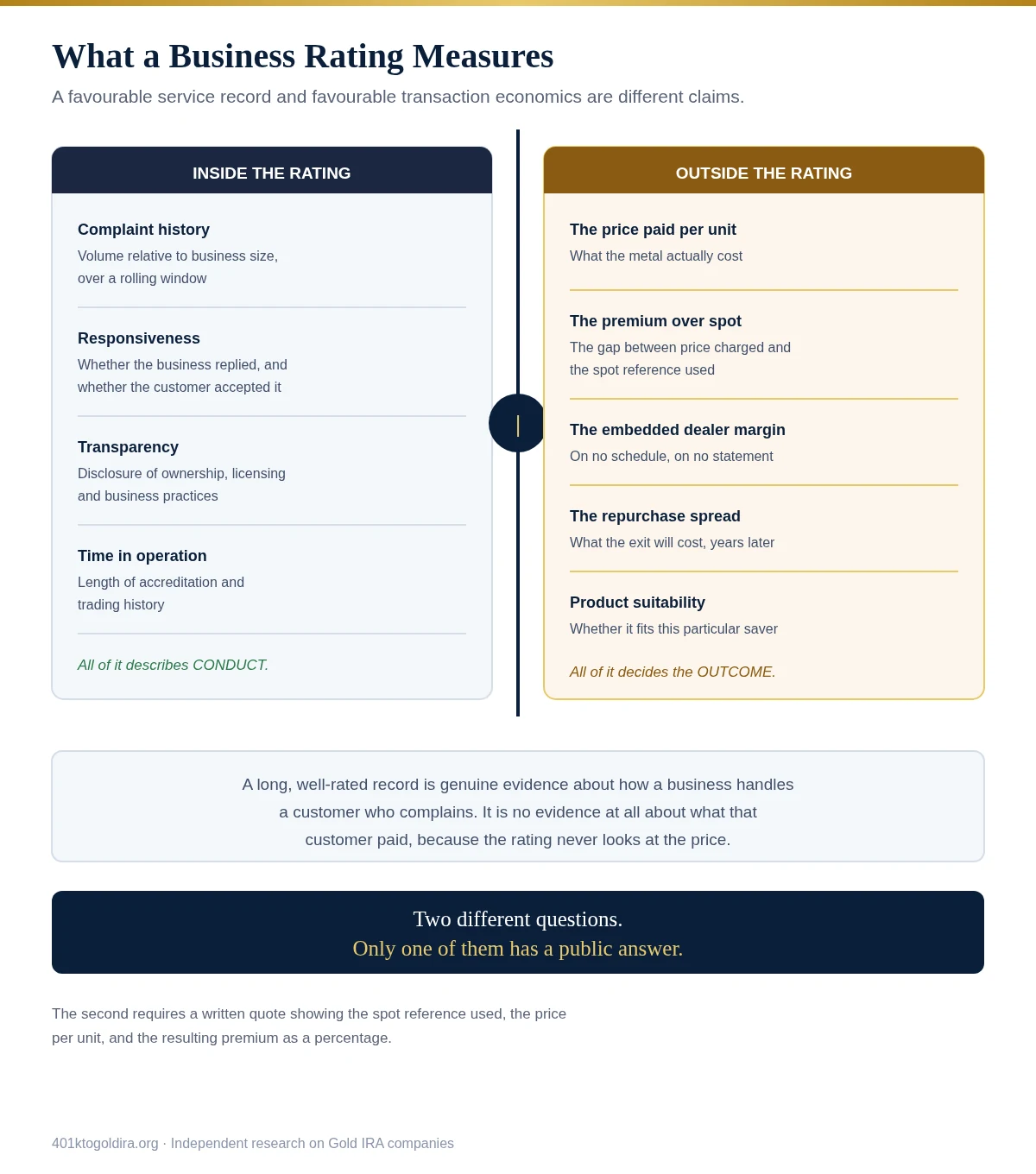
BBB's own methodology is narrower than many interpretations of an A+ grade. It says:
“BBB ratings represent the BBB's opinion of how the business is likely to interact with its customers.”
BBB says the rating uses information it can obtain from the business, public data sources and complaints. It also explicitly says customer reviews are not included in calculating the letter grade and that ratings are not a guarantee of reliability or performance.
BBB's current Birch Gold profile presents accreditation as a commitment to the BBB Standards for Trust. The organisation's explanatory material emphasizes customer complaints, transparency and responsiveness as information relevant to the rating.
That makes the A+ relevant to a particular question: how does the business presently perform within BBB's complaint-handling and business-profile framework?
It does not answer several different questions:
- what price was charged for a particular ounce or coin;
- what portion of that price represented premium over contemporaneous spot;
- what Birch's acquisition cost was;
- what dealer margin was embedded in the quote;
- what a salesperson earned from that transaction;
- what the same product could immediately be resold for;
- whether a specialty coin's initial premium would persist at liquidation;
- whether a particular product allocation was suitable for the buyer; or
- whether the transaction's tax and retirement-account consequences matched the buyer's circumstances.
None of those variables appears in BBB's stated definition of its rating.
Why does Birch Gold Group's complaint count decay over time?
What does BBB's three-year window change?
BBB's complaint page reports two separate rolling totals: complaints in the preceding three years, and complaints closed in the preceding 12 months. Both move as records enter and leave their windows, which is why this article does not republish either figure. The current totals, their division into Resolved and Answered status, and BBB's breakdown by issue type should be read from the live BBB complaints page, which is the only place they are current.
Those are not lifetime totals.
BBB states that Business Profiles generally cover a three-year reporting period. As an older complaint crosses the reporting boundary, it can disappear from the displayed total even when no new complaint has been resolved or withdrawn. A count can therefore fall simply because time passes.
This has an important consequence for historical articles, and it is the reason no count appears above. A sentence claiming that Birch Gold Group “has n complaints” without an observation date is incomplete. Several months later the same page may show a different number even if both observations were accurate when made. Without the date and the underlying BBB page, an isolated complaint count becomes effectively unverifiable, which is exactly the defect a republished figure would reproduce here.
The same limitation prevents today's BBB record from serving as a thirteen-year complaint archive. The long accreditation date survives on the profile; older complaint narratives generally do not.
What do “Resolved” and “Answered” mean?
BBB distinguishes the two statuses. “Resolved” indicates that the complainant verified satisfaction with the resolution. “Answered” means the business addressed the complaint but the consumer either did not accept the response or did not tell BBB that the response was satisfactory. The live complaints page shows how the current window divides between the two, and that split moves with the window like the total itself.
That is useful evidence about recent complaint handling. It does not convert the underlying factual allegations into findings for or against either party.
BBB itself warns that displayed complaint text may not represent every complaint filed. Some consumers decline publication, some submissions do not meet publication standards, and BBB may display only a portion in high-volume cases.
What do the recent Birch Gold Group complaint narratives actually say?
The narratives are more informative than the raw count because they reveal the kinds of disagreements reaching BBB. They must nevertheless be read as allegations and responses, not adjudicated facts.
What recurring themes appear?
Several accessible complaints concern pricing clarity and specialty-product economics. Customers alleged that products such as Australian Florins or other nonstandard coin selections had been acquired at premiums they later believed were too high relative to metal value or subsequent buyback offers. Birch disputed material parts of those allegations and, in several responses, pointed to written transaction documents and recorded confirmations as evidence that pricing had been disclosed before finalization.
A second cluster concerns the difference between purchase price, custodian-statement valuation and later liquidation value. That distinction matters because a custodian statement may use spot or melt-based valuation while a dealer quote may reflect a separate market or repurchase value. Complaint narratives show customers disputing those gaps and Birch responding with its own explanation of market valuation and signed pricing disclosures.
A third theme is liquidation process and communication. One answered complaint alleged that a requested liquidation was delayed while metal prices moved and disputed whether an earlier quotation had been locked. Another resolved complaint alleged difficulty obtaining a response to a request to liquidate silver. Birch disputed aspects of the first and said call records showed attempted contact in the second.
The most significant narrative for verification purposes is a resolved complaint in which Birch acknowledged that it had fallen short in explaining the buyback value of a particular fractional coin and said an employee had supplied an outdated estimate rather than a current buyback quotation. That response does not establish a company-wide pricing practice. It does demonstrate why a same-time written repurchase quotation is more reliable evidence than a generalized oral description of future value.
The narratives also reveal a recurring evidentiary divide: customers sometimes describe what they remember being told, while Birch frequently refers to a signed Transaction Agreement or recorded confirmation. Searches of Birch Gold Group's public website during this review did not locate a current publicly posted copy of that transaction agreement. The paperwork Birch cites when answering complaints therefore appears materially important but is not available to a prospective customer through the public pages located in this research.
That gap makes the agreement itself one of the most important documents to obtain before, rather than after, a transaction.
What does Birch Gold Group publish about itself before contact?
What services and minimums are published?
Birch Gold Group's FAQ observed on August 20, 2026 states that it is a U.S. physical-precious-metals dealer operating since 2011. Its IRA pages describe assistance with self-directed precious-metals IRAs involving gold, silver, platinum and palladium as well as direct-delivery purchases. BBB independently categorizes the company as a precious-metals dealer offering those product categories.
The company currently publishes a $5,000 minimum, but the wording deserves precision. Its FAQ says:
“Birch Gold Group currently requires a minimum investment of $5,000”
and immediately qualifies the figure by saying it can vary with market conditions and product availability. The same FAQ says the minimum applies to direct-delivery purchases as well as Precious Metals IRAs.
The main Precious Metals IRA page similarly recommends starting with at least $5,000, and the Gold IRA page says $5,000 is generally needed to begin. These are first-party current statements, not independent guarantees that every transaction will be accepted at that threshold.
What does the company publish about storage?
Birch Gold Group says the IRA custodian and precious-metals depository are separate providers selected by the customer, with Birch able to make recommendations. The company's current IRA material names Equity Trust Company and GoldStar Trust Company as custodians it frequently works with and lists several storage facilities, including Delaware Depository, Brink's and International Depository Services.
Those statements should not be converted into the phrase “IRS-approved depository.” The tax rules address two different legal questions. Trustee or custodian qualification is governed through IRC §408 and, for nonbank entities, Treasury Regulation §1.408-2(e). Metals themselves must satisfy the exceptions in IRC §408(m)(3), including the applicable bullion standards and possession requirement.
Birch's storage pages discuss allocated or commingled storage and segregated storage, depending on facility. The company also publishes claims concerning insurance and facility security. Because those pages are Birch's own descriptions of third-party storage providers, those claims establish only what Birch publishes, not independent verification of the depositories' current insurance contracts or operating practices.
What does Birch publish about buybacks?
The Gold IRA page says a Precious Metals Specialist can provide an “up-to-date buyback quote” and portrays that quote as more useful for liquidation purposes than a custodian statement.
Another Birch page states that the company asks for a right of first refusal when customers sell metals originally purchased through Birch. That is buyback language, but it is not a publicly posted formula guaranteeing repurchase at a particular percentage of spot, preserving an original premium, or guaranteeing that Birch will always be the highest bidder.
The company's risk disclosure further says precious-metal values fluctuate, redemption may produce more or less than original cost, and Birch does not guarantee a profit. It also says Birch does not provide investment advice and that assistance does not create a fiduciary relationship.
What is not publicly established?
The accessible company pages did not provide a complete public ownership chart, a full list of present affiliates, a publicly retrievable customer Transaction Agreement, a SKU-level live price list, a standing premium-over-spot table, a salesperson commission schedule, a guaranteed buyback formula or a complete schedule covering every custodian and depository combination.
Those absences matter because they concern the documents and numbers most capable of distinguishing the cost of the IRA wrapper from the cost of the metals transaction itself.
Does Birch Gold Group publish a complete fee schedule?
What does the company say about fixed fees?
Birch's FAQ states:
“There is no single, fixed fee structure because every customer’s purchase is customized.”
For direct-delivery purchases, the company says the quoted purchase price already incorporates sourcing, fabrication, shipping and insurance and that there are no additional Birch charges beyond that quote. For IRA transactions, it says the independently selected custodian and depository charge separate fees.
The company's Prices & Fees page makes the same structural distinction and expressly says:
“we do not quote product prices online.”
It says current physical-metal pricing is determined when an order is finalized and that an itemized quote is supplied before confirmation.
Is there at least an example IRA schedule?
Yes, but it should not be presented as a universal Birch fee schedule.
The main Precious Metals IRA page currently gives an example for a custodian/depository arrangement commonly used by Birch customers: a $50 account-setup charge, $30 wire charge, $110 annual storage/insurance charge and $125 annual management charge. It describes the resulting recurring amount as $235 and says the arrangement uses a flat annual charge rather than a percentage of account assets.
The Prices & Fees page similarly describes roughly $110 per year for storage and insurance and identifies its example as involving Equity Trust and Delaware Depository. It explicitly says those are not Birch Gold prices or fees but fees charged by the separate providers.
There is, however, an important first-party inconsistency. Birch's current Gold IRA and Silver IRA pages each publish $100, rather than $110, for annual storage/insurance while still listing $125 for management.
Nothing in the pages reviewed establishes which storage figure would apply to a new specific account. The difference may reflect different provider assumptions, page-update timing or another variable, but the public material does not resolve it. A current written schedule from the chosen custodian and depository is therefore necessary.
Which fee figures are still missing?
The public examples do not establish universal current amounts for:
- custodian purchase-transaction charges;
- custodian sale-transaction charges;
- outgoing transfer charges;
- cash-distribution charges;
- in-kind metal distribution charges;
- account-termination or closing charges;
- check, ACH or special-processing charges;
- depository minimum charges across all facilities;
- value-based or volume-based storage tiers;
- segregated-storage surcharges;
- separately billed insurance, if applicable;
- liquidation-related administrative charges; or
- future changes to any provider's schedule.
Nor do those account fees disclose the dealer's transaction-level economics.
Where does the full cost of a Birch Gold Group IRA transaction actually sit?
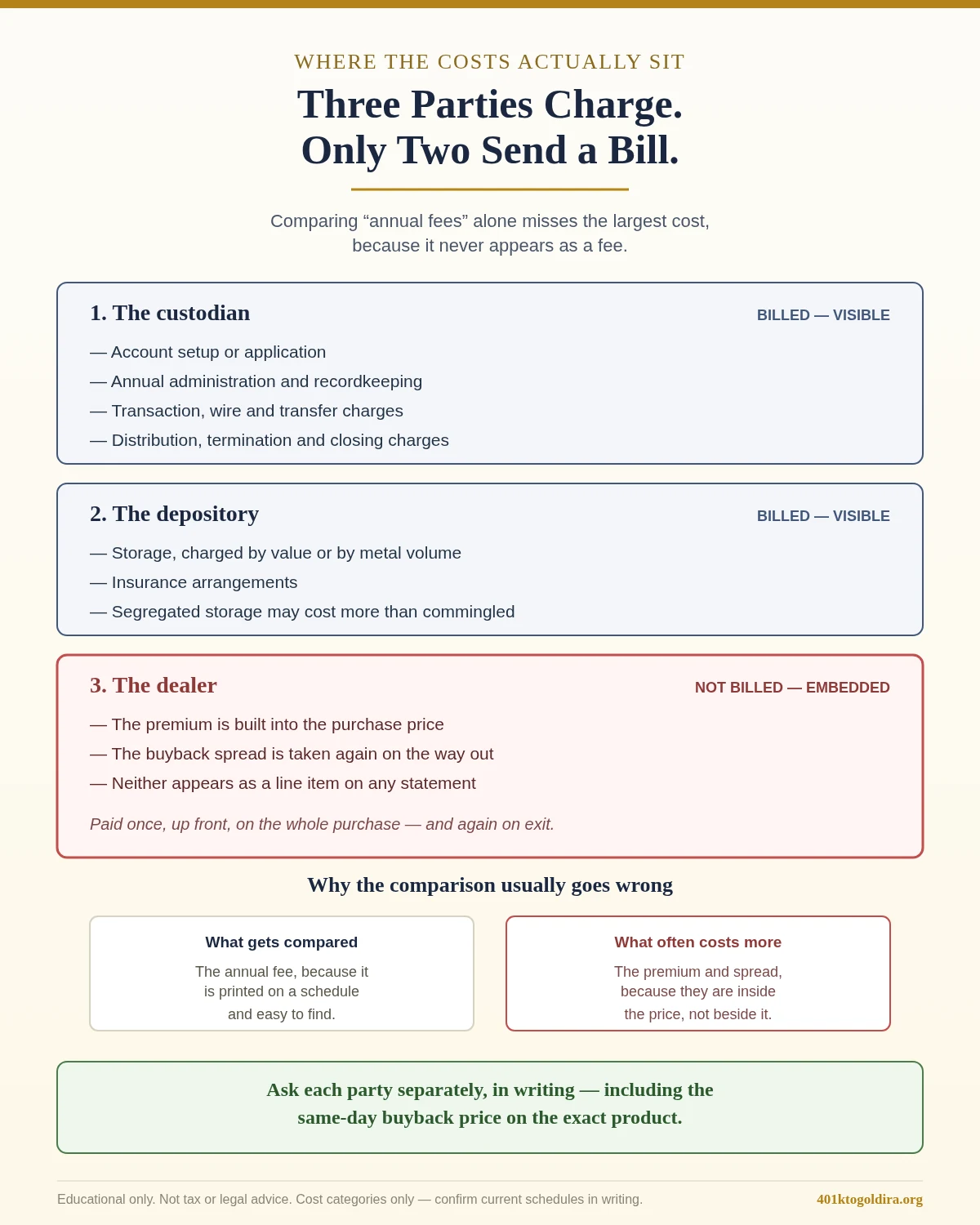
A self-directed precious-metals IRA involves three separate economic layers.
What does the custodian charge?
The custodian administers the IRA. Depending on provider and account activity, relevant categories can include establishment, annual administration, purchases, sales, wires, distributions, transfers and account termination. Birch's published examples disclose only some of those categories for commonly used arrangements.
What does the depository charge?
The depository physically stores the metals and may incorporate insurance into its storage charge. Pricing can depend on provider, asset size and storage method. Birch itself says depository fees vary according to the institution and size of the holdings.
Where does the dealer's compensation appear?
The dealer component is structurally different.
Birch's own bullion explainer says dealer premiums are added to physical-metal prices to cover costs and profit margins. Its FAQ says the quoted purchase price incorporates sourcing and fabrication costs, while a Birch response to a BBB complaint stated that the company's profit is the difference between what it paid to acquire metal on the customer's behalf and what the customer paid.
That means dealer compensation need not appear as a line item labelled “dealer fee.” It is embedded in the metal price.
A premium over spot should not, however, be equated entirely with dealer profit. Physical-metal retail pricing can also reflect fabrication, minting, wholesaler economics, availability, shipping and product-specific factors. Determining the dealer's actual transaction margin would require the dealer's acquisition cost as well as the retail price. Birch does not publish that transaction-specific acquisition figure on the public pages reviewed.
This is why an apparently modest annual IRA fee schedule cannot establish the full economic cost of a precious-metals purchase. CFTC specifically instructs physical-metals buyers to compare the spot value of the metal with the retail price and to ask how sales personnel and the company are compensated.
Why does the round-trip cost matter more than the purchase price alone?
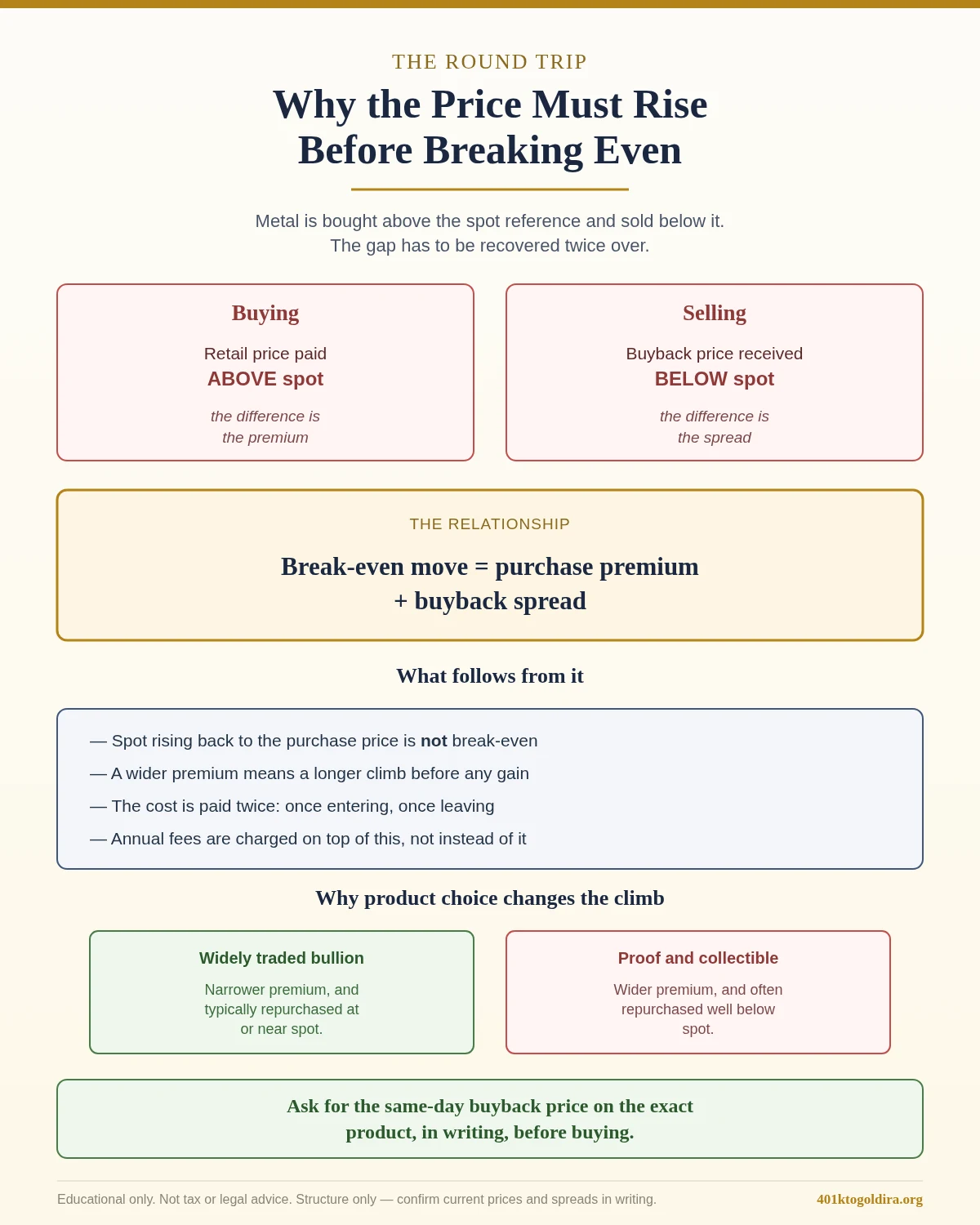
CFTC describes the basic physical-metals structure clearly: dealers generally sell metal above spot and buy it back below spot. It calls the difference between the dealer's sell price and buy price the dealer spread and says a larger spread, combined with other transaction and ongoing costs, requires a larger increase in spot price before economic profit becomes possible.
A purchase quotation therefore answers only half of the pricing question.
How does break-even work?
Consider an illustrative model only.
Let the spot value at purchase be S, the retail entry premium be p, and the eventual repurchase discount from future spot be b.
The acquisition price is:
S × (1 + p)
If future spot is F, liquidation proceeds are:
F × (1 − b)
Before custody and storage costs, break-even occurs when:
F / S = (1 + p) / (1 − b)
For modest percentages, the economic hurdle is often described approximately as the entry premium plus the exit discount. The exact equation is slightly higher because the exit discount operates against the future metal price. Custodian and storage charges increase the hurdle further.
This is why “the metal returned to the purchase-day spot price” is not synonymous with break-even.
Why can proof or specialty coins widen the gap?
CFTC warns that numismatic or collectible products can carry higher markups and lower liquidity than common bullion. NASAA similarly warns that semi-numismatic products can be sold with substantial markups over melt value and advises independent valuation and comparison of premiums and fees.
Birch's own bullion education page also distinguishes bullion from proof and numismatic coins and says bars and rounds generally carry lower premiums while collectible characteristics can increase the premium on coins. That is a first-party general explanation, not proof of the premium on any Birch transaction.
The only reliable way to measure a particular order's round-trip cost is therefore product by product: contemporaneous spot or melt value, retail purchase quote and a same-time written repurchase quote for exactly the same item.
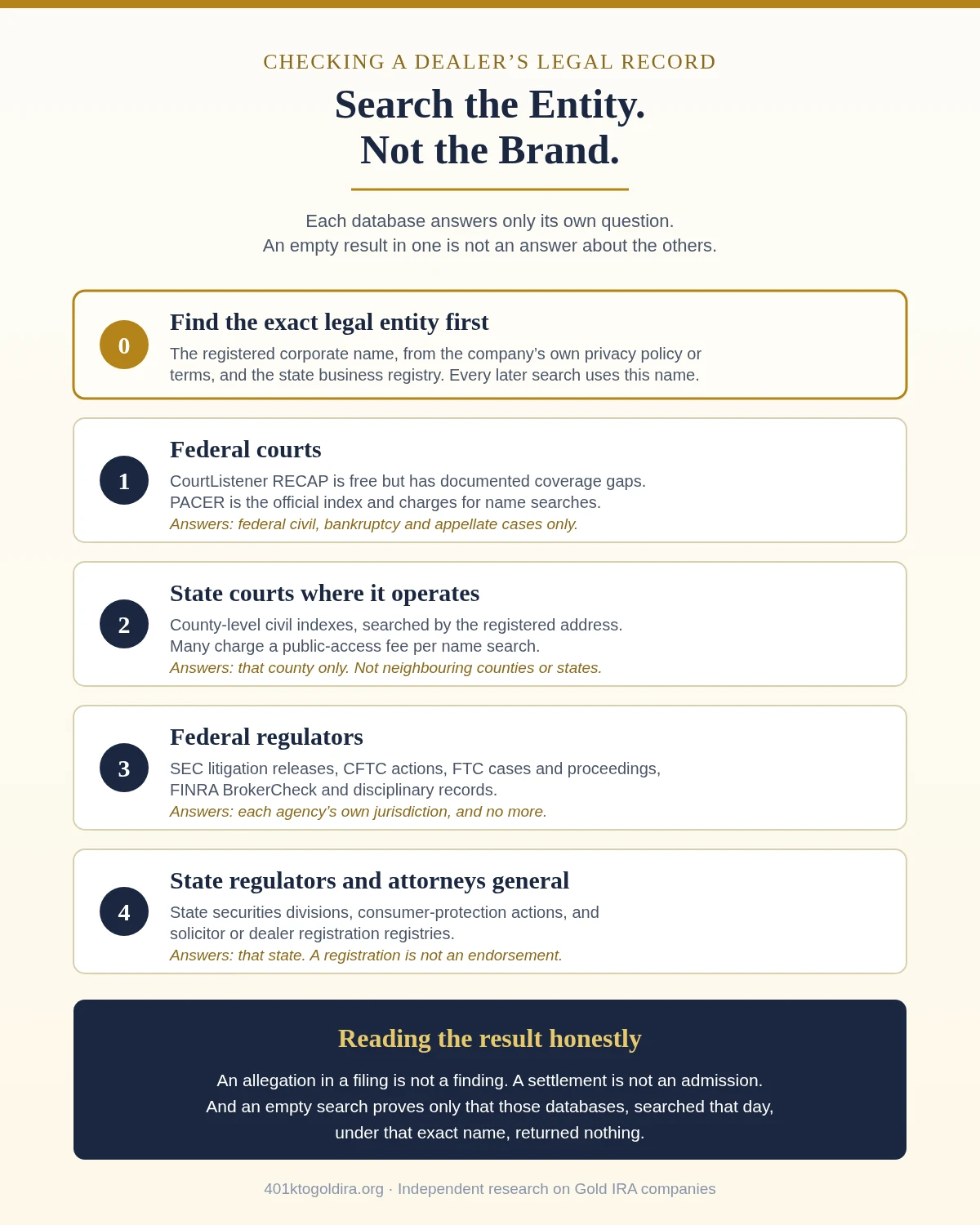
What did public-record searches for Birch Gold Group return?
Exact-name searches were performed across the permitted public sources on August 20, 2026. The results must be read as database-search results rather than certifications of conduct.
| Database | Result of this research | What that result cannot establish |
| CourtListener / RECAP | The accessible web index searches performed did not produce a reliable exact-name federal docket that could be attributed to the current Birch Gold Group entity with sufficient confidence. | RECAP is not a complete substitute for PACER. A no-result web search cannot establish absence of federal litigation. |
| PACER Case Locator | The official national index was identified, but an authenticated paid nationwide party-name search was not exhausted. PACER says its Case Locator covers appellate, bankruptcy and district courts and updates daily. | No claim that Birch Gold Group has never been a federal litigant can be made from this research. |
| Los Angeles Superior Court Civil Party Index | The official county civil party-name index was identified. Its paid name search was not exhausted. | The analysis therefore makes no “no Los Angeles cases” claim. Nor was every California county index exhaustively queried. |
| SEC Litigation Releases | Exact-name searches did not surface a Litigation Release identifying Birch Gold Group as a defendant or respondent. SEC says these releases summarize civil actions brought by the Commission in federal court. | SEC investigations are private before public action, and SEC jurisdiction is not a general licensing or conduct audit of every retail physical-metals dealer. |
| CFTC Enforcement | Exact-name searches of public CFTC enforcement material did not surface a target enforcement action against Birch Gold Group. | Retail physical-metal dealer activity is not comprehensively captured by CFTC enforcement records; absence from the public index does not establish absence of complaints or other regulatory contact. |
| FTC Cases and Proceedings | Exact-name searches did not surface a public FTC federal or administrative case naming Birch Gold Group as a target. The FTC database contains matters the agency has brought in court or administratively. | The public case library is not equivalent to the FTC's underlying consumer-complaint database or confidential investigative files. |
| FINRA Enforcement | No exact-name disciplinary action surfaced in the public searches performed. FINRA says formal disciplinary actions concern member firms and associated persons, while investigations are confidential. | FINRA's jurisdiction does not amount to comprehensive regulation of ordinary retail physical-metal dealer transactions. |
| California DFPI | Exact-name searches of the Department of Financial Protection and Innovation's public enforcement material did not surface a target action. DFPI directs the public to its Actions and Orders database for enforcement history. | DFPI only enforces laws within its jurisdiction. No-result searches do not establish absence of complaints, referrals or matters outside that jurisdiction. |
| State attorneys general | Exact-name public-site searches, including California, did not surface a target-specific public enforcement action in the material reviewed. | California's Attorney General warns that a scarcity of public complaint information should not be interpreted as proof that a business is legitimate and does not publicly release company complaint holdings as a general background-check service. |
The central conclusion from this table is intentionally modest: no target-specific SEC, CFTC, FTC, FINRA or DFPI public enforcement matter surfaced in the searches performed, but the authenticated PACER index and paid California county searches were not exhausted.
That is not a finding of good conduct. It is a description of the public records located and the boundaries of the search.
What do regulators say should be obtained in writing?
CFTC's physical-metals advisory provides the most direct instruction:
“Ask for all fees, costs, commissions, and agreed retail price in writing BEFORE signing a sales agreement or turning over any money.”
It also recommends calculating the metal's spot value, comparing it with the retail price, asking what the dealer would pay if the metal were sold back immediately, asking how salespeople are paid, determining whether commissions are included in the spread, and identifying storage, insurance and administrative charges.
FINRA condenses the same principle into five words:
“Get a full accounting of fees.”
Its guidance specifically discusses account-opening charges, commissions, storage and management costs and says the break-even effect of those costs should be understood before funds are committed.
NASAA adds a separate warning that is especially relevant to Gold IRAs: self-directed IRA custodians do not vet precious-metals dealers or their sales practices and do not perform due diligence on the quality or legitimacy of the investments selected for the account. Custodian participation therefore should not be interpreted as independent validation of the dealer's pricing or product recommendation.
What should a Birch Gold Group verification packet contain before funds move?
| Question to resolve | Document to request | What a satisfactory answer looks like |
| What minimum applies to the proposed transaction? | Written quote or account-opening communication | Confirmation of the applicable minimum and whether the publicly stated $5,000 threshold has changed because of product availability or market conditions. Birch says the current amount can vary. |
| Exactly what metals are being purchased? | Itemized trade proposal | Product name, issuer or mint, metal, fineness, gross and fine weight, quantity, classification and unit price. |
| What is each item's metal value at the moment of quotation? | Quote showing timestamp plus contemporaneous spot reference | Enough information to calculate metal weight multiplied by spot and compare that amount with the quoted retail price, consistent with CFTC guidance. |
| What is the premium over spot or melt? | SKU-by-SKU written price comparison | The percentage and dollar difference between the metal value and retail quote, with an explanation of what the premium represents. |
| What part of the price represents Birch's dealer economics? | Written pricing disclosure and Transaction Agreement | A clear description of dealer compensation and any transaction-specific markup disclosure. Birch's own materials confirm that physical-metal prices include dealer profit economics, but no public SKU-level margin table was located. |
| What would Birch pay for the same products immediately? | Same-time written buyback quote | A product-by-product repurchase amount rather than a general assurance that a buyback service exists. CFTC specifically recommends asking for the dealer's immediate buyback price. |
| Who is the IRA custodian? | Custodian agreement and complete fee schedule | Exact legal entity and all setup, administration, purchase, sale, wire, distribution, transfer and termination charges. |
| Which depository and storage method will apply? | Depository schedule and storage agreement | Facility, allocated/commingled or segregated arrangement, charging basis, insurance treatment, minimums and all withdrawal or handling charges. |
| Which published Birch fee example actually applies? | Current provider-issued schedules | Reconciliation of the public $100-versus-$110 storage/insurance discrepancy and confirmation of the current charge for the chosen arrangement. |
| What sales contract governs the order? | Current Transaction Agreement before final confirmation | Full pricing, cancellation, delivery, dispute, liquidation and other material terms with no reliance on a later copy. BBB responses show Birch itself treating this document as important evidence in pricing disputes. |
| Does every proposed IRA metal meet the applicable tax-code standards? | Product-level confirmation from the custodian | Confirmation tied to IRC §408(m)(3), not a generic marketing label. |
| How is the salesperson compensated? | Written compensation explanation | Whether compensation varies with product, revenue, margin or transaction size, as CFTC recommends asking directly. |
| What is the complete round-trip hurdle? | Purchase quote, same-time repurchase quote, custodian schedule and storage schedule | Sufficient figures to calculate the immediate liquidation gap and then add ongoing account costs. |
Which Birch Gold Group figures still cannot be verified publicly?
This section is more important than a generalized conclusion because it identifies the precise boundaries of public research.
Which company facts are verifiable?
The following are presently sourceable:
Birch Gold Group's current public FAQ states a $5,000 minimum subject to market conditions and product availability. BBB displays an A+ rating and accreditation since July 22, 2013. BBB's rolling complaint page displays a current complaint total and its division between resolved and answered status, each of which is verifiable at the moment it is read and not afterwards. Birch's own pages publish examples of common custodian and depository charges and describe separate custodian and storage-provider relationships. Birch also publicly states that product prices are not quoted online and that live buyback quotations can be obtained from its specialists.
Which BBB-history figures remain unknown?
The current BBB profile does not establish:
- Birch's lifetime number of BBB complaints;
- annual complaint totals for each year since accreditation;
- the text of complaints that have aged outside the reporting window;
- how many historical complaints were never publicly displayed;
- a thirteen-year resolution percentage; or
- an independently documented accreditation-status chronology showing every period of accreditation or lapse.
The present A+ therefore cannot be mathematically translated into a decade-long complaint rate.
Which dealer-pricing figures remain unknown?
The public pages reviewed do not establish:
- a live retail price for every available product;
- the contemporaneous premium over spot for each product;
- Birch's acquisition cost for a particular order;
- Birch's dollar or percentage margin on that order;
- a public ceiling on that margin;
- the salesperson's transaction-specific commission;
- whether compensation differs among bullion, proofs and other specialty products;
- a guaranteed same-day buyback percentage;
- a guaranteed future buyback formula;
- the portion of an original premium, if any, that will be recognized on resale; or
- a product-by-product round-trip spread.
Those are not minor omissions. They are the figures needed to determine transaction economics.
Which IRA-administration figures remain unknown?
Birch's published fee examples do not establish universal current charges for every custodian. Missing or provider-dependent categories include purchase transactions, sales, wires beyond the published example, cash distributions, in-kind distributions, outbound transfers, account termination and other administrative services.
The public pages also contain the unresolved $100-versus-$110 storage/insurance discrepancy. Only the provider's current written schedule can determine which amount applies to a proposed account.
Which storage figures remain unknown?
No complete public comparison was located establishing, for every storage option offered through Birch:
- the exact annual storage rate;
- whether charges are flat, value-based or volume-based;
- minimum annual charges;
- allocated-versus-segregated differentials;
- withdrawal, handling or shipping fees;
- separate insurance charges;
- insurance deductibles or exclusions; or
- future fee-change provisions.
Birch publishes descriptive information about storage providers, but a company description of a third-party facility is not a substitute for the storage provider's binding account agreement.
Which corporate and contractual details remain unknown?
The permitted public sources did not yield:
- a complete current beneficial-ownership structure;
- a public list of all affiliates referenced in Birch's policies;
- a predecessor/successor explanation covering the period before current Iowa incorporation;
- a publicly accessible current customer Transaction Agreement; or
- a transaction-wide compensation schedule for sales personnel.
These gaps do not establish adverse facts. They identify what cannot be responsibly claimed from the available primary record.
How do IRA tax rules change the verification process?
IRC §408(m) generally treats an IRA's acquisition of collectibles as a distribution, then creates specified exceptions under §408(m)(3) for certain coins and qualifying bullion. For bullion, the statute also imposes a physical-possession requirement involving the trustee described in §408.
IRS Publication 590-A similarly explains that an IRA's acquisition of collectibles is generally treated as a distribution while recognizing statutory exceptions for specified coins and bullion.
Trustee or custodian qualification is a separate question. Treasury Regulation §1.408-2(e) sets the framework under which a nonbank entity may demonstrate that it is qualified to serve as trustee or custodian. The IRS maintains information on qualifying nonbank trustees and custodians under that framework.
The precise language matters. Metals are not made eligible because a dealer calls them “approved.” The relevant inquiry is whether each proposed product meets the standards and exceptions in IRC §408(m)(3), while trustee or custodian qualification is evaluated separately.
What questions does the Birch Gold Group BBB record answer—and which remain open?
Does the A+ rating mean BBB has found Birch's prices competitive?
No. BBB defines its rating around expected business-customer interaction and information such as complaint history. Its published methodology does not audit the price per ounce or compare a dealer's premiums with competing market quotations.
Does the A+ rating mean a particular product is suitable for a retirement saver?
No. Suitability is not part of BBB's stated rating methodology. Birch's own risk disclosure says the company does not provide investment advice and that its assistance does not create a fiduciary relationship.
Does accreditation since 2013 mean thirteen years of complaints are visible?
No. BBB generally uses a three-year Business Profile reporting period. Older complaints decay from the public window, so the current complaint page cannot reconstruct the entire accreditation period.
Is the current complaint count low or high?
The permitted evidence supports the count, not a normative label, and the count itself belongs on the live BBB page rather than in an article that cannot update with it. BBB advises considering transaction volume, complaint nature and company responses rather than evaluating the number in isolation.
What do the complaint narratives add?
They expose recurring areas worth documenting before a transaction: pricing comprehension, specialty-coin premiums, statement value versus buyback value, reliance on sales explanations versus written agreements, and liquidation timing. Those are themes in allegations and responses, not judicial findings.
Does a resolved BBB complaint prove the customer's allegation was correct?
No. BBB's resolved status indicates that the complainant verified satisfaction with the resolution. It does not constitute an adjudication that every factual allegation was established.
Does an answered complaint mean Birch ignored it?
No. BBB defines answered to mean the business addressed the issues but the consumer either did not accept the response or did not report satisfaction to BBB.
Does the published $235 annual figure represent the complete cost of owning metals in an IRA?
No. Birch presents that figure in connection with a commonly used custodian/depository arrangement. The purchase price of the metals is separate, and the dealer component is embedded within the retail price rather than captured by the annual account figure.
Why do some Birch pages show different storage figures?
The main IRA and Prices pages use roughly $110 for storage/insurance in their examples, while the Gold IRA and Silver IRA pages show $100. The reviewed public pages do not reconcile the difference. A current written schedule from the chosen service providers is the only reliable way to establish the applicable charge.
Does Birch publish product prices online?
No. The company's current Prices & Fees page expressly says it does not quote product prices online and explains that final quotes are produced when orders are being finalized.
Does Birch offer a buyback service?
Birch publishes that its specialists can provide current buyback quotations and elsewhere says it requests a right of first refusal when customers liquidate metals purchased through the company. Those statements establish the existence of a described buyback process, not a guaranteed future price or formula.
Does using an IRA custodian independently validate the metals dealer?
NASAA says no: self-directed IRA custodians do not vet precious-metals dealers or their sales practices and generally do not perform due diligence on the underlying investments.
Does the absence of a public SEC, CFTC, FTC, FINRA or DFPI result establish a clean regulatory history?
No. Those databases have specific jurisdictions and disclosure rules. SEC investigations are conducted privately before public action; FINRA investigations are confidential; paid federal and county court searches were not exhausted. The search results therefore describe the public material located, not the absence of all complaints, investigations or litigation.
What is the central conclusion?
Birch Gold Group's BBB record provides more information than a newly accredited profile would. The present profile shows a business that BBB says has been accredited since July 2013 and currently carries an A+ rating, and the complaints page records a response against every complaint in the current three-year window. How many that is, and how the window divides between resolved and answered, are readable only on the live profile.
But the longevity of the accreditation should not be confused with a thirteen-year public complaint ledger. BBB's rolling reporting window removes old complaint material. Nor should the A+ rating be converted into a conclusion about price. BBB does not determine whether an ounce was purchased at a competitive premium, whether a specialty coin's premium can later be recovered, what dealer margin was embedded in the quote, or whether the product selected matched a retirement saver's needs.
The complaint narratives make that boundary concrete. Several disputes involve precisely the variables BBB does not independently price-test: premiums, product valuation, later buyback amounts, explanations given during the sale and liquidation mechanics. Birch disputes important allegations, and BBB's own status labels on the live page record how far each complaint in the current window progressed; in at least one published response it also acknowledged a failure to properly explain a particular buyback value.
The public record therefore supports two propositions at the same time.
First: the long BBB accreditation and present A+ rating are legitimate pieces of due-diligence information about Birch Gold Group's standing and recent complaint-response record within BBB's system.
Second: those facts leave the central transaction economics unverified.
A retirement saver still requires the product-by-product retail quotation, contemporaneous metal value, premium, written repurchase quote, complete custodian schedule, complete depository schedule, applicable Transaction Agreement and salesperson-compensation explanation to determine the actual economics of a proposed purchase.
Those documents answer questions the A+ rating was never designed to answer.
Which primary sources were used?
Birch Gold Group
- Birch Gold Group FAQ
- Birch Gold Prices & Fees
- Birch Gold Precious Metals IRA page
- Birch Gold Gold IRA page
- Birch Gold Silver IRA page
- Birch Gold Storage Options
- Birch Gold Privacy Policy
- Birch Gold Risk Disclosure
- Birch Gold bullion explainer
- Birch Gold Gold IRA pros and cons
Better Business Bureau
Regulatory guidance and enforcement
-
-
-
-
Court and statutory sources
- PACER Case Locator National Index
- IRC §408 — Cornell Legal Information Institute
- Treasury Regulation §1.408-2 — Cornell Legal Information Institute
- IRS Publication 590-A
- IRS Publication 590-B
Disclaimer: This material is educational research only and is not financial, investment, tax or legal advice. Precious-metals prices can rise or fall, and past performance does not guarantee future results. Published minimums, fee examples, storage arrangements, complaint counts and business terms can change without notice and should be confirmed from the relevant dealer, custodian, depository and primary record before any transaction. Retirement-account eligibility, rollovers, distributions, custody and tax treatment should be reviewed with appropriately qualified financial, tax and legal professionals.
The dedicated Birch Gold Group BBB record page →
Considering Birch Gold Group?
Birch Gold Group offers a wide selection of metals that may qualify under IRC §408(m), publishes its own fee schedule, and states a $5,000 minimum subject to market conditions. Educational resources available for first-time customers.
Minimum investment: $5k · BBB rating: A+
Owners of this website may be paid to recommend Birch Gold Group. The content on this website, including any positive reviews of Birch Gold Group and other reviews, may not be neutral or independent.
Researched and written by Daniel M. — independent precious-metals retirement researcher.
Disclaimer: This page is for general educational research only. It is not financial, tax, legal or retirement-plan advice, and Birch Gold Group does not offer tax or legal advice. Purchasing precious metals involves risk: prices can rise or fall, and transaction costs can materially affect resale economics. Past performance does not guarantee future results. Tax treatment depends on the account, transaction, asset and individual facts. Retirement savers should review controlling account documents and IRS rules and consult a qualified tax or legal professional before a rollover, purchase, distribution or conversion.