Affiliate disclosure: The publisher may receive compensation from precious-metals companies, including this one. That compensation does not change what the company publishes, what the BBB record shows, or what the searches returned.
Affiliate Disclosure: This article may contain affiliate links, which means the publisher may receive compensation from qualifying actions, at no additional cost to the reader. Affiliate relationships do not change the sourcing standard used here.
A prospective retirement saver researching American Hartford Gold encounters an unusual information problem. Large amounts of secondary material repeat specific claims about minimums, fees, promotions and costs, yet the most important numbers are not always accompanied by a primary document.
The clearest example is the frequently repeated claim that American Hartford Gold requires a $10,000 minimum for a Gold IRA. Earlier automated searches and a manual review had failed to locate that figure on the company's public website. Because parts of the site depend on client-side rendering, those failures could not establish that the company had never published it.
That position can now be resolved.
American Hartford Gold currently publishes the $10,000 figure on its own Gold IRA FAQ. Under the question about a minimum initial contribution, the page states:
“Yes, The minimum order size for our self-directed Gold IRA is $10,000.”
That wording was visible on the company's FAQ when observed on August 20, 2026. The important noun is order: the page calls $10,000 a minimum order size, even though the FAQ heading asks about a minimum “initial contribution amount.” The public page does not establish that the same number governs every account-opening, rollover, subsequent purchase, promotion or negotiated transaction.
That finding illustrates the purpose of this analysis. The question is not whether American Hartford Gold is “cheap,” “expensive,” preferable or unsuitable. The question is narrower and more useful: what can a retirement saver actually establish from primary documents before speaking with the company, and which economically important facts still require a written quote?
What does this article cover?
- What American Hartford Gold publishes about itself.
- Whether the $10,000 Gold IRA minimum can now be sourced.
- Which IRA fees are publicly disclosed and which are not.
- How custodian, depository and dealer costs differ.
- Why the entry premium and exit price must be examined together.
- What the company's “free silver” promotions do and do not establish.
- What the BBB record shows.
- What federal, state and court-record searches returned.
- What CFTC, FINRA and NASAA guidance says should be obtained in writing.
- A document-by-document verification checklist.
- A detailed inventory of figures that remain publicly unverifiable.
- Frequently asked verification questions.
- Primary-source links and research limitations.
What can be established about American Hartford Gold before contact?
What does the company say it does?
American Hartford Gold's own website markets precious-metals purchases, physical delivery and self-directed precious-metals IRA services. Its contact page links specifically to a product catalog, Gold IRA opening material, IRA guides, rollover information and promotions. BBB independently categorizes the business as a precious-metals dealer and describes its services as including gold and silver coins, bars and rounds, Gold IRA and Silver IRA rollovers, and physical delivery.
The company's website states that it operates three locations and employs more than 200 people. Its listed offices are at 11755 Wilshire Boulevard in Los Angeles, 21550 Oxnard Street in Woodland Hills, California, and 319 Clematis Street in West Palm Beach, Florida. Those are company-published statements rather than independent verification of staffing levels or office functions. BBB separately lists the Wilshire Boulevard address as the business-profile address.
What can be established about the legal naming?
The available documents use several related names. The current publicly linked Shipping and Transaction Agreement identifies the contracting seller as American Hartford Gold LLC at the Wilshire Boulevard address. The website's Terms and Conditions describe the site as owned and operated by “American Hartford Gold Group and/or its affiliates, related entities, divisions, subsidiaries, or parent companies.” BBB describes the profiled entity as an LLC and lists “The Hartford Gold Group, LLC” and “American Hartford Gold Group” as alternate names.
BBB says the business started and was incorporated on March 30, 2015, and currently identifies Scott Gerlis as Executive Chairman and Max Baecker as President. Those are BBB-profile facts, not a complete corporate-ownership record.
What the permitted source set does not provide is a complete current equity-ownership chart showing every parent, subsidiary, affiliate and beneficial owner or reconciling every historical and current entity name. The company's Terms acknowledge affiliates and related entities without enumerating them. The transaction agreement establishes the contracting entity for that document, but not the entire corporate group.
The company's risk disclosure also states that assistance from the dealer does not create a fiduciary or special relationship and that the company does not provide legal, investment or tax advice. That distinction matters because a dealer's commercial role is different from that of an IRA custodian or independent professional adviser.
October 2026 corporate update: the Rosland Capital asset acquisition
On October 6, 2026, American Hartford Gold announced its acquisition of assets belonging to Rosland Capital. AHG says Rosland customers can access its precious-metals services and customer support. Importantly, the company expressly states that it is not assuming liability for Rosland Capital's obligations. The announcement does not establish that existing IRA custody arrangements or customer contracts automatically transferred. Customers affected by the transition should verify their contractual counterparty, custodian, depository and applicable buyback terms directly.
The distinction matters for anyone reading the two companies' records together. An asset purchase is not a merger of corporate histories: Rosland Capital's own complaint record and any legal liabilities remain Rosland's, and nothing in the announcement transfers them to AHG or extends AHG's promotional terms to Rosland customers. The release also carries company self-descriptions, including claims about market position and cumulative delivery volumes, which are statements by the company rather than independently verified facts. The announcement names a dedicated service line for Rosland clients, 866-767-3916.
Source: American Hartford Gold, “American Hartford Gold Acquires Assets of Rosland Capital in Major Expansion”, company announcement dated October 6, 2026, americanhartfordgold.com, retrieved 12 October 2026.
Does American Hartford Gold publish a $10,000 Gold IRA minimum?
Is the figure finally sourceable?
Yes.
The company's Gold IRA FAQ currently asks whether American Hartford Gold has a minimum initial contribution amount and answers:
“Yes, The minimum order size for our self-directed Gold IRA is $10,000.”
The wording was directly retrievable from the company's public page when observed on August 20, 2026.
That establishes one specific proposition: American Hartford Gold itself currently publishes a $10,000 minimum order size for its self-directed Gold IRA.
It does not independently establish that $10,000 has always been the company's minimum, when that wording first appeared, whether exceptions are possible, whether promotional accounts use a different threshold, or whether the amount applies identically to initial funding, an initial metals order and later orders.
Why did previous searches fail?
A previous failure to retrieve a number from a website is not proof that the number was absent from the browser-rendered page. American Hartford Gold uses pages whose content can vary in server-side accessibility, and some pages or components can depend on client-side rendering. Accordingly, earlier unsuccessful automated and manual attempts should be described only as failed attempts to locate the figure, not evidence that American Hartford Gold did not publish it at the time.
The present finding supersedes that uncertainty because the wording is now directly retrievable from the company's FAQ. What remains unestablished is when the company began publishing it. No permitted archival source was used to establish an insertion date.
This distinction is important for any future article update. If the FAQ changes or the number disappears, a server-side fetch failure alone should not be represented as proof of a policy change.
Which American Hartford Gold fees are published, and which remain quote-dependent?
Is there a complete current public Gold IRA fee schedule?
No complete current dollar-denominated Gold IRA fee schedule was located in the accessible first-party pages reviewed for this analysis.
The company's FAQ says depository fees “vary based on your account’s size and the metal holdings in your depository” and adds that storage may sometimes be free depending on the situation. The company's separate storage page similarly says annual storage charges can vary according to account size and specific circumstances and may be waived.
American Hartford Gold itself advises consumers on another current page to obtain a written schedule separating custodial fees from storage charges, determine whether charges are flat or account-value-based, ask whether segregated storage changes the cost, and obtain transaction-related pricing information. That advice indirectly demonstrates why a marketing statement about “fees” is not a substitute for an account-specific schedule.
Which specific figures are missing?
No current universal figure was located on the accessible public pages for:
- custodian account setup or application charges;
- annual custodian administration charges;
- purchase transaction charges imposed by the custodian;
- sale transaction charges imposed by the custodian;
- cash or in-kind distribution charges;
- IRA termination or account-closing charges;
- wire, check or transfer charges;
- the precise annual storage charge for a proposed account;
- the exact formula used to calculate storage;
- the dollar differential between segregated and commingled storage;
- whether insurance is separately charged or incorporated into storage;
- the retail price of a proposed IRA product before a live quote;
- the premium over contemporaneous spot for that product;
- the dealer's acquisition-cost margin on a particular transaction;
- a contemporaneous repurchase price for the same product; or
- the resulting round-trip economic cost.
The absence of a public figure does not mean that a charge is zero. It means the figure could not be established from the public first-party pages reviewed.
The transaction agreement does contain a 3% merchant-processing charge for credit-card transactions, but the same document separately states that IRA purchase funds are received from the third-party custodian. The credit-card provision therefore should not be transformed into a claim that Gold IRA purchases universally incur a 3% fee.
Where does the full cost of a Gold IRA actually sit?
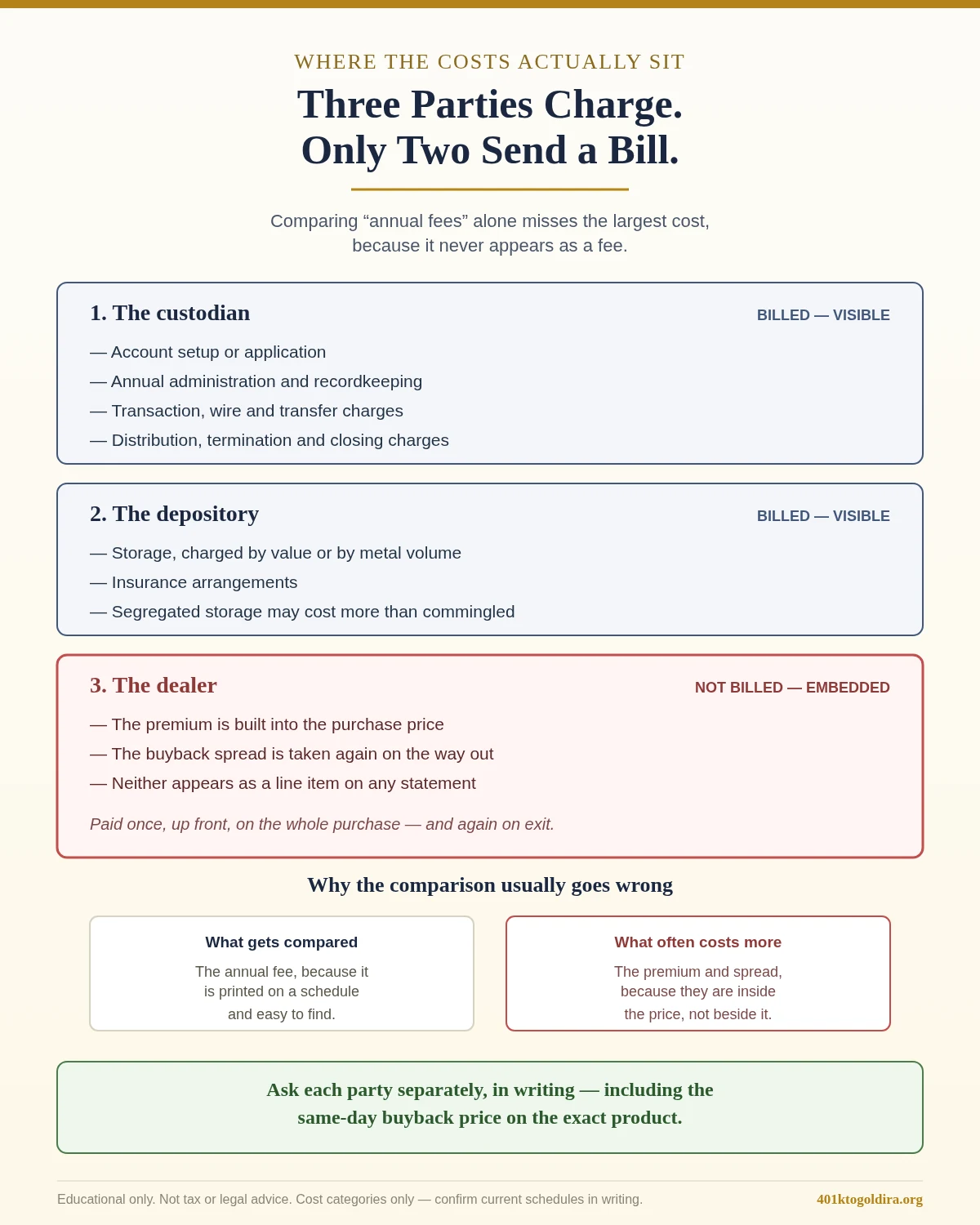
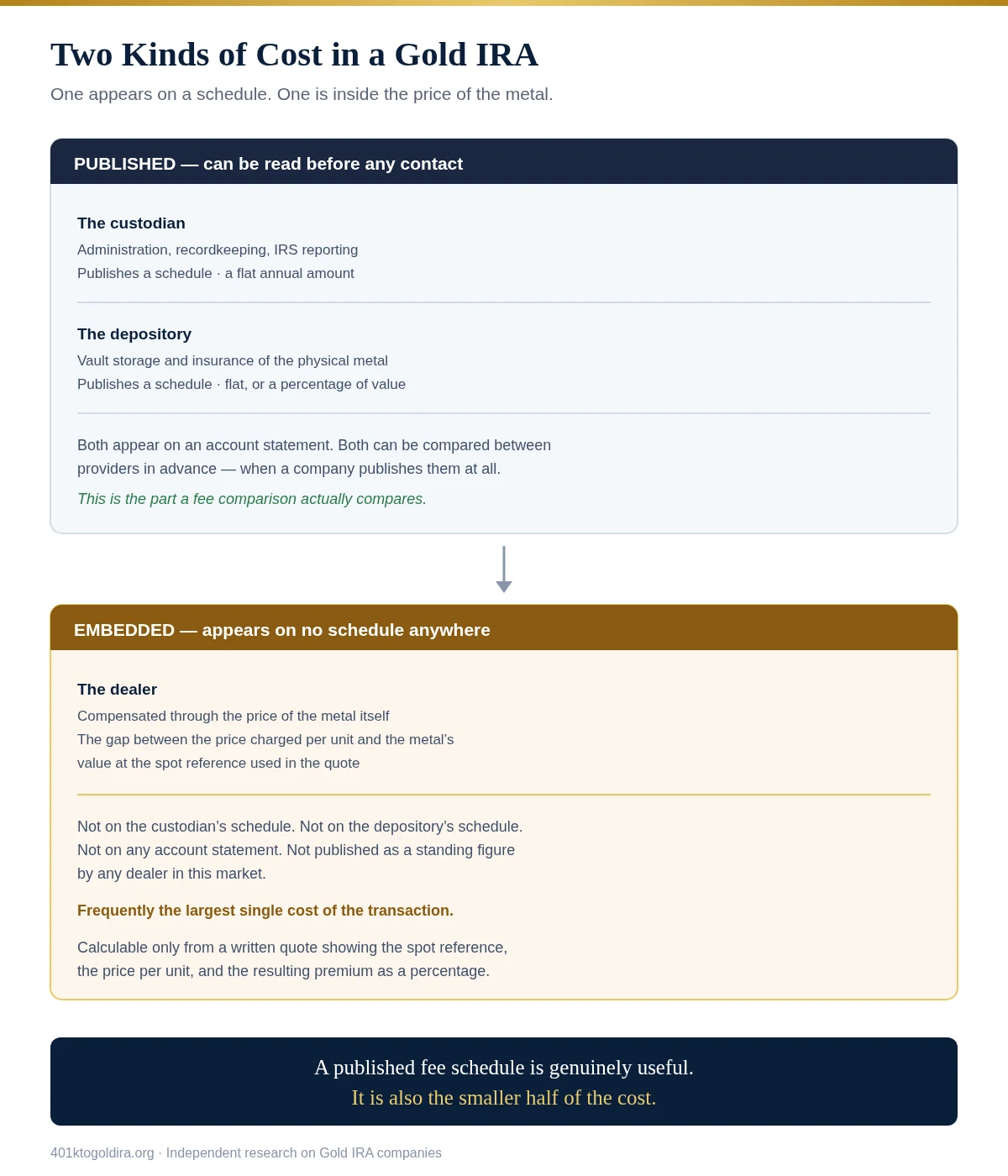
A precious-metals IRA involves three economically distinct parties: the IRA custodian, the storage provider and the metals dealer. Treating all three as one “Gold IRA fee” obscures the largest information gap.
What does the custodian charge?
A self-directed IRA custodian administers the tax-advantaged account. Potential charges can include establishment, annual administration, transactions, distributions and account termination. CFTC guidance specifically identifies IRA custodial charges as part of the costs that must be considered, while FINRA advises obtaining a complete accounting of charges before funds are committed.
American Hartford Gold's own transaction agreement confirms the structural separation: for IRA purchases, purchase funds are received from a third-party custodian before the metals are delivered.
What does the depository charge?
Storage is a separate relationship. The current transaction agreement says American Hartford Gold may suggest storage companies but that the customer selects the storage provider. The company's storage page discusses commingled and segregated arrangements and says annual charges can depend on account size and circumstances.
A complete written depository proposal therefore needs to identify not merely “storage,” but the storage basis, segregation method, insurance treatment and any circumstances under which a promotional waiver ends.
Where is the dealer's compensation?
This is the cost most likely to disappear when analysis focuses only on a list of account fees.
American Hartford Gold's current transaction agreement says:
“The purchase price Customer agrees to pay includes AHG’s profit margin on that transaction.”
It then defines its own capitalized term “Spread” as the difference between the retail price quoted to the customer and the price at which American Hartford Gold acquires the metals from its wholesaler at the time of purchase. The agreement says this amount can vary between transactions and may be negotiable.
The same form states that, when the agreement is offered to a customer, its acquisition-cost “Spread” for cash and IRA transactions can range from 1.00% to 19.99% for bullion, from 19.99% to 45.99% for company-exclusive and semi-numismatic coins, and as high as 59.99% for certain limited-supply numismatic coins. Those figures are the company's own contractual ranges under its own definition. They are not a universal premium-over-spot schedule and they do not establish the markup on any particular SKU.
The agreement also states that sales representatives receive commissions based at least partly on sales volume and profit margin and may receive additional sales-linked compensation.
That means dealer compensation is not necessarily a separately billed line item comparable with an annual custodian charge. It can be embedded inside the purchase price itself. Depending on the product and transaction, that embedded pricing component can exceed the visible administrative charges and therefore deserves separate measurement. CFTC and NASAA guidance both emphasize markups and spreads when evaluating physical precious-metals transactions.
What does a true round trip have to recover before break-even?
Why is the purchase price only half of the calculation?
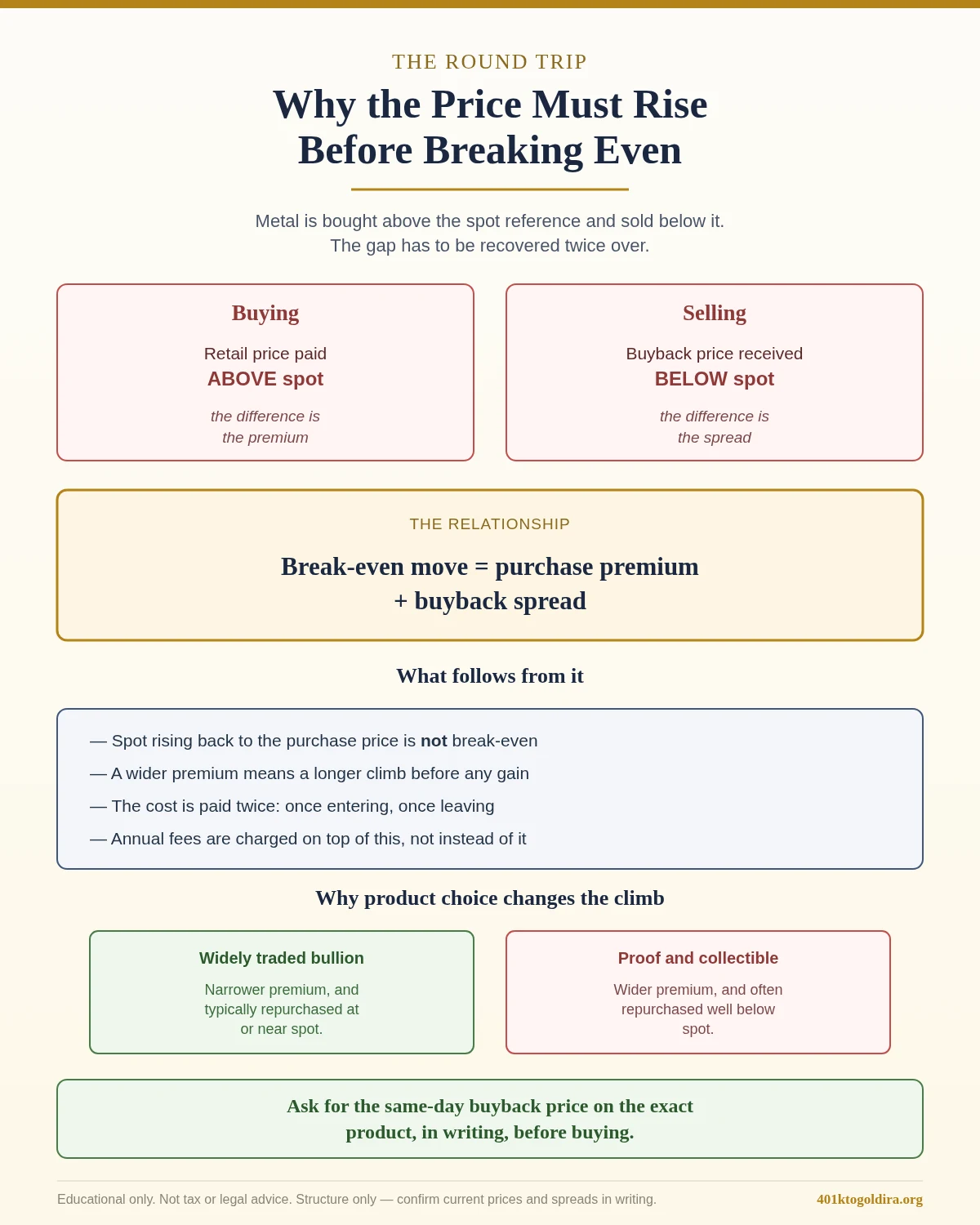
CFTC guidance distinguishes spot price from retail price and explains that dealers generally sell physical metal above spot and repurchase it below spot. It therefore recommends obtaining both the retail purchase price and the amount the dealer would pay if the same metal were sold back.
This introduces an important terminology problem. American Hartford Gold's contract uses “Spread” to describe retail price minus the company's wholesaler acquisition cost. The CFTC uses dealer spread for the gap between the dealer's selling price and repurchase price. Those are different calculations. A buyer comparing documents should not assume that one measures the other.
What is the mathematical break-even point?
An illustrative model makes the issue clearer.
Assume the underlying spot value at entry is S, the retail purchase premium relative to that spot value is p, and a future dealer repurchase quote is b below contemporaneous future spot.
The initial purchase cost is:
S × (1 + p)
The future liquidation value is:
Future spot × (1 − b)
Ignoring custody and storage, exact break-even requires:
Future spot / initial spot = (1 + p) / (1 − b)
For illustration only, if an entry quote were 10% above spot and the eventual repurchase quote were 5% below future spot, spot would need to rise approximately 15.79% merely for the liquidation proceeds to equal the original purchase amount. Custodial and storage costs would raise the required return further.
For small percentages, the entry and exit percentages are sometimes informally added together, but the exact calculation is multiplicative rather than a simple sum.
CFTC makes the underlying principle explicit: larger spreads and other ongoing costs require a larger increase in the metal price before economic profit becomes possible.
Specialty, semi-numismatic and limited-supply products can create a wider hurdle than common bullion. American Hartford Gold's own agreement publishes materially wider acquisition-cost spread ranges for those classifications than for bullion, while NASAA warns that semi-numismatic pricing can include substantial seller markups. The economics of any particular proof or collectible product, however, remain quote-specific rather than inferable from its label alone.
What can the company's “free silver” promotions actually establish?
What does American Hartford Gold currently advertise?
American Hartford Gold maintains several first-party promotional pages, and the offers visible across those pages are not identical.
One current-specials page advertised up to $5,000 in free silver together with up to three years without transfer, storage or maintenance charges when observed during this research.
A separate company-controlled landing page advertised up to $15,000 in free silver on qualifying purchases and storage, maintenance and insurance for up to three years.
Another company landing page advertised up to $25,000 in free silver on qualified accounts and a package including account setup and storage for up to five years.
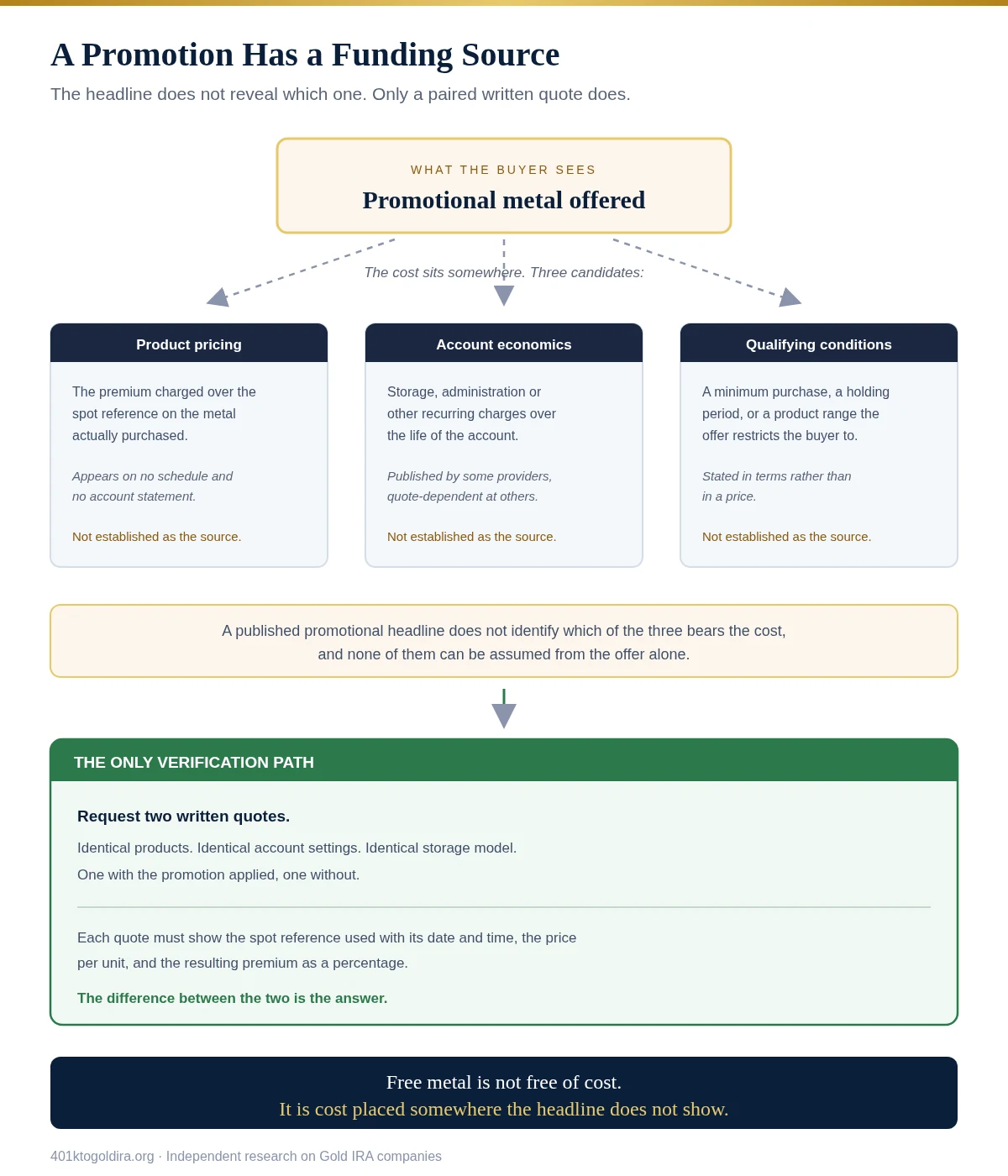
Those pages can coexist as different marketing campaigns. They do, however, demonstrate why a headline offer cannot establish the promotion applicable to a particular Gold IRA. The public pages reviewed do not provide one universally applicable qualification table tying each purchase amount, product mix and account arrangement to one promotional benefit.
Does the promotion prove that another charge is higher?
No.
No evidence in the permitted sources establishes that American Hartford Gold funds promotional silver by widening the product premium, increasing storage charges or imposing a longer commitment. None of those mechanisms should be asserted without documentation.
The correct verification question is economic rather than accusatory: where does the cost of the promotion ultimately sit?
CFTC specifically advises prospective precious-metals customers to determine how a company earns its profit when it appears to give away precious metal or another large incentive.
The strongest test would be a pair of contemporaneous written proposals for the same products, quantities, custodian and storage arrangement, one reflecting the promotion and one without it, together with the full promotion terms and same-time repurchase quotes. That comparison can reveal whether the underlying economics change.
What does the BBB record show, and what does it not show?
What are the current BBB figures?
The BBB profile identifies American Hartford Gold as an accredited business with an A+ rating and says accreditation began on June 3, 2016.
The complaint profile observed on August 20, 2026 displayed 115 complaints during the preceding three years and 45 complaints closed during the preceding 12 months. Because both are rolling windows, those numbers can change without any change in historical accuracy.
The live complaint filters classified the 115 records as 62 “Answered” and 53 “Resolved.” By complaint type, BBB displayed 40 service-or-repair issues, 36 product issues, 22 sales-and-advertising issues, six billing issues, six customer-service issues, three delivery issues and two order issues. BBB defines “Resolved” as a case in which the complainant verified satisfaction; “Answered” means the business addressed the complaint but the consumer either did not accept the response or did not report satisfaction to BBB.
BBB cautions that displayed complaint text may not represent every complaint submitted because consumers may decline publication, records may fail BBB publication standards, or only a portion may be shown when volume is high.
What themes recur in the published complaint narratives?
A review of the displayed narratives shows recurring allegations, not adjudicated facts, involving product pricing or markups, the economics of specialty coins, difficulty reconciling retail purchase prices with later valuations or repurchase quotes, delayed delivery in some transactions, and difficulty obtaining callbacks or account information. American Hartford Gold's published responses dispute some pricing allegations and state in other cases that representatives were addressing the concerns or that matters had been resolved.
Those narratives are useful for identifying questions that deserve documentation. They are not court findings and should not be converted into factual conclusions about disputed transactions.
What does an A+ rating mean?
BBB says its rating represents BBB's opinion of how a business is likely to interact with customers and is based on information available to BBB, including complaints. BBB expressly says a rating is not a guarantee of reliability or performance, and customer reviews do not determine the letter grade.
Accordingly, the A+ rating establishes how American Hartford Gold currently scores under BBB's own methodology. It does not independently audit metal premiums, wholesaler acquisition costs, custodian fees, IRA eligibility of individual products, future repurchase pricing, depository economics or tax treatment.
What did searches of courts and regulators return?
A public-record search is strongest when the databases searched and the databases not exhausted are named explicitly.
| Source searched | Result of this research | What the result cannot establish |
| CourtListener / RECAP | A federal docket was located for Mathys v. The Hartford Gold Group, LLC, No. 1:20-cv-03927 in the Northern District of Illinois. CourtListener lists filing on July 6, 2020 and termination on December 7, 2020. The direct docket page could not be fully retrieved in this environment. | The caption alone does not establish liability, misconduct or the merits. The caption also uses a related entity name rather than the exact “American Hartford Gold LLC” name used in the current transaction agreement, so the permitted material is insufficient to resolve corporate identity solely from that docket entry. |
| PACER Case Locator | PACER provides the nationwide federal index across district, bankruptcy and appellate courts, but an authenticated nationwide party search was not exhausted. | A web search of RECAP is not a substitute for a paid/authenticated PACER search. Sealed matters and records not captured by RECAP can also escape public-web discovery. |
| Los Angeles Superior Court Civil Party Index | The court provides a paid name-based index covering multiple civil case categories and states that the index is updated daily. The paid name search was not exhausted in this research. | No claim of “no California cases” can be made. |
| Palm Beach County eCaseView | The clerk provides an electronic court-record system, but its interactive interface did not permit a reliable exhaustive scripted exact-name search in this research. | No claim of “no Florida cases” can be made. |
| SEC Litigation Releases | Exact-name searches did not surface an SEC Litigation Release naming American Hartford Gold as a target. SEC explains that its Litigation Releases concern civil actions brought by the Commission in federal court. | This does not establish absence of complaints, inquiries, confidential investigations, matters under another entity name or matters outside SEC jurisdiction. |
| CFTC Enforcement Actions | Exact-name searches did not locate an enforcement action against American Hartford Gold. One CFTC court filing involving another dealer mentioned American Hartford Gold as a competitor; it was excluded because the company was not the respondent in that passage. | A textual mention in another company's case is not an enforcement action against American Hartford Gold. |
| FTC Cases and Proceedings | Exact-name searches of the FTC's cases/proceedings material did not surface an enforcement case against American Hartford Gold. | FTC complaint information, investigations and nonpublic material are not exhausted by a public case search. |
| FINRA Enforcement | No exact-name disciplinary action against American Hartford Gold surfaced in the public FINRA enforcement search used here. FINRA's enforcement function concerns securities-industry firms and associated persons subject to its jurisdiction. | The result does not represent comprehensive oversight of a retail physical-metals dealer. FINRA also says its investigations are confidential. |
| NASAA / state securities regulators | No target-specific NASAA enforcement page surfaced in the searches performed. NASAA guidance was located concerning precious-metals and self-directed IRA risks. | NASAA's website is not a unified exhaustive docket of every state securities regulator. |
| California Attorney General | No target-specific enforcement item surfaced in the exact-name web search used for this research. California's Attorney General states that its office does not release information about consumer complaints it receives. | Absence of a public enforcement page says nothing about the number of consumer complaints or confidential investigations. |
| Florida Attorney General | The relevant public interface was not reliably retrievable enough to support an exhaustive result. | No absence claim is made. |
The appropriate conclusion is therefore deliberately limited. This research found one federal CourtListener docket under a related business name and did not surface a target enforcement action in the public SEC, CFTC, FTC or FINRA searches performed. Several paid, authenticated, interactive and state-level indexes were not exhausted.
That is a report of searches, not a finding of good conduct. An absence from a public database does not establish absence of complaints, arbitration, sealed litigation, claims brought under another entity name, private settlements or future enforcement.
That limitation is particularly relevant because American Hartford Gold's current transaction agreement contains an arbitration provision directing covered disputes to JAMS. Private arbitration can resolve disputes without generating an ordinary public court docket.
What do regulators say should be obtained in writing?
CFTC's precious-metals customer advisory states:
“Ask for all fees, costs, commissions, and agreed retail price in writing BEFORE signing a sales agreement or turning over any money.”
The same advisory directs buyers to compare the metal's weight and spot value with the retail quote, request the price the dealer would pay to repurchase the metal, determine how salespeople are compensated, establish how the company earns money when offering large promotional benefits, and identify storage, insurance and administrative costs.
FINRA makes the same principle unusually concise:
“Get a full accounting of fees.”
FINRA then identifies account-opening charges, sales commissions, storage and management costs as examples and says all costs should be obtained in writing with their break-even effect understood.
NASAA adds an important institutional warning: self-directed IRA custodians do not vet precious-metals dealers or their sales practices, and custodians generally do not perform due diligence on the quality or legitimacy of assets selected for self-directed accounts. Custodian participation therefore should not be treated as an independent endorsement of the dealer's product selection or pricing.
What should a complete verification packet contain before funds move?
| Verification question | Document to request | What a satisfactory answer looks like |
| What is the minimum initial order for the proposed self-directed Gold IRA, and is that an order minimum, funding minimum or account-opening minimum? | Written dealer quote or account terms | The exact threshold, the transaction to which it applies, exceptions if any, and the period for which the quoted minimum remains valid. The public FAQ currently supports a $10,000 minimum order size. |
| What exactly is being purchased? | Itemized trade confirmation | Legal/product name, mint or issuer, metal, weight, fineness, classification, quantity, unit price and total retail price. CFTC recommends comparing weight and spot value with the retail quote. |
| What dealer margin is embedded in the price? | Written transaction disclosure plus quote | A clear explanation of the dealer's pricing methodology and the transaction-specific economics. The current AHG contract confirms that dealer profit margin is included in the purchase price. |
| What would the dealer pay to repurchase exactly the same products at the same moment? | Written contemporaneous repurchase quote | SKU-by-SKU repurchase figures with timestamp or validity period. CFTC explicitly recommends obtaining a next-day or contemporaneous buyback figure. |
| Who is the IRA custodian? | Custodian account agreement and fee schedule | Exact legal entity plus setup, annual administration, transaction, distribution, termination and miscellaneous charges. IRS Publication 590-A defines who can serve as IRA trustee or custodian. |
| Where will the metals be held? | Storage agreement or depository schedule | Exact facility/provider, storage method, fee basis, insurance treatment and segregation status. The dealer's own agreement places storage-company selection in a separate relationship. |
| What does the promotion actually provide? | Full promotional terms | Qualification threshold, eligible products/accounts, exact benefit, fee-waiver duration, exclusions and expiration/validity conditions. Current company landing pages advertise materially different campaign maxima and waiver periods. |
| Does the promotion change transaction economics? | Paired same-time quotes with and without the promotion | Identical SKU, quantity, custodian and storage assumptions so the two proposals can be compared without changing variables. CFTC recommends determining how a seller earns money when large freebies are offered. |
| Does each proposed metal qualify for IRA treatment? | Written product eligibility confirmation from the custodian | Product-by-product confirmation tied to IRC §408(m)(3), rather than a generic marketing label. |
| What contract governs the purchase? | Current Shipping and Transaction Agreement plus applicable state addendum | Complete terms covering pricing, cancellation, repurchase language, storage and dispute resolution, with no blank commercial terms. |
Which figures still cannot be verified publicly?
This is the most important section for interpreting the available material.
Which major claim is no longer unverified?
The $10,000 Gold IRA minimum order size is no longer an unsourced secondary claim. It is currently published by American Hartford Gold itself.
What remains uncertain is the scope of the minimum: whether exceptions exist, whether all account types use it, whether it applies to later purchases, and whether particular promotions carry higher qualification thresholds.
Which custodian costs remain unverified?
The accessible public pages reviewed did not establish universal current dollar figures for:
- account establishment;
- annual administration;
- purchases;
- sales;
- wires;
- distributions;
- in-kind distributions;
- transfers; or
- termination.
A prospective customer therefore cannot construct a complete first-year or long-term IRA administration cost from the dealer's public site alone.
Which storage costs remain unverified?
The company acknowledges that storage cost varies with account circumstances but does not publish a universal current formula on the pages reviewed. Accordingly, the following remain unknown until an account-specific proposal is produced:
- annual dollar cost;
- percentage-of-value cost, if any;
- volume-based cost, if any;
- segregated-storage differential;
- insurance treatment;
- post-promotion storage cost; and
- future changes to those charges.
Which dealer-pricing figures remain unverified?
Despite unusually useful disclosure in the transaction agreement, the public sources still do not reveal the transaction-level economics of a prospective purchase.
Unknown until quoted are:
- exact retail price for each proposed SKU;
- contemporaneous spot or melt value;
- actual percentage premium over spot;
- American Hartford Gold's acquisition cost for that transaction;
- actual acquisition-cost “Spread” within the broad contractual ranges;
- any negotiated reduction;
- salesperson compensation attributable to the transaction;
- contemporaneous dealer repurchase price;
- repurchase discount relative to spot;
- true same-time round-trip spread; and
- total break-even hurdle after dealer, custodian and storage costs.
Which promotional figures remain unverified?
The public campaign pages establish advertised maximum benefits, but not a single universal qualification schedule.
Unverified for a particular transaction are:
- which campaign applies;
- required account or purchase size;
- eligible products;
- whether promotional metal is delivered separately or acquired inside the IRA;
- exact amount of promotional metal corresponding to a proposed purchase;
- the exact duration and scope of any fee waiver;
- charges after a waiver expires;
- whether the same products receive identical quotes without the promotion; and
- the economic source of the promotional benefit.
None of those gaps proves an unfavorable term. They identify information that cannot be determined from the published pages alone.
How do the IRA tax rules interact with this verification?
IRC §408(m) generally treats an IRA's acquisition of a collectible as a distribution, but §408(m)(3) creates specified exceptions for certain coins and qualifying bullion. For qualifying bullion, the statute requires physical possession by the trustee described in §408.
IRS Publication 590-B likewise explains the collectibles rule, identifies exceptions for certain coins and bullion, and states that qualifying coins must remain in the possession of the IRA custodian or trustee rather than the account owner or beneficiary.
Separately, Publication 590-A says an IRA trustee or custodian must be a bank, federally insured credit union, savings and loan association, or another entity accepted by the IRS to act in that capacity. Treasury Regulation §1.408-2(e) describes how a nonbank entity demonstrates qualification, and the IRS maintains a current list of qualifying nonbank trustees and custodians.
The distinction matters. Metal eligibility is tested under IRC §408(m)(3); trustee or custodian qualification is a different legal question governed by §408 and Treasury Regulation §1.408-2. A generic marketing description should not replace product-level confirmation from the actual IRA custodian.
What questions remain most common?
Is the American Hartford Gold $10,000 Gold IRA minimum verified?
It is verified as a current first-party published statement. The Gold IRA FAQ observed on August 20, 2026 states that the minimum order size for the company's self-directed Gold IRA is $10,000. That is stronger evidence than an affiliate review repeating the number, although it remains the company's own statement rather than independent verification of how every account is handled.
Is “minimum order size” the same as “minimum account balance”?
Not necessarily. The company uses minimum order size. A retirement account can contain cash, metals or other permitted holdings depending on the custodian and account structure. The safest interpretation is therefore the wording actually published rather than substituting “account minimum” for “order minimum.”
Does American Hartford Gold publish a complete Gold IRA fee schedule?
No complete current universal dollar schedule was located in the accessible pages reviewed. The company says storage costs vary and directs customers to obtain account-specific information. Its own educational page recommends requesting written custodian and storage schedules.
Does “no buyback fee” mean there is no exit cost?
No such inference is justified. One promotional landing page advertises “No Buyback Fees,” while the transaction agreement says American Hartford Gold does not guarantee either repurchase or a particular repurchase price. A separately itemized buyback fee and the economic gap between retail purchase price and later repurchase price are different concepts.
Does the A+ BBB rating establish that product markups are narrow?
No. BBB says its rating measures BBB's view of likely customer interaction using its own criteria, including complaint information. BBB expressly says the rating is not a guarantee of business performance. Its methodology does not constitute an audit of precious-metals pricing.
Does an IRA custodian validate the dealer's pricing or product recommendation?
NASAA says self-directed IRA custodians do not vet precious-metals dealers or their sales practices and generally do not perform due diligence on the quality or legitimacy of self-directed assets. Custodian participation therefore does not independently validate dealer pricing.
Does the free-silver headline establish the value of the promotion?
It establishes only the advertised campaign terms visible on that particular page. Because different company-controlled landing pages advertise different maximum amounts and waiver durations, the operative offer requires written transaction-specific terms.
Does the absence of an SEC, CFTC, FTC or FINRA search result prove an unblemished regulatory history?
No. Public enforcement databases have different jurisdictions, indexing methods and disclosure rules. Confidential investigations, consumer complaints, cases under different entity names and matters outside a regulator's jurisdiction may not appear. FINRA expressly notes that its investigations are confidential, and California's Attorney General says consumer-complaint information received by that office is not released.
Are all gold and silver products suitable for an IRA?
No. IRC §408(m) starts from a collectibles rule and then provides specific exceptions. The relevant inquiry is whether the particular coin or bullion meets §408(m)(3), not whether a dealer broadly markets a product as suitable for retirement accounts.
Can IRA metals simply be taken into personal possession while remaining inside the IRA?
IRS Publication 590-B says qualifying coins must remain in the possession of the IRA custodian or trustee and treats owner or beneficiary possession as a distribution. Section 408(m)(3)(B) separately requires qualifying bullion to remain in the physical possession of the trustee. Tax consequences should be confirmed with a qualified tax professional before any distribution or custody change.
The full American Hartford Gold fee analysis →
Considering American Hartford Gold?
American Hartford Gold provides a streamlined setup process with strong promotions and customer service. Free silver may be available on qualifying rollovers.
Minimum investment: $10k · BBB rating: A+
Owners of this website may be paid to recommend American Hartford Gold. The content on this website, including any positive reviews of American Hartford Gold and other reviews, may not be neutral or independent.
Researched and written by Daniel M. — independent precious-metals retirement researcher.
Disclaimer: This page is for general educational research only. It is not financial, tax, legal or retirement-plan advice, and American Hartford Gold does not offer tax or legal advice. Purchasing precious metals involves risk: prices can rise or fall, and transaction costs can materially affect resale economics. Past performance does not guarantee future results. Tax treatment depends on the account, transaction, asset and individual facts. Retirement savers should review controlling account documents and IRS rules and consult a qualified tax or legal professional before a rollover, purchase, distribution or conversion.