Affiliate disclosure: Some links on this page may be sponsor links. The site owners may be compensated if customers request information from companies mentioned here. This page is educational only and does not provide financial, tax, or legal advice. Customers should speak to a financial or tax advisor before making decisions about SEP IRA rollovers, withdrawals, contributions, or precious metals allocations.
Quick Answer: Can a SEP IRA Move to a Gold IRA?
In most cases, SEP IRA funds can be moved into a self-directed IRA that holds physical gold and other precious metals that qualify under IRC §408(m), as long as the account follows standard IRA rollover and transfer rules. The IRS treats SEP IRA rollovers and transfers largely the same as traditional IRA transactions, which means funds can go to another IRA or qualified plan if the process is handled correctly.
The key requirement is that the destination account is a self-directed IRA that allows precious metals and uses an approved custodian and depository. The move can be structured as a trustee-to-trustee transfer or as a rollover under the 60-day rule, but each option has different tax and timing implications. Customers should speak to a financial or tax advisor before making decisions about SEP IRA rollovers, withdrawals, or new Gold IRA allocations.
SEP IRA Basics for Self-Employed Investors
A SEP IRA (Simplified Employee Pension) is a retirement plan designed for self-employed individuals and small-business owners that allows employer contributions into IRA accounts for eligible workers. Contributions are generally tax-deductible to the business and are made entirely by the employer, with immediate vesting for the employee.
Contribution limits for SEP IRAs are higher than for standard IRAs, often up to 25% of compensation, subject to an annual dollar cap that can exceed typical traditional IRA limits. Employer contributions can reach tens of thousands of dollars, making SEP IRAs a common tool for solo business owners and small firms that want to save aggressively for retirement. Withdrawals from SEP IRAs follow standard IRA rules, including a potential 10% early distribution penalty before age 59½ and required minimum distributions in later years.
SEP IRA to Gold IRA: Why Self-Directed Structure Matters
A SEP IRA to Gold IRA move is usually not about changing the type of plan, but about changing the custodian and investment options to a self-directed structure. Many mainstream SEP IRA custodians only offer traditional assets like mutual funds, ETFs, and stocks, or “paper gold” such as gold ETFs and mining shares.
Self-directed SEP IRAs and self-directed IRAs can hold alternative assets, including certain precious metals that meet IRS purity and storage rules. A self-directed Gold IRA is simply a self-directed IRA that focuses primarily on gold and other qualifying metals rather than on traditional securities. In practice, this means a self-employed investor might transfer or roll over a SEP IRA into a new self-directed IRA account that has the flexibility to buy gold bullion and other metals.
Transfer vs Rollover: Why the Distinction Matters
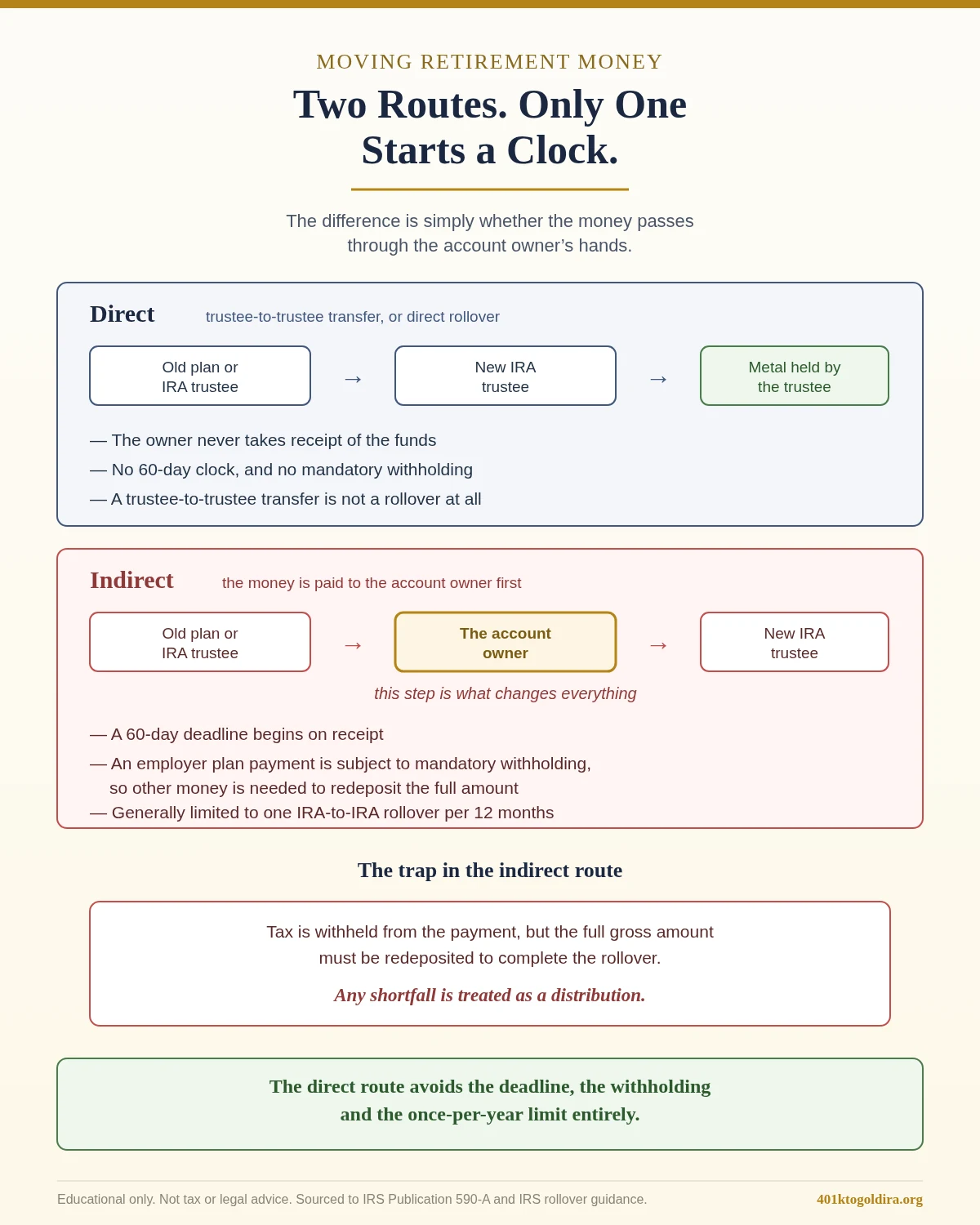
Understanding the difference between a transfer and a rollover is critical when moving a SEP IRA to a Gold IRA, because the tax results can differ. Custodians and IRS guidance typically describe three main methods for moving IRA funds.
| Method | How funds move | Key points for SEP IRA to Gold IRA |
|---|---|---|
| Trustee-to-trustee transfer | Funds go directly from the current SEP IRA custodian to the new self-directed IRA custodian. | Often the simplest option; the account holder never receives the money, and taxes are generally not withheld. |
| Direct rollover | The plan or custodian issues a check payable to the new IRA or plan. | Common for rollovers from employer plans; can also apply when moving SEP IRA funds if structured correctly. |
| 60-day rollover | Funds are paid to the account holder, who then has 60 days to deposit them in another IRA or plan. | Riskier option; missing the deadline can trigger income tax and penalties, and only one such rollover per IRA is allowed in a 12-month period. |
The IRS notes that, in general, SEP IRA rollover rules are the same as for traditional IRAs. Many custodians and advisors recommend trustee-to-trustee transfers or direct rollovers, because these keep the account holder out of the middle and avoid common 60-day timing mistakes. Customers should speak to a financial or tax advisor before choosing a method, especially when large balances or multiple retirement plans are involved.
Step-by-Step Process: SEP IRA to Gold IRA
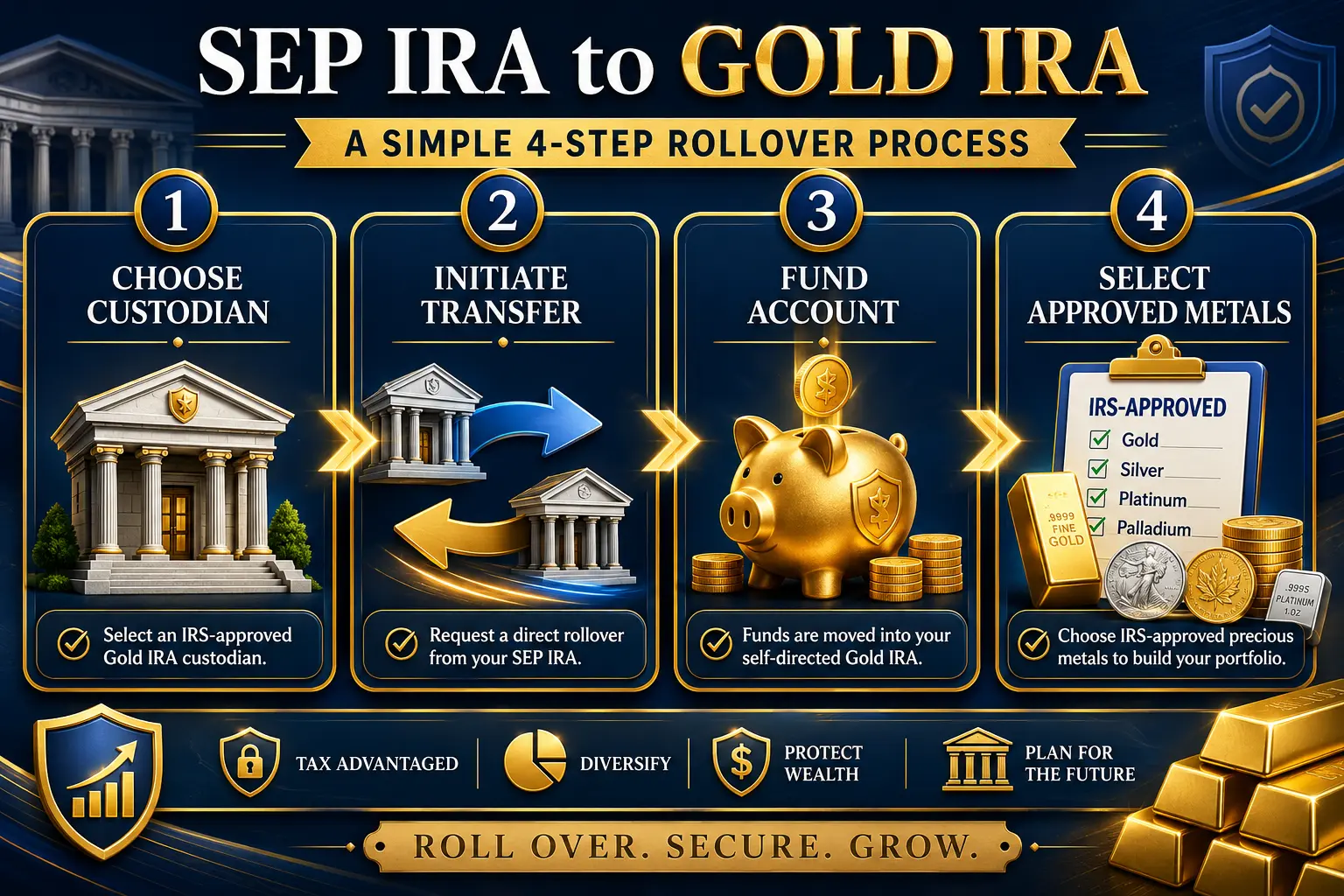
A typical SEP IRA to Gold IRA process follows a series of clear steps based on custodian and IRS guidance.
1. Decide on account structure
Self-employed investors first decide whether the destination account will be a self-directed traditional IRA or a self-directed SEP IRA that allows precious metals. Many Gold IRA providers help open self-directed IRAs that are designed specifically for holding physical metals.
2. Choose a self-directed IRA custodian
The next step is selecting a custodian that offers self-directed IRAs and permits precious metals that qualify under IRC §408(m) holdings. Guidance from self-directed IRA firms stresses the importance of comparing fees, services, and experience in alternative assets like gold and silver.
3. Open the new self-directed IRA
Once a custodian is chosen, the account holder completes an application for the new self-directed IRA, providing identifying information and details about existing retirement plans. For SEP plans, the employer may have already completed IRS Form 5305-SEP to establish the plan, but the IRA itself is owned and controlled by the individual.
4. Initiate transfer or rollover of SEP IRA funds
The account holder and custodian then work together to initiate a trustee-to-trustee transfer, direct rollover, or 60-day rollover from the SEP IRA into the new self-directed IRA. IRS guidance explains that most pre-retirement payments can be rolled over within 60 days or transferred directly to another IRA to avoid current taxation. The SEP IRA rollover rules mirror traditional IRA rules, but careful paperwork is needed to document the transaction properly.
5. Select metals that qualify under IRC §408(m) and place orders
After funds arrive in the new account, the custodian and a chosen precious metals dealer help select gold and other metals that meet the standards in IRC §408(m)(3) that meet purity requirements. Self-directed IRA resources emphasize checking purity, eligible coin types, and approved refiners before placing orders.
6. Arrange storage at an approved depository
The custodian and dealer arrange for metals to be shipped to a depository under the trustee's control, where they are held in secure storage. Guidance from self-directed IRA and precious metals IRA providers stresses that personal possession of IRA-owned metals is not permitted; metals must remain under the control of a bank or approved trustee.
7. Monitor the account and maintain records
After the SEP IRA to Gold IRA movement is complete, the account holder and custodian monitor valuations, fee charges, and required minimum distributions over time. As with any IRA, taxes are generally owed when distributions are taken, and early withdrawals may trigger penalties.
Educational Video: Gold IRA Rollover Overview
The approved Gold IRA educational video below explains the basic rollover process and self-directed IRA mechanics.
IRA-Eligible Metals and Storage Rules
IRS rules for precious metals IRAs apply whether the funding comes from a SEP IRA, traditional IRA, or another plan. Guidance from self-directed IRA providers and IRS-focused resources highlights two main areas: metal eligibility and storage.
- Eligible metals and purity: Gold, silver, platinum, and palladium can be held, but they must meet minimum fineness standards, such as 99.5% purity for many gold bullion products.
- Approved forms: Common eligible forms include specific bullion coins like American Gold Eagles and Canadian Maple Leafs, and bars or rounds produced by approved refiners.
- Storage requirements: All IRA-owned metals must be stored in a depository under the trustee's control or bank; personal possession or home storage is not allowed for IRA holdings.
Self-directed IRA guidance notes that section 408(m) of the Internal Revenue Code governs which metals qualify and states that bullion must be held in the physical possession of a trustee or similar entity. These rules apply equally whether the account is funded by regular contributions, SEP employer contributions, or rollovers from other plans.
Tax Mistakes to Avoid
Moving a SEP IRA to a Gold IRA touches several tax rules, and mistakes can lead to unexpected tax bills or penalties. IRS publications and custodian resources highlight several common issues in rollover and transfer transactions.
- Missing the 60-day rollover window: When funds are paid directly to the account holder, the IRS generally requires that they be redeposited into another IRA or plan within 60 days to avoid taxation and early withdrawal penalties.
- Completing more than one 60-day rollover in 12 months from the same IRA: IRS guidance explains that, in most cases, only one such rollover per IRA is permitted in a one-year period.
- Confusing rollovers and contributions: SEP contributions are employer contributions, while rollovers involve moving existing balances; mislabeling transactions can complicate tax reporting.
SEP IRA holders must also consider early distribution penalties if funds are withdrawn and not correctly rolled over before age 59½, as well as required minimum distribution rules later in retirement. Customers should speak to a financial or tax advisor before making decisions that involve rollovers, distributions, or conversion from SEP IRAs to precious metals IRAs.
Avoid the rollover mistakes that create tax problems
The rollover guide walks through timing, custodian paperwork, and the questions to ask before moving retirement funds.
Open the Rollover Guide →How Active SEP Contributions Affect Planning
Ongoing SEP contributions by a self-employed business or small-business owner can affect timing and structure of a SEP IRA to Gold IRA move. Employer contributions are made into SEP IRAs on a tax-year basis, and eligible employees receive contributions into their accounts as soon as funds are deposited.
Guidance from SEP and self-directed IRA providers notes that a transfer to a self-directed IRA is often easier when the employer is not currently making contributions, or when the employer understands how future contributions will be handled. Some business owners choose to establish a new self-directed SEP IRA with a custodian that supports precious metals, so future employer contributions go directly into a metals-eligible account rather than into a traditional brokerage SEP IRA.
SEP IRA contribution limits and tax treatment remain subject to IRS rules even when the account is self-directed, which means employer contributions are generally pre-tax and taxed upon withdrawal. Coordinating SEP contributions, rollovers from other plans, and new Gold IRA purchases is often a topic for professional advice.
Provider and Custodian Questions
Self-employed investors evaluating a SEP IRA to Gold IRA move benefit from asking detailed questions of custodians and Gold IRA providers. Guidance from self-directed IRA companies and Gold IRA articles suggests several practical areas to review.
- Account type and structure: Does the provider support self-directed SEP IRAs, self-directed traditional IRAs, or both? How are employer contributions and rollovers handled in a self-directed environment?
- Fees and pricing: What are the custodial fees, transaction fees, and depository charges for holding precious metals? How are dealer markups on coins and bars disclosed and calculated?
- Metal eligibility and storage: Which specific gold, silver, platinum, and palladium products are permitted under IRS rules and the custodian's policies? Which depositories are used, and how is insurance and segregation handled?
- Rollover and transfer support: How does the provider handle trustee-to-trustee transfers and direct rollovers from SEP IRAs and other plans? What guidance is offered to reduce timing errors and paperwork issues for 60-day rollovers?
Independent educational resources like the Gold IRA Rollover Guide, 403(b) to Gold IRA rollover guide, and TSP to Gold IRA guide can help compare rollover processes across different plan types and highlight questions to raise with providers.
FAQ
Can a SEP IRA be rolled into a self-directed Gold IRA?
Yes, in many cases SEP IRA funds can be rolled into or transferred to a self-directed IRA that permits precious metals that qualify under IRC §408(m), following the same general rollover rules used for traditional IRAs. The process usually involves opening a self-directed IRA, selecting a custodian and depository, and then initiating a trustee-to-trustee transfer or rollover from the SEP IRA.
Does a SEP IRA to Gold IRA move affect contribution limits?
A SEP IRA to Gold IRA move does not change the underlying SEP contribution rules; employer contribution limits remain based on IRS formulas tied to compensation and annual caps. However, when funds are rolled into a new self-directed IRA, future contributions may need to be coordinated carefully so they go to the correct account and remain within annual limits.
Are early withdrawal penalties a risk in SEP IRA rollovers?
Early withdrawal penalties can arise if SEP IRA distributions are taken and not properly rolled over or transferred according to IRS rules, especially before age 59½. Using trustee-to-trustee transfers or direct rollovers and tracking the 60-day window helps reduce this risk, but tax and financial advisors often recommend reviewing individual circumstances before moving funds.
What metals can a self-employed investor hold in a Gold IRA?
Self-directed Gold IRAs can hold certain gold, silver, platinum, and palladium products that meet IRS purity and form requirements, such as specific bullion coins and bars. Collectible or numismatic coins generally are not eligible for IRA treatment, and all metals must be stored at a depository under the trustee's control rather than in personal possession.
How can self-employed investors compare Gold IRA providers?
Guidance from FINRA and the CFTC advises obtaining the price, spread, buyback figure and all charges in writing before purchase, and checking public complaint and enforcement records. Alongside that, it is worth comparing metal eligibility, depository partners and rollover support. Internal research tools such as the Best Gold IRA Companies guide, Gold IRA Calculator, and Gold IRA Rollover Guide can help self-employed investors understand trade-offs between providers and estimate potential allocations.
Article reviewed and edited by Daniel — independent precious-metals retirement researcher.