
Affiliate disclosure: The publisher may receive compensation from precious-metals companies, including this one. That compensation does not change what court, regulator, BBB or company records show.
Considering Lear Capital?
Lear Capital publishes a complete Gold IRA fee schedule, which most of this market does not, and holds BBB accreditation dating to 1997. Its public record includes resolved regulatory matters worth reading alongside that disclosure.
Minimum investment: $10k · BBB rating: A+
Owners of this website may be paid to recommend Lear Capital. The content on this website, including any positive reviews of Lear Capital and other reviews, may not be neutral or independent.
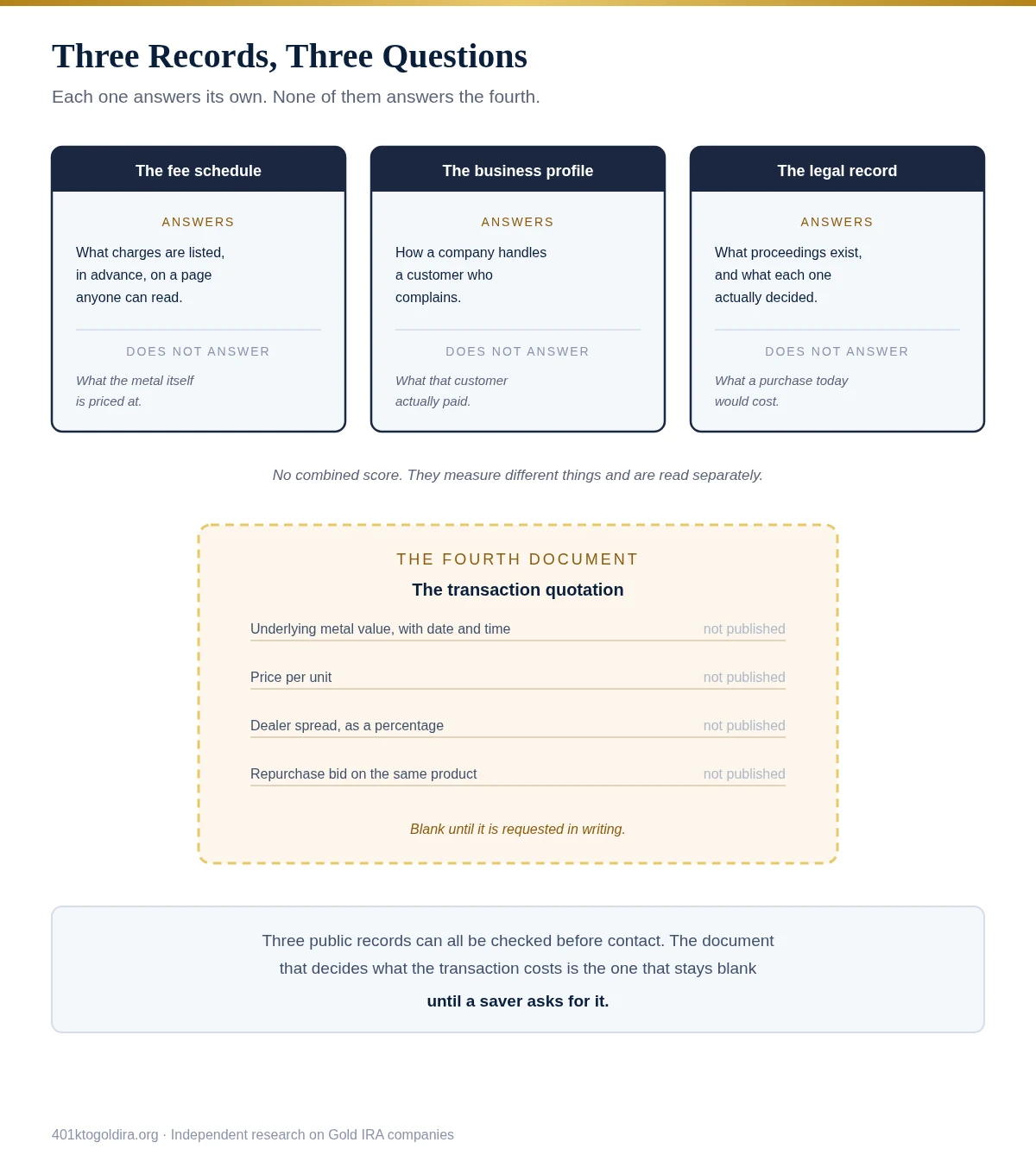
Lear Capital presents three public records that should not be averaged into one verdict.
The first is unusually specific fee disclosure: Lear publishes a $10,000 Gold IRA minimum and a schedule for application, wire, annual maintenance and storage charges. The second is its present BBB record. Contrary to an older preliminary description, the BBB profile observed for this research displayed an A+ rating and accreditation dating to 1997. The third is a documented legal record: a New York Attorney General proceeding resolved by consent order, a multi-state resolution implemented through the company's Chapter 11 plan, and the Chapter 11 case itself.
Each record answers a different question. A fee schedule establishes what the company currently publishes about listed account charges. BBB applies its own complaint-handling and business-profile criteria. Court and regulator documents establish allegations, agreed terms and judicial actions only to the extent those documents say so. None of the three determines the economics of a new metals quote.
Lear's current Transaction Agreement is therefore central. It says the retail price includes a dealer “Spread,” defines that spread as Lear's gross profit on the transaction, gives a general current range of 2% to 35% of quoted purchase price, and says the exact spread is confirmed during the transaction process and included on the invoice. The Gold IRA fee table is useful, but it is not the complete cost picture. (Lear Capital Transaction Agreement)
Current Lear webpages cited below were observed for this research, unless a filing or order carries its own date. Schedules, promotions, BBB rolling counts and dockets can change and should be confirmed at their primary sources.
What does this article cover?
- Lear's published Gold IRA minimum, fee schedule and reimbursement tiers.
- Storage, buyback and the dealer spread that sits outside the IRA fee table.
- The New York Attorney General matter, multi-state resolution and Chapter 11 case, separated by evidentiary type.
- The current BBB rating, rolling complaint counts and complaint themes.
- Flat-fee arithmetic, regulator guidance, a verification packet and the figures that remain quote-dependent.
- Required image briefs and the consolidated primary-source list.
- More than $10,000: $50 setup fee covered.
- $25,000–$50,000: first-year fees covered; reimbursement after the first month in storage.
- $50,000–$75,000: first and second years covered.
- $75,000+: first three years covered.
- The page adds: “Limited Mintage coins only.”
- Minimum Investment and Fee Transparency at Lear Capital
- Lear Capital IRA FAQ
- Lear Capital Gold IRA Guide
- Lear Capital Transaction Agreement
- Lear Capital Online Terms and Conditions
- Lear Capital State-by-State Refund Policy
- Lear Capital Legal Notices
- Lear Capital Bankruptcy Page
- Verified Petition — People of the State of New York v. Lear Capital, Inc. and Kevin DeMeritt
- Consent Order and Judgment
- New York Attorney General settlement announcement
- Lear Capital, Inc. First Amended Chapter 11 Plan, Case 22-10165 (BLS), Doc. 694
- Wisconsin Department of Financial Institutions — multi-state resolution
- Iowa Insurance Division — multi-state resolution
- PACER Case Locator
- CFTC — 10 Things to Ask Before Buying Physical Metals
- CFTC Enforcement Actions
- FINRA — Physical Precious Metals
- FINRA Enforcement
- SEC Litigation Releases
- SEC Administrative Proceedings
- FTC Cases and Proceedings
- IRS Publication 590-A
- IRS Publication 590-B
- Cornell LII — IRC §408
- Cornell LII — Treasury Regulation §1.408-2
What Gold IRA fees does Lear Capital currently publish?
What is the published minimum and schedule?
Lear's current fee-transparency page states that a Gold IRA requires a $10,000 minimum contribution. Direct purchases for home delivery have product-dependent minimums rather than one published universal threshold. (Lear Capital — Minimum Investment and Fee Transparency)
| Published charge | Non-segregated | Segregated |
| Gold IRA minimum contribution | $10,000 | $10,000 |
| Application fee | $50 one time | $50 one time |
| Wire transfer fee | $30 one time | $30 one time |
| Annual maintenance | $125 | $125 |
| Annual storage | $110 | $160 |
| First-year total | $315 | $365 |
| Recurring annual total, Year 2+ | $235 | $285 |
Lear describes the storage charge as flat-rate, without an extra storage charge merely for adding more metal later. These figures are Lear's published terms, not an independent custodian or depository quotation. (Lear Capital — Fee Transparency)
Are all current Lear pages consistent?
No. Lear's general Gold IRA guide repeats the $125 maintenance charge and $110/$160 storage figures but gives recurring totals of $225–$275, which do not add correctly; the components total $235 or $285. That guide also says first-year fees may reach $415, while the dedicated fee page gives $315 or $365. The live IRA FAQ agrees with the dedicated page on $315 first-year and $235 recurring for electronic statements plus non-segregated storage. (Lear Gold IRA Guide; Lear IRA FAQ)
The defensible conclusion is narrow: Lear publishes unusually detailed fee information, but current pages contain internal inconsistencies. A new account still needs the binding custodian and depository schedules.
What does the fee-reimbursement program require?
Lear's FAQ says it will pay setup and storage account fees based on invoice purchase amount:
(Lear IRA FAQ)
The conditions are substantive. The public ranges overlap at exactly $50,000 and $75,000, and the page does not list every qualifying Limited Mintage product. A written offer should identify the controlling tier, qualifying products, reimbursement timing, charges covered and post-reimbursement charges.
What does Lear say about storage?
Lear's newer guide describes segregated storage as holding specific metals separately in the customer's name and non-segregated storage as commingling same-type holdings. It says segregated storage is intended to return the specific deposited items. Those are company descriptions and should be checked against the depository contract. (Lear Gold IRA Guide)
The site also names different custodian relationships on different live pages: the newer guide names Equity Trust Company as its primary custodial partner, while the older FAQ names Self Directed IRA Services, Inc. That is not enough to infer which entity would administer a new account. The executed application must answer that question.
Does the published fee schedule show the full cost?
Where does the dealer component sit?
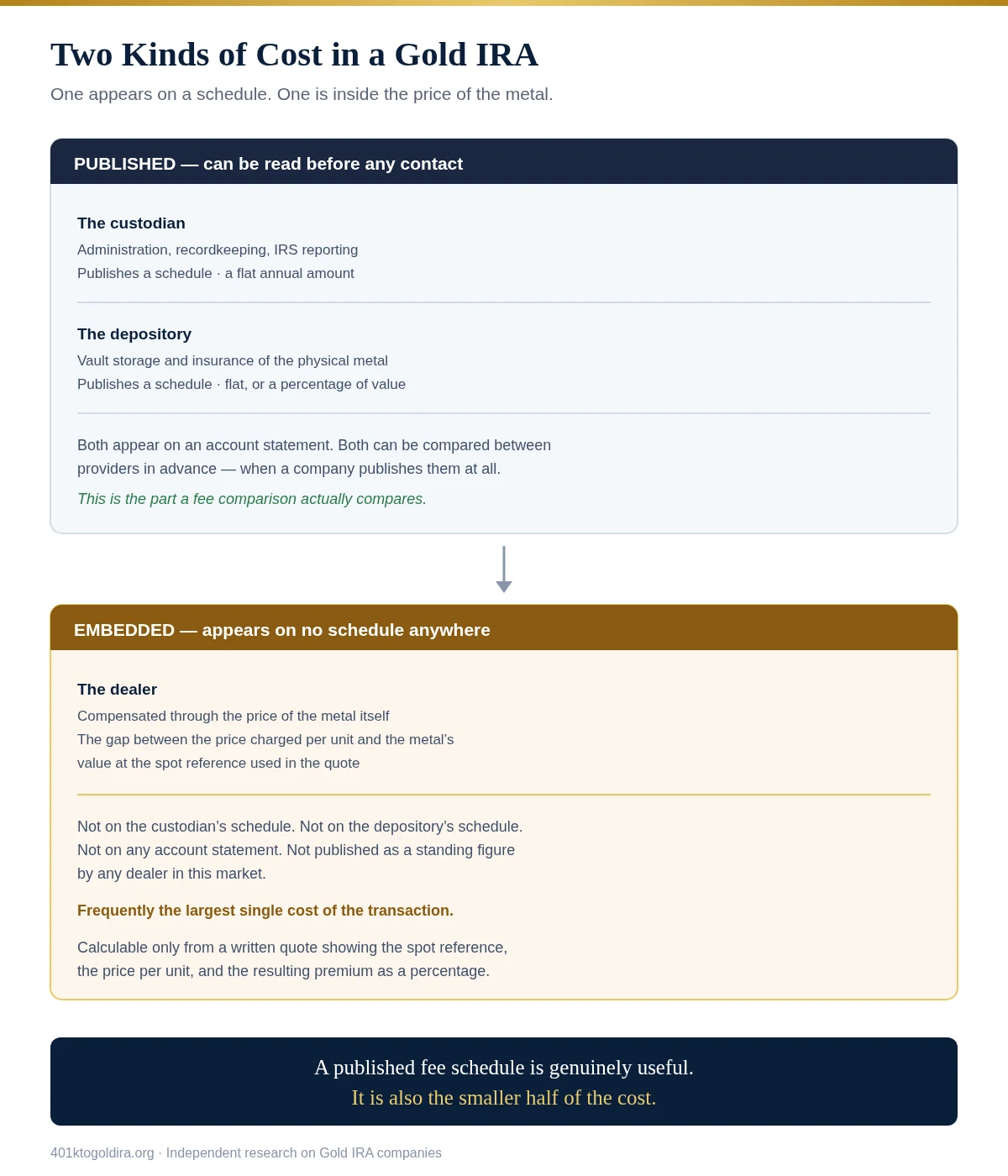
The account fee table does not show the dealer's transaction spread. Lear's current Transaction Agreement does.
It defines “Spread” as the difference between the retail price and Lear's acquisition cost, says the spread covers operating expenses and profit, and publishes a general range of 2%–35% of quoted purchase price. The agreement says the exact spread varies by metal, customer, transaction type and time and is included on the invoice. (Lear Transaction Agreement)
The agreement also says sales representatives are commissioned partly according to sales amount and profit margin and may receive other sales-linked compensation. This makes the product quote economically separate from the flat IRA schedule.
A self-directed precious-metals IRA has three distinct cost layers: the custodian/administrator, the depository, and the dealer. Lear expressly says it is not the IRA custodian or administrator. A complete cost analysis therefore requires the custodian schedule, depository schedule and dealer quote together.
Supporting diagram — published-vs-embedded-cost
Placement: beside this three-part cost explanation.
Alt text: Documentary split diagram showing visible account charges on one side and transaction pricing embedded in a precious-metals quote on the other. Application, administration, wire and storage appear as account documents, while a shaded spread field sits inside the generic product price. Both feed into total economic cost, showing why a detailed IRA fee schedule still requires separate review of the dealer's product pricing.
What does Lear Capital publish about buybacks and round-trip cost?
Is repurchase guaranteed?
No. Lear's current Transaction Agreement says it does not guarantee that it will repurchase metals it sells. It says that, as of transmission of the agreement, Lear had not refused an opportunity to repurchase metals originally sold by Lear and directs customers to request current pricing. That is a statement of practice, not a guaranteed future obligation. (Lear Transaction Agreement)
The online Terms say Lear's buyback or bid prices are lower than its retail sell or ask prices. The agreement says a future offer is tied to the wholesaler's listed bid and the PDF version states that a variable service fee may be charged on a buyback. No universal current buyback service-fee percentage was located. (Lear Online Terms)
Why does the round trip matter?
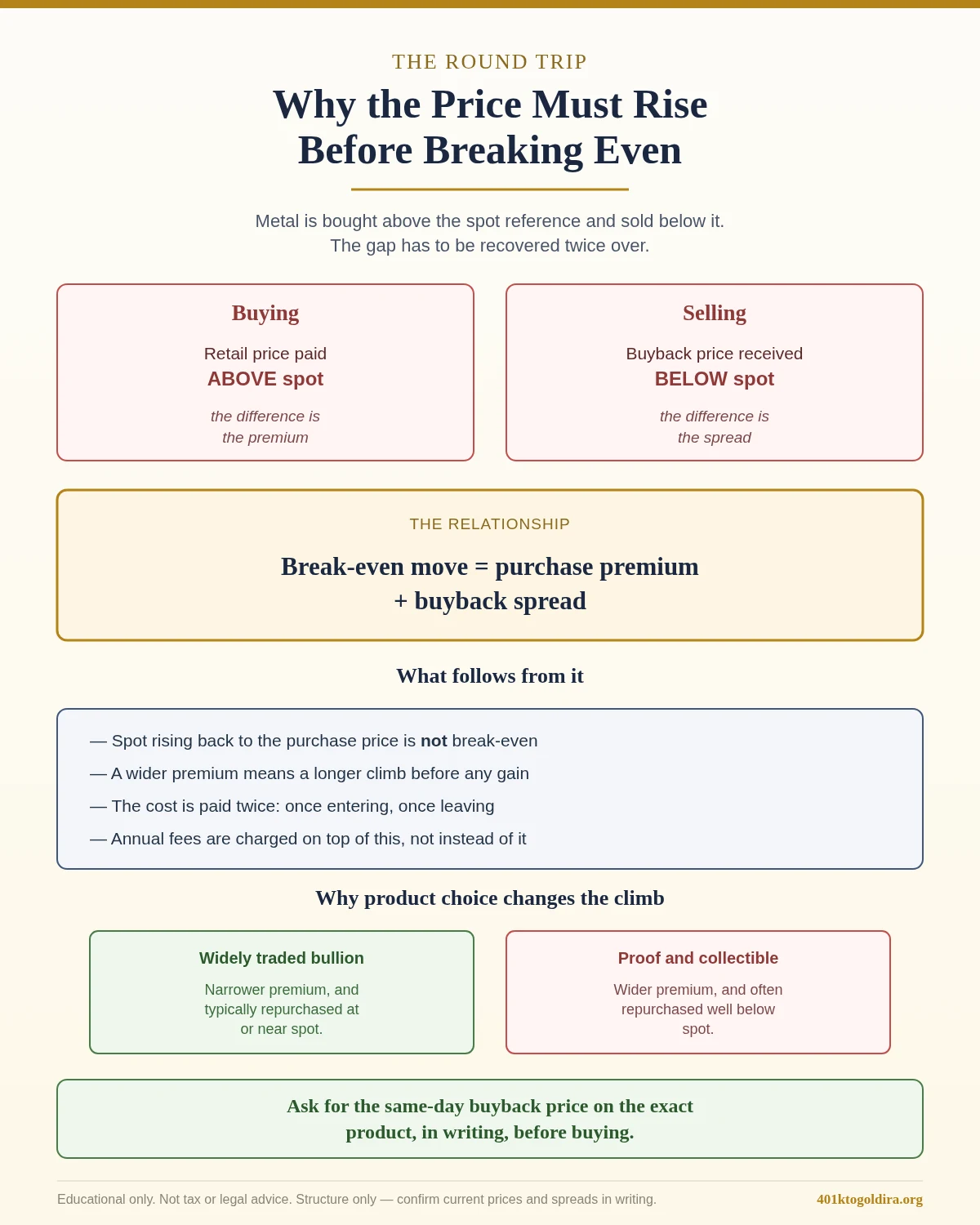
CFTC explains that retail physical metal is generally purchased above spot and sold back below spot, and recommends obtaining both the retail price and contemporaneous repurchase price. (CFTC guidance)
Illustratively, if S is underlying metal value, p the entry premium, F future metal value and b the exit discount:
Purchase cost = S × (1 + p)
Liquidation proceeds = F × (1 − b)
Break-even requires F / S = (1 + p) / (1 − b)
Account charges raise that hurdle further. Lear's agreement also says bullion/numismatic classifications are company opinions that can differ among sellers. Product label is therefore weaker evidence than the same item's weight, fineness, retail quote, exact spread and same-time repurchase quote.
Supporting diagram — round-trip-break-even
Placement: beside the formula.
Alt text: A transaction timeline moves from underlying metal value to a higher retail purchase amount and later from future metal value to a lower repurchase bid. Account and storage charges run beneath the holding period. The break-even marker lies above the original underlying value, showing that a return to the starting metal price does not necessarily recover entry pricing, exit spread and ongoing account costs.
How much do the flat recurring fees represent at different account sizes?
The following is arithmetic only, not a projection of returns, metal values or future fee policy. It applies Lear's currently published recurring charges before any reimbursement and excludes dealer spread, future buyback economics, taxes and any unlisted transaction or distribution charges.
| Illustrative account value | $235 recurring charge | $285 recurring charge |
| $10,000 | 2.35% | 2.85% |
| $25,000 | 0.94% | 1.14% |
| $50,000 | 0.47% | 0.57% |
| $75,000 | 0.31% | 0.38% |
| $100,000 | 0.24% | 0.29% |
Because the disclosed maintenance and storage amounts are flat, their percentage effect falls as account value rises. That mathematical fact says nothing about whether the dealer spread rises, falls or remains the same with transaction size. The spread is separately quote-dependent under Lear's current agreement. (Lear Capital — Fee Transparency; Lear Capital Transaction Agreement)
What did the New York Attorney General matter actually establish?
What was filed?
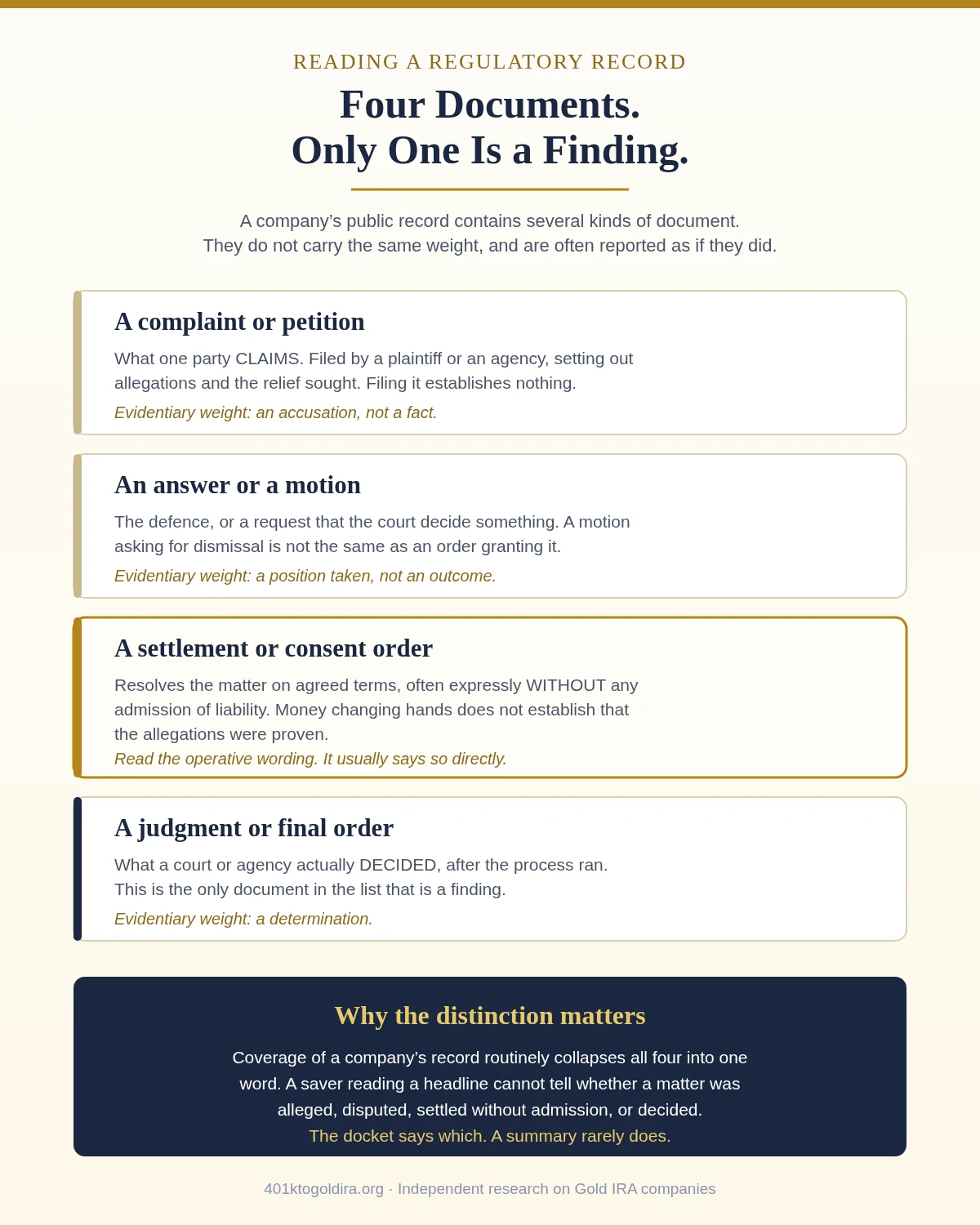
The New York Attorney General filed a Verified Petition in Erie County Supreme Court on June 17, 2021 against Lear Capital, Inc. and Kevin DeMeritt. It alleged, among other things, deficient New York registrations and undisclosed commissions of up to 33% in certain precious-metals transactions. A petition is an initiating pleading: those assertions were the Attorney General's allegations, not findings created by filing the document. (NYAG Verified Petition)
What did the resolution require?
The matter ended through a Consent Order and Judgment. The order required $6 million in monetary relief for New York customers in connection with alleged registration violations, with distribution administered by the Attorney General. It also imposed New York-specific requirements concerning fee disclosure in recorded confirmations and invoices, a 24-hour cancellation opportunity for IRA and certain higher-gross-profit telephone transactions, dedicated cancellation and complaint channels staffed by non-commissioned personnel, complaint tracking and employee training. (NYAG Consent Order; NYAG announcement)
This is an agreed, court-entered resolution, not a trial judgment establishing every petition allegation.
Was there an express no-admission clause?
No express no-admission clause was located in the operative consent order reviewed for this article. Lear's later bankruptcy plan describes the New York settlement with the phrase “Without admitting any wrongdoing.” That wording belongs to the later debtor-filed plan, not to the New York consent order, and should be attributed accordingly. (Lear First Amended Chapter 11 Plan)
What was the multi-state regulatory resolution?
Who participated and what was created?
Lear's First Amended Chapter 11 Plan defines “Participating States” to encompass authorities from 42 jurisdictions, including the District of Columbia and Puerto Rico: Alabama, Arizona, Arkansas, California, Colorado, Connecticut, Delaware, D.C., Georgia, Hawaii, Idaho, Illinois, Indiana, Iowa, Kentucky, Louisiana, Maine, Maryland, Massachusetts, Michigan, Minnesota, Mississippi, Missouri, Montana, Nebraska, New Hampshire, New Mexico, North Carolina, North Dakota, Ohio, Oregon, Puerto Rico, Rhode Island, South Carolina, South Dakota, Tennessee, Texas, Utah, Vermont, Washington, West Virginia and Wisconsin. The plan identifies the relevant securities, banking, insurance, financial-protection or attorney-general offices. (Lear First Amended Plan)
The plan created a $5.5 million Customer Fund for allowed customer claims and qualifying customers who had not filed claims. Its “Recovery Calculation” uses the difference between the total spread charged and paid according to Lear's books and a hypothetical 12% spread. Remaining funds were allocated pro rata to qualifying unfiled customers. Wisconsin and Iowa regulator releases state that the pro rata program covered qualifying purchases during January 1, 2016 through March 3, 2022. (Wisconsin DFI; Iowa Insurance Division)
State releases describe allegations that regulators had been investigating when the bankruptcy began. The resolution itself was implemented through the plan.
Was it a merits finding?
The plan states that the debtor “neither admits nor denies any violation” and that there had been no court finding of wrongdoing. The bankruptcy court's confirmation made the plan and its obligations operative; it did not adjudicate every underlying state allegation on the merits. (Lear First Amended Plan)
Supporting diagram — regulatory-action-anatomy
Placement: beside this distinction.
Alt text: Four-stage documentary diagram separates an initiating complaint or petition, a response, a negotiated settlement or consent order, and a judgment or final order. Each carries an evidentiary label—allegation, response, agreed resolution or determination. A note explains that a court can enter or confirm negotiated terms without deciding every underlying factual allegation and that procedural orders determine only the issues actually before the tribunal.
What does the Chapter 11 record establish?
Lear Capital, Inc. filed a voluntary Chapter 11, Subchapter V petition in the U.S. Bankruptcy Court for the District of Delaware on March 2, 2022, Case No. 22-10165 (BLS). Its First Amended Plan, Document 694, was filed June 5, 2023. Wisconsin DFI reports that the bankruptcy court confirmed the plan on June 12, 2023. (Lear First Amended Plan; Wisconsin DFI)
The plan is informative but historical. It describes Lear Capital, Inc. as the debtor and records that, in 2022, its average transaction spread was 23.4% and spreads could reach 33%. Those figures are not current price terms. The current Lear Capital LLC Transaction Agreement instead publishes a general 2%–35% range. (Lear First Amended Plan; current Transaction Agreement)
Lear's current bankruptcy page states that the company completed its reorganization in early 2024. That is a first-party statement. An authenticated, paid review of every later PACER docket entry was not exhausted here, so present procedural status should be checked in PACER rather than copied from any article. (Lear bankruptcy page; PACER Case Locator)
The legal entity name also changed in the public materials. Bankruptcy and BBB records use Lear Capital, Inc. Current Transaction Agreements, legal notices and refund policy identify Lear Capital, LLC. The public sources reviewed do not provide one document fully reconciling that transition, so both names belong in future record searches.
What are the three legal matters in evidentiary terms?
| Matter | Type | What it establishes | What it does not establish |
| New York AG | Petition + consent order | Allegations were filed; $6 million relief and specified New York practices were ordered by agreement | The petition alone did not prove its allegations |
| Multi-state resolution | Negotiated Chapter 11 plan | $5.5 million customer fund, recovery formula, customer period and conduct commitments | Plan expressly states no admission and no court finding on underlying violations |
| Chapter 11 | Federal bankruptcy case + confirmed plan | Filing, reorganization process, claim treatment and confirmation are legal facts | Bankruptcy itself is not a merits finding about sales conduct |
What does the current BBB record show?
What are the current rating and counts?
The BBB profile, observed September 1, 2026, displayed A+, Accredited, accreditation since September 18, 1997, and 29 years in business. That current source does not support the preliminary description of Lear as carrying the sector's lowest BBB rating. No historical BBB grade is reconstructed here without an archival BBB source. (BBB Lear Capital profile)
The same source, observed September 1, 2026, showed 33 total complaints in the last three years and 11 complaints closed in the last 12 months. BBB says Business Profiles generally cover a rolling three-year reporting period and warns that displayed narrative text may not represent every complaint. These are point-in-time counts that change as complaints enter or age out of the window, so they should be read with the observation date above rather than as a settled figure. (BBB Lear Capital complaints)
What do the narratives repeatedly concern?
Visible narratives include allegations and company responses involving: delays or communication during liquidation; disagreements about spread, markup or what was understood at confirmation; reconciliation of ordered products, depository records and custodian valuations; and the difference between original purchase cost and later liquidation value. Lear frequently responds by referring to recordings, transaction agreements, invoices, depository information or subsequent payment.
Those narratives are not findings. Their value is operational: they identify documents that should exist before or during a transaction.
BBB says its rating is its opinion of how a business is likely to interact with customers and is not a guarantee of reliability or performance. The BBB grade therefore does not audit product price, dealer acquisition cost, suitability or future buyback economics. (BBB rating methodology)
The current A+ rating, detailed fee disclosure and historical legal record are not mutually exclusive. They measure different things.
What do other federal enforcement searches add?
Exact-name public searches of SEC litigation and administrative materials, CFTC enforcement material, FTC cases and proceedings, and FINRA disciplinary material did not surface a separate current target enforcement action against Lear Capital, Inc. or Lear Capital, LLC in the searches performed for this research.
That finding is deliberately narrow. SEC databases concern securities-law proceedings; CFTC jurisdiction is not a universal registry for immediate-delivery retail precious-metals sales; the FTC public case library is not its complete consumer-complaint inventory; and FINRA systems principally concern member brokerage firms and associated securities professionals. A no-result in any one of those systems does not erase the New York, state-regulator or bankruptcy records described above, and it does not establish the absence of nonpublic complaints or investigations. (SEC Litigation Releases; SEC Administrative Proceedings; CFTC Enforcement Actions; FTC Cases and Proceedings; FINRA Enforcement)
What do CFTC and FINRA say should be obtained in writing?
CFTC's precious-metals advisory gives a direct instruction:
“Ask for all fees, costs, commissions, and agreed retail price in writing BEFORE signing a sales agreement or turning over any money.”
The same guidance says the prospective purchaser should calculate the metal's spot value, compare that figure with the retail price, ask what the dealer would pay to repurchase the metal, ask how sales personnel are compensated, and identify storage, insurance and administrative costs. (CFTC — 10 Things to Ask Before Buying Physical Metals)
FINRA's guidance condenses the principle to:
“Get a full accounting of fees.”
FINRA discusses account-opening costs, sales commissions, storage and management charges, and the break-even effect of those expenses. (FINRA — Physical Precious Metals)
For Lear Capital, the current transaction agreement makes an additional document particularly important: the invoice on which Lear says the exact spread for the transaction is included. The invoice should therefore be treated as a core verification document, not merely a receipt.
What should a complete Lear Capital verification packet contain?
| Question | Document to request | What a satisfactory answer contains |
| What Gold IRA minimum applies? | Current account-opening terms | Confirmation of the $10,000 published minimum and whether any product-specific or transaction-specific exception applies |
| Which custodian will administer the account? | Custodian agreement | Exact legal entity, setup, annual administration, transactions, wires, distributions, transfers and termination charges |
| Which depository and storage method apply? | Depository agreement and schedule | Facility, segregated or non-segregated method, insurance treatment, handling costs and distribution procedures |
| Does a fee reimbursement apply? | Written promotion terms | Qualifying products, exact invoice threshold, boundary treatment, years covered, reimbursement timing and post-waiver fees |
| What metals are being purchased? | Itemized quote | Mint/refiner, product, metal, weight, fineness, quantity and unit price |
| What is Lear's exact spread? | Recorded confirmation plus invoice | The percentage Lear says is its transaction spread, consistent across the recording and invoice |
| What is the underlying metal value? | Contemporaneous spot/melt calculation | Enough product data to calculate metal content and compare it with the retail quote |
| What would immediate resale produce? | Same-time written buyback quote | SKU-level repurchase amount and the quotation's validity period |
| Is any buyback service fee applicable? | Written buyback terms | Current percentage or dollar charge, if any, and when it applies |
| What controls cancellation? | Current Transaction Agreement and applicable state refund policy | The applicable cancellation window, start time, method and any state-specific extension |
| What happens on an in-kind distribution? | Custodian/depository distribution instructions | Which specific metals are returned under the selected storage method and all handling/shipping charges |
| Does each retirement-account metal meet the applicable tax-code standard? | Product-level custodian confirmation | Confirmation tied to IRC §408(m)(3), rather than a generic marketing label |
Which figures still cannot be verified from the public material alone?
Despite the amount Lear publishes, several material terms remain account- or transaction-specific.
Account and service charges not established as universal current figures: custodian purchase/sale transactions, cash and in-kind distributions, outgoing transfer, termination, rush processing, special handling, distribution shipping/insurance and the percentage of any buyback service fee.
Dealer-pricing figures unavailable before a quote: exact retail product price, Lear's acquisition cost, exact spread within the current 2%–35% general range, contemporaneous premium relative to spot or melt, transaction-specific salesperson compensation, same-time repurchase bid, future repurchase bid and resulting round-trip break-even hurdle.
Reimbursement details requiring confirmation: treatment of exactly $50,000 and $75,000, the complete set of Limited Mintage products, whether substitutions affect eligibility, which provider charges are covered and what happens if provider fees change.
Custody and storage details requiring executed documents: the actual custodian for the new account, binding storage method, insurance provisions, handling charges and distribution mechanics.
Legal-record items that remain time-sensitive: current PACER status, future regulatory filings and BBB's rolling complaint count.
These gaps do not negate the published fee schedule. They define its boundary.
How do the IRA tax rules fit into the verification?
IRC §408(m) generally treats an IRA's acquisition of collectibles as a distribution and then provides specific exceptions under §408(m)(3) for certain coins and qualifying bullion. The bullion exception includes statutory fineness and possession conditions. (Cornell LII — IRC §408)
Trustee or custodian qualification is a different legal issue. Treasury Regulation §1.408-2(e) sets conditions under which a nonbank entity can qualify to act as trustee or custodian. (Cornell LII — Treasury Regulation §1.408-2)
Accordingly, the precise terminology is IRA-eligible metal or metal that meets the standards in IRC §408(m)(3). A storage facility's role and a nonbank custodian's qualification should not be described with language suggesting that the IRS “approves” particular coins, metals or depositories. IRS Publication 590-A and Publication 590-B provide the broader IRA contribution, rollover, distribution and collectibles framework. (IRS Publication 590-A; IRS Publication 590-B)
Considering Lear Capital?
Lear Capital publishes a complete Gold IRA fee schedule, which most of this market does not, and holds BBB accreditation dating to 1997. Its public record includes resolved regulatory matters worth reading alongside that disclosure.
Minimum investment: $10k · BBB rating: A+
Owners of this website may be paid to recommend Lear Capital. The content on this website, including any positive reviews of Lear Capital and other reviews, may not be neutral or independent.
What do the three records each measure?
Frequently asked questions
Does Lear currently publish a $10,000 Gold IRA minimum?
Yes. The fee-transparency page observed for this research states a $10,000 Gold IRA minimum contribution; direct-delivery minimums vary by product. (Lear fee page)
Does the published fee schedule represent the full cost?
No. It publishes listed account charges, while Lear's Transaction Agreement separately discloses a dealer spread generally ranging from 2% to 35% and says the exact spread appears on the invoice. (Lear Transaction Agreement)
Is Lear's BBB rating currently low?
No. The BBB profile observed for this research displayed A+. The article does not infer what the grade was at an earlier date without an archival BBB source. (BBB profile)
Did the New York petition prove its allegations?
No. It was an initiating pleading. The matter ended through a consent order that imposed monetary relief and business-practice requirements without a trial adjudication of every allegation. (NYAG petition; consent order)
Did the New York consent order expressly contain a no-admission clause?
No such express clause was located in the operative order reviewed. Lear's later bankruptcy plan uses the phrase “Without admitting any wrongdoing” when summarizing that settlement; that wording belongs to the later plan. (Lear First Amended Plan)
Was the multi-state resolution a court finding of the underlying allegations?
The court confirmed the Chapter 11 plan, making its terms operative. The plan itself states that the debtor neither admitted nor denied violations and that there had been no court finding of wrongdoing concerning those resolved issues. (Lear First Amended Plan)
Does Lear guarantee a buyback?
No. The current agreement disclaims a guaranteed repurchase and directs customers to request current buyback pricing. (Lear Transaction Agreement)
Is the Chapter 11 case's present status independently verified here?
Not through a fully exhausted authenticated PACER review. Lear's own site says the reorganization was completed in early 2024; a reader requiring present docket status should check Case 22-10165 (BLS) directly in PACER. (Lear bankruptcy page; PACER)
Consolidated primary-source list
Lear Capital first-party sources
BBB
New York Attorney General
Multi-state and bankruptcy sources
Federal regulatory guidance and enforcement indexes
Tax and statutory sources
Disclaimer: This article is educational research only and is not financial, investment, tax or legal advice. Precious-metals prices can rise or fall, and past performance does not guarantee future results. Fee schedules, reimbursement programs, transaction agreements, BBB complaint counts and court dockets can change. Transaction-specific metal prices, dealer spreads, buyback bids, custodian charges and depository terms should be confirmed in current written documentation. Retirement-account eligibility, rollovers, distributions, custody and tax consequences should be reviewed with appropriately qualified financial, tax and legal professionals before action is taken.